
The IP telephony vs. VoIP debate is a naming dispute dressed up as an architecture decision. VoIP is a transmission method. IP telephony is the broader system built around it. Philippine enterprises that burn procurement cycles arguing over which one to “choose” are asking the wrong question. The real scalability constraint lives in SIP protocol standardization, network underlay quality, and unified communications architecture, none of which the IP-telephony-versus-VoIP label resolves on its own.
TL;DR: VoIP is a subset of IP telephony, not a competing technology. The label distinction matters for vendor conversations but doesn’t determine whether a Philippine enterprise phone system will scale. SIP architecture, network design, and underlay quality are the actual gates to growth.
VoIP Lives Inside IP Telephony, Not Next to It
The confusion starts with vendors who market these as two separate product categories. They aren’t. As PanTerra Networks states directly, “Voice over Internet Protocol (VoIP) is a subset of IP Telephony that allows voice calls over the Internet.” IP telephony is the umbrella term for any phone system that routes voice as data packets over IP networks. VoIP describes one specific part of that system: the conversion of analog voice into digital packets for transmission.
Think of it this way. A Yeastar P-Series PBX handling 500 extensions across 3 branch offices is an IP telephony deployment. The voice streams flowing between those extensions use VoIP. The call routing logic, the dial plans, the presence indicators, the voicemail-to-email integration, the CRM connectors: that’s the IP telephony layer wrapping around the VoIP core. One is the engine; the other is the car.
This taxonomy matters because Philippine enterprise scalability depends on the “car,” not just the engine. A BPO in Cebu adding 200 agent seats doesn’t need “more VoIP.” It needs additional SIP trunk capacity, QoS policies on the LAN, maybe an upgraded switch stack, and dial-plan changes. Every one of those is an IP telephony concern that VoIP alone doesn’t address.
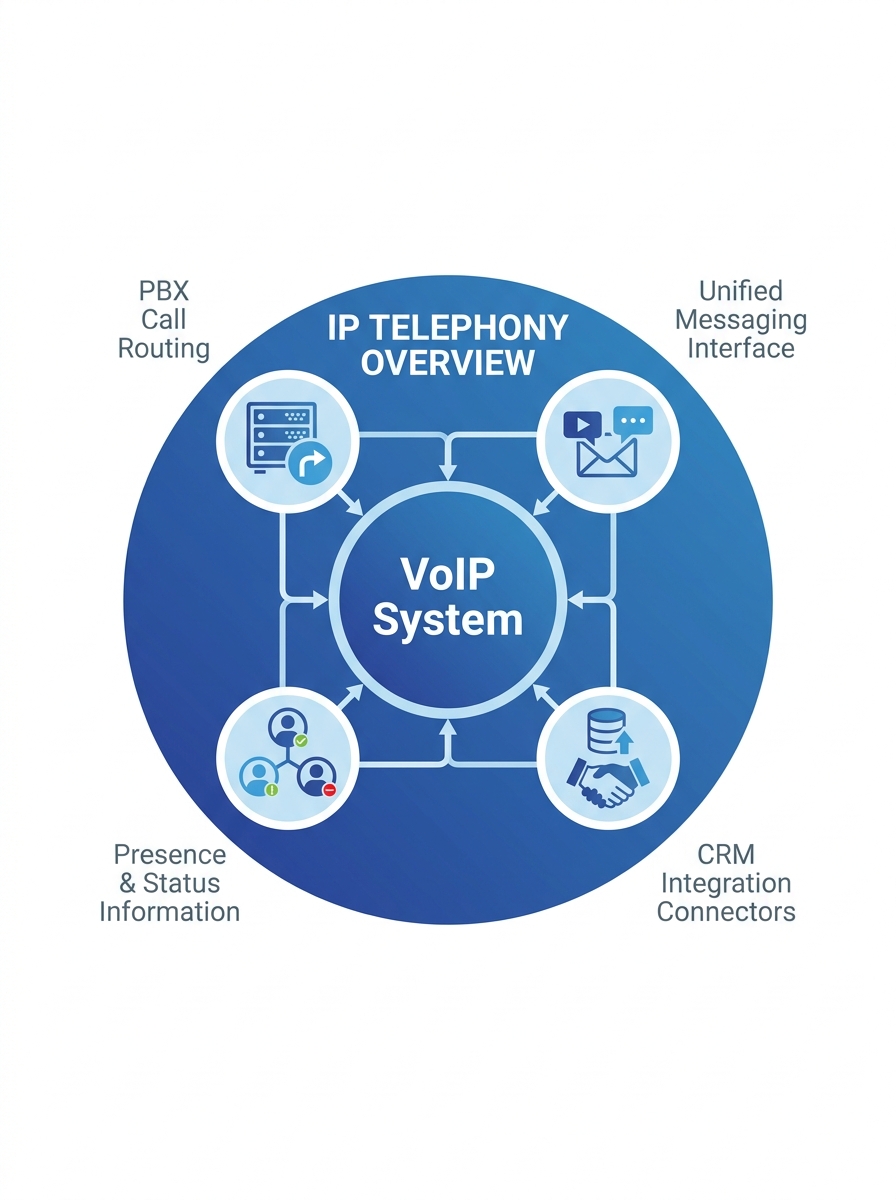
The practical takeaway: when you evaluate enterprise phone systems for a Philippine multi-site deployment, you’re always buying IP telephony. VoIP is the voice transport layer baked into every option. The differentiators sit above it.
| Feature | VoIP (Transport Layer) | IP Telephony (Full System) |
|---|---|---|
| Scope | Voice packet transmission only | Voice, video, messaging, presence, integrations |
| Protocol | RTP/SRTP for media delivery | SIP, H.323, SCCP for signaling + RTP for media |
| Scalability lever | Bandwidth and codec selection | Trunk capacity, PBX cluster sizing, QoS policies |
| Deployment model | Embedded in any IP phone system | On-premises, cloud, or hybrid (per TechTarget) |
| Philippine enterprise cost driver | ISP bandwidth fees | PBX licensing, SIP trunk subscriptions, network hardware |
| Failover scope | Codec fallback, jitter buffer tuning | Trunk failover, geographic redundancy, DR site activation |
SIP Protocol Standardization Already Answered the Architecture Question
Why does the IP telephony vs. VoIP framing persist? Partly because the terminology predates the protocol convergence that made the debate irrelevant. Before SIP became dominant, enterprises genuinely did face competing architectures. Cisco’s proprietary SCCP (Skinny) protocol locked customers into Cisco Unified Communications Manager clusters. Avaya had its own signaling stack. H.323, standardized by the ITU-T, competed with SIP for years.
SIP won. The IETF published RFC 3261 as the core SIP specification, and the protocol has since become the default signaling standard for voice, video, and messaging across virtually every vendor. Cisco CUCM version 15 supports SIP natively. Yeastar’s P-Series runs SIP. Microsoft Teams Direct Routing uses SIP. The global VoIP market, growing at a 10.8% compound annual growth rate according to industry projections, runs overwhelmingly on SIP-based infrastructure.
This convergence means Philippine enterprises face far fewer telephony infrastructure decisions than they did a decade ago. SIP protocol standardization collapsed the distinction between “choosing VoIP” and “choosing IP telephony” into a single procurement path. You pick a PBX platform (on-premises, cloud, or hybrid), connect SIP trunks from a Philippine telco, and build out your unified communications architecture on top.
SIP protocol standardization collapsed the distinction between “choosing VoIP” and “choosing IP telephony” into a single procurement path.
The security layers reinforce this convergence. As Vonage’s SIP protocol documentation explains, “SIP follows modern encryption standards and can be layered with TLS, SRTP, and VPN protocols for added protection.” Those protections apply identically whether you describe your deployment as “VoIP” or “IP telephony.” The encryption doesn’t change based on the label. If you’re hardening a deployment, the same VoIP security controls apply either way.
So what does the SIP convergence mean for enterprise scalability in the Philippines? It means scaling decisions come down to three measurable factors: how many concurrent SIP sessions your PBX cluster supports, how many SIP trunks your provider delivers, and whether your LAN/WAN can maintain packet loss below 1% and jitter below 30ms at peak load. None of those factors depend on whether you call the system “VoIP” or “IP telephony.”
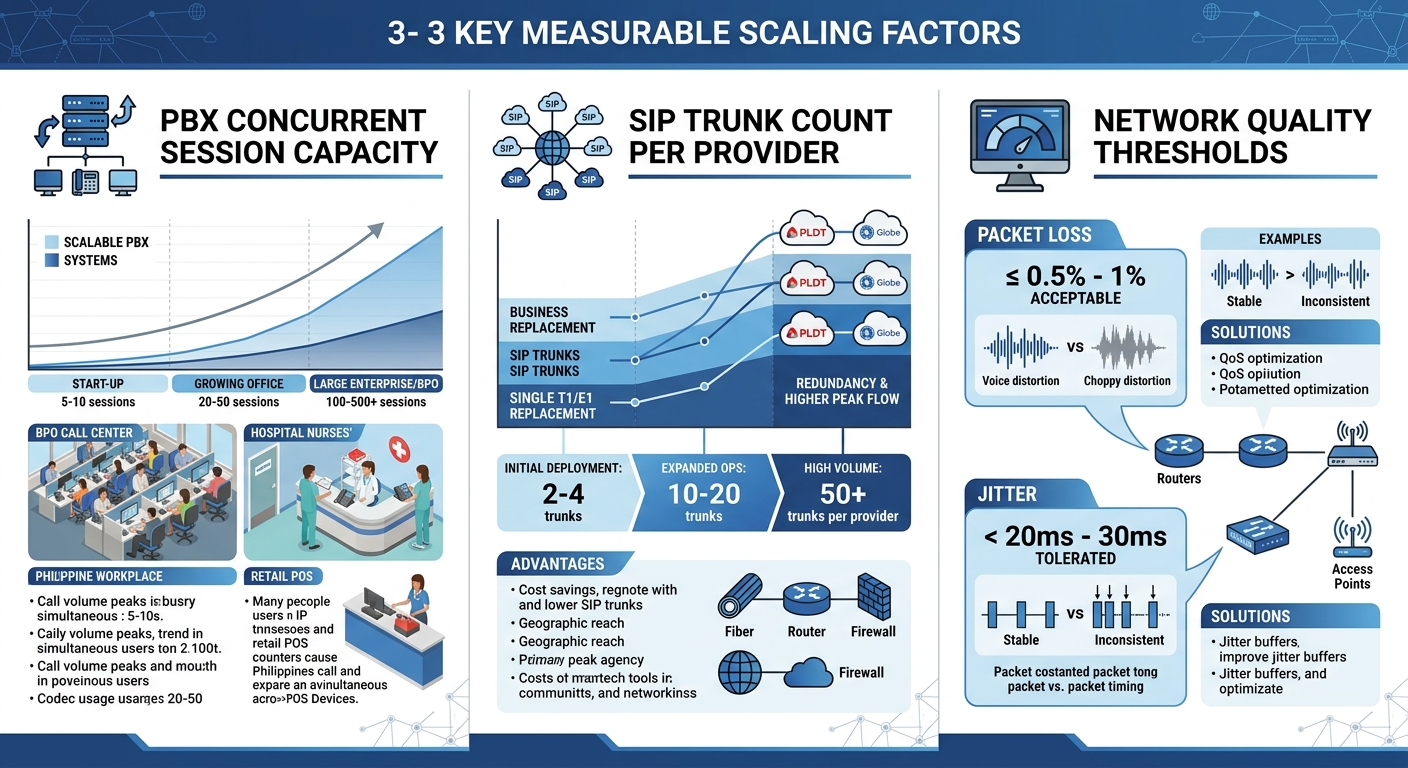
The Real Scaling Bottleneck Is the Network Underlay
For Philippine enterprises specifically, the constraint that breaks telephony at scale is almost never the PBX software or the VoIP codec. It’s the network underneath. A 300-seat call center in Davao running G.729 codec at 8 kbps per call needs only 2.4 Mbps of raw bandwidth for voice. Even G.711 at 64 kbps per call needs 19.2 Mbps for 300 simultaneous calls. These are small numbers in 2026. The problem is reliability, not bandwidth.
Philippine ISP infrastructure has improved significantly. Converge ICT allocated up to P23 billion for nearly 1 million new fiber ports in its 2026 provincial expansion push. Globe and PLDT continue investing in metro fiber. But enterprise scalability Philippines still faces a gap between Manila fiber quality and provincial link stability. A hospital system in the Visayas connecting 5 sites over MPLS will hit voice quality issues that a Manila-only deployment never encounters.
This is where the real telephony infrastructure decisions happen. Do you run SD-WAN or MPLS as the underlay for multi-site voice? Do you centralize the PBX in a Manila data center or distribute instances per region? Do you keep analog PSTN trunks as failover at provincial sites where internet uptime drops below 99.5%?
Acquire BPO provides an instructive case. The company enhanced its global network infrastructure by adopting Software Defined Interconnection through Console Connect, as documented by Bladegrass Technologies. That gave them on-demand, scalable connectivity across multiple regions. The voice quality improvements came from the network redesign, not from switching between “VoIP” and “IP telephony.”
Info: If your Philippine enterprise runs voice across more than 2 sites, benchmark each link independently. A single provincial circuit running above 1% packet loss during business hours will degrade every call touching that link. Diagnose link quality before upgrading the PBX. We’ve covered [how to run those diagnostics](/blog/voip-call-quality-troubleshooting-philippine-networks) step by step.
The Yeastar P-Series platforms illustrate this point well. A P570 supports up to 500 users and 200 concurrent calls. For a mid-sized Philippine enterprise, that capacity ceiling won’t be the bottleneck. The bottleneck will be whether the fiber link to your Makati office sustains consistent quality, whether QoS policies on your switches actually prioritize RTP traffic, and whether your data center infrastructure has redundant power and cooling for the on-premises PBX.
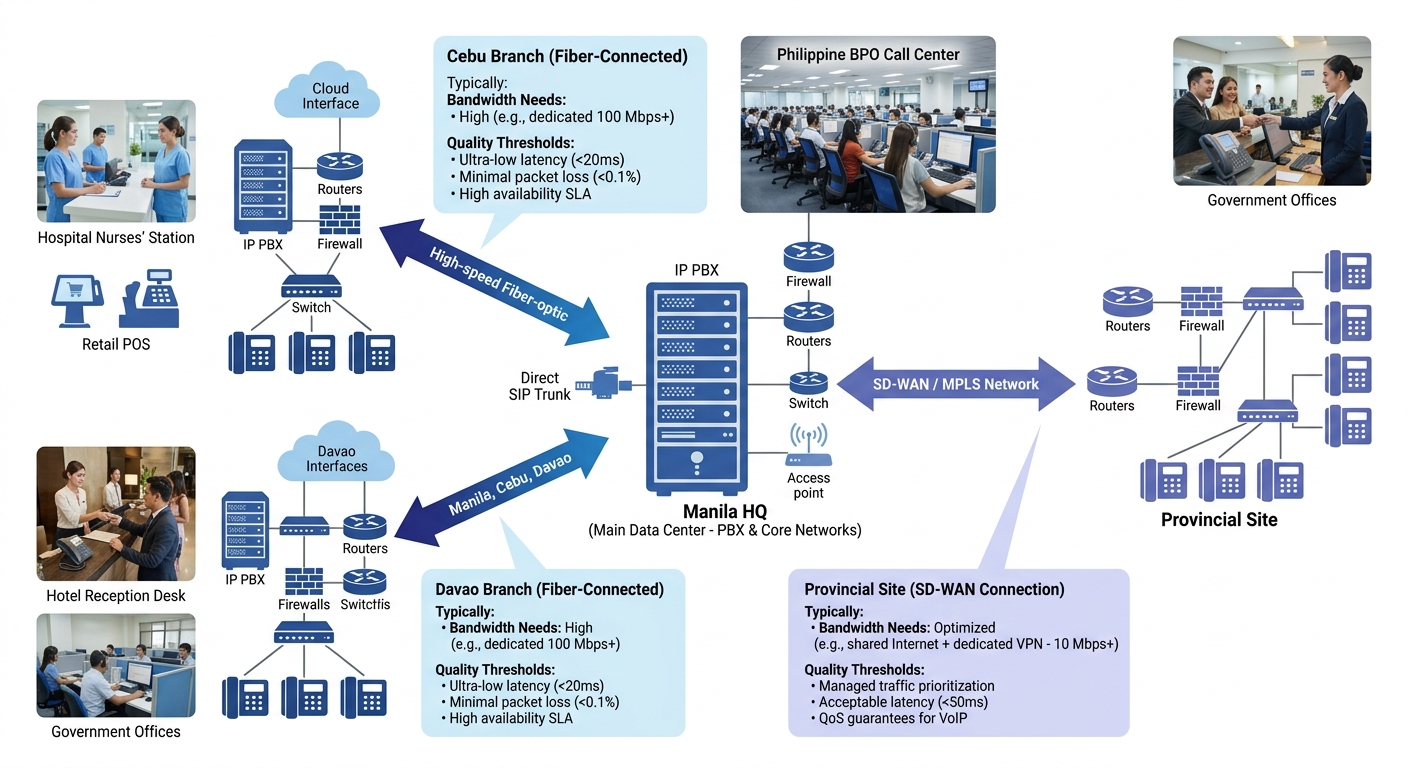
The three-axis evaluation I’d propose for Philippine enterprise telephony scaling (call it the TSN framework: Trunk capacity, Session ceiling, Network quality) looks like this:
- Trunk capacity: how many concurrent external calls can your SIP trunks support, and does your provider offer geographic redundancy? If your SIP trunk failover configuration relies on a single provider, you have a single point of failure regardless of PBX capability.
- Session ceiling: how many internal concurrent sessions does your PBX cluster handle before performance degrades? Cisco CUCM clusters scale to tens of thousands of devices. Yeastar’s P-Series tops out in the hundreds. Match the platform to your actual seat count plus 30% headroom.
- Network quality: does every WAN link between sites maintain packet loss under 1%, jitter under 30ms, and one-way latency under 150ms during peak hours? If any link fails this threshold, no amount of PBX investment will fix the call quality on that segment.
The Claim, Revisited
The IP telephony vs. VoIP distinction is real at the taxonomy level. IP telephony is the whole system; VoIP is the voice transport method inside it. That’s a fact, and it’s useful when reading vendor datasheets or writing RFP requirements. But the distinction has no bearing on whether a Philippine enterprise can scale from 100 seats to 1,000, or from 2 sites to 20.
Enterprise scalability Philippines comes down to SIP trunk math, PBX session ceilings, and the quality of the network carrying the packets. These are concrete, measurable engineering decisions. They exist identically whether your procurement team labels the project “VoIP migration” or “IP telephony deployment.”
The UCaaS market has reached $23 billion globally as cloud communications adoption accelerates. Philippine enterprises are part of that wave, with BPOs, hospitals, schools, and government agencies all moving toward unified communications architecture that bundles voice, video, messaging, and collaboration. Within that architecture, the VoIP-versus-IP-telephony label becomes as relevant as asking whether your car uses “gasoline combustion” or “an internal combustion engine.” One describes the chemistry; the other describes the machine. You need both, and you buy them together. Spend your procurement energy on the TSN framework instead, and you’ll make telephony infrastructure decisions that actually determine whether the system holds up when your enterprise doubles in size.