
Philippine government agencies choosing between hardware-based and software-based VoIP must clear three compliance gates before cost enters the conversation: NTC registration, NPC data residency, and NIST SP 800-58 security alignment. On-premises hardware PBX remains the defensible default because it satisfies all three without architectural workarounds.
TL;DR: On-prem hardware VoIP clears Philippine NTC and NPC compliance requirements by default. Software and cloud alternatives can match on features and monthly cost, but introduce data-residency risks and audit complexity that most agencies aren’t staffed to manage. Use the Three-Gate Procurement Filter below to evaluate any deployment model before comparing price.
The NTC Registration Gate Comes First
Every Philippine government agency deploying VoIP must hold a valid Certificate of Registration (COR) from the National Telecommunications Commission, renewed annually at PhP 5,000, before a single IP phone powers on. The compliance burden sits with the agency, not the vendor. An NTC spot audit that finds an expired or missing COR can halt operations immediately.
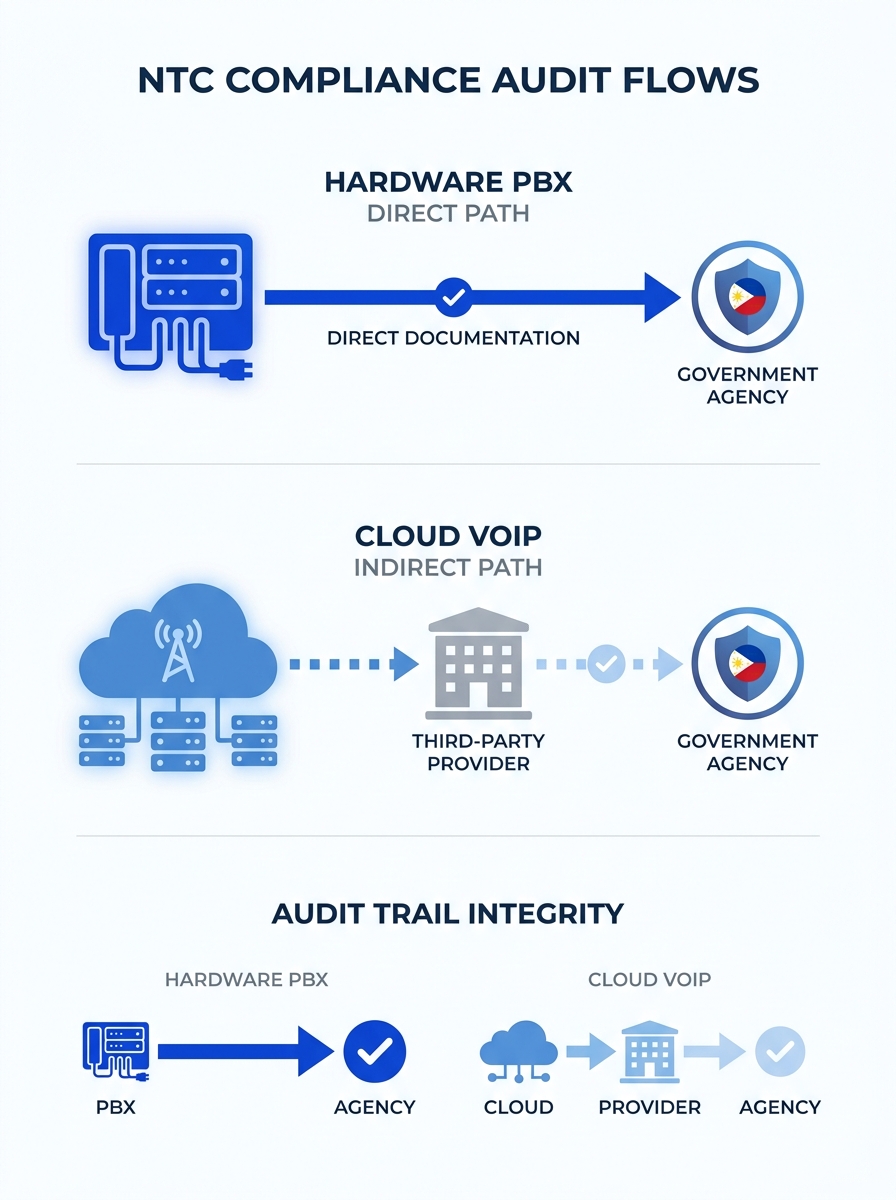
Hardware PBX systems simplify this gate. The agency owns the infrastructure, controls the trunk connections, and can present a clean audit trail showing exactly which devices connect to the PSTN at the regulated interconnection rates (PhP 1.00 per minute for fixed, PhP 1.50 for mobile). Software-only or cloud-hosted deployments complicate the picture because the SIP trunking provider may handle PSTN interconnection from a shared platform, and the agency must still demonstrate compliance ownership during audits.
This distinction matters more than it sounds. Government procurement officers who’ve been through an NTC review know that auditors want to see physical infrastructure maps, trunk provisioning documents, and COR renewal receipts tied to specific equipment. A cloud dashboard screenshot doesn’t carry the same weight as a rack-mounted PBX with serial numbers matching the registered inventory.
Data Residency and the NPC Constraint
The National Privacy Commission requires government agencies handling personal information to maintain defensible data residency practices. Call recordings, voicemail files, call detail records (CDRs), and directory entries all qualify as personal data under the Data Privacy Act of 2012.
On-premises hardware VoIP stores everything locally. The agency’s IT team controls where recordings live, who accesses them, and how long they’re retained. There’s no ambiguity about jurisdiction because the data never leaves the building.
Cloud-hosted VoIP introduces a jurisdictional question: where does the provider store call recordings? If the answer is a data center in Singapore, the US, or anywhere outside Philippine territory, the agency faces cross-border data flow obligations under NPC Circular 2016-02. These obligations aren’t impossible to meet, but they require documented adequacy assessments, binding corporate rules, or contractual clauses that most Philippine government procurement processes aren’t structured to evaluate.
Software PBX platforms installed on agency-owned servers occupy a middle ground. They keep data local while offering the flexibility of software updates and feature expansion. Yeastar’s P-Series, for example, runs on local hardware but delivers the management interface and feature set typical of cloud platforms. This hybrid approach satisfies data residency requirements without sacrificing modern functionality.
Agencies that already struggle with VoIP security hardening will find the NPC compliance layer even harder to maintain on a fully cloud-hosted model. The security perimeter expands to include the provider’s infrastructure, their subprocessors, and every network hop between your office and their data center.
TCO Breakdown Across Three Deployment Models
Why does the cost comparison between hardware VoIP and software VoIP get so confusing for government? Because published pricing guides focus on monthly per-user fees while ignoring compliance labor, power infrastructure, and vendor lock-in exit costs. The total cost of ownership includes setup, hardware, maintenance, scalability, and long-term value according to industry pricing analyses, but Philippine government agencies carry at least three additional line items unique to their regulatory environment.
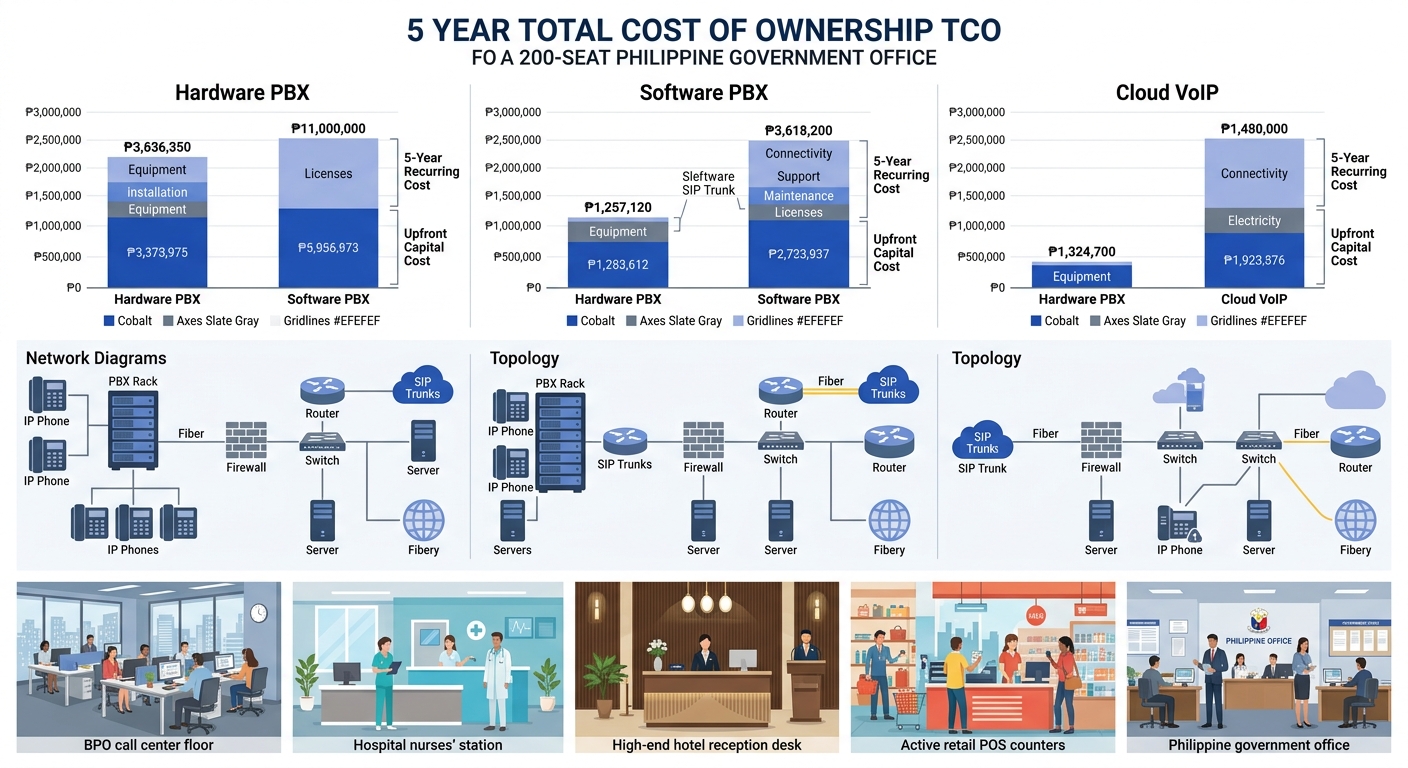
Here’s how the three primary deployment models compare across a 5-year lifecycle for a 200-extension government office:
| Cost Category | Hardware PBX (On-Prem) | Software PBX (On-Prem Server) | Cloud-Hosted VoIP |
|---|---|---|---|
| Upfront hardware | PhP 800K–1.5M (PBX + phones + switches) | PhP 300K–600K (server + phones) | PhP 50K–150K (phones only) |
| Monthly service | PhP 0 (self-managed) | PhP 0–15K (support contract) | PhP 80K–200K (per-user subscription) |
| 5-year total | PhP 1.2M–2.0M | PhP 900K–1.5M | PhP 5.0M–12.5M |
| NTC compliance labor | Low (single audit trail) | Low to medium | High (shared infrastructure docs) |
| Data residency risk | None (local storage) | None (local storage) | High (NPC adequacy assessment required) |
| Power failure behavior | Continues on UPS/genset | Continues on UPS/genset | Fails when internet drops |
| Vendor lock-in severity | Medium (proprietary firmware) | Low (SIP-standard) | High (provider-dependent features) |
The cloud model’s lower upfront cost is deceptive for government. A 200-seat deployment at PhP 400–1,000 per user per month reaches PhP 5M–12.5M over five years. That’s 3x to 6x the lifetime cost of an on-prem hardware system, consistent with the cost differentials documented in Mitel’s 2026 pricing analysis. Government budget cycles favor large capital expenditure over recurring operational expense anyway, which aligns naturally with the on-prem model’s front-loaded cost structure.
Power Continuity Changes the Calculus Outside Metro Manila
Provincial government offices face power interruptions that Metro Manila agencies rarely plan for. Typhoon-prone regions in the Visayas and Mindanao can lose grid power for 24 to 72 hours. Any VoIP deployment that depends on continuous internet connectivity to a remote data center will fail during exactly the emergencies when communication matters most.
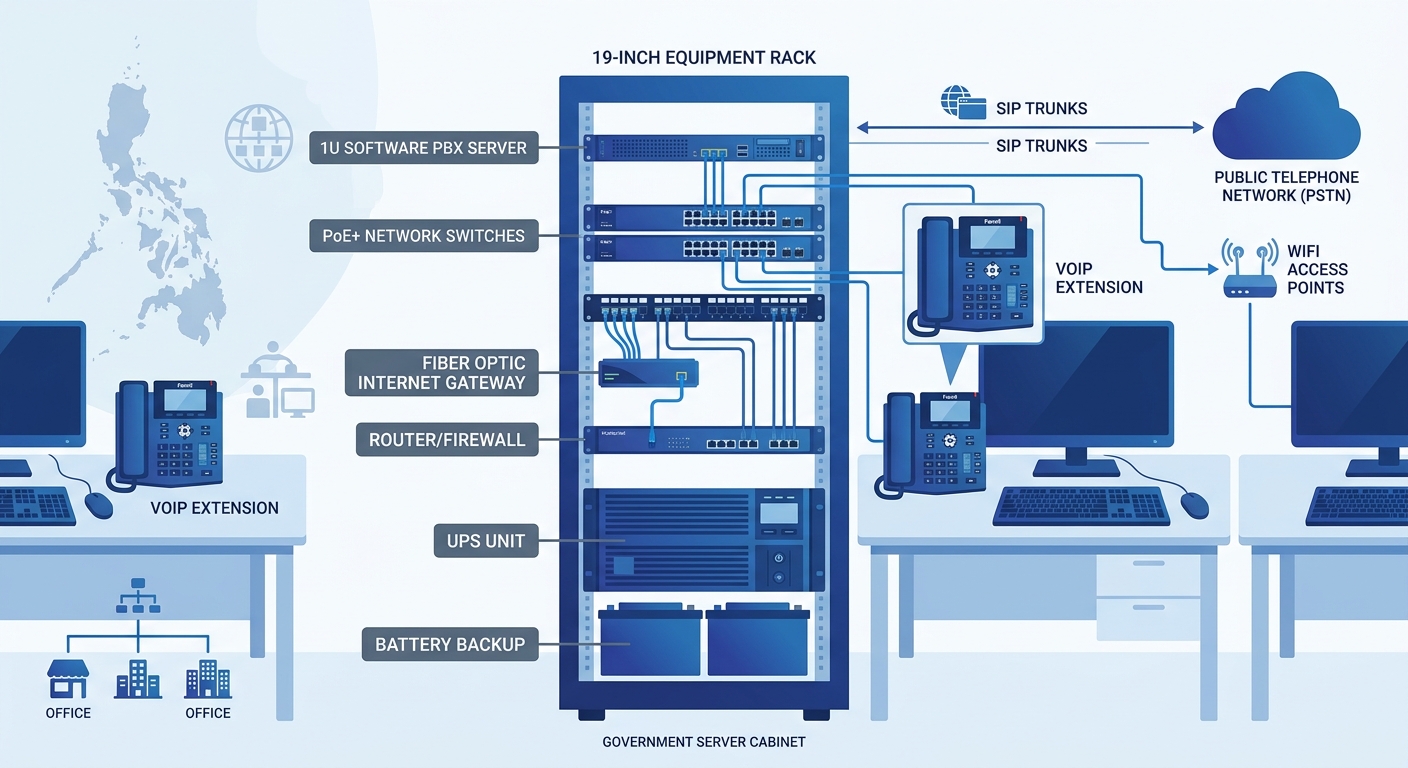
Hardware PBX systems connected to UPS units and generator sets with automatic transfer switches continue operating during grid outages. Every IP phone, PoE switch, and PBX server on battery backup means the internal phone system stays live even when external internet is down. Internal extension-to-extension calling works, intercom and paging functions stay operational, and the system degrades gracefully rather than collapsing entirely.
This is where Fanvil desk phones and audio paging earn their place in government deployments. Their PoE-powered endpoints draw minimal wattage, extending UPS runtime significantly compared to power-hungry multi-function terminals. For agencies planning their telecom resilience framework, per-device power draw directly affects how many hours of phone service you get from a given UPS capacity.
Cloud-hosted VoIP offers zero functionality during an internet outage. The phones become inert. Software PBX on local servers behaves identically to hardware PBX during power events, provided the server infrastructure is on the same UPS/genset circuit.
Warning: Government agencies outside Metro Manila should test actual UPS runtime under full phone system load before signing off on any VoIP deployment. A UPS rated for 30 minutes on paper may deliver only 18 minutes when supporting 50 PoE phones, two switches, and a PBX server simultaneously.
The Three-Gate Procurement Filter
Philippine government telecom procurement decisions benefit from a structured evaluation that puts compliance ahead of features. The Three-Gate Procurement Filter forces agencies to verify regulatory fitness before comparing vendor pricing.
Gate 1: NTC Audit Readiness. Can the proposed deployment produce a complete infrastructure map, trunk provisioning documents, and COR renewal receipts tied to specific serial-numbered equipment within 48 hours of an audit request? If the answer requires coordinating with a cloud provider’s support team across time zones, the deployment fails this gate.
Gate 2: NPC Data Residency. Does every category of personal data (call recordings, CDRs, voicemail, directory entries) remain within Philippine jurisdiction at all times, including during backup and disaster recovery? If the provider’s backup replicates to an offshore data center, the agency needs documented NPC-compliant cross-border transfer mechanisms before procurement can proceed.
Gate 3: NIST SP 800-58 Security Alignment. Does the deployment architecture address the specific IP telephony risks outlined in NIST SP 800-58, including call interception, toll fraud, denial-of-service, and unauthorized configuration access? Hardware PBX systems behind FortiGate firewalls with dedicated voice VLANs satisfy this gate architecturally. Cloud deployments shift much of the security responsibility to the provider, and the agency must verify their controls through independent audit reports, typically SOC 2 Type II or ISO/IEC 27001 certification.
Any deployment model that clears all three gates is a viable candidate. At that point, and only at that point, does TCO comparison become the deciding factor. Agencies that have repeated the most common IP telephony deployment mistakes almost always skipped one of these gates during procurement.
Philippine government agencies that evaluate VoIP vendors on price before confirming NTC, NPC, and NIST compliance fitness are buying problems they’ll discover during the first audit.
Where Software PBX Narrows the Gap
The comparison above tilts toward hardware PBX, but software PBX platforms running on agency-owned servers deserve serious consideration for offices with competent IT staff. Xorcom’s CompletePBX, for instance, is deployed by police and military forces worldwide for its service continuity and call tracking capabilities, with homologation processes that ensure compliance with local carrier interconnection requirements.
Software PBX offers three advantages over traditional hardware PBX that matter for government:
- Lower hardware refresh costs. When the PBX software runs on standard server hardware, you replace commodity servers on a 5-year cycle instead of proprietary PBX chassis on vendor-dictated timelines. A Dell PowerEdge server costs 40–60% less than a comparable proprietary PBX appliance at refresh time.
- Faster security patching. Software updates deploy through standard package management rather than firmware flashes requiring vendor engineering support. Given the recent critical vulnerabilities found in major PBX platforms, patch speed matters.
- Easier multi-site consolidation. Agencies with branch offices across provinces can consolidate PBX systems onto centralized platforms more easily than shipping and configuring hardware appliances to each location.
The tradeoff is staffing. Software PBX requires Linux administration skills, SIP protocol knowledge, and network engineering capacity that many provincial government IT departments lack. Agencies that pair software PBX with Jabra conference and call-center devices for their operations get the flexibility of software management with the audio quality and durability of purpose-built hardware endpoints.
What Remains Unsettled
Several open questions will shape how the hardware VoIP vs software VoIP landscape evolves for Philippine government agencies over the next two to three years.
The DICT’s digital transformation push encourages cloud adoption across government, but NPC data residency requirements haven’t been relaxed to accommodate cloud-hosted communications platforms. Until the NPC issues specific guidance on government VoIP in cloud environments, procurement officers will continue interpreting the rules conservatively. That conservatism favors on-premises deployments.
Converge’s 2026 provincial fiber expansion, which targets nearly 1 million new fiber ports outside Metro Manila, changes the infrastructure equation for provincial offices. Reliable fiber connectivity is the prerequisite for cloud VoIP viability, and as that connectivity improves, the technical barrier to cloud adoption drops. Whether the regulatory barrier drops alongside it is a separate question entirely.
The interconnection fee structure (PhP 1.00 for fixed, PhP 1.50 for mobile) hasn’t been revised in years. Any adjustment would ripple through the TCO calculations for every deployment model. Agencies building 5-year procurement plans should model scenarios with 20–30% increases in interconnection fees as a stress test against their chosen architecture.
And the security surface keeps expanding regardless of deployment model. VoIP reliability and compliance in the Philippines depend on keeping firmware current, segmenting voice traffic, and monitoring for toll fraud. These responsibilities don’t disappear with any procurement choice. They simply shift between the agency’s IT team and a third-party provider.
The Three-Gate Procurement Filter works today because Philippine regulations favor infrastructure the agency controls. If NPC guidance evolves, or if hyperscale providers build Philippine-jurisdiction data centers with ISO/IEC 27001 certification and NTC-registered trunk infrastructure, the gates will need recalibration. For now, on-premises hardware and software PBX deployments carry the lowest compliance risk and, across a 5-year lifecycle, the lowest total cost for most government offices.