Converge ICT Solutions announced plans to deploy nearly one million new fiber ports nationwide in 2026, backed by a capital expenditure budget of P18 billion to P23 billion, with 900,000 ports targeted at Visayas and Mindanao markets as the carrier deepens its provincial infrastructure footprint. Chief Executive Officer Dennis Anthony H. Uy disclosed the expansion during the company’s annual stockholders’ meeting on May 29, according to BusinessWorld.
TL;DR: Converge ICT is deploying up to 1 million fiber ports in 2026 with P18-23 billion in capital spending, focusing 900,000 ports on Visayas and Mindanao to capture provincial broadband demand and support recently launched data center operations.
The rollout represents Converge’s strategic pivot toward provincial markets as internet penetration and digital service consumption accelerate outside Metro Manila. The carrier is betting that infrastructure investment in underserved regions will position it to capture subscriber growth as provincial enterprises, schools, and government agencies upgrade connectivity infrastructure.
Network Expansion Targets Visayas and Mindanao Capacity
The 900,000-port allocation for Visayas and Mindanao signals Converge’s intent to build market share in regions historically dominated by incumbent telcos. “This 2026, Converge is positioned for a transformative year. We are on track to roll out close to one million new ports, deepening our roots in the provinces,” Uy said during the stockholders’ meeting.
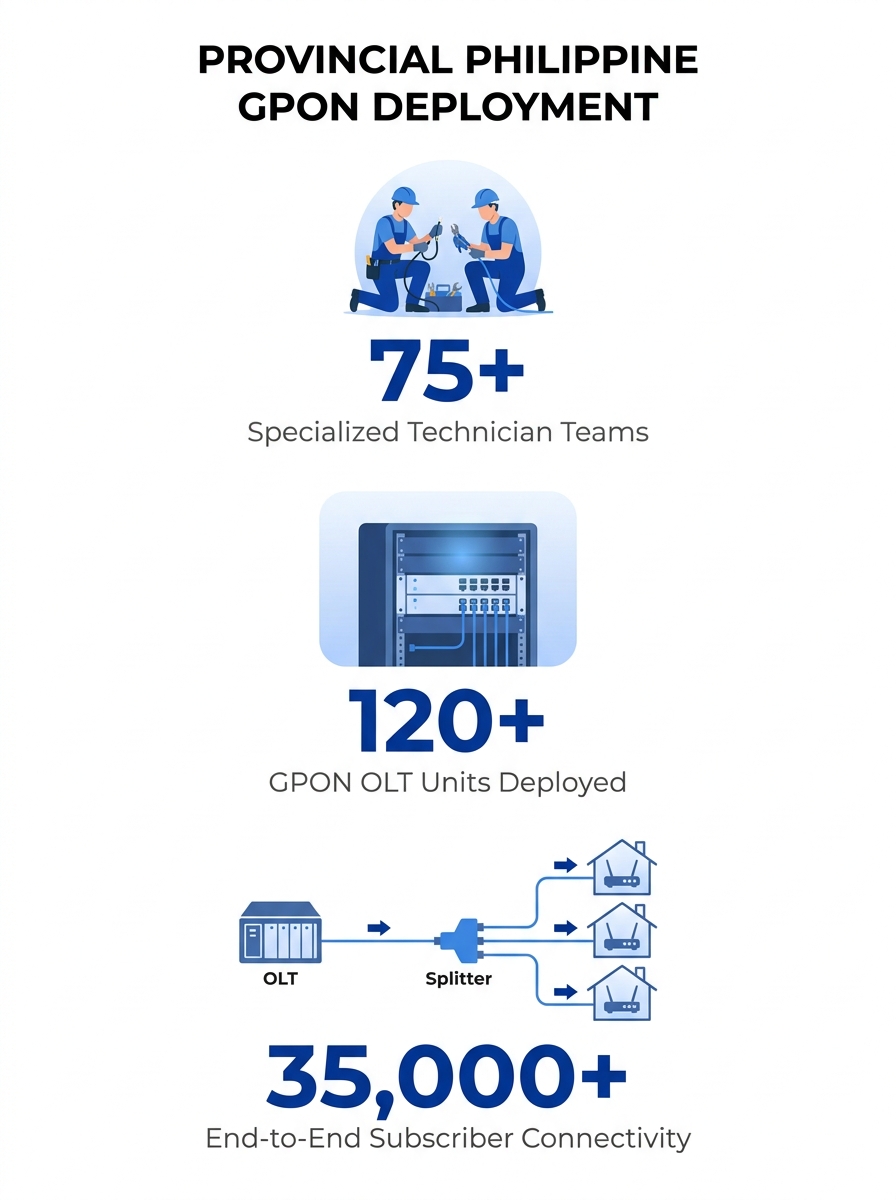
The capital budget includes fiber-to-the-home infrastructure, distribution network upgrades, and capacity expansion at network aggregation points. The investment cycle mirrors PLDT’s rural expansion strategy, which targeted 3,500 remote sites to address government broadband mandates and underserved enterprise demand. Philippine network operators are competing on coverage breadth as provincial BPO operations, manufacturing facilities, and educational institutions demand enterprise-grade connectivity that local ISPs cannot deliver at scale.
Data Center Launches Position Converge for Cloud and AI Workload Growth
Converge’s P5 billion, 12-megawatt data center in Pampanga launched in March and is now operational alongside a Tier-3 facility in Caloocan. “Our Tier-3 data centers in Angeles and Caloocan are now live and ready to host the country’s valuable data assets,” Uy said. The carrier expects data center revenue to contribute materially to growth as enterprises migrate workloads off on-premise infrastructure and government agencies pursue cloud-first policies.
The company is positioning its data center business to capture demand from artificial intelligence, cloud computing, and analytics workloads. “Technologies such as artificial intelligence, cloud computing and advanced analytics are reshaping industries. We will continue to use these innovations to deliver better customer experience and drive sustainable growth,” Uy said. Philippine enterprises deploying VoIP, unified communications, and customer engagement platforms increasingly require colocation providers with carrier-neutral connectivity and digital resilience beyond basic redundancy.
Converge’s data centers compete directly with PLDT Enterprise’s facilities and hyperscaler edge deployments. The Angeles location offers proximity to Clark Freeport Zone’s IT park tenants, while Caloocan serves Metro Manila enterprise customers seeking disaster recovery sites outside CBD flood zones. Philippine IT managers evaluating colocation providers weigh power SLA guarantees, cross-connect options to multiple carriers, and physical security controls alongside rack pricing, factors Converge must deliver to differentiate against established operators.
Financial Performance and Revenue Growth Outlook
Converge reported a 0.7 percent increase in first-quarter net income to P3.04 billion, while revenue rose 3.6 percent to P11.19 billion, according to the company’s disclosure last month. The carrier is maintaining its full-year revenue growth target of up to 10 percent despite macroeconomic headwinds tied to Middle East conflict impacts on fuel prices and supply chains.
The modest Q1 growth reflects subscriber acquisition costs in newly built-out markets, where port utilization lags initial capacity deployment by several quarters. Fiber operators typically achieve 20-30 percent take rates in the first year post-deployment, climbing to 40-50 percent as enterprise and residential awareness builds. Converge’s provincial strategy trades near-term margin pressure for long-term subscriber base expansion in regions where incumbent telcos have underinvested in fiber-to-the-premises infrastructure.
Operational Efficiency and Fleet Electrification
Chairman Jose P. de Jesus announced plans to convert 20 percent of Converge’s vehicle fleet to electric and hybrid units by 2030, building on the purchase of over 120 hybrid and electric vehicles already deployed for installation and repair operations. “Even prior to the fuel crisis, Converge had purchased over 120 hybrids and electric vehicles to support on-ground installation and repairs. We are now doubling that to manage risks arising from fuel supply disruptions and price volatility,” de Jesus said.
The fleet conversion addresses operational cost volatility in a business model dependent on technician dispatch for fiber drop installations, service activations, and trouble ticket resolution. Philippine telecom operators run field teams at scale, Converge’s nearly 1 million port rollout will require thousands of installation trips across archipelago geography where fuel price swings directly impact unit economics. Electric vehicle adoption also aligns with NTC and DICT sustainability reporting expectations as regulators press carriers on environmental, social, and governance metrics.
The Takeaway
Converge’s P18-23 billion capital commitment and 900,000-port Visayas/Mindanao focus confirm that provincial fiber deployment remains the primary growth vector for Philippine carriers competing in saturated Metro Manila markets. The expansion directly affects enterprise telecom infrastructure planning for multi-site businesses evaluating whether to wait for incumbent upgrades or negotiate early adopter pricing with new entrants building capacity in their regions. IT managers in Cebu, Davao, Iloilo, and Cagayan de Oro should treat the port rollout as a trigger to reassess carrier diversity strategies and validate that backup connectivity plans account for multiple fiber providers where previously only DSL and fixed wireless were available. The data center launches add another decision node: whether to colocate workloads provincially for latency optimization or centralize in Metro Manila facilities with more mature ecosystems and interconnection density.