
Fortinet’s comparison data confirms MPLS networks deliver better baseline reliability for latency-sensitive VoIP, while SD-WAN costs 40–60% less per site by running over broadband and LTE instead of private circuits. Philippine multi-site deployments face a genuine tradeoff between deterministic performance and cost-efficient agility, and the honest answer involves a third option most carriers downplay.
TL;DR: For most Philippine enterprises with 5–30 branches, SD-WAN over dual broadband delivers VoIP quality matching or exceeding single-circuit MPLS at significantly lower cost. Sites requiring guaranteed sub-10ms inter-branch latency benefit from a hybrid approach where MPLS serves as one underlay path managed by SD-WAN’s traffic-steering engine.
Three Underlays at a Glance
Before examining each option’s tradeoffs for multi-site network underlay decisions, here’s how they stack up across the metrics that determine VoIP call quality for Philippine branch connectivity.
| Attribute | MPLS-Only | SD-WAN Over Broadband | Hybrid (MPLS + SD-WAN) |
|---|---|---|---|
| Typical per-site monthly cost (PH) | PHP 25,000–80,000/Mbps | PHP 3,000–15,000/Mbps | PHP 20,000–50,000 combined |
| Provisioning lead time | 4–12 weeks | 1–5 days | 4–12 weeks (MPLS leg) |
| Jitter SLA | Carrier-guaranteed, under 5ms | Software-managed, typically under 8ms | Under 5ms on MPLS path, broadband failover |
| Packet loss handling | Carrier-managed, SLA-backed | FEC + packet duplication across paths | Best of both |
| Failover speed | Minutes to hours (manual reroute) | Sub-second automatic path selection | Sub-second |
| Native encryption | None (relies on network isolation) | Built-in IPsec/AES-256 | Encrypted across all paths |
| Cloud VoIP optimization | Poor (backhaul required) | Excellent (local internet breakout) | Good to excellent |
| Per-application monitoring | Limited without paid add-ons | Real-time dashboards included | Full dashboard visibility |
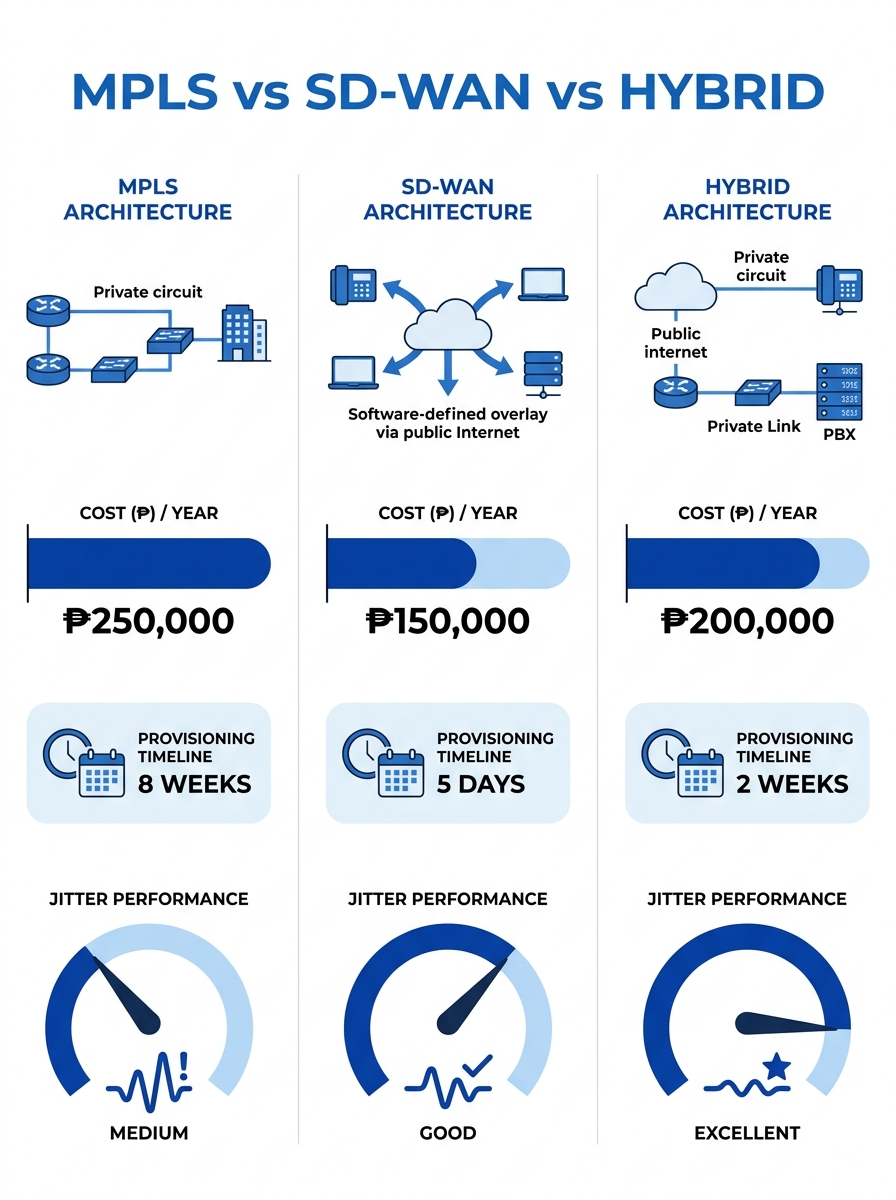
MPLS-Only: Deterministic Quality at a Steep Price
MPLS VoIP transport provides carrier-managed label-switched paths with contractual guarantees on latency, jitter, and packet loss between sites. A carrier selling MPLS in the Philippines will commit to sub-5ms jitter and under 0.1% packet loss across its private network. The Fortinet comparison confirms that MPLS supports QoS through label prioritization, giving voice packets guaranteed treatment at every hop. For a hospital running inter-branch paging between Metro Manila and Cebu campuses, or a bank connecting 15 teller sites to a centralized on-premise PBX, those contractual numbers offer real comfort.
The problem for Philippine deployments is operational, not theoretical. MPLS circuits between Metro Manila and provincial branches take 4–12 weeks to provision, requiring physical site surveys, trenching, and fiber splicing. As a CT Link analysis of SD-WAN versus MPLS economics notes, MPLS is a private network with higher security than the public internet, but that privacy comes with rigid provisioning workflows. Construction disruptions and typhoon damage create recurring single-point-of-failure risks on each circuit. A BPO in Cebu or a government office in Davao running on a single MPLS link faces hours of downtime when that circuit goes down, because MPLS failover typically requires manual carrier intervention or a secondary circuit at full additional cost.
Cost is the other constraint. Philippine MPLS bandwidth runs PHP 25,000–80,000 per megabit per month depending on distance and carrier. A 10-site network consuming 10 Mbps of MPLS per branch pays PHP 2.5 million to PHP 8 million monthly for the WAN alone. That budget could fund dual broadband plus SD-WAN appliances at every site with significant money left over.
MPLS also has a cloud problem. When your VoIP platform sits in the cloud, whether that’s a hosted PBX, a UCaaS service, or a SIP trunk terminating at an internet-facing SBC, MPLS forces traffic through a central hub before reaching the internet. That backhaul adds 15–40ms of unnecessary latency to every call. Enterprises that have already moved from on-premise PBX to cloud VoIP find MPLS working against their architecture rather than supporting it.
Where MPLS still wins: inter-branch voice traffic that never touches the public internet, environments requiring carrier-grade SLAs with contractual penalties, and organizations running legacy PBX systems that depend on consistently low-jitter site-to-site trunks.
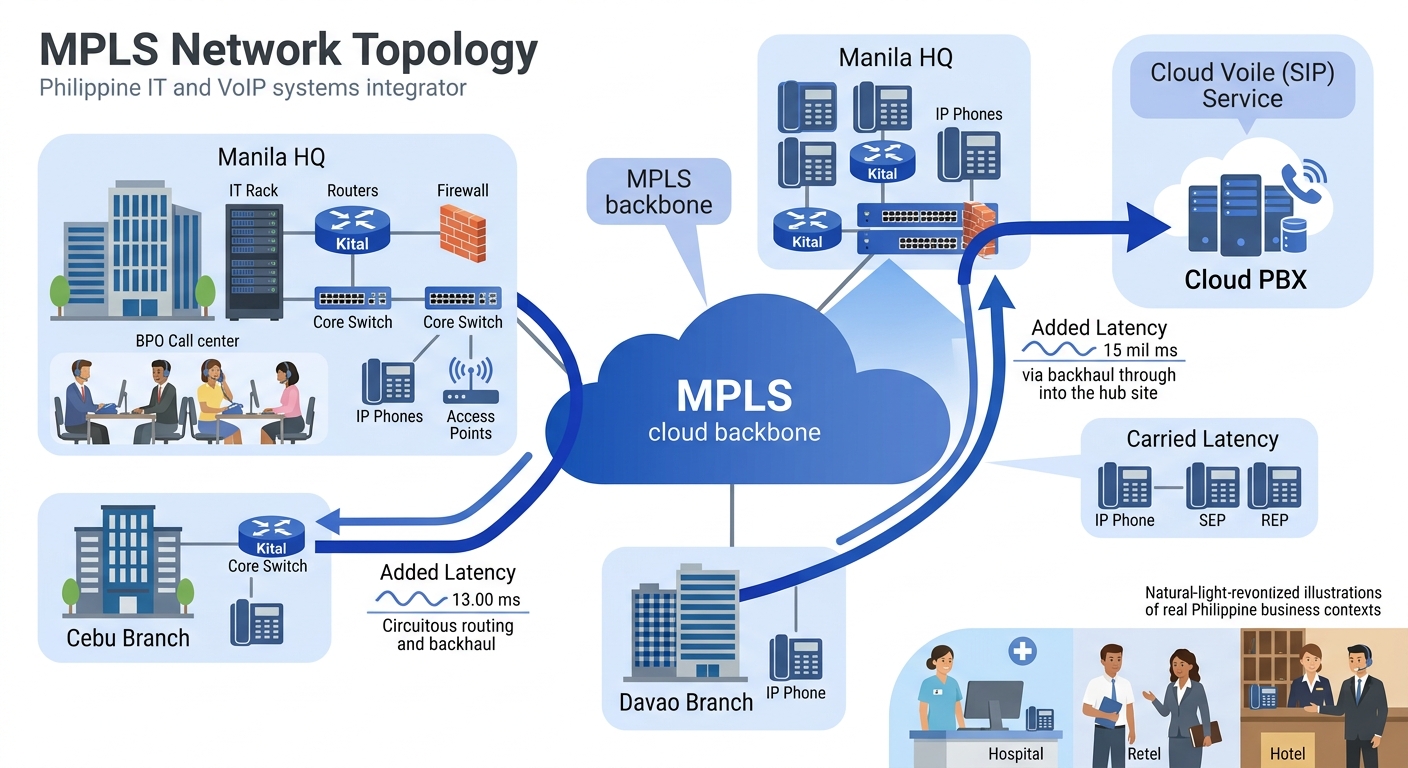
SD-WAN Over Broadband: Intelligent Path Selection Compensates for Internet Variability
SD-WAN deployed over dual broadband links (fiber primary, LTE or 5G backup) achieves VoIP jitter performance under 8ms in most Philippine metro areas and sub-15ms on provincial connections. Palo Alto Networks’ SD-WAN monitoring documentation describes how SD-WAN appliances track jitter, latency, and packet loss per application class across every available path, flagging “impacted” status when none of the available paths meet the quality thresholds defined in the Path Quality Profile.
The difference from MPLS: SD-WAN doesn’t guarantee low VoIP jitter through circuit exclusivity. It achieves it through three real-time mechanisms working simultaneously.
Dynamic path selection monitors every available underlay link continuously. When the primary fiber link at a Makati branch starts showing 12ms jitter (above the 8ms threshold configured for voice), the SD-WAN controller moves RTP packets to the LTE backup within milliseconds. Cisco Meraki’s SD-WAN monitoring capabilities detail how these metrics are tracked per VPN tunnel and per application in real time, giving IT teams visibility that MPLS carriers charge separately for.
Forward Error Correction (FEC) reconstructs lost packets mathematically at the receiving end. On a broadband link showing 1–2% packet loss (common during evening congestion on Philippine ISPs), FEC can reduce effective loss to under 0.05% for voice traffic. Packet duplication takes a more aggressive approach: sending identical voice packets across two separate underlay links simultaneously, guaranteeing arrival even if one path drops packets entirely.
SD-WAN doesn’t guarantee low jitter through circuit exclusivity. It achieves it through continuous measurement and sub-second path correction across every available link.
The deployment advantage is dramatic for Philippine branch connectivity. An SD-WAN appliance from vendors like Fortinet, Cisco Meraki, or Palo Alto ships to a branch site and connects to whatever broadband is available locally. Configuration pushes from the central controller. A new branch in Iloilo or General Santos can be online with full VoIP quality policies in 1–5 days rather than the 4–12 weeks required for MPLS circuit provisioning.
For organizations tracking hidden network bottlenecks that degrade VoIP quality, SD-WAN’s centralized dashboard provides per-application jitter, latency, and packet loss across every branch in a single pane. MPLS carriers either don’t share this level of application-aware data or charge separately for SNMP-based monitoring add-ons.
SD-WAN’s weakness is the underlying transport itself. Broadband internet in Philippine provincial areas can be inconsistent: asymmetric speeds, shared last-mile congestion during peak hours, and occasional multi-hour outages from weather events. SD-WAN mitigates these issues through path intelligence, but it can’t compensate when both available links degrade simultaneously. In areas with only a single ISP option and no LTE coverage, SD-WAN’s path diversity advantage disappears entirely.
Warning: SD-WAN’s quality guarantees depend on having at least two independent underlay links per site. A branch with only one ISP and no wireless backup gets none of the failover benefits. Survey last-mile availability at every location before committing to an SD-WAN Philippines deployment.
The Hybrid Architecture: MPLS as One Path, SD-WAN as the Brain
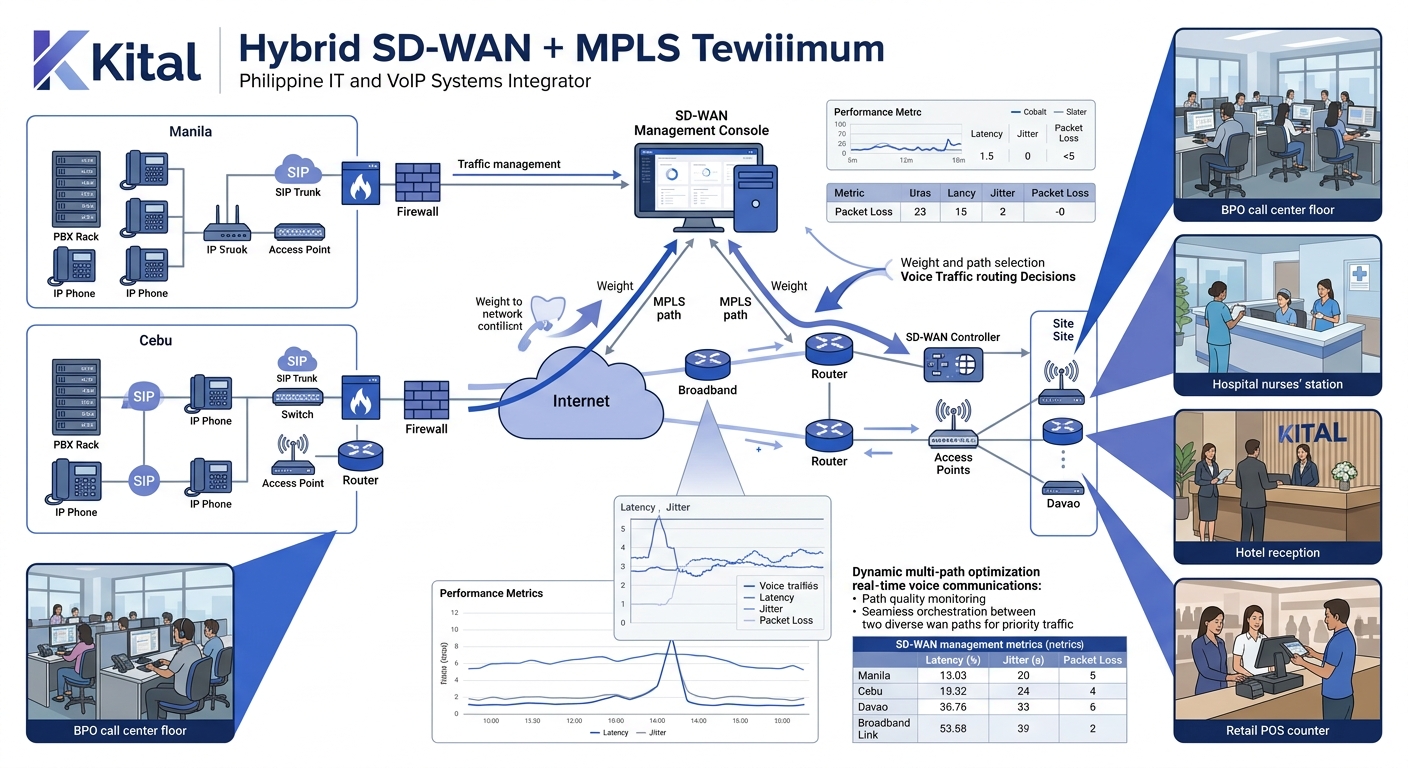
Why choose one when the architecture can treat MPLS as one available underlay path among several, managed by an SD-WAN overlay that makes real-time routing decisions across all links? As the MHO networking team explains, “MPLS core can serve as the high-performance backbone for mission-critical services, while SD-WAN can ride on top to optimize the last mile and provide dynamic path selection across multiple links.”
This architecture solves the specific failure modes of both standalone approaches. The MPLS circuit provides a guaranteed-quality path for inter-branch voice traffic that needs sub-5ms jitter. The broadband link provides local internet breakout for cloud VoIP platforms, eliminating the backhaul penalty. And the SD-WAN controller monitors both paths, steering traffic to whichever link delivers better performance at any given moment.
For Philippine enterprises running multi-site PBX consolidation projects, hybrid is often the pragmatic migration path. You keep existing MPLS circuits active during the transition period, add broadband links at each site, deploy SD-WAN appliances, and gradually shift traffic to the cheaper underlay as monitoring data confirms acceptable quality. When the MPLS contract expires, you have months of performance data to decide whether renewal is justified for each specific site.
The cost falls between the two extremes: PHP 20,000–50,000 per site monthly, depending on whether you retain full MPLS bandwidth or downgrade to a thinner circuit. The tradeoff is complexity. You’re managing two carrier relationships per site, two billing cycles, and an SD-WAN platform that needs its own network security solutions governing encrypted tunnels across both public and private paths. IPsec configuration, firewall policies, and access control rules all need to cover both underlays consistently.
Hybrid shines for organizations with mixed site profiles: headquarters and major branches in Metro Manila on MPLS plus broadband, smaller provincial offices on dual broadband only, and temporary or seasonal sites on LTE-only with SD-WAN overlay. The SD-WAN controller applies the same QoS policies regardless of which underlay each site uses, ensuring consistent VoIP quality across the entire network.
How to Choose Between These Three
The right multi-site network underlay for your VoIP deployment depends on three variables specific to your organization, not to carrier marketing materials.
If your VoIP platform is cloud-hosted (UCaaS, hosted PBX, SIP trunks terminating at an internet SBC): SD-WAN over broadband is the better underlay. MPLS forces backhaul that adds 15–40ms of latency to every cloud-bound call. SD-WAN’s local internet breakout routes voice traffic directly to the cloud platform. A solid VoIP call quality monitoring practice using SD-WAN’s built-in per-application dashboards will give you real-time confirmation of jitter and loss per branch, something MPLS monitoring tools rarely provide without extra cost.
If your VoIP system is on-premise with heavy site-to-site trunk traffic: Hybrid makes sense. The MPLS path carries inter-branch calls with guaranteed QoS, while the broadband path handles internet-facing traffic and serves as automatic failover. This profile is common in Philippine banks, hospitals, and government agencies running Yeastar or Cisco on-premise PBX systems across 10+ locations.
If you’re deploying new sites rapidly or operating in areas with limited carrier infrastructure: SD-WAN over broadband with LTE backup is the only practical option. MPLS provisioning timelines of 4–12 weeks make it unsuitable for fast-scaling operations like retail chains, BPO satellite offices, or disaster-recovery sites that need to be live within days.
For most Philippine enterprises with 5–30 branches, the practical path in 2026 is to start with SD-WAN over dual broadband at every site. Monitor VoIP jitter and packet loss for 60–90 days using the SD-WAN controller’s application-aware analytics. If specific routes consistently exceed 10ms jitter or 0.5% packet loss during business hours despite path selection and FEC, add an MPLS circuit to those specific sites as a third underlay path. You’ll spend less overall, deploy faster, and have the data to justify every peso of MPLS spend only where the numbers show it’s genuinely needed.