
Eastern Communications’ Project Maaasahan deployed satellite internet and digital learning equipment to 10 public schools across 10 provinces in its first phase, directly serving 2,785 students and 155 teachers while extending free community Wi-Fi access to 29,517 residents in surrounding barangays, according to The Manila Times. The program launched in 2024 through partnerships with Unconnected.org, the Department of Education, and local government units.
TL;DR: Eastern Communications’ Project Maaasahan connected 10 underserved public schools with satellite internet in its first phase, serving 2,785 students and 155 teachers while each school operates as a free community Wi-Fi hub after hours.
The 148-year-old telecommunications provider operates Project Maaasahan alongside its participation in the Philippine Domestic Submarine Cable Network (PDSCN), one of the country’s largest undersea fiber cable projects. The dual approach addresses national infrastructure resilience through submarine cable redundancy while targeting digital inclusion in geographically isolated and disadvantaged areas through school-based connectivity hubs. Each participating school receives satellite-powered internet connections and Maaasahan Kits containing laptops and digital learning tools, according to the report.
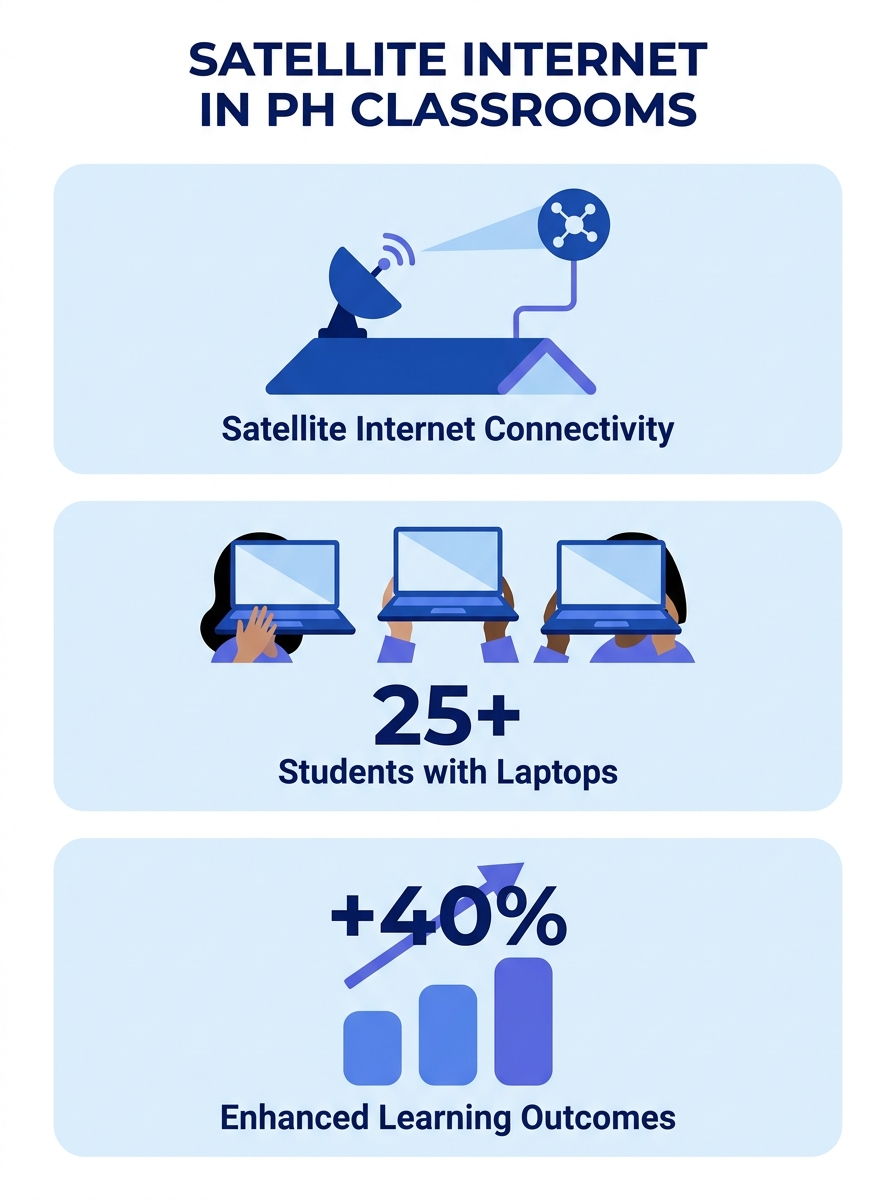
Schools Double as Community Internet Access Points
Project Maaasahan transforms public schools into dual-purpose connectivity centers—serving students and teachers during school hours, then functioning as free community Wi-Fi access points for surrounding barangays after school ends. The first-phase deployment reached communities across 10 provinces, with the 29,517-resident impact figure representing families and individuals in barangays adjacent to participating schools. Teachers gained access to digital resources that expand curriculum options beyond print-based materials, while students received exposure to computing devices and internet-connected learning tools previously unavailable in their communities.
The program addresses a fundamental infrastructure gap in Philippine education: digital access disparity between urban schools and those in remote or economically disadvantaged areas. The satellite-based delivery model bypasses terrestrial infrastructure limitations that have historically excluded these schools from broadband connectivity programs, similar to Globe’s recent commercial Starlink satellite-to-mobile service launched for areas beyond terrestrial tower coverage.
Submarine Cable Network Builds National Redundancy
Eastern Communications’ participation in PDSCN complements Project Maaasahan by strengthening the underlying national telecommunications infrastructure. The submarine cable network improves broadband reliability and expands access in underserved areas while building redundancy capacity designed for a country frequently affected by natural disasters. PDSCN represents a strategic investment in the digital backbone that ultimately enables connectivity programs like Project Maaasahan to function reliably, according to the company.
The initiative parallels recent Philippine infrastructure-sharing developments, including PLDT and DITO’s July 3 infrastructure-sharing agreement that expanded network reach through collaborative deployment. Eastern’s PDSCN role earned the company “Nation Builder Award” and “Innovative Tech Company of the Year” recognition at the ACES Awards 2026.
Regional Recognition for Digital Inclusion Impact
Project Maaasahan received the “ESG Initiative of the Year – Philippines” award at the Asian Telecom Awards 2026 and earned two Silver awards at the APAC Stevie Awards 2026 for “Innovation in Purpose-Driven Marketing” and “Innovation in Community Relations or Public Service Communications.” The recognition signals regional industry acknowledgment of school-based connectivity models as viable digital inclusion mechanisms in archipelagic nations where terrestrial infrastructure faces geographic deployment challenges.
The awards cite Project Maaasahan’s integration of connectivity delivery with education stakeholder partnerships—specifically the collaboration structure involving Unconnected.org as the non-profit partner, the Department of Education as the educational authority, and local government units as community implementation facilitators. This multi-stakeholder model addresses the coordination complexity that has historically limited government telecom solutions deployment in isolated areas by distributing technical, regulatory, and community engagement responsibilities across specialized partners.
Why This Matters Now
Philippine enterprises and government agencies evaluating network infrastructure investments face a dual imperative: strengthening core telecommunications resilience while extending connectivity benefits to underserved constituencies. Eastern Communications’ combined approach—submarine cable infrastructure investment paired with targeted last-mile satellite delivery to high-impact community anchors—demonstrates a scalable model that addresses both requirements simultaneously.
The Project Maaasahan framework offers specific implementation insights for organizations operating corporate social responsibility or public-private partnership programs: satellite-based delivery bypasses terrestrial infrastructure gaps that delay traditional broadband expansion, while school-based deployment maximizes community reach through existing trusted institutions. The 29,517-resident impact from 10 school installations—an average reach of 2,951 residents per school—provides a concrete benchmark for organizations calculating community connectivity ROI.
For IT managers and operations leads at Philippine enterprises, the underlying lesson centers on infrastructure layering: submarine cable networks like PDSCN build national-scale redundancy and capacity, but targeted satellite deployments remain necessary to reach communities where fiber economics don’t pencil. The combination addresses business continuity requirements (redundant backbone capacity for disaster scenarios) while supporting broader digital inclusion objectives that increasingly factor into corporate sustainability reporting and government procurement evaluation criteria.