
PLDT Inc. and DITO Telecommunity Corp. signed a memorandum of understanding on July 3 to share telecommunications infrastructure across their networks, marking the first formal collaboration between the two competitors, according to Manila Bulletin. The agreement enables reciprocal tower site access, in-building network colocation, and submarine cable capacity sharing without monetary exchange between the carriers.
TL;DR: PLDT and DITO signed an infrastructure-sharing MOU on July 3 establishing reciprocal tower access, in-building colocation rights, and submarine cable capacity arrangements to expand coverage and reduce redundant network investment.
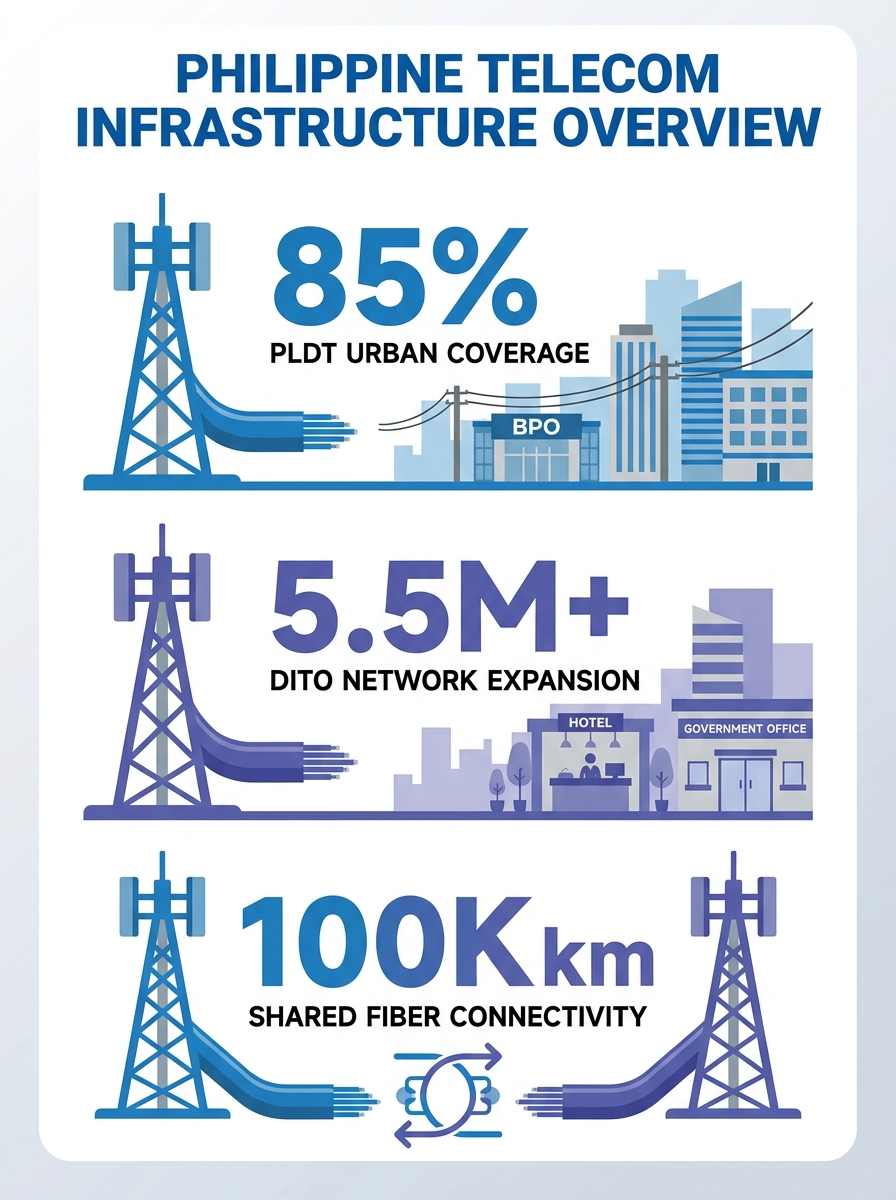
The MOU establishes a framework for resource sharing that extends to PLDT’s wireless subsidiary Smart Communications Inc. Both telcos will grant each other access to eligible tower sites under reciprocal rights agreements that involve no direct financial transactions. The arrangement also covers in-building solution (IBS) colocation in commercial buildings and other indoor locations, plus submarine cable capacity through indefeasible right of use (IRU) arrangements for international connectivity assets.
Partnership Structure and Technical Scope
The infrastructure-sharing framework covers three primary infrastructure categories. Tower site sharing allows both carriers to deploy equipment on existing macro cell towers operated by either company, eliminating the need for parallel tower construction in overlapping coverage zones. In-building solution colocation extends shared infrastructure to commercial buildings, shopping centers, and other indoor venues where both networks currently deploy separate distributed antenna systems. Submarine cable IRU arrangements enable both carriers to optimize existing international gateway capacity rather than provisioning redundant undersea fiber links.
“This agreement reflects that, even as we compete in the marketplace, we can collaborate where it matters the most: accelerating digital inclusion, helping connect every Filipino, and creating greater opportunities for our people and our nation,” said Manuel V. Pangilinan, chairman and chief executive officer of PLDT, in the company’s statement.
The reciprocal access model differs from traditional tower lease arrangements used by independent tower companies. Neither PLDT nor DITO will pay recurring site fees to the other party for tower access rights. Instead, the agreement functions as a bilateral exchange where both carriers gain equivalent infrastructure access based on geographic and technical site eligibility criteria.
Capital Efficiency and Network Expansion Impact
PLDT stated the partnership will reduce unnecessary duplication of network investments by maximizing use of existing infrastructure. Rather than constructing separate cell sites in locations where both carriers seek coverage, the shared-access model allows each company to redeploy saved capital toward geographic expansion in underserved areas. The arrangement targets broader network footprint across both urban metros and provincial markets where infrastructure gaps currently limit service availability.
“May this partnership usher and blossom into many more things so that we can have meaningful results for our companies, and more importantly, for the betterment of services for all our respective customers,” said Eric Alberto, president and CEO of DITO, in the joint announcement.
Philippine enterprises operating multi-site networks across regions currently evaluate carrier selection based on geographic coverage reliability and backbone redundancy. Infrastructure-sharing arrangements between major carriers reduce the coverage differentiation that drives split-carrier strategies in enterprise procurement. Organizations deploying SD-WAN or unified communications systems across branch locations assess whether shared tower infrastructure affects service-level agreement commitments and failover redundancy in dual-carrier configurations.
The in-building colocation component directly impacts enterprise connectivity planning for office towers, BPO facilities, and commercial buildings in Metro Manila, Cebu, and other urban centers. Shared IBS deployments may improve indoor signal penetration for both networks but introduce technical considerations around interference management and frequency coordination that building managers and enterprise IT teams historically managed through carrier-separated deployments.
Regulatory Context and Industry Precedent
The PLDT–DITO agreement represents the first formal infrastructure-sharing arrangement between the country’s major mobile network operators since DITO launched commercial service in 2021. Philippine telecommunications regulation under the National Telecommunications Commission permits infrastructure sharing among licensed carriers but does not mandate tower access or impose specific sharing obligations. The voluntary nature of this MOU contrasts with regulatory frameworks in other Southeast Asian markets where government agencies require tower-sharing quotas or open-access mandates.
PLDT’s infrastructure strategy has shifted toward monetizing existing assets while reducing capital expenditure intensity. The company filed for a P24.2-billion data center REIT IPO earlier this year, positioning physical infrastructure as a standalone financial asset class separate from service operations. The DITO partnership extends that asset-optimization approach to mobile network infrastructure, treating cell sites and submarine cables as shared resources rather than exclusive competitive advantages.
Neither company disclosed specific timelines for implementing the framework or identified initial geographic zones where infrastructure sharing will commence. The MOU establishes governing principles and access rights but leaves operational deployment schedules and technical integration details to subsequent working agreements between network operations teams.
Why This Matters Now
Philippine enterprises and government agencies evaluating carrier strategies face shifting infrastructure economics as major telcos move from build-everywhere competition to selective infrastructure sharing. Organizations that locked in multi-year enterprise agreements based on assumed network differentiation should reassess whether shared tower infrastructure changes the risk calculus around single-carrier versus multi-carrier procurement. The reciprocal access model eliminates some geographic coverage gaps that previously justified split-carrier strategies, but introduces new questions about whether shared infrastructure sites meet enterprise failover and redundancy requirements.
IT managers planning network expansions into provincial markets or secondary cities should monitor whether PLDT–DITO infrastructure sharing accelerates carrier deployment in regions that currently lack reliable connectivity from both networks. The capital redeployment rationale suggests both carriers may prioritize underserved areas where neither operator currently maintains infrastructure, potentially improving enterprise site selection options for branch offices, regional data centers, and remote workforce locations outside Metro Manila.
The submarine cable IRU component affects international connectivity planning for organizations evaluating direct internet access, cloud service provider connectivity, and cross-border WAN links. Shared cable capacity may reduce per-megabit pricing through improved utilization economics, but enterprises should confirm whether IRU arrangements affect latency profiles, failover paths, or SLA terms in carrier quotes for international circuits and cloud on-ramps.