
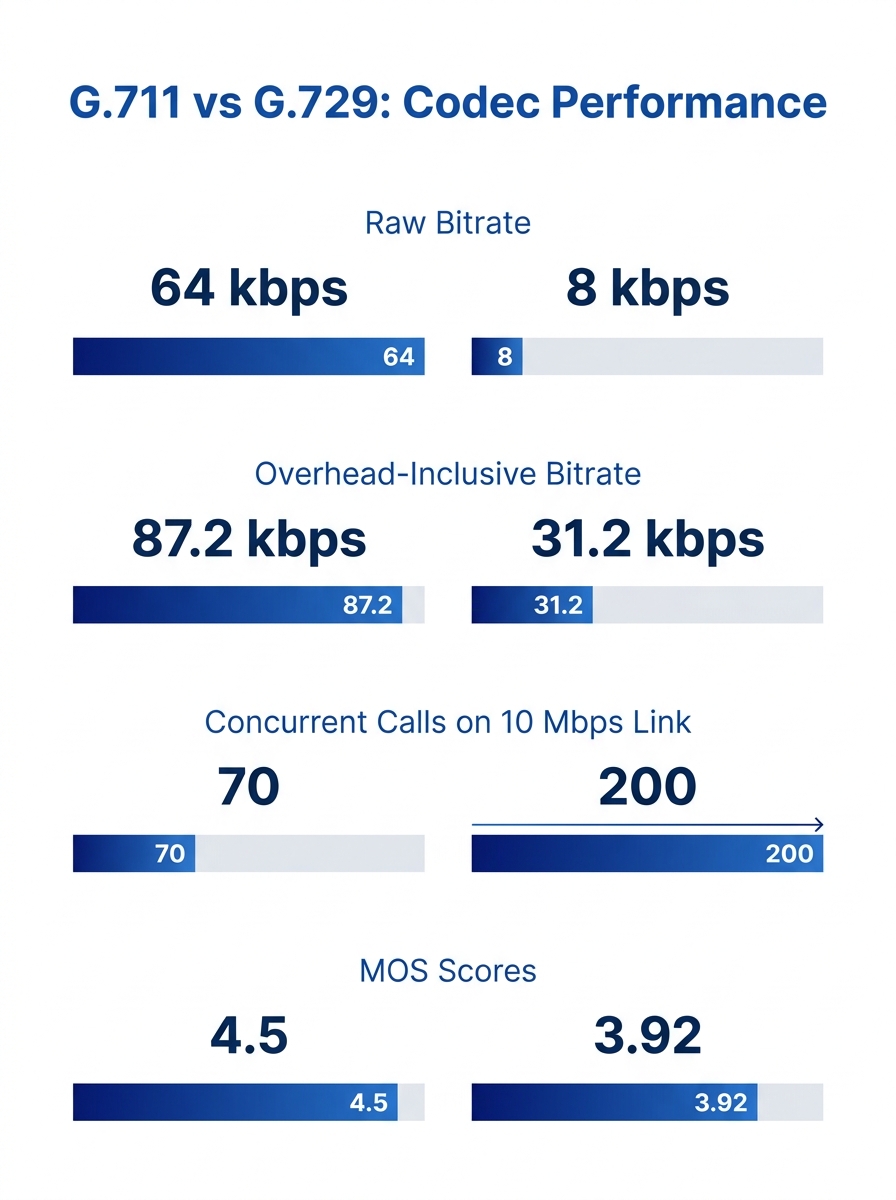
G.711 consumes 87.2 kbps per call with IP overhead included; G.729 uses 31.2 kbps. That eight-fold compression difference determines whether a 10 Mbps government leased line supports 70 concurrent calls or 200. For Philippine agencies running bandwidth-constrained telephony on provincial links, codec selection is the single highest-impact configuration decision after QoS.
TL;DR: G.729 should be the default codec for most Philippine government VoIP deployments, consuming 31.2 kbps per call versus G.711’s 87.2 kbps. G.711 remains appropriate only where dedicated 100 Mbps symmetric fiber and strict DSCP 46 marking are in place. Opus is the future but not yet widely supported on government-deployed endpoints.
The Eight-Fold Gap in Raw Bandwidth
The raw codec bitrate tells the story before overhead even enters the picture. G.711 digitizes voice without compression at 64 kbps, while G.729 compresses down to 8 kbps. The FCC notes that VoIP calls require less than 0.5 Mbps per line, but that figure obscures wide variation between codecs. Once you add IP, UDP, and RTP headers, a G.711 call balloons to roughly 87.2 kbps per direction. A G.729 call, carrying the same headers on a much smaller payload, lands at approximately 31.2 kbps.
Both codecs operate at 50 packets per second in standard configurations, as VoIP practitioners have documented. This means each lost or late packet drops exactly 20 milliseconds of audio regardless of which codec you’re running. The packet rate is identical; what changes is how much bandwidth each of those 50 packets demands from your pipe.
For a municipal government office with 50 phone extensions, the difference works out to about 4.36 Mbps aggregate on G.711 versus 1.56 Mbps on G.729 at full concurrent load. That 2.8 Mbps saved is bandwidth available for data traffic, video calls, or simply avoiding congestion during peak hours. When you’re calculating your actual VoIP network load before migration, codec selection is where most of the math happens.
Concurrent Call Capacity on Government Leased Lines
Why does the bandwidth gap matter at scale? Because Philippine government agencies rarely operate on generous internet connections. A 10 Mbps leased line, common at provincial or municipal offices connected to regional hubs, supports approximately 200 simultaneous G.729 calls but only about 70 G.711 calls. A 500-seat government facility would need 43.6 Mbps on G.711 compared to 15.6 Mbps on G.729. The monthly recurring cost difference between a 50 Mbps and a 20 Mbps leased line from PLDT or Globe adds up across dozens of sites in a department-wide rollout.
The Philippine government’s fixed broadband infrastructure ranks among the weakest in Southeast Asia for sustaining real-time voice traffic, and deployments that ignore this reality fail in predictable ways. Provincial links running at 5 to 10 Mbps with no traffic prioritization cannot sustain G.711 for more than a handful of concurrent calls before quality degrades. As the World Bank has noted, Philippine telecom operators face infrastructure challenges that inhibit equitable delivery of connectivity, which directly affects how agencies should approach voice compression trade-offs.
| Attribute | G.711 | G.729 | G.722 | Opus |
|---|---|---|---|---|
| Raw bitrate | 64 kbps | 8 kbps | 48–64 kbps | 6–510 kbps (adaptive) |
| Bitrate with IP overhead | 87.2 kbps | 31.2 kbps | ~80 kbps | Varies |
| MOS (lab conditions) | 4.5 | 3.92 | 4.5+ (wideband) | 4.5+ |
| Codec latency | 0.125 ms | ~15 ms | ~2 ms | ~5 ms |
| License cost | Free | Free (patents expired 2017) | Free | Free / open-source |
| Packet loss tolerance | Degrades at 1% | Moderate | Degrades at 1% | High (built-in FEC) |
| Concurrent calls on 10 Mbps | ~70 | ~200 | ~75 | ~120–300 depending on bitrate |
This table should be your reference when evaluating codec options against your specific link capacity. Agencies deploying communication systems for Philippine government agencies across multiple sites will often end up with a mixed approach: G.729 as the default with G.711 reserved for specific high-bandwidth locations.
MOS Scores in the Lab vs. Provincial Reality
G.711 posts a Mean Opinion Score of 4.5 in laboratory conditions. G.729 scores approximately 3.92 on the same scale. That 0.58-point gap sounds small, and in a controlled environment with zero packet loss and sub-50ms latency, G.711 does sound noticeably clearer. The difference between 0.125 milliseconds of codec latency on G.711 and roughly 15 milliseconds on G.729 is real but nearly imperceptible in isolation.
The problem is that Philippine government networks don’t operate in laboratory conditions. Congested provincial links routinely show 2 to 3% packet loss during business hours. Shared internet connections at municipal offices compete with email, web browsing, file downloads, and sometimes video streams. When you layer real-world conditions onto the codec comparison, G.711’s theoretical quality advantage erodes fast.
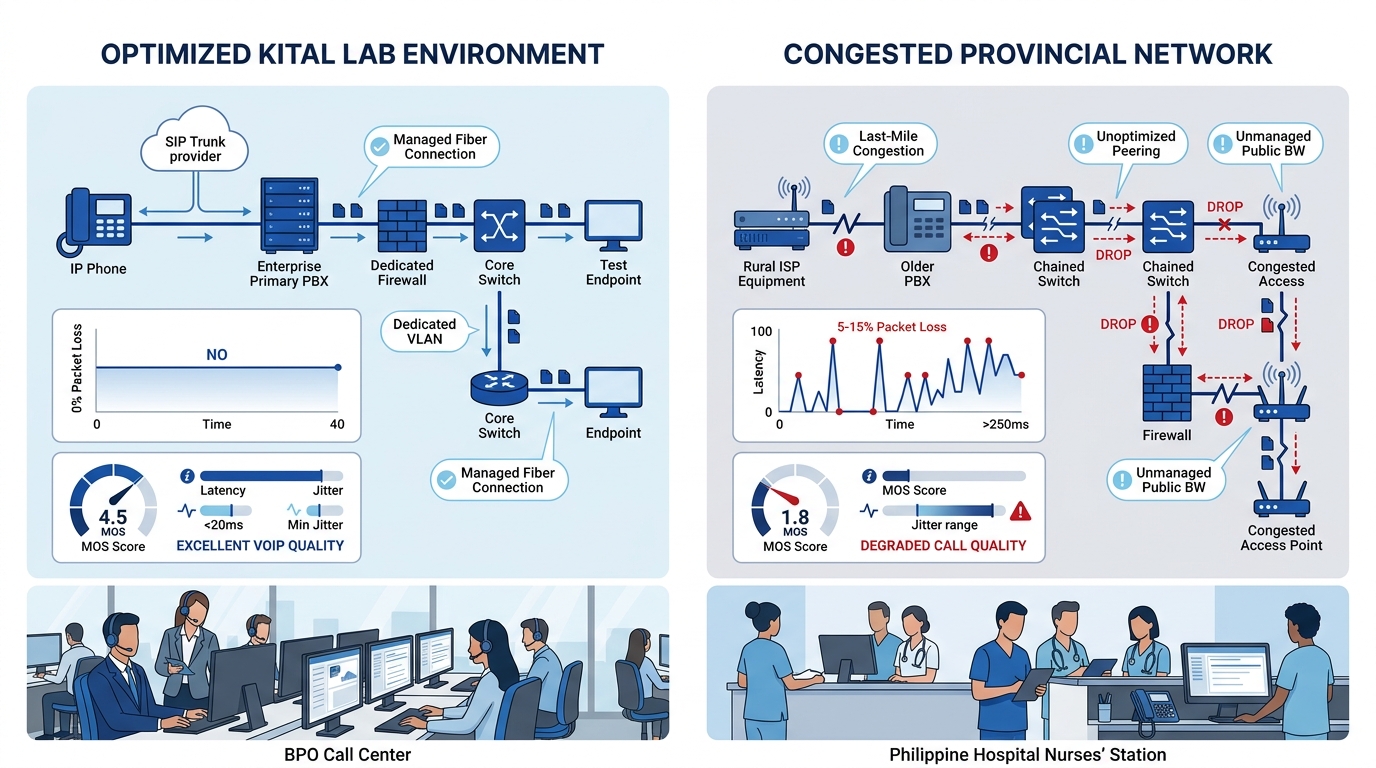
VoIP calls require continuous, low-latency bandwidth, and shared residential-grade or budget commercial internet connections are prone to the exact problems that destroy call quality. If you’re tracking your real-time call quality metrics, you’ll see MOS scores on G.711 drop below 3.5 whenever packet loss crosses the 1% threshold. G.729 holds up better under the same conditions because its compressed payloads create less aggregate congestion on the link, reducing the very packet loss that hurts G.711 most.
G.711’s superior lab MOS score becomes irrelevant on a provincial link with 2–3% packet loss, because the codec’s bandwidth demands contribute to the congestion that destroys its own quality advantage.
Packet Loss and Jitter Hit Every Codec Equally at the Packet Level
All three major codecs (G.711, G.729, and G.722) transmit at 50 packets per second. Each packet carries exactly 20 milliseconds of audio. When a packet is lost or arrives beyond the jitter buffer window, 20 ms of speech disappears regardless of codec. The compression ratio doesn’t change the packet-level behavior; it changes how many bits travel inside each packet and therefore how much bandwidth the aggregate call stream demands.
This means your QoS configuration matters as much as your codec choice. DSCP 46 (Expedited Forwarding) marking and proper VLAN segmentation ensure voice packets get priority treatment through every switch and router hop. Without QoS, switching from G.711 to G.729 reduces bandwidth consumption but doesn’t prevent packet loss caused by buffer overflows on congested interfaces.
Warning: Codec selection and QoS are not interchangeable. G.729 reduces bandwidth demand but does not replace proper traffic prioritization. Legacy Cat5 cabling and unmanaged Fast Ethernet switches must be audited and replaced, as lack of 802.1p priority marking will undermine any codec you choose.
Government IT teams often treat codec selection as the primary fix for poor call quality. The data shows otherwise. A pre-migration network readiness audit that identifies switch capabilities, cable grades, and available QoS features should always precede codec decisions. The codec determines how much bandwidth each call needs; QoS determines whether that bandwidth is actually available when a call is in progress.
Opus: The Adaptive Future That Isn’t Quite Here Yet
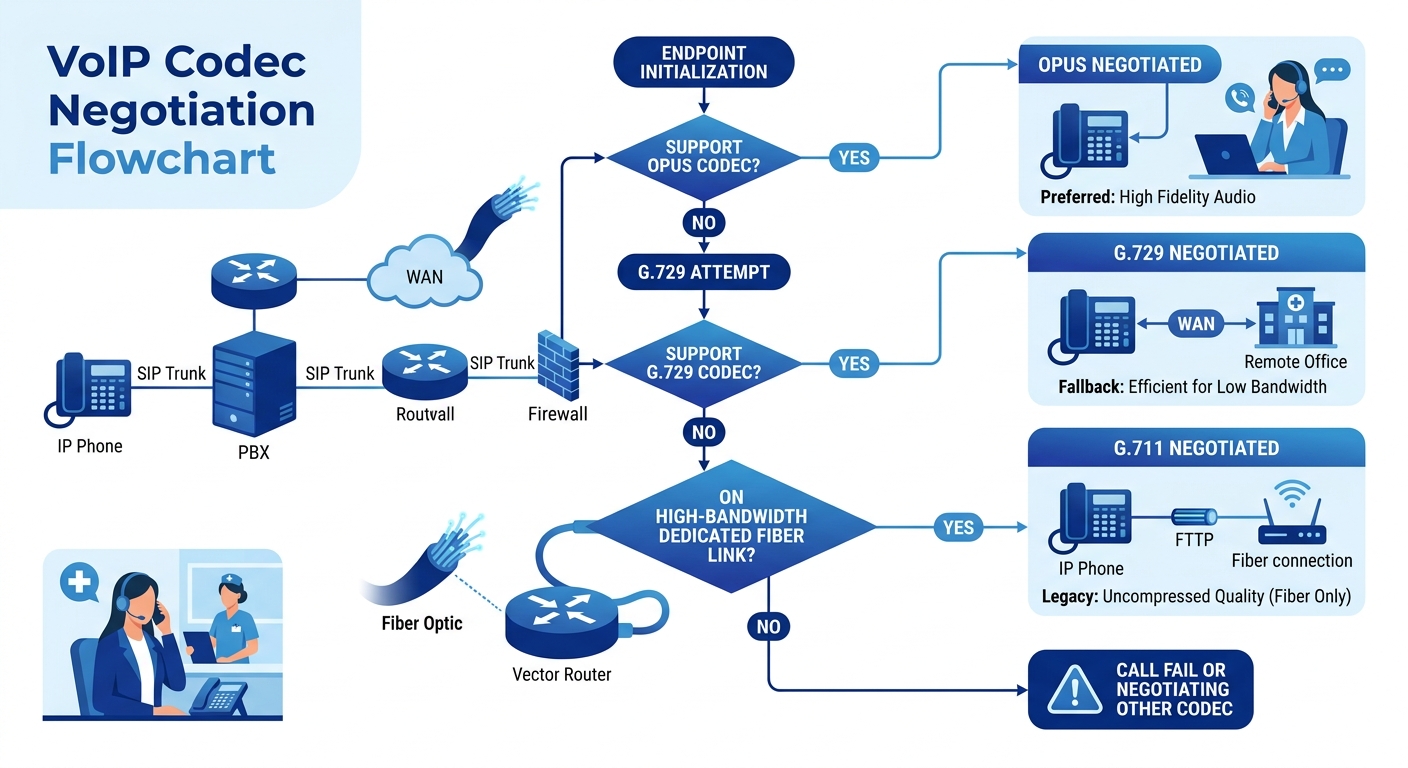
Opus offers adaptive bitrate ranging from 6 to 510 kbps, native forward error correction (FEC), and wideband audio quality that matches or exceeds G.722. On paper, it solves the G.729-versus-G.711 dilemma entirely by adjusting compression dynamically based on available bandwidth. In practice, government endpoints don’t widely support it.
Most Philippine government VoIP deployments run on Yeastar P-Series, Cisco, or Asterisk-based systems paired with Fanvil or Grandstream desk phones. Opus support exists on many of these platforms in current firmware, but older deployed hardware and SIP trunking providers may not negotiate Opus correctly. Trunk-side codec negotiation failures create one-way audio or call setup failures that are difficult to diagnose without packet-level inspection.
The practical recommendation for 2026 deployments: configure Opus as the preferred codec on endpoints and trunks that support it, with G.729 as the fallback. This gives you adaptive quality where the infrastructure permits it while ensuring every call still completes on links that can’t handle the negotiation. Track what percentage of your calls actually complete on Opus versus falling back to G.729 to build a data-driven case for endpoint upgrades.
The Three-Axis Codec Score for Government Deployments
Choosing a codec for a Philippine government network requires evaluating three axes simultaneously: link capacity utilization, acceptable quality floor, and endpoint compatibility.
Link capacity utilization is straightforward arithmetic. Calculate your peak concurrent call count, multiply by the per-call bandwidth of each candidate codec (including overhead), and compare the result against your available link capacity after reserving bandwidth for data traffic. If G.711 at peak load would consume more than 60% of your link, it is not a viable option for that site regardless of its quality advantages.
Acceptable quality floor depends on the use case. Administrative phone calls between government offices tolerate a MOS of 3.8 or higher without complaints. Citizen-facing hotlines, especially those handling emergency or medical consultations, benefit from the clarity of a MOS above 4.0. G.729’s 3.92 MOS sits right at the boundary, which means network conditions determine whether the codec is adequate or marginal for sensitive applications.
Endpoint compatibility constrains your choices in ways the first two axes don’t. A 2018-vintage Cisco 7800-series phone supports G.711 and G.729 natively but may require firmware updates for Opus. Fanvil X-series phones from 2022 onward support Opus out of the box. Government procurement cycles mean most deployments have a mix of old and new hardware, which makes a single-codec mandate impractical. The codec selection analysis for bandwidth-constrained Philippine networks covers additional edge cases around mixed-hardware environments.
What The Data Doesn’t Capture
The bandwidth numbers, MOS scores, and concurrent-call calculations in this article assume stable link conditions. Real Philippine government networks experience daily fluctuations: ISP congestion during morning peak hours, microwave backhaul degradation during heavy rain in provinces like Samar or Leyte, and power instability that causes equipment reboots and packet storms.
No codec benchmarking dataset fully accounts for the geographic and infrastructural diversity across Philippine government sites. A DILG regional office in Metro Manila on a 100 Mbps PLDT fiber link faces different constraints than a DSWD satellite office in a fourth-class municipality sharing a 5 Mbps DSL connection with three other tenants. The 87.2 kbps versus 31.2 kbps per-call math is valid everywhere, but the infrastructure surrounding each link shapes whether either codec delivers acceptable voice quality.
What the numbers also can’t tell you is how end users perceive quality. A MOS of 3.92 might be perfectly fine for a clerk confirming document receipt, but noticeably lacking for a public health nurse conducting a telehealth consultation. Government agencies need to measure actual call quality post-deployment, site by site, rather than relying on codec specification sheets. The gap between spec-sheet performance and field performance is where most VoIP deployments quietly fail, and no amount of codec optimization can fix a network that hasn’t been properly prepared for real-time voice traffic.