
Three approaches dominate the VoIP readiness assessment landscape for Philippine enterprises: internal IT audits, vendor-guided evaluations, and independent third-party reviews. Each catches infrastructure bottlenecks the others routinely miss, and choosing the wrong fit for your network size and complexity turns migration day into an expensive disaster recovery exercise.
TL;DR: Internal audits offer deep network knowledge but often skip voice-specific benchmarks. Vendor assessments are fast and free but biased toward that vendor’s product. Independent third-party audits catch the most infrastructure gaps but cost ₱150,000 to ₱500,000 and take 3 to 6 weeks. Your pick depends on call volume, number of branch offices, and whether your existing network has ever carried real-time voice traffic.
What a VoIP Readiness Assessment Actually Measures
A proper network pre-migration audit tests five things: available bandwidth per concurrent call, one-way latency, jitter, packet loss, and QoS policy enforcement under load. Raw download speed is almost never the problem. According to AMVIA’s bandwidth analysis, the deciding factors are “low latency below 150 ms, low jitter below 30 ms, and negligible packet loss,” which “matter more than raw download speed, which is rarely the bottleneck for voice.”
The bandwidth math is straightforward but frequently botched. Each standard-quality VoIP call consumes roughly 100 Kbps, while HD voice needs about 150 Kbps. A 200-seat BPO floor in Cebu where 40% to 60% of agents are on calls simultaneously needs between 8 Mbps and 18 Mbps of dedicated, QoS-prioritized bandwidth reserved for voice alone. That’s before you account for screen-sharing, CRM traffic, or backup replication running on the same pipe. We’ve written extensively about how to calculate your actual network load before migration, and the exercise should happen before any audit approach begins.
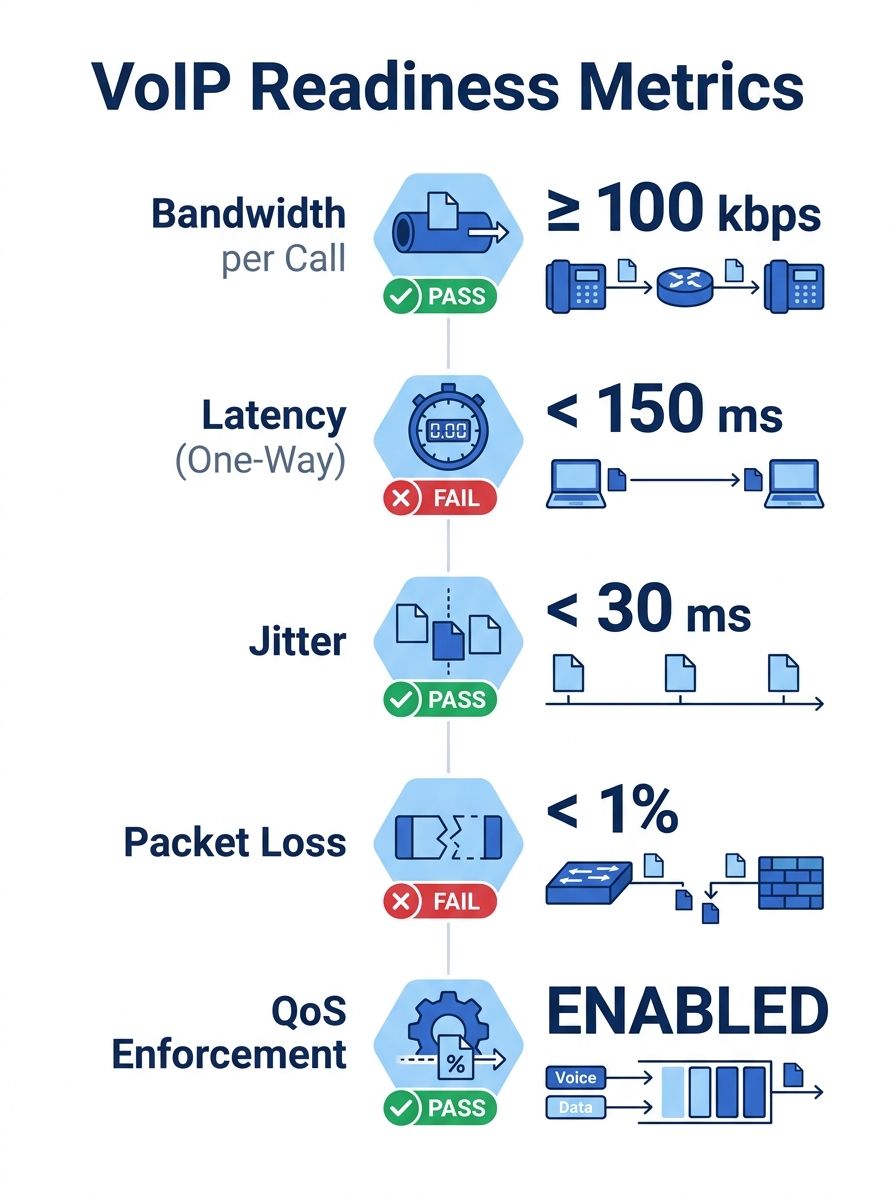
The minimum connection speed for VoIP falls between 90 Kbps and 156 Kbps per line, but that floor assumes zero contention. Philippine enterprise networks rarely operate at zero contention, especially in shared-tenant buildings across Makati or BGC where multiple businesses ride the same fiber drop. An infrastructure bottleneck diagnosis that ignores contention ratios is measuring the wrong thing.
Here’s how the three audit approaches compare across the attributes that matter most:
| Attribute | Internal IT Audit | Vendor-Guided Assessment | Independent Third-Party |
|---|---|---|---|
| Typical cost | Staff time only | Bundled with contract | ₱150,000 to ₱500,000+ |
| Bias toward specific product | None | High | None |
| Timeline | 2 to 4 weeks | 1 to 2 weeks | 3 to 6 weeks |
| Coverage of legacy systems | Strong | Weak | Strong |
| Voice-specific test tooling | Often missing | Included | Included |
| Pilot program framework included | Rarely | Frequently | Usually |
| Catches WAN issues across branches | Only if tested per site | Depends on scope | Standard practice |
Running the Audit with Your Own IT Team
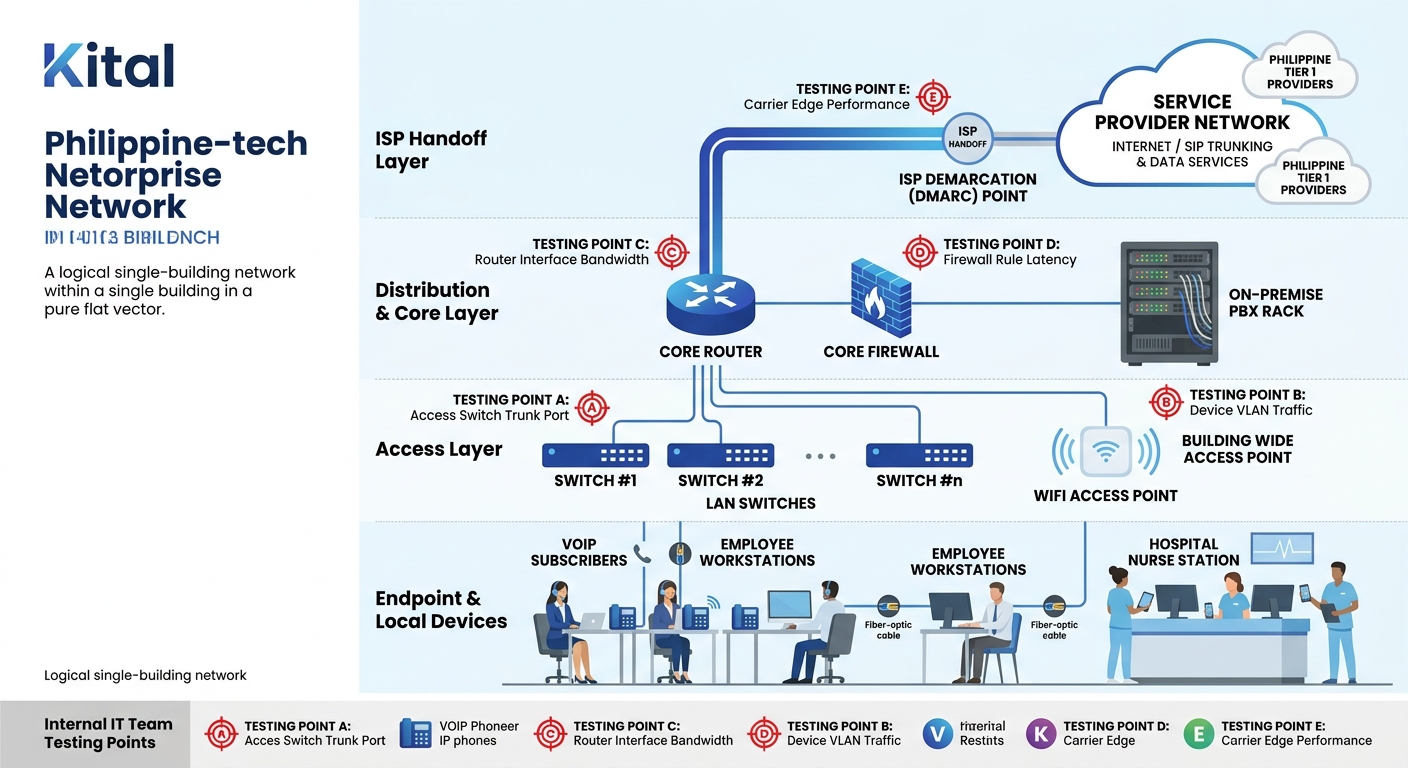
An internal audit works best when your IT staff already understands real-time traffic engineering and your enterprise operates from a single site, or at most 2 to 3 offices connected by managed MPLS or SD-WAN links. The advantage is obvious: nobody knows your network topology, your switch firmware versions, and your existing VLAN structure better than the people who built it.
The gap shows up in voice-specific testing. Most Philippine enterprise IT teams have deep experience with data networking but limited exposure to the SIP signaling chain that underpins VoIP calls. They know how to run a speed test; they don’t always know how to measure one-way jitter across 30 seconds of sustained UDP traffic at the codec bitrate you’ll actually deploy. If your team hasn’t configured QoS policies for voice traffic prioritization on your specific router models, the audit will reflect data-network health rather than voice-network readiness.
Where internal audits excel is catching legacy infrastructure problems that outsiders miss entirely. Your IT team knows that the Quezon City branch runs on a 10-year-old Cisco Catalyst with firmware two major versions behind, or that the Davao office shares its ISP connection with the building’s CCTV system. These details don’t appear in any external scan.
Warning: Internal audits frequently skip the pilot migration step. Wanclouds’ migration framework recommends you “conduct a pilot migration for one non-critical workload to validate readiness” before committing to full cutover. If your internal team plans to go straight from audit to full deployment, you’re skipping the step most likely to reveal problems under real traffic conditions.
Cost is minimal (staff hours only), but the hidden expense is opportunity cost. A 2-to-4-week internal audit pulls your network engineers off other projects. For a 50-seat office with a single ISP link, that tradeoff makes sense. For a 500-seat operation across 4 branches, the scope overwhelms most internal teams.
Vendor-Guided Readiness Programs
RingCentral’s implementation methodology describes how an implementation advisor “guides you through a network readiness assessment to make sure your network is prepared to handle your new phone system,” including assistance with QoS configuration, firewall rules, and bandwidth validation. Yeastar, Cisco, and other vendors offer similar pre-deployment evaluations, typically bundled at no additional cost when you sign a service agreement.
The speed advantage is real. Vendor-guided assessments compress the timeline to 1 to 2 weeks because the vendor has standardized tooling, pre-built test scripts, and clear pass/fail thresholds tuned to their own platform’s requirements. A Yeastar P-Series assessment, for instance, tests against the specific codec and call-flow patterns that Yeastar hardware will use. That precision eliminates guesswork.
The tradeoff is scope bias. A vendor assessment validates whether your network can run their product. It does not validate whether your network is ready for VoIP in general, whether your existing SIP trunk provider’s configuration will survive the migration, or whether your analog lines need ATA gateway planning. Philippine enterprises with mixed environments (some Fanvil handsets, some legacy PABX extensions, some softphones for remote BPO agents) often discover post-migration that the vendor assessment never tested the interaction between their platform and your existing endpoints.
A vendor assessment validates whether your network can run their product. It does not validate whether your network is ready for VoIP in general.
Vendor programs also tend to undercount concurrent call requirements. The standard sizing formula estimates 40% to 60% of total staff active on calls simultaneously during peak hours. But Philippine BPO operations often hit 75% to 85% concurrency during US-timezone night shifts, and hospital switchboards during flu season can spike to 90%+ of extensions active. If the vendor uses generic concurrency assumptions, your bandwidth budget comes up short within the first week of live operation.
The biggest blind spot: vendor assessments almost never include a structured pilot program framework. They test your network, hand you a report, and proceed to installation. The pilot phase, where you run VoIP alongside your legacy system to catch real-world failures, is the step that separates clean migrations from chaotic ones. Shadow-run pilots deliver the highest data fidelity but double your infrastructure costs during testing, while single-department pilots cost less and still expose critical issues like NAT traversal failures on specific router models.
Hiring an Independent Network Auditor
Independent third-party audits cost between ₱150,000 and ₱500,000 depending on the number of sites, total endpoints, and depth of the assessment. They take 3 to 6 weeks. And they catch problems that neither internal teams nor vendor programs are structured to find.
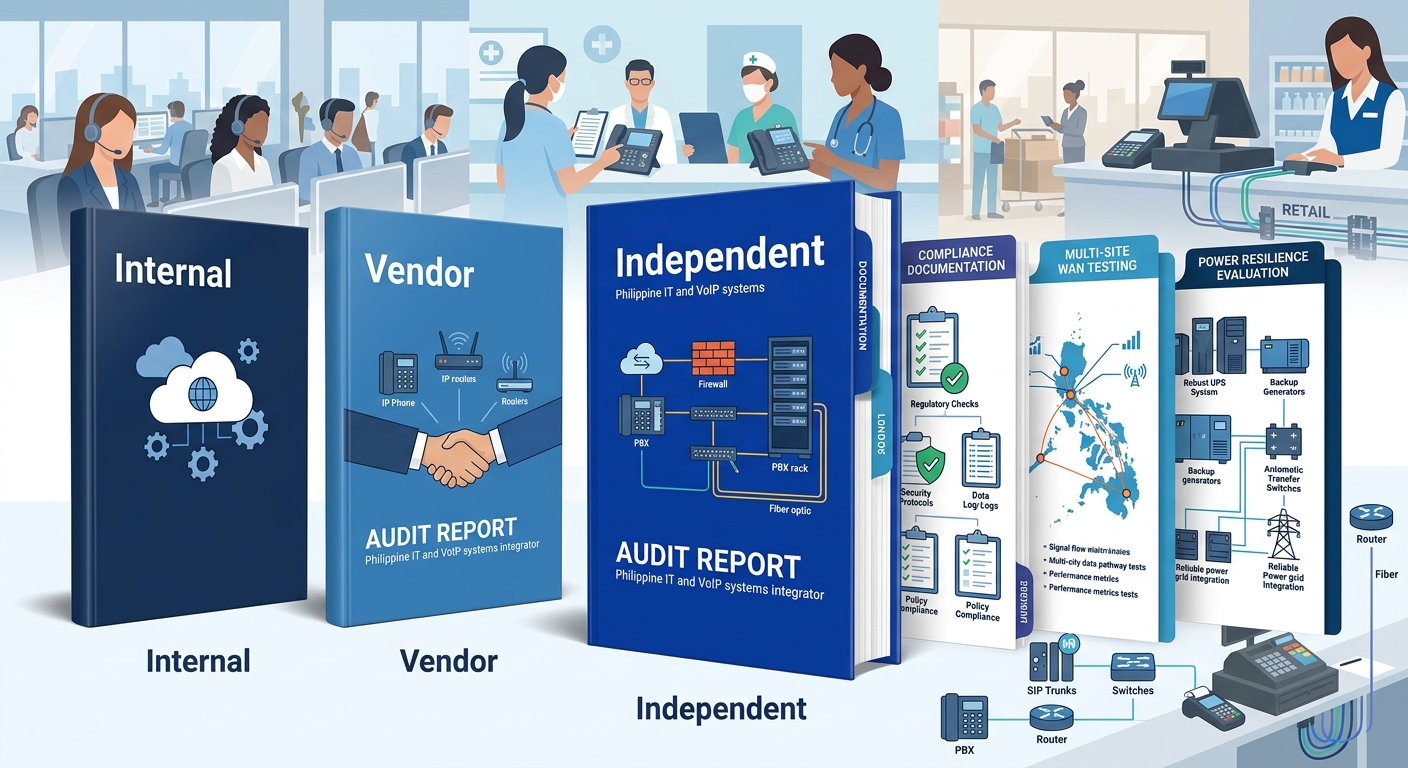
The value of an independent audit shows up most clearly in multi-branch enterprises. A BPO with offices in Makati, Cebu IT Park, and Davao needs WAN-level testing across each link, including failover behavior when the primary ISP drops. Independent auditors test your firewall and NAT configuration from outside your network perimeter, simulating the conditions that remote extensions and SIP trunks will actually face. They measure latency and jitter per-link, per-branch, at different times of day, across weekdays and weekends.
What makes third-party audits particularly relevant for Philippine enterprise infrastructure gaps is their treatment of power and environmental factors. Philippine commercial buildings experience an average of 8 to 12 unplanned power interruptions per year in areas outside Metro Manila’s core business districts. An independent auditor evaluates your UPS runtime per network closet, your generator switchover time, and whether your PoE switches can sustain phone power during a 30-minute brownout. These factors directly affect voice availability, and they’re absent from every vendor-guided assessment we’ve seen.
The Audit-Ready Cloud Migration Framework (ARCMF), published in the Scientific Journal of AI and Blockchain Technologies, describes how regulated industries should integrate “compliance-by-design, automated evidence collection, and real-time compliance monitoring into every stage, from pre-migration assessment to post-migration operation.” Philippine enterprises in banking, healthcare, and government procurement fall under NTC and BSP regulations that require documented audit trails for communication system changes. An independent auditor produces that documentation as a standard deliverable. Internal teams and vendor programs rarely do.
The downside is cost and calendar time. A ₱300,000 audit fee represents a significant line item for a 100-seat enterprise, and the 3-to-6-week timeline can delay your migration by a full quarter if you didn’t plan for it. For enterprises already running business telephone systems that handle 20 or fewer concurrent calls from a single location, the independent audit’s depth exceeds what the situation demands.
Tip: If you’re a regulated enterprise (banking, healthcare, government), budget for the independent audit and treat it as a compliance requirement rather than an optional expense. The documentation alone can save you weeks during NTC or BSP review.
How to Choose Between These Three
The honest answer depends on three variables: how many physical sites you operate, whether you’re in a regulated industry, and how much voice traffic you’ll carry.
Single-site enterprises with fewer than 50 endpoints should start with an internal audit supplemented by vendor tooling. Run your own bandwidth and latency tests using the thresholds above (sub-150ms latency, sub-30ms jitter, less than 1% packet loss, 150 Kbps reserved per HD call). Then let your chosen vendor validate their platform-specific requirements. Total cost: staff time plus zero vendor fees. Timeline: 2 to 3 weeks combined.
Multi-branch enterprises with 50 to 500 endpoints need the independent third-party audit for WAN-level and inter-site testing, but can supplement with vendor assessments for platform-specific validation. Budget ₱150,000 to ₱350,000 for the independent work and expect a 4-to-6-week combined timeline. This is where the pilot program framework becomes essential. Run a single-department pilot at your most challenging site (worst ISP, oldest switches, highest call volume) before committing to enterprise-wide rollout.
BPO operations, hospitals, government agencies, and any enterprise above 500 endpoints should treat the independent audit as mandatory. The cost (₱300,000 to ₱500,000+) represents less than 2% of a typical ₱25-million-plus VoIP deployment budget at that scale, and the infrastructure bottleneck diagnosis it provides will surface problems that would cost 5x to 10x more to fix after go-live. Pair this with a multi-branch parallel pilot to stress-test real WAN conditions across Philippine geography. You should also confirm that your backup and recovery solutions cover the new voice infrastructure, since VoIP configuration databases and call-routing tables need the same protection as any other business-critical system.
Rader Solutions’ readiness checklist framework emphasizes that preparation spans hardware upgrades, software updates, security hardening, and scalability planning as interconnected steps rather than independent checkboxes. Whichever audit approach you choose, the readiness assessment only works if it feeds into a migration plan that treats these dependencies as a single chain. Test the chain before you trust it, and build your real-time performance dashboard during the pilot phase so you have baseline metrics from day one of production.