
Globe Telecom received National Telecommunications Commission approval on June 29 to launch commercial satellite-to-mobile service in partnership with Starlink, extending connectivity to the three percent of the Philippine population currently beyond terrestrial tower reach, according to the telco’s announcement.
TL;DR: Globe Telecom’s NTC-approved satellite-to-mobile service via Starlink now covers areas unreachable by cellular towers, offering text and light-data capability starting at P99 for prepaid subscribers and free for postpaid customers.
The regulatory clearance allows Globe to deploy low-earth-orbit satellite connectivity for disaster response and routine access in geographically isolated areas where cellular infrastructure remains uneconomical to build. The NTC cited digital-divide reduction and emergency-response capability as primary justifications for commercial authorization.
Globe already activated the technology during response to a magnitude 7.9 earthquake in Mindanao provinces, delivering emergency communications to more than 150,000 customers when terrestrial assets were damaged or destroyed, the company reported. The deployment demonstrated operational readiness under actual disaster conditions before commercial release.
Service Architecture and Device Compatibility
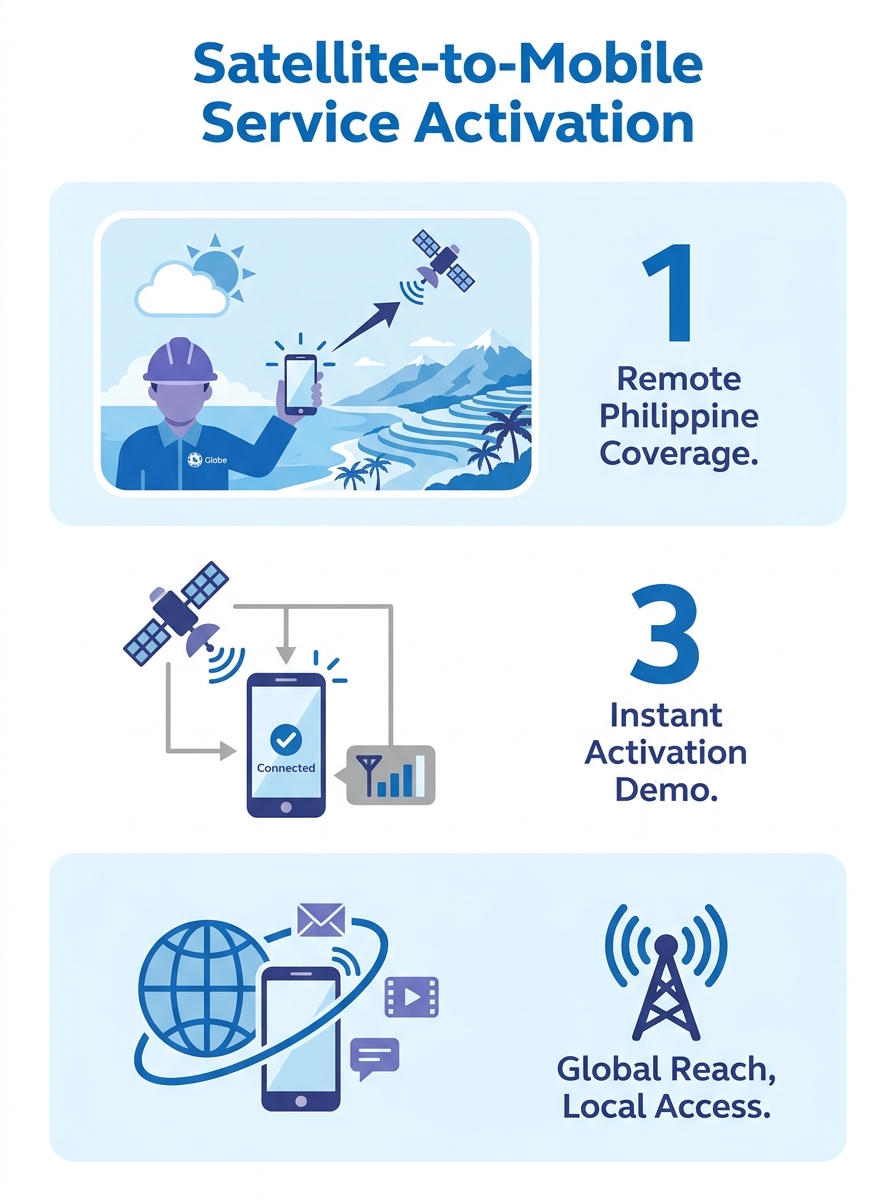
The satellite-to-mobile solution connects LTE-capable smartphones directly to Starlink’s low-earth-orbit satellite constellation without requiring specialized hardware beyond existing cellular radios. Subscribers must maintain clear line-of-sight to the sky for handset-to-satellite signal acquisition.
Globe structured the service tier at P99 monthly for prepaid users and bundled it at no additional charge for postpaid accounts. Compatibility varies by handset manufacturer and model; the service requires LTE network capability as the baseline radio specification.
Supported applications include chat platforms, navigation services, and SMS text messaging. The service delivers light-data throughput optimized for low-bandwidth communication rather than media streaming or high-volume transfers. Philippine enterprises operating remote sites—mining camps, agricultural estates, island resorts—gain fallback connectivity when wireline or microwave links fail.
First Southeast Asian Commercial Deployment
Globe signed a memorandum of agreement with Starlink in January 2026 to bring the technology into the Philippines as the first commercial satellite-to-mobile deployment in Southeast Asia. The partnership positions Globe ahead of regional carriers still conducting pilot trials with alternative satellite providers.
“Given the NTC’s approval for commercial launch, Globe can now extend its reach beyond our traditional towers, ensuring that even in the most remote or disaster-stricken areas, Filipinos will remain connected,” said Carl Raymond Cruz, Globe president and CEO, in the statement.
The telco frames the service as network-support infrastructure rather than a primary-access channel. Terrestrial cellular networks continue to serve 97 percent of the population with higher throughput and lower latency than satellite links. The satellite tier activates automatically when handsets lose terrestrial signal or when network operators designate specific areas for satellite-only coverage during infrastructure outages.
Implications for Enterprise Continuity Planning
Philippine enterprises evaluating business continuity communication plans now have a third-layer fallback option beyond dual-carrier terrestrial SIMs and portable microwave links. The satellite service reduces dependency on physical infrastructure vulnerable to typhoon damage, flooding, or seismic events.
BPO call centers operating in Tier 2 cities—Iloilo, Bacolod, Cagayan de Oro—can provision satellite-to-mobile access for management teams coordinating evacuation or damage assessment when primary fiber circuits and backup microwave paths both fail. The light-data capability supports encrypted messaging platforms used for incident command rather than full call-center traffic restoration.
Government agencies managing provincial offices face similar requirements. The Department of Health’s rural health units, for instance, can maintain telemedicine consultation links during infrastructure loss if satellite-connected devices remain operational. The NTC’s regulatory approval specifically highlighted emergency-response applications as a public-interest justification for commercial authorization.
Context and Outlook
Globe’s satellite-to-mobile launch marks the third major Philippine telecom infrastructure shift in 18 months following PLDT’s data center REIT filing and the Supreme Court’s resolution of NOW Telecom’s regulatory-fee dispute. The convergence of satellite access, terrestrial 5G densification, and fixed-wireless expansion reshapes enterprise network-design assumptions for remote and disaster-prone locations.
The P99 price point positions satellite access as incremental insurance rather than everyday connectivity. Enterprises typically absorb the cost for field personnel—surveyors, utility inspectors, agricultural extension staff—whose roles require extended time in areas without terrestrial coverage. Postpaid subscribers receive the capability at no marginal cost, reducing friction for consumer adoption during emergencies.
Regulatory precedent remains unsettled: the NTC has not yet published technical guidelines governing satellite-to-mobile spectrum coordination, handover protocols between terrestrial and satellite networks, or quality-of-service standards for emergency communications. As neighboring countries watch Globe’s deployment, the Philippine regulatory framework may influence broader ASEAN satellite-access policy in 2027.