
The Philippines’ Unified 911 emergency response system opened two satellite command centers in Mindanao this July, extending integrated police, fire, and medical dispatch to Cagayan de Oro and the Bangsamoro Autonomous Region in Muslim Mindanao (BARMM), according to Gadgets Magazine. The facilities connect to the National Command Center in Metro Manila and the Regional Command Center in Cebu through a nationwide network that consolidates more than 200 local emergency hotlines into a single 24/7 toll-free system powered by NGA 911 technology and PLDT communications infrastructure.
TL;DR: Two new Unified 911 satellite command centers in Cagayan de Oro and BARMM bring local-language emergency telecommunicators and integrated police, fire, and medical dispatch to Mindanao as part of a nationwide expansion that opened four facilities in Luzon and Visayas earlier in 2026.
The Mindanao deployment follows satellite command center launches in Ilocos Norte, Isabela, Iloilo, and Tacloban earlier in 2026. Additional facilities in Pampanga and Camarines Sur are scheduled to open during the third quarter as the Department of the Interior and Local Government continues the nationwide rollout.
Local-Language Telecommunicators Reduce Response Time
Emergency telecommunicators at the BARMM Satellite Command Center operate in Maranao, Iranun, Maguindanao, Tausug, Yakan, and other regional languages, Fire Chief Inspector Espiridion Ganibe stated. The dialect capability allows callers under stress to describe emergencies using familiar place names and regional expressions, improving information accuracy during the initial dispatch phase.
“Communicating in familiar dialects enables callers to explain emergencies more clearly, allowing dispatchers to collect accurate information and send responders more quickly,” Ganibe said in a DILG statement.
Fire Chief Inspector Willie M. Tan Jr. of the Cagayan de Oro facility noted that local telecommunicators possess firsthand knowledge of nearby communities, landmarks, and road networks, enabling faster location identification when callers reference local geography.
The language-specific deployment addresses a long-standing gap in Philippine emergency response infrastructure, where national hotlines historically required callers to communicate in English or Tagalog regardless of regional linguistic norms. For hospitals, BPO operations, and government agencies implementing unified communications, the model demonstrates how dialect-sensitive emergency support reduces critical incident response delays in regions where English proficiency varies across demographics.
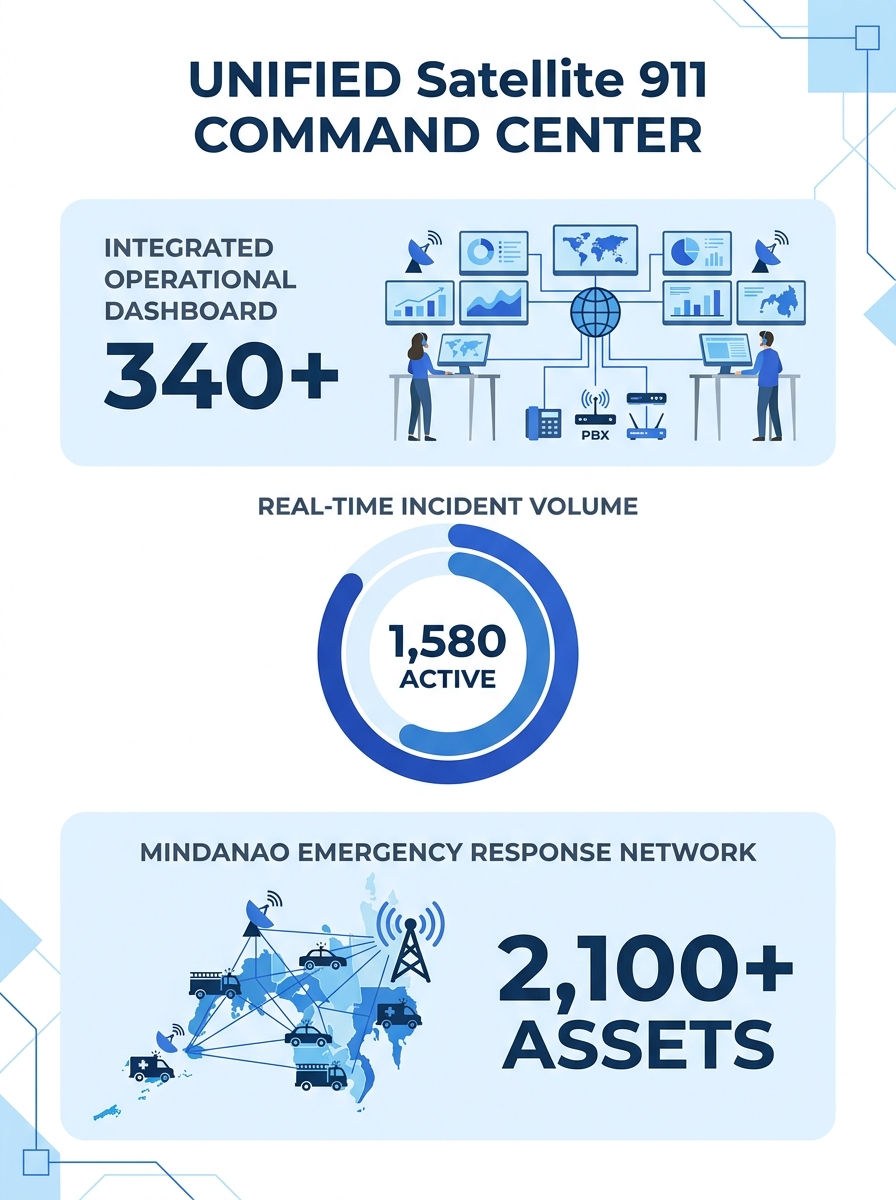
Network Architecture Supports Real-Time Inter-Regional Coordination
The two Mindanao command centers integrate fully with the national Unified 911 system, enabling real-time information sharing and resource coordination during major disasters, severe weather events, and large-scale incidents. “If there is a major disaster, a large fire, severe weather event, or multiple emergencies happening at the same time, we coordinate closely with the National Command Center and other regional centers,” Tan said. “Information is shared in real time, and resources can be mobilized quickly wherever they are needed.”
The platform supports voice calls, text messages, photo uploads, and live video transmission, providing responding units with situational awareness before arrival. NGA 911 supplies the emergency response technology layer, while PLDT provides the underlying communications infrastructure connecting satellite facilities to regional and national command centers.
The nationwide consolidation replaced fragmented local hotlines with standardized reporting protocols, a transition that required coordination across municipal police departments, fire districts, and emergency medical services. For enterprises evaluating VoIP scalability in multi-site Philippine deployments, the Unified 911 architecture illustrates how toll-free centralized systems integrate geographically dispersed endpoints through carrier-grade communications infrastructure without requiring per-site emergency response staff.
Technology Infrastructure Built on Carrier-Grade Backbone
PLDT’s role as the communications infrastructure provider means the emergency network operates on the carrier’s fiber backbone and redundant data circuits connecting satellite facilities to regional and national command centers. The architecture mirrors enterprise unified communications deployments where remote branch offices require guaranteed uptime for mission-critical voice applications.
Jonvic Remulla, secretary of the Department of the Interior and Local Government, stated that the satellite command center model “removes barriers during the moments when every second counts” by placing emergency response infrastructure closer to the communities served. “This is how we make emergency assistance faster, more accessible, and truly nationwide,” Remulla said in the DILG announcement.
The expansion follows a deployment timeline that began with the National Command Center in Metro Manila, added a Regional Command Center in Cebu, and now extends satellite facilities across Luzon, Visayas, and Mindanao. The third-quarter 2026 openings in Pampanga and Camarines Sur will bring the national footprint to ten command centers by year-end.
Government Implications
The Unified 911 satellite command center rollout establishes a technical precedent for how Philippine government agencies can deploy dialect-sensitive, regionally distributed service delivery platforms on centralized network infrastructure. The model addresses a persistent challenge in nationwide digital services: maintaining standardized operations while accommodating regional linguistic and geographic diversity. Government IT planners evaluating unified communications architecture for multi-regional deployments can reference the NGA 911 and PLDT implementation as a carrier-grade example of toll-free centralized dispatch integrated with local knowledge and language capability.
The third-quarter Pampanga and Camarines Sur deployments will test whether the satellite command center model scales beyond the initial Mindanao launch. Provincial and municipal government agencies monitoring the rollout should evaluate whether emergency response integration requirements—standardized protocols, carrier-grade uptime, inter-regional coordination—translate to other centralized service delivery initiatives requiring local-language support and geographic distribution across archipelago infrastructure.
The consolidation of 200-plus local hotlines into a single nationwide system demonstrates how legacy fragmented emergency infrastructure can migrate to integrated platforms without disrupting municipal operations. For government agencies planning VoIP migrations or unified communications rollouts across geographically dispersed offices, the Unified 911 implementation timeline—launching regional hubs first, then satellite facilities—provides a phased deployment model that maintains operational continuity during the transition from legacy to IP-based voice infrastructure.