Equinix has redefined business continuity planning around “operational survivability,” a framework that replaces traditional failover-and-redundancy with fault-isolated parallel environments designed to operate when primary infrastructure degrades, according to the company’s May 29 announcement positioning AI workloads as the forcing function behind the shift. Global 2000 enterprises incur approximately $400 billion in downtime annually, with an average cost of $540,000 per hour, underscoring how systemic disruption has become across business operations.
TL;DR: Equinix argues that AI’s integration into real-time decision systems has made traditional backup strategies insufficient, requiring enterprises to adopt architecturally independent environments that run concurrently rather than waiting in standby.
AI Embedded in Transaction Paths Changes Risk Calculus
Zeus Kerravala, the industry analyst who authored Equinix’s announcement, positions AI as a “force multiplier” for continuity risk because machine learning workloads now sit in the transaction path rather than batch processing layers. When AI services fail, enterprises lose fraud detection, logistics orchestration, and customer experience systems that directly drive revenue, not just slower reporting cycles.
The shift affects Philippine enterprise IT leaders evaluating backup and recovery solutions because AI inference models running on multi-cloud infrastructure introduce hidden shared dependencies across data stores, identity providers, and control planes. Kerravala notes that AI workloads are “highly interconnected,” typically spanning multiple clouds and networks, which increases the likelihood of cascading failures when a single component degrades.
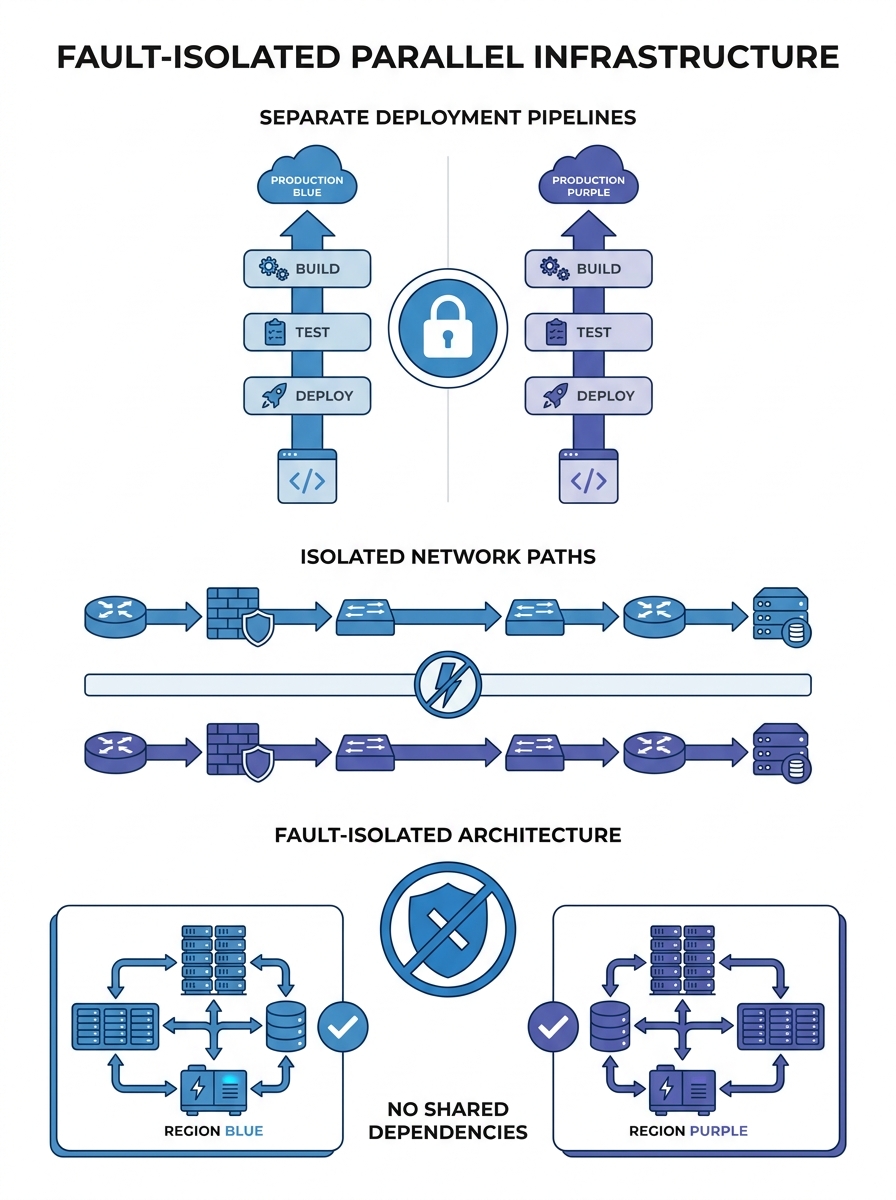
Equinix cites Zscaler’s Business Continuity Cloud as an example of “architectural independence,” a continuously operating environment with separate deployment pipelines, network paths, domains, and routing that preserves zero-trust policies and user experience when primary stacks cannot function. The design positions parallel infrastructure not as cold backup or secondary regions, but as logically separate control and data planes that eliminate shared blast radii.
Architectural Independence Requires Decoupling at Multiple Layers
Traditional resilience architectures deploy “N+1 in the same cloud” configurations, which Equinix argues share invisible dependencies through cloud regions, identity providers, or operations teams. Architectural independence pushes beyond redundancy by separating blast radii across infrastructure footprints, deployment pipelines, and even organizational control.
Philippine enterprises managing multi-site operations can apply three design principles from the framework. First, parallel environments must use distinct network paths and domains to prevent failures in one stack from propagating automatically. Second, independence extends beyond physical infrastructure to deployment pipelines, change windows, and supporting systems, requiring decoupling at the automation layer. Third, always-on postures eliminate risky manual reconfiguration during cutover by running independent environments concurrently, making failover transparent to endpoints.
Kerravala identifies concentration risk as a growing concern, particularly when multiple critical processes depend on the same cloud-hosted AI platform or third-party model provider. The framework positions independence by provider, platform, and organizational control as the operating discipline that replaces document-and-disaster recovery exercises.
AI Transforms Continuity From Reactive to Predictive
AI functions both as a risk factor and a resilience engine in the operational survivability model. On the risk side, Equinix highlights new dependencies introduced by cloud-hosted AI platforms, third-party models, and external data feeds, all of which create supply chain vulnerabilities. Model integrity represents a distinct continuity risk when hallucinations or corrupted training data turn AI-driven automated operations into failure modes rather than decision support.
The opportunity layer uses AI to build predictive continuity capabilities. Kerravala describes systems that analyze infrastructure metrics, weather patterns, geopolitical events, and supply chain data to forecast disruptions before they hit production environments. Self-healing operations link anomaly detection directly to automated remediation, enabling infrastructure that can reconfigure, scale, or isolate components autonomously without manual intervention.
Philippine IT leaders evaluating digital resilience architectures face increased latency sensitivity as generative and analytical workloads move into real-time transaction processing. Degradation translates directly into user-visible impact rather than backend delays, which raises the stakes for continuity planning beyond what traditional disaster recovery timelines accommodated.
Adversarial AI Accelerates Threat Complexity
Equinix positions AI as reshaping the threat landscape because adversaries now use machine learning to automate attack discovery, scale exploitation, and generate convincing social engineering at volume. The framework argues that continuity planning must account for both the frequency and complexity of incidents increasing simultaneously, which traditional backup strategies were not designed to address.
The architectural independence model addresses this through fault isolation that limits how far automated threats can propagate when they breach a single environment. Separate deployment pipelines prevent compromised automation from affecting parallel stacks, while distinct identity domains contain credential-based attacks to one control plane.
Kerravala notes that emerging AI regulations can force rapid operational changes affecting which models and data can be used and where they can run, introducing regulatory uncertainty as a continuity risk factor separate from technical infrastructure failures. Philippine enterprises operating in regulated verticals such as banking, healthcare, and BPO call centers face compliance requirements that now extend to AI model governance alongside traditional data residency rules.
Context and Outlook
The shift from resilience to operational survivability reflects how AI has moved from pilot projects to production systems that enterprises cannot afford to lose even temporarily. Philippine IT leaders planning infrastructure upgrades in 2026 face a decision point: continue investing in traditional backup-and-restore architectures, or adopt the higher upfront cost of parallel environments that eliminate single points of failure across providers and platforms.
Equinix’s positioning of architectural independence as an “operating discipline” rather than a technology purchase signals that the framework requires organizational changes beyond infrastructure procurement. Philippine enterprises must evaluate whether their operations teams, change management processes, and deployment pipelines can support genuinely independent environments, or whether shared dependencies at the human layer will undermine technical decoupling.
The $540,000 per hour downtime cost cited for Global 2000 firms establishes the business case for moving beyond N+1 redundancy, but Philippine SMBs and mid-market enterprises will need to scale the model to infrastructure budgets that cannot support full duplicate stacks. The practical question becomes which layers of architectural independence deliver the highest continuity value for specific workload profiles—a calculation that depends on how deeply AI has become embedded in each organization’s revenue-generating processes.