
G.711 consumes 87.2 Kbps per concurrent call. G.729 cuts that to 31.2 Kbps. Opus adapts anywhere from 6 to 510 Kbps based on real-time network conditions. For Philippine enterprises weighing G.729 vs G.711 (and now Opus), the right codec depends on available bandwidth, tolerance for compression artifacts, and handset compatibility across your sites.
TL;DR: G.711 gives the best audio quality but eats bandwidth fast. G.729 is the workhorse for bandwidth-constrained Philippine links with acceptable audio. Opus outperforms both on paper but requires newer endpoints. Pick by site, not by organization.
Three Codecs, Three Tradeoffs
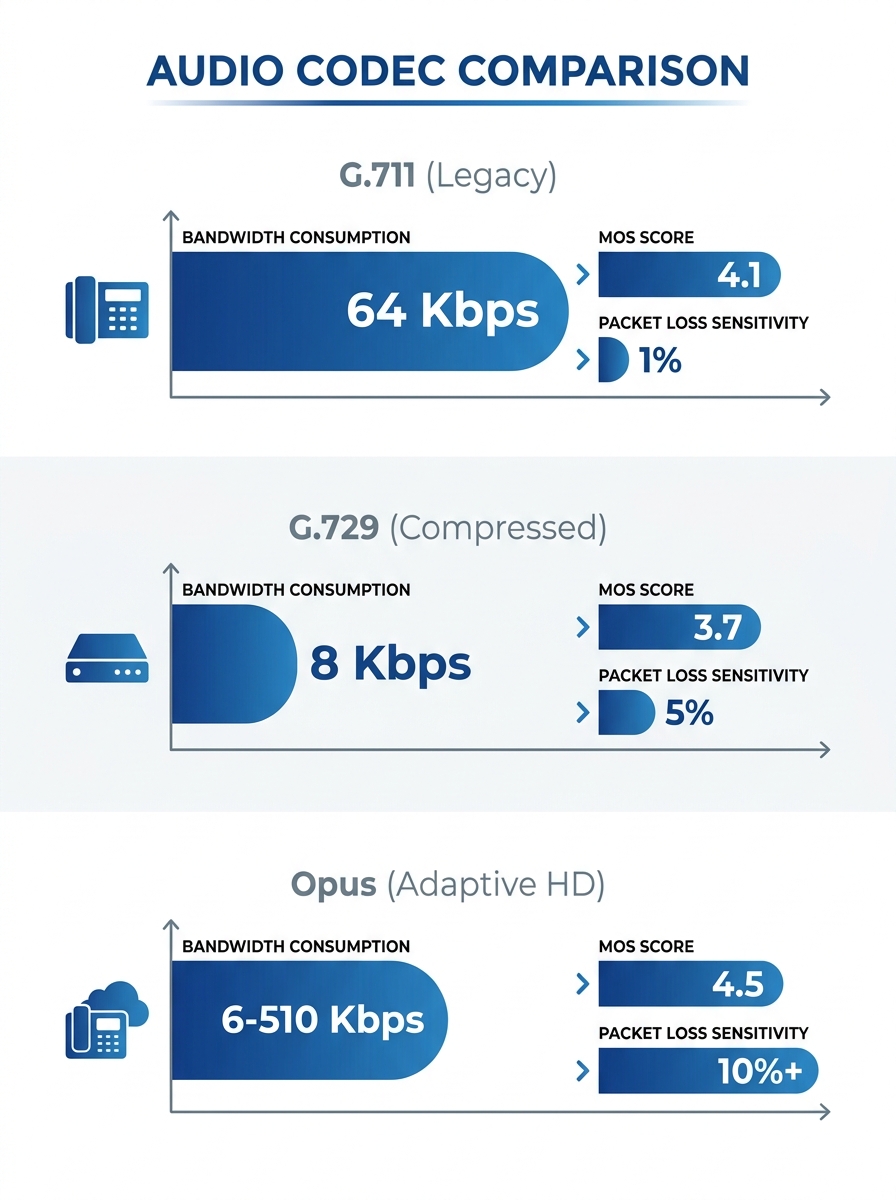
Before examining each codec individually, here’s how they stack up across the dimensions that matter for bandwidth optimization in VoIP deployments across Philippine network constraints.
| Attribute | G.711 | G.729 | Opus |
|---|---|---|---|
| Raw bitrate | 64 Kbps | 8 Kbps | 6–510 Kbps (adaptive) |
| Bandwidth per call (with IP/UDP/RTP headers) | 87.2 Kbps | 31.2 Kbps | 16–90 Kbps typical |
| Maximum MOS (ideal conditions) | 4.5 | 3.92 | 4.5+ (wideband) |
| Frequency range | 300–3,400 Hz (narrowband) | 300–3,400 Hz (narrowband) | 50–20,000 Hz (fullband) |
| Licensing | Royalty-free | Licensed (patents expired 2017, now free in most implementations) | Royalty-free, open-source |
| Packet loss sensitivity | Degrades noticeably at 1% | More sensitive (each lost packet = larger chunk of compressed data) | Built-in forward error correction |
| Hardware support | Universal | Universal | Limited on legacy SIP handsets |
As network engineer Kerry Cordero documented in his bandwidth calculation guide, “If you have 7,000 concurrent calls, each using about 31.2 Kbps, then the total bandwidth required would be around 218,400 Kbps, or about 218.4 Mbps.” That same call volume on G.711 would need 610.4 Mbps. The difference is massive for any BPO floor in Cebu or Davao running hundreds of agent seats on a shared fiber uplink.
G.711 Delivers Toll-Quality Audio at a Steep Bandwidth Price
G.711 is the baseline codec for VoIP worldwide, and it remains the default on nearly every SIP phone that ships from Fanvil, Yeastar, and Cisco. It samples audio using Pulse Code Modulation at 64 Kbps with zero compression, which means the audio stream arriving at the far end is essentially identical to what the microphone picked up. The result: a maximum Mean Opinion Score (MOS) of 4.5 under ideal conditions, the highest of any narrowband codec in common enterprise use.
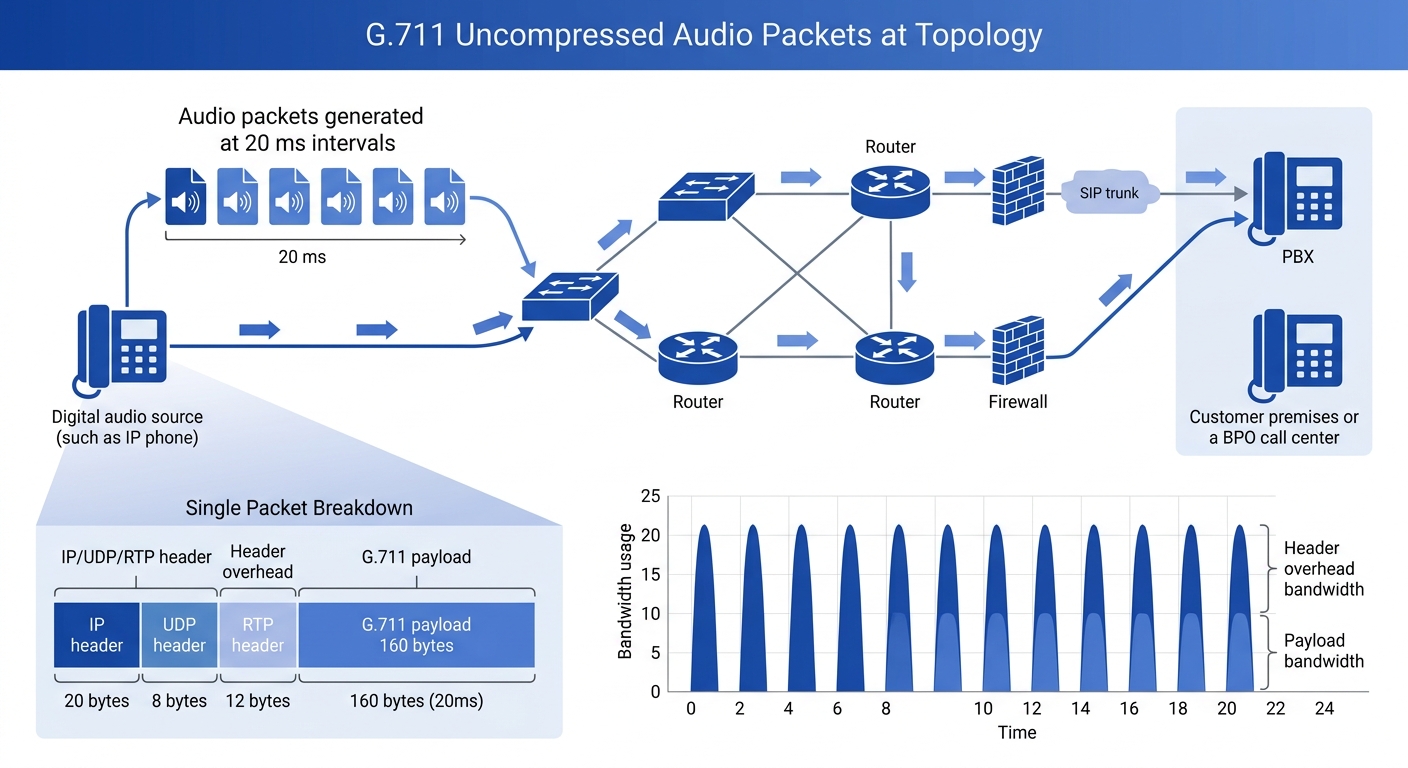
That clarity comes at a cost. Each G.711 call requires 87.2 Kbps of actual bandwidth once you add IP, UDP, and RTP packet headers. A 50-seat call center on a 10 Mbps DSL link (still common in provincial Philippine branches) can sustain roughly 114 simultaneous G.711 calls before saturating the pipe. Factor in data traffic, cloud application usage, and backup jobs running during business hours, and that number drops to 60–70 calls in practice.
Where G.711 shines in Philippine deployments is on sites with dedicated fiber (100 Mbps symmetric or higher) and proper QoS marking in place. If you’ve already configured DSCP 46 queuing on your WAN edge routers, G.711 gives you the best possible call quality with the lowest processing overhead on your PBX. The codec is royalty-free, universally compatible, and introduces minimal encoding delay (0.125 ms per sample).
The problem surfaces on call quality when packet loss enters the picture. As Twilio’s engineering team has documented, “high latency, excessive jitter, and significant packet loss can severely degrade call quality, leading to echo, distortion, or dropped calls.” G.711 calls degrade noticeably at 1% packet loss, and on congested provincial links where loss spikes to 2–3% during peak hours, you’ll hear it immediately as choppy, robotic audio. Because G.711 sends uncompressed samples, every lost packet creates a gap in the audio that the receiving endpoint must fill with silence or interpolation.
Warning: If your site’s packet loss regularly exceeds 1% during business hours, G.711 will produce audible quality degradation regardless of available bandwidth. Run synthetic test calls every 5–15 minutes during peak periods to measure your actual loss rate before committing to a codec.
For organizations running root-cause diagnostics on call quality issues, G.711’s uncompressed nature does offer one advantage: captured RTP streams are easier to analyze in Wireshark because the audio payload is raw PCM data. Troubleshooting compressed codec streams requires additional decode steps.
G.729 Compresses Hard and Sounds Good Enough
G.729 attacks the bandwidth problem directly. It compresses voice audio down to 8 Kbps using Conjugate-Structure Algebraic-Code-Excited Linear Prediction (CS-ACELP), an algorithm designed specifically for human speech. With packet headers, each call consumes 31.2 Kbps of bandwidth. That’s 64% less than G.711 per call.
For Philippine enterprises operating across bandwidth-constrained networks, the math is straightforward. That same 10 Mbps DSL link supporting 70 usable G.711 calls can handle roughly 200 G.729 calls with room for data traffic. A BPO operation running 500 concurrent agent calls needs approximately 15.6 Mbps on G.729 versus 43.6 Mbps on G.711. When comparing SD-WAN and MPLS overlays for multi-site voice traffic, the codec choice directly shapes your circuit sizing and monthly recurring costs from Globe, PLDT, or Converge.
Audio quality on G.729 sits at a MOS of approximately 3.92 under clean network conditions. As TechTarget’s codec analysis puts it, “G.729’s audio call quality at low bandwidth is understandable to humans” and is “a suitable narrowband VoIP codec for enterprises handling large numbers of calls per second.” The audio sounds slightly thinner than G.711, with a subtle metallic quality that trained ears notice but most callers don’t flag as a problem. For inbound and outbound call center operations, for government agency hotlines, for hospital reception desks in Metro Manila and Cebu, G.729 delivers acceptable voice quality at dramatically lower bandwidth cost.
A 500-seat BPO floor needs 15.6 Mbps on G.729 versus 43.6 Mbps on G.711. That 64% bandwidth reduction determines whether your provincial fiber link can carry both voice and data, or whether one starves the other.
The tradeoff? Call quality and packet loss interact more aggressively with G.729 than G.711. Each lost G.729 packet represents a larger chunk of compressed audio data, and the codec’s reconstruction algorithm struggles more to interpolate missing frames. Where G.711 degrades gradually as loss climbs from 0.5% to 2%, G.729 can jump from “fine” to “unintelligible” in a narrower loss window. The ITU-T G.114 recommendation sets the one-way latency threshold at 150 ms, and jitter should stay below 30 ms. On G.729, exceeding either threshold produces more audible artifacts than the same violation would on G.711.
Licensing used to be a concern. G.729 was patent-encumbered until 2017, and organizations paid per-channel license fees to use it. Those patents have expired, and most modern PBX platforms (Asterisk, FreePBX, Yeastar P-Series, 3CX) include G.729 support without additional cost. If you’re still running an older system that charges for G.729 channels, that’s a sign you’re overdue for a PBX platform evaluation.
Why Opus Is the Wildcard Philippine IT Teams Keep Overlooking
Opus entered the VoIP codec landscape as an IETF-standardized, royalty-free, open-source codec that adapts its bitrate in real time based on detected network conditions. According to Telnyx’s codec documentation, “Opus produces high-quality audio while maintaining low bandwidth requirements” and “is becoming increasingly popular in VoIP technology due to its superior performance in varying network conditions.”
The technical specifications back that claim. Opus supports sample rates from 8 kHz (narrowband, equivalent to G.711’s frequency range) up to 48 kHz (fullband, CD-quality). Its bitrate adjusts dynamically from 6 Kbps to 510 Kbps, meaning it can compress as aggressively as G.729 on a congested link and expand to wideband quality when bandwidth permits. It includes built-in forward error correction (FEC) that proactively protects against packet loss, a feature neither G.711 nor G.729 offers natively. Under ideal conditions, Opus achieves MOS scores above 4.5, and VoIPmonitor.org’s codec guide confirms that “narrowband codecs max out around MOS 4.2 even in perfect conditions,” giving Opus a measurable advantage in wideband mode.
For bandwidth optimization in VoIP, Opus’s adaptive bitrate is uniquely suited to Philippine network realities. A branch in Davao might have 20 Mbps fiber that drops to effective throughput of 8 Mbps during afternoon congestion. Opus detects the degradation and scales its bitrate down automatically, maintaining call continuity where G.711 would clip and G.729 would introduce artifacts. When the congestion clears, the codec scales back up without manual intervention.
So why isn’t every Philippine enterprise using Opus? Hardware support. Legacy SIP desk phones from Fanvil, Grandstream, and older Cisco models don’t support Opus in their firmware. The codec lives primarily in softphone clients (Oasis, Oasis, Oasis), WebRTC-based platforms, and newer IP phone models. If your deployment relies on 200 physical Fanvil X-series handsets across three floors, you can’t negotiate Opus without a forklift hardware upgrade or a shift to softphones. WebRTC-based UC platforms, which handle media negotiation differently than traditional SIP, are the natural home for Opus. But mixing Opus-capable softphones with G.711/G.729 desk phones creates transcoding load on your PBX, adding 10–20 ms of processing delay per call that crosses codec boundaries.
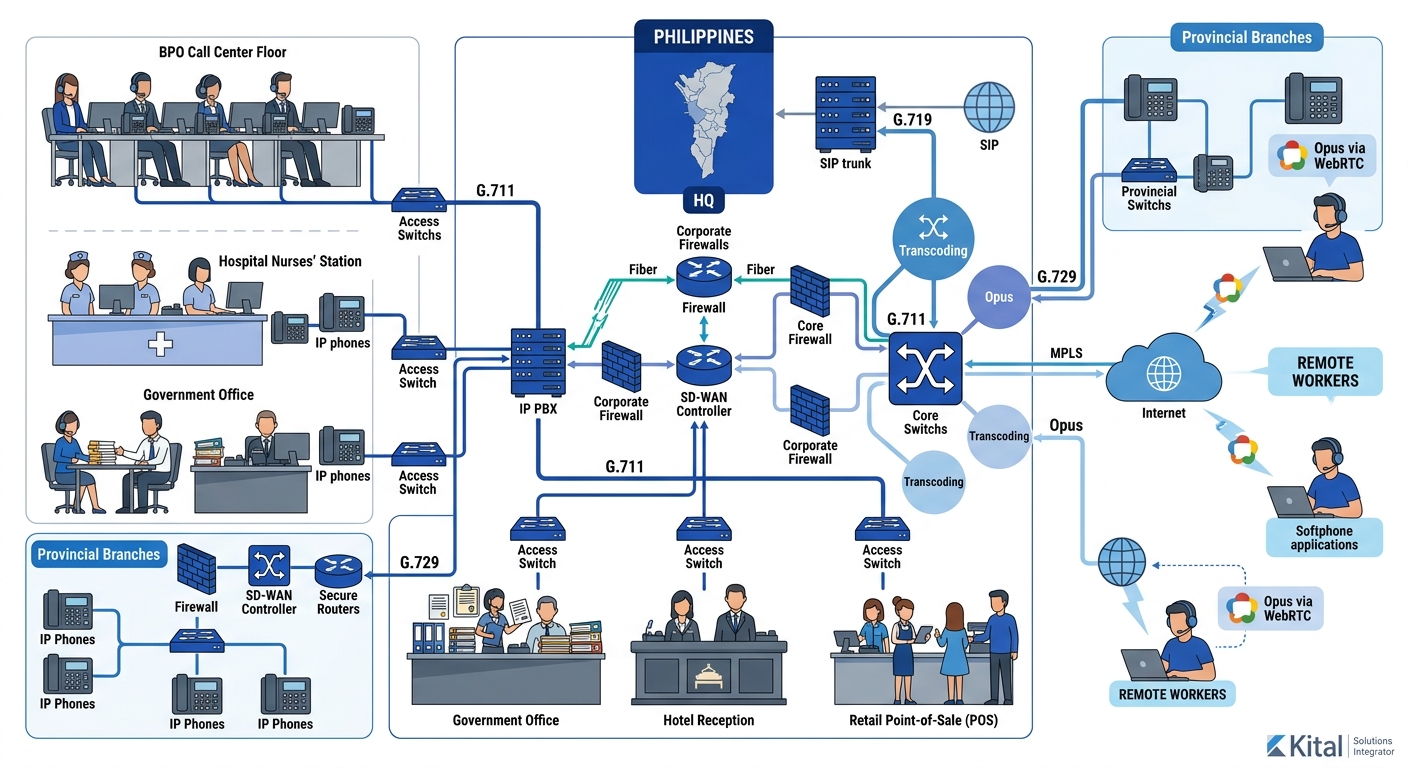
Tip: If you’re deploying Microsoft Teams with Direct Routing in the Philippines, Teams clients negotiate Opus (specifically the SILK/Opus variant) by default. Your SBC will transcode to G.711 or G.729 for PSTN breakout. Size your SBC’s transcoding capacity accordingly. Organizations that have [troubleshot Teams Direct Routing failures](/blog/microsoft-teams-direct-routing-breaks-enterprise-networks) often find transcoding bottlenecks at the root.
Who Should Pick Which
The VoIP codec comparison reduces to three real-world scenarios common across Philippine enterprises.
Pick G.711 when your sites have 50 Mbps or more of dedicated, QoS-marked bandwidth per 100 concurrent calls. This applies to Metro Manila headquarters on PLDT or Converge fiber, hospitals with dedicated voice VLANs, and government agencies with NTC-compliant circuits that separate voice and data traffic. G.711 gives you a MOS of 4.5, universal handset compatibility, and the simplest troubleshooting path. The per-call cost is 87.2 Kbps, but if you have the bandwidth, there’s no reason to compress.
Pick G.729 when bandwidth is tight, call volume is high, and you need every kilobit. Provincial BPO floors, hotel front desks on shared internet links, school administrative offices running 5–10 Mbps plans, satellite offices connected via LTE failover: these are G.729 territory. You sacrifice roughly 0.5 MOS points versus G.711 (3.92 vs 4.5) and gain a 64% reduction in bandwidth per call. For a 200-seat operation, that’s the difference between needing 17.4 Mbps and needing 6.24 Mbps for voice alone.
Pick Opus when your workforce is softphone-heavy, your UC platform supports it natively, and your network conditions fluctuate. Remote workers on residential Converge or Globe fiber, field staff on mobile hotspots, WebRTC-based contact centers: Opus’s adaptive bitrate and built-in FEC handle variable Philippine link quality better than any fixed-rate codec. Its packet loss resilience means you’ll maintain audible calls through the 1–3% loss windows that would make G.729 unintelligible.
Most Philippine enterprises won’t pick one codec organization-wide. The practical answer is a per-site codec policy: G.711 for your well-provisioned headquarters, G.729 for your bandwidth-constrained branches, and Opus for your softphone and WebRTC users. Configure your PBX codec priority lists per device profile or per trunk, and accept that some transcoding overhead is the price of matching each site’s codec to its actual network capacity. When you’re building a call quality monitoring workflow with packet captures, tag each call’s negotiated codec in your CDRs so you can correlate MOS scores to codec choice and identify sites that need reclassification.
The codec alone won’t fix a network with 5% packet loss and 200 ms of jitter. But on a reasonably healthy link, the right codec choice for each site’s bandwidth profile is the single highest-impact configuration decision you’ll make for perceived call quality.