
A successful VoIP migration framework for Philippine enterprises follows four sequential stages: network readiness assessment, pilot deployment, phased production rollout, and post-migration optimization. Skipping or compressing any stage, particularly the pilot, is the single most common reason enterprise telephony deployments stall or fail outright in the Philippine market.
Cisco’s PDIOO lifecycle (Plan, Design, Implement, Operate, Optimize), documented by authors Ramesh Kaza and Salman Asadullah in their reference text on IPT implementation stages, splits enterprise telephony into five overlapping phases with predesigned questionnaires and decision gates for each. The framework is solid engineering, but it was designed for organizations with dedicated project management offices and predictable domestic bandwidth. Philippine enterprises operate in a different environment: asymmetric provincial links where upload throughput can drop below 2 Mbps, ISPs that traffic-shape UDP packets during peak hours, and an NTC mandate requiring all carriers to shut down 3G networks by December 31, 2026. That deadline forces any enterprise still relying on GSM gateways for voice failover to migrate those trunks to LTE or 5G-capable VoIP gateways within the next six months. The four-stage blueprint described here compresses Cisco’s five-phase model into a sequence that fits Philippine infrastructure realities without sacrificing the rigor that prevents mid-rollout collapse.
The Assessment Nobody Wants to Fund
The network readiness assessment is where the entire IPT implementation either gets its foundation or inherits the fault lines that surface six months later during production traffic. A proper VoIP readiness audit evaluates three interconnected layers: physical infrastructure (switch models, cabling categories, PoE budgets), logical configuration (VLAN segmentation, QoS policies, firewall NAT behavior), and service-level capacity (available bandwidth per concurrent call after accounting for data traffic). Most Philippine enterprises skip the third layer entirely, treating bandwidth as a single number on their ISP contract rather than a variable that shifts by time of day and trunk utilization.
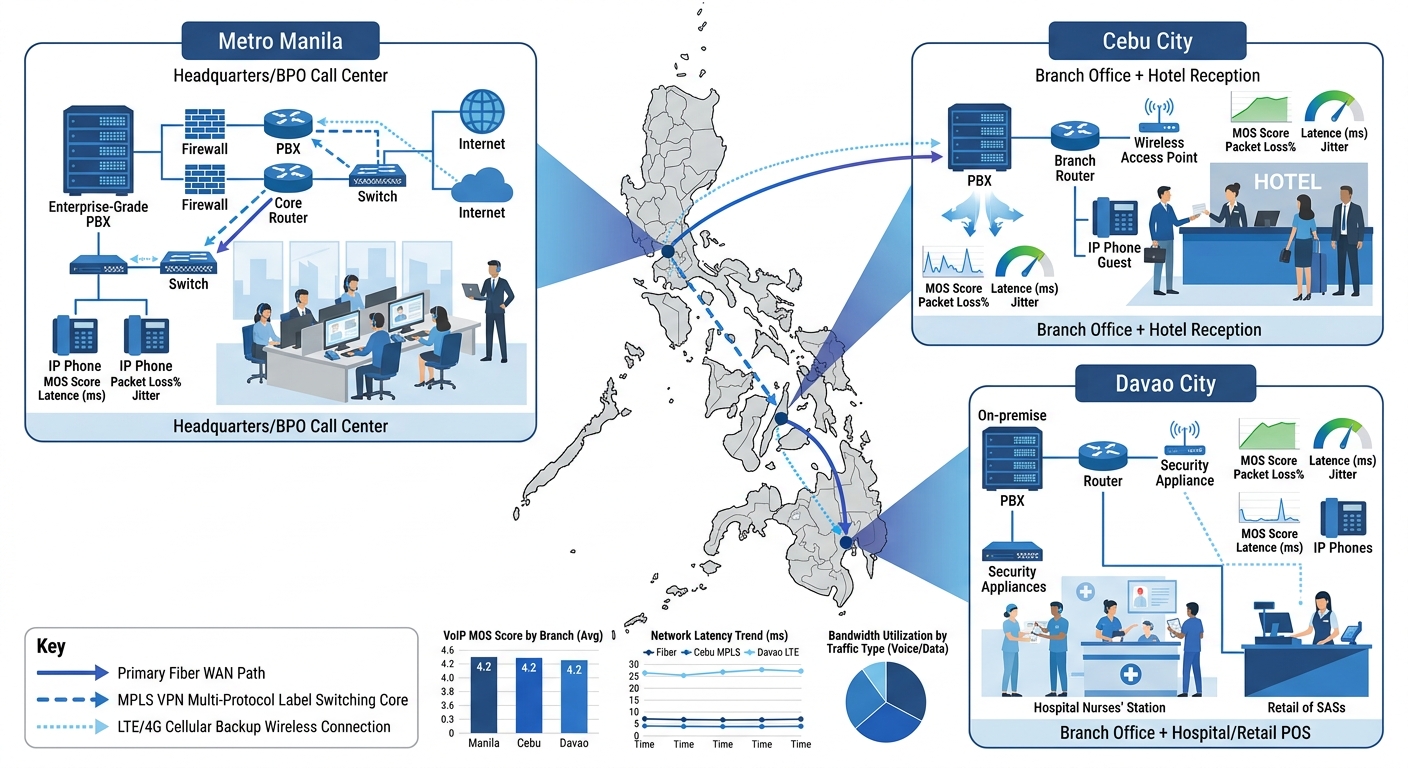
The Mushroom Networks deployment methodology dissects the migration map into three components: the customer-premises network, the inter-office network, and the voice trunks. This decomposition matters because each component has different failure modes in the Philippine context. The customer-premises network on a single floor of a Makati office building is usually fine: Cat 6 cabling, managed PoE switches, controlled environment. The inter-office network connecting that Makati headquarters to a Cebu branch over a 10 Mbps MPLS circuit is where things get fragile. And the voice trunks, the SIP connections to local telcos or international carriers, introduce their own latency and codec negotiation challenges that don’t appear until the first 50 concurrent calls hit the border controller.
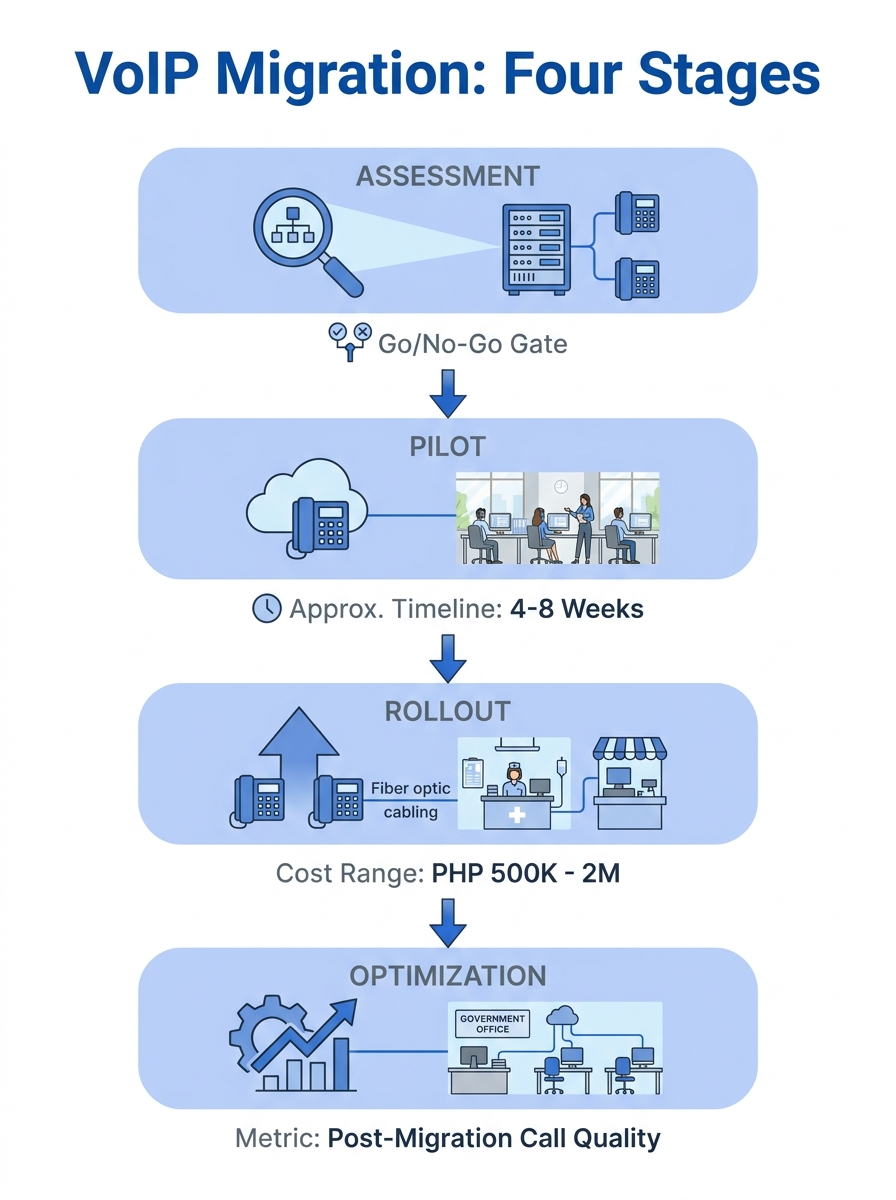
Bandwidth budgeting during the assessment stage requires arithmetic that accounts for codec overhead, not raw payload. G.711 consumes 87.2 kbps per call with IP headers included, while G.729 uses 31.2 kbps. On a 10 Mbps leased line shared with data traffic, the practical difference is between supporting 70 concurrent calls and supporting 200. If you haven’t already worked through the bandwidth math for your specific link speeds, the assessment stage is when that calculation has to happen, because every downstream decision about codec selection, call admission control thresholds, and failover routing depends on those numbers. Vendor assessment tools validate whether existing infrastructure can handle the demands of the target solution, but Philippine enterprises should supplement those tools with their own 72-hour traffic captures that span both weekday peaks and weekend BPO shift changes.
Why the Pilot Determines Everything
A pilot program is where the migration blueprint meets real users, real call patterns, and real Philippine ISP behavior under load. The VoIP and IPT Best Practices literature is explicit on this point: each stage has recommended best practices that should be followed, and the pilot stage is where organizations most often cut corners because early test calls “sound fine” and stakeholders push for faster deployment. A 15-minute demo call to a conference bridge reveals almost nothing about how the system behaves under 200 concurrent sessions with mixed codecs and agents toggling between voice and screen-share.
Philippine enterprises can choose from three pilot approaches, each with sharply different cost profiles and discovery potential. A single-department pilot (say, deploying Fanvil IP phones to a 30-seat customer service team on one floor) costs between PHP 120,000 and PHP 280,000 and runs two to four weeks. It tests LAN conditions effectively but misses WAN-related problems like NAT traversal failures across different firewall vendors and the jitter spikes that occur on provincial asymmetric connections. A multi-branch parallel pilot, suited for enterprises with four or more sites, costs PHP 350,000 to PHP 750,000 and runs four to eight weeks. This approach tests real WAN conditions across heterogeneous links, which is exactly where Philippine enterprise telephony deployments tend to break: the Metro Manila fiber link performs perfectly while the Davao ADSL connection produces MOS scores below 3.0 during afternoon peak hours. The third option, a shadow-run pilot, costs three to four times the baseline and runs six to twelve weeks, operating the new VoIP system alongside the legacy PBX for instant rollback capability. Banks and hospitals in the Philippines increasingly choose this approach because the cost of a failed voice cutover in those environments isn’t measured in inconvenience but in regulatory exposure and patient safety.
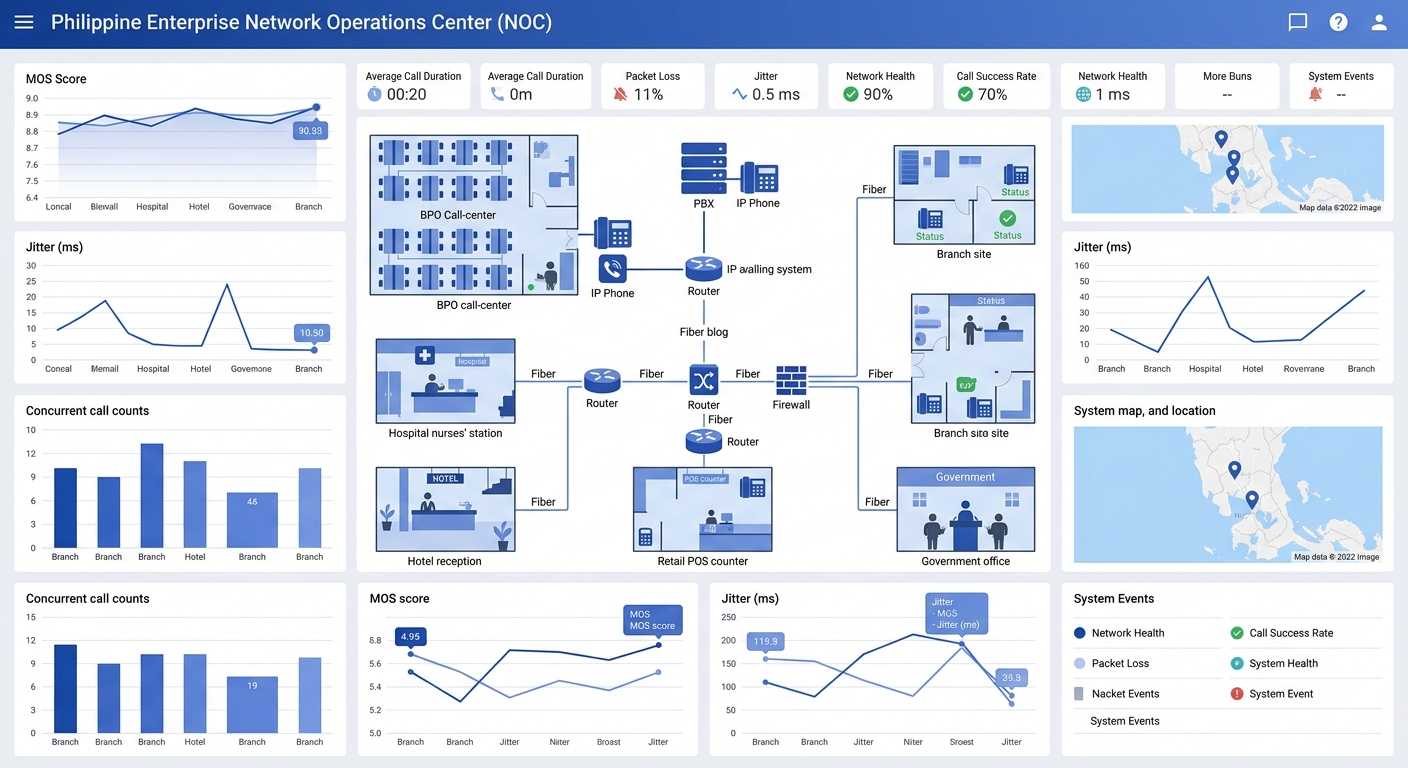
The performance targets for any pilot should be concrete: a Mean Opinion Score of 3.8 or higher, jitter under 30 milliseconds at the 95th percentile, and one-way latency under 150 milliseconds. These aren’t arbitrary thresholds; they’re the minimum values at which users stop complaining about voice quality and start treating the system as production-grade. Running the pilot across a full 30-day billing cycle is critical for detecting ISP traffic shaping that only manifests at certain times of month or certain traffic volumes. Detailed guidance on structuring VoIP pilot programs for Philippine conditions is worth reviewing before committing to any of the three approaches, because the pilot design constrains what you can learn and, by extension, what risks you carry into production rollout.
A 15-minute demo call to a conference bridge reveals almost nothing about how the system behaves under 200 concurrent sessions with mixed codecs and agents toggling between voice and screen-share.
Rolling Out Across Philippine Geography
The phased production rollout is where enterprise telephony deployment either scales cleanly or reveals every shortcut taken in the first two stages. The net2phone migration framework recommends forming cross-departmental teams during planning, with representatives from each division acting as communication channels for their departments during rollout. This organizational structure matters more in Philippine enterprises than in single-country, single-timezone deployments because a company with offices in Makati, Cebu, and Davao is effectively rolling out across three different ISP environments, three different power grid reliability profiles, and possibly three different levels of local IT support capability.
BPO call centers present a particular rollout challenge because agent seat counts shift across shifts, and call volume patterns follow US and Australian business hours rather than Philippine daytime peaks. A BPO operation running 800 concurrent calls at 2 AM Manila time needs QoS configurations that prioritize voice traffic when the data team is running overnight batch uploads on the same WAN link. Configuring DSCP 46 marking for voice packets is non-negotiable, but the specific queue depths and scheduling algorithms depend on the router vendor and the traffic mix at each site. Cisco, Fortinet, and even mid-range Mikrotik routers handle DSCP differently in their default configurations, and a QoS policy that works perfectly on a Cisco ISR at headquarters can produce different behavior on a Fortinet FortiGate at a branch office. With 85% of organizations having embraced cloud-first strategies, some enterprises add a hosted UCaaS layer on top of on-premises PBX deployments at smaller satellite offices where full hardware rollout doesn’t justify the cost.
The 3G phase-out deadline adds urgency to any rollout happening in the second half of 2026. Enterprises using GSM gateways for voice failover, a common setup in provincial offices where landline reliability is poor, need to replace those gateways with LTE or 5G-capable alternatives before December 31, 2026. Smart’s 5G network scored 81.5 out of 100 on Opensignal’s Voice App Experience metric in October 2025, but most Philippine 5G coverage remains Non-Standalone (NSA), which means true network slicing for guaranteed VoIP quality isn’t available yet. The practical implication is that 5G can serve as a WAN backup transport, but you still need internal network segmentation and DSCP marking to protect voice quality when 5G is the active path.
Post-rollout optimization, the fourth stage, involves continuous monitoring and iterative adjustments to codec selection, call admission control limits, and failover routing. Equipping agents and executives with proper audio hardware matters here as well; Jabra headsets with noise cancellation consistently outperform built-in laptop microphones in open-plan BPO floors, and the MOS improvement from proper headset deployment alone can push borderline call quality from 3.5 to 4.0. The optimization stage doesn’t have an end date. It runs as long as the system is in production, absorbing changes in call volume, new branch offices, ISP upgrades, and the eventual transition to Standalone 5G when Philippine carriers reach that milestone.
What This Framework Cannot Solve
The four-stage blueprint handles the technical progression well. It does not handle the organizational resistance that stalls most Philippine enterprise migrations somewhere between the pilot and the production rollout. An IT director who has run a successful 30-seat pilot with excellent MOS scores and clean jitter numbers still faces a procurement process that can take 90 days for hardware purchase orders, a facilities team that hasn’t planned the electrical and cabling work for PoE switch installation at branch offices, and a CFO who approved the pilot budget but hasn’t signed off on the full deployment cost. The framework assumes that success in one stage creates momentum for the next. In practice, success in the pilot often creates a pause while the organization debates whether the investment in enterprise data center infrastructure and branch-office upgrades is justified by the results.
There’s also the question of whether a four-stage linear model is the right shape for every organization. Some Philippine enterprises are skipping on-premises PBX entirely and deploying hosted UCaaS platforms that compress the assessment-pilot-rollout cycle into weeks rather than months. The four-stage model described here is most valuable for enterprises with existing on-premises infrastructure, multiple branch offices across different Philippine regions, and call volumes large enough that a failed migration creates real business damage. For a 15-person office in a single BGC tower with symmetric fiber, the full blueprint is overkill. For a 2,000-seat BPO operation spread across Makati, Clark, and Iloilo, it’s the minimum viable process. The framework gives you a sequence and a set of checkpoints, but it can’t tell you whether your organization has the procurement discipline, the cross-departmental coordination, and the executive patience to follow them. That judgment still belongs to the people who have to live with the phone system on the other side of the migration.