
NIST SP 800-207 defines zero-trust architecture as eliminating implicit trust from every network layer, and SIP-based VoIP systems are the layer Philippine enterprises keep leaving unprotected. Deploying a zero-trust VoIP security policy requires five sequential stages, from asset discovery through continuous verification, each addressing a different attack surface that traditional perimeter firewalls miss entirely.
Stage 1: Mapping Every Voice Asset Before You Write a Single Policy
Why does enterprise network segmentation Philippines-wide consistently fail on the first attempt? Because organizations underestimate their own voice footprint. Telecom Metric’s zero-trust telephony framework identifies audit and discovery as the mandatory first step, noting that “many organizations underestimate their voice footprint, especially when multiple departments independently adopt UCaaS solutions.”
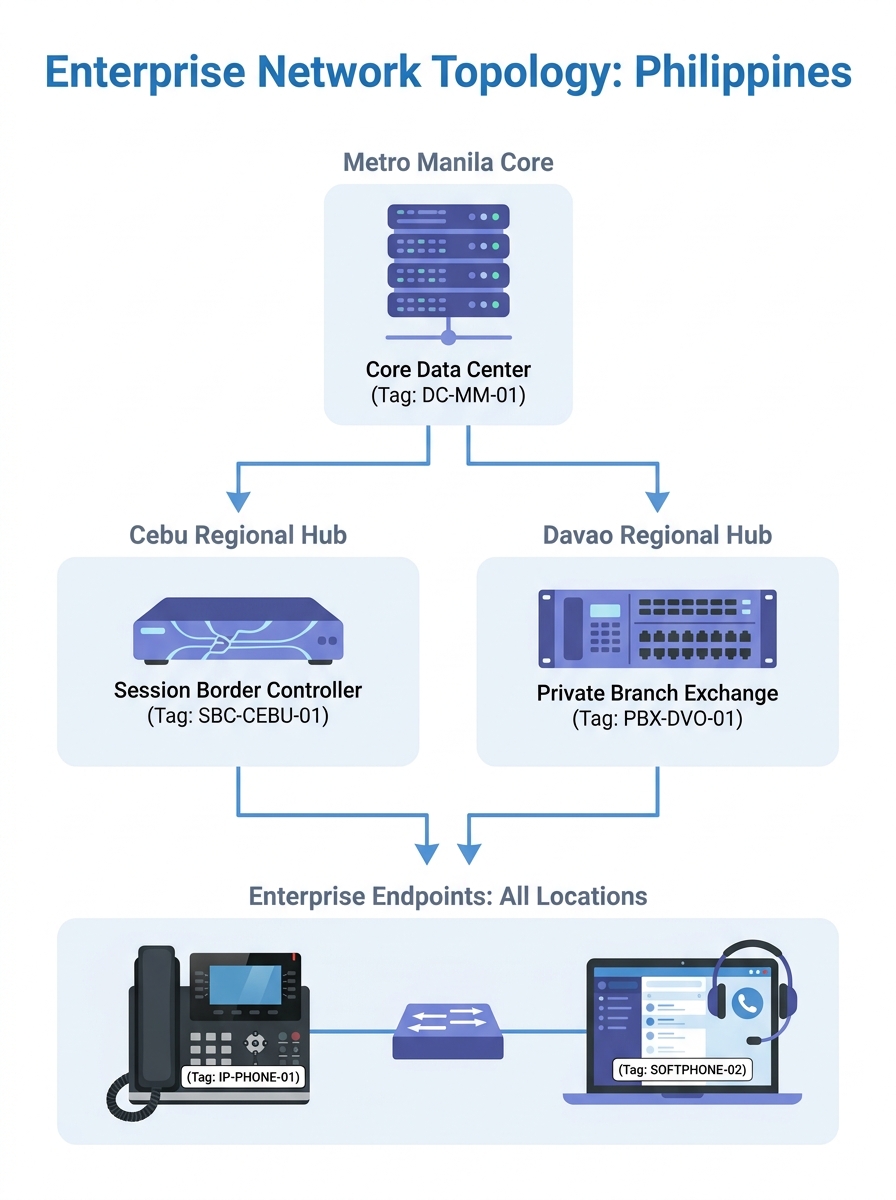
A Philippine enterprise running 200 SIP extensions across 3 offices might actually have 340 voice-capable endpoints once you count softphones on employee laptops, mobile SIP clients, lobby intercoms, and contact center agent headsets registered through separate UCaaS platforms. Before any ZTNA policy gets written, you need a complete inventory of every device touching SIP ports 5060 (unencrypted) and 5061 (TLS-encrypted).
The audit should catalog at minimum: every PBX and IP-PBX node, all SIP trunks and their provider configurations, every registered endpoint by MAC address, all Session Border Controllers in the path, and any third-party integrations pulling call data via APIs. If you’ve already done work on VoIP call flow diagnostics and packet capture, that toolkit gives you a head start on identifying undocumented voice traffic patterns.
For Philippine BPO operations running 500+ agent seats, this discovery phase typically reveals 15–25% more active SIP registrations than IT departments have on record. Rogue softphone installations and shadow UCaaS subscriptions are the usual culprits.
Stage 2: Identity Governance and Multi-Factor Authentication Lock the Front Door
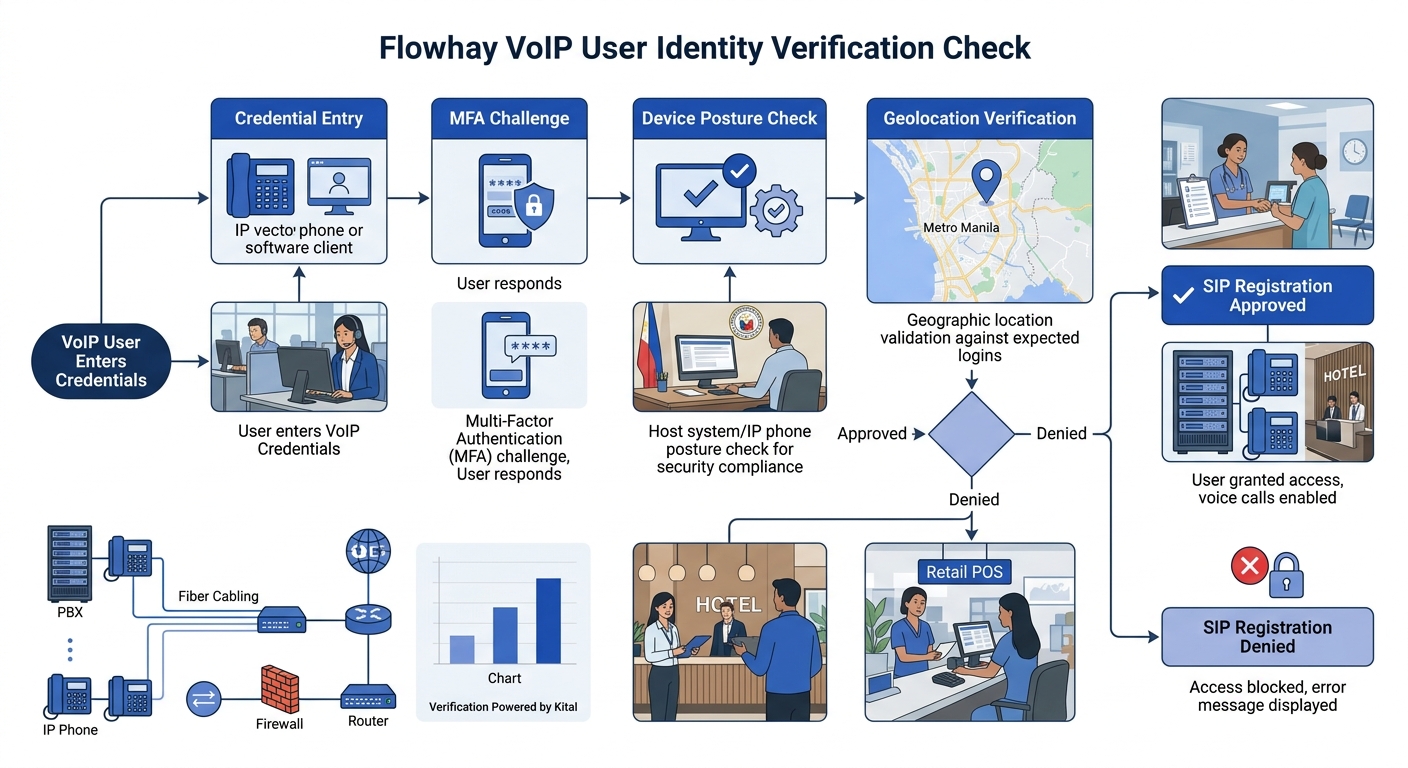
Every zero-trust deployment lives or dies on identity verification. For VoIP network access control, this means no device and no user gets to register a SIP endpoint or initiate a call without proving who they are, what device they’re on, and whether that device meets your security posture requirements.
Fortinet’s ZTNA framework, built into FortiOS 7.0 and later versions, enforces per-session access decisions based on identity, device health, and contextual risk. The foundational principle is “never trust, always verify,” which in VoIP terms means every SIP REGISTER request gets validated against your identity provider before the PBX accepts it. Adaptive authentication layers MFA over this baseline, increasing scrutiny when a user attempts registration from an unfamiliar IP range or geographic location.
InstaSafe’s secure VoIP access model adds device posture checks, geolocation binding, and geo-fencing to restrict voice access to specific approved devices. For a Philippine bank with 12 branch offices, this means an agent’s SIP softphone works from the Makati headquarters but won’t register if the same credentials appear from an IP geolocated outside the Philippines.
Three elements define the identity layer for ZTNA Philippines enterprise VoIP deployments:
- Identity provider integration: Azure AD, Okta, or on-premises LDAP directories authenticate every user before SIP registration proceeds.
- Device posture enforcement: Endpoint agents verify OS patch level, disk encryption status, and antivirus signatures. Devices failing any check get quarantined from voice VLANs.
- Contextual access policies: Time-of-day restrictions, geographic binding, and role-based permissions determine which SIP resources each user can reach.
Enterprises deploying FortiGate firewalls alongside their PBX infrastructure can enforce ZTNA access proxy rules at the network edge, ensuring SIP traffic from remote workers passes through the same identity checks as on-premises users. FortiOS ZTNA tags assign trust levels dynamically based on 8 or more device attributes per session.
Stage 3: Microsegmentation Separates Voice Traffic From Everything Else
Flat networks are where VoIP attacks spread fastest. Once an attacker breaches the data VLAN, lateral movement to unprotected SIP infrastructure takes minutes on an unsegmented network. The Cellcrypt 2025 VoIP security guide states directly that “separating VoIP traffic from general data traffic can greatly reduce vulnerability” by employing dedicated VLANs for voice systems.
Enterprise network segmentation Philippines deployments should isolate at minimum 4 distinct zones for voice infrastructure:
| Segment | Contents | Access Policy |
|---|---|---|
| Voice VLAN | IP phones, softphone endpoints | SIP/RTP only; no internet access; identity-verified devices only |
| Signaling DMZ | SBCs, SIP proxies | Inbound SIP from trunks; outbound to Voice VLAN; no direct endpoint access |
| Management VLAN | PBX admin interfaces, CDR databases | Restricted to IT admin roles; MFA required; no voice traffic |
| Guest/IoT VLAN | Lobby phones, visitor Wi-Fi, intercoms | Isolated; no routing to Voice or Management VLANs |
DHCP scopes and ACLs on each VLAN enforce what traffic crosses boundaries. The SBC sits between the signaling DMZ and your SIP trunk provider, processing voice traffic at near wire-rate speeds according to Ribbon Communications’ analysis. Ribbon’s research highlights that standard firewalls perform “minimal inspection of VoIP packets,” making them susceptible to SIP spoofing attacks that an SBC catches through deep packet inspection of SIP headers and SDP payloads.
If your infrastructure already includes SBCs positioned for failover, those same devices become your microsegmentation enforcement points for voice traffic. The SBC validates every SIP message against your policy engine before it reaches the PBX, dropping malformed INVITE requests, stripping unauthorized SIP headers, and rate-limiting REGISTER floods to 30–50 requests per second per source IP.
Firewalls perform minimal inspection of VoIP packets, making them susceptible to SIP spoofing attacks that only a Session Border Controller catches through deep SIP header analysis.
For Philippine enterprises with multi-site PBX deployments, each site’s voice VLAN should be locally segmented with inter-site SIP traffic tunneled through encrypted connections between SBCs. Running SIP across the public internet between your Manila and Cebu offices without an encrypted tunnel between SBCs is the equivalent of leaving your front door open and hoping nobody walks in.
Stage 4: ZTNA Enforcement Reaches Every Endpoint and Every Location
With identity governance and microsegmentation in place, stage 4 extends zero-trust enforcement to every user regardless of location. Traditional VPNs grant broad network access once authenticated. ZTNA does the opposite: it creates encrypted tunnels to specific applications, keeping all other resources invisible to the connecting user.
For a Philippine enterprise with 150 remote call center agents, 3 physical offices, and 40 field staff using mobile SIP clients, ZTNA enforcement means each user group connects through application-specific tunnels. The remote agent’s ZTNA client establishes an encrypted session to the contact center’s SIP proxy and nothing else. That agent never sees the management VLAN, the CDR database, or even the IP addresses of other voice infrastructure components.
Seqrite’s ZTNA platform supports VoIP services alongside web apps, thick clients like SAP, and remote access protocols including RDP, SSH, and VNC. This multi-protocol support matters for Philippine enterprises where voice infrastructure often coexists with legacy applications on the same network.
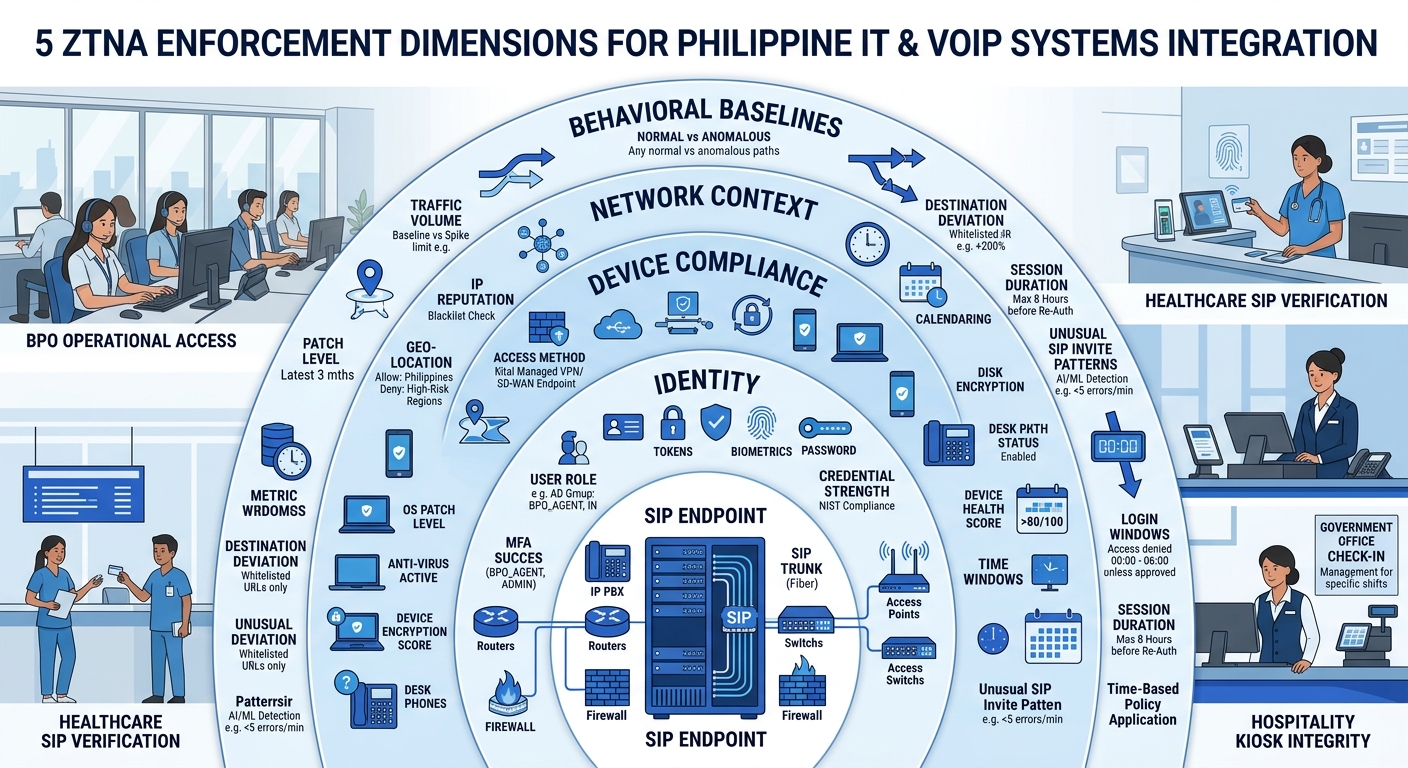
Context-based SIP security policy enforcement during this stage covers 5 key dimensions:
- User identity verified through your IdP with MFA on every session.
- Device compliance checked continuously, not once at login. If an agent’s laptop antivirus definitions fall 72+ hours behind, the ZTNA agent quarantines that device’s SIP access within 60 seconds.
- Network context evaluated per connection. A SIP registration from a corporate SSID gets a different trust score than one from a public coffee shop Wi-Fi in BGC.
- Time-based controls restrict after-hours SIP registration for roles that don’t require 24/7 voice access.
- Behavioral baselines flag anomalies. An account that normally handles 40 calls per shift suddenly initiating 400 INVITE requests triggers automatic session termination.
Warning: Kill-switch capability is essential at this stage. Your ZTNA platform must be able to revoke a specific user’s voice access within seconds during an active incident, without disrupting other users’ calls.
Deploying business telephone systems with ZTNA-aware firmware simplifies endpoint enforcement. IP phones from manufacturers like Yeastar and Fanvil support 802.1X authentication and TLS-encrypted SIP signaling, feeding device posture data directly into your ZTNA policy engine.
Stage 5: Continuous Monitoring Closes the Loop
Zero-trust VoIP security doesn’t have a finish line. Stage 5 establishes the monitoring, auditing, and policy refinement cycle that keeps the architecture effective as threats evolve and your voice infrastructure changes.
Monthly access audits should review every active SIP registration against your HR system’s employee roster. Philippine enterprises with staff turnover rates above 20% annually, common in BPO operations, accumulate orphaned SIP accounts fast. A 500-seat contact center with 22% annual attrition generates roughly 110 deactivated accounts per year that need SIP credential revocation within 24 hours of offboarding.
The monitoring stack for VoIP ZTNA covers 3 data streams:
- SIP signaling logs: Every REGISTER, INVITE, BYE, and CANCEL recorded with timestamps, source IPs, and user identity. Anomaly detection flags deviations from per-user baselines.
- ZTNA session telemetry: Continuous trust scores per active session, updated every 30–60 seconds based on device posture and behavioral signals.
- Network flow data: East-west traffic within voice VLANs monitored for lateral movement attempts. Any traffic from the voice VLAN to the data VLAN that doesn’t match an explicit policy rule triggers an alert.
If your organization has already built out VoIP call quality monitoring, those same collection points feed security analytics. Jitter spikes and packet loss patterns that look like quality degradation can also indicate a man-in-the-middle attack on the RTP stream.
Quarterly policy reviews should evaluate whether access rules still match business requirements. A department that added 15 new roles since the last review needs those roles mapped to SIP security policy groups. The NIST SP 800-207 framework recommends treating policy as living documentation, updated with every infrastructure change rather than on a fixed calendar alone.
Integration with SIEM platforms like FortiSIEM or Splunk correlates VoIP security events with broader network intelligence. A failed SIP registration from the same IP that just attempted an RDP brute force against your management VLAN tells a very different story than a standalone authentication failure.
Where Philippine VoIP Security Lands Now
Philippine enterprises face a specific convergence of risk factors that makes zero-trust VoIP deployment more urgent than in markets with more mature infrastructure. NTC-registered SIP trunk providers vary widely in their own security practices. PLDT, Globe, and regional ISPs deliver connectivity with different SIP security capabilities, and your ZTNA architecture has to compensate for whatever your carrier doesn’t cover.
The 5-stage deployment sequence described here takes a typical 200–500 seat Philippine enterprise 4–6 months from initial audit to continuous monitoring. Rushing the identity governance stage or skipping microsegmentation to save on switch configuration time creates gaps that undermine every subsequent layer.
Organizations already running SD-WAN or MPLS underlays for multi-site VoIP have a head start: their traffic engineering already separates voice from data at the WAN level, and adding ZTNA enforcement at each site builds on that existing segmentation rather than starting from zero. The SBC, the identity provider, the ZTNA agent, and the monitoring stack form four pillars that reinforce each other. Weaken any one of them and the “never trust, always verify” principle collapses back into the perimeter-only model that left your SIP infrastructure exposed in the first place.