
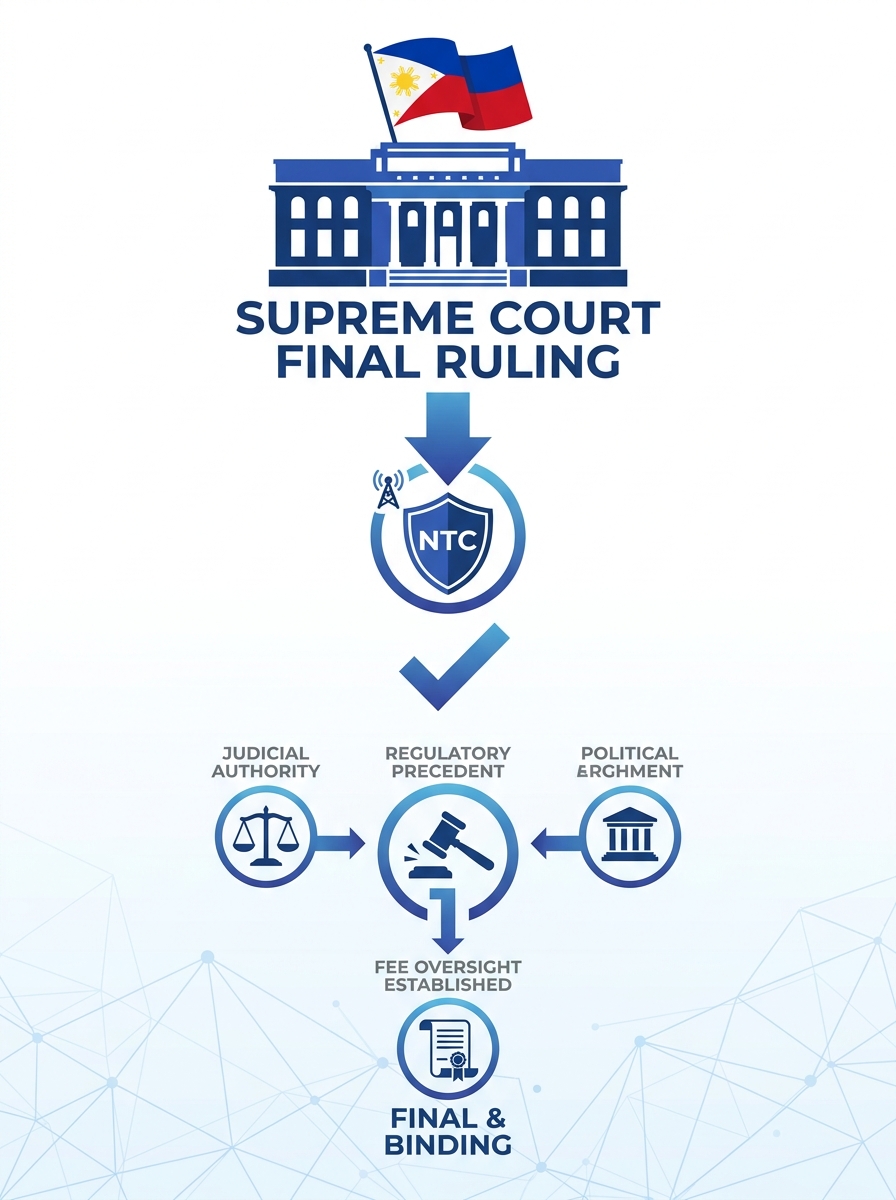
The Supreme Court’s April 21 denial of NOW Telecom’s final motion for reconsideration clears the National Telecommunications Commission to pursue collection of P3.77 billion in unpaid regulatory fees and penalties, the NTC announced June 27, ending a decade-long dispute over how the regulator calculates Supervision and Regulation Fees when companies convert debt into equity.
TL;DR: The Supreme Court denied NOW Telecom’s final appeal with finality April 21, 2026, upholding NTC’s authority to collect P3.77 billion in unpaid Supervision and Regulation Fees and Spectrum User Fees plus penalties, and affirming the company’s disqualification from 3G frequency assignment for non-payment.
The High Court also directed the immediate issuance of an entry of final judgment covering all consolidated cases involving NOW Telecom, which formerly operated as Next Mobile Inc., according to the NTC’s June 27 statement. The resolution marks the conclusion of a legal challenge that began when the NTC disqualified NOW Telecom from securing 3G spectrum after the carrier failed to pay outstanding regulatory obligations.
The ruling establishes binding precedent on how Philippine telecom regulators may treat debt-to-equity conversions when computing annual supervision fees—a calculation methodology that directly affects carrier licensing obligations and spectrum-assignment eligibility nationwide.
The Debt-to-Equity Dispute at the Center of the Case
NOW Telecom challenged the NTC’s decision to include additional paid-in capital created through a debt-to-equity conversion in the base figure used to calculate Supervision and Regulation Fees. The company argued that converting creditor liabilities into stock subscriptions should not trigger increased regulatory fee obligations because no new cash entered the business. The Supreme Court rejected that position.
“The Supreme Court held that when NOW Telecom converted its creditors’ liabilities to stock subscription, there was a corresponding increase in its capital stock in consideration for the extinguishment of the liability, which is now considered as paid stock,” the NTC said in its statement. The ruling treats debt-forgiveness-for-equity transactions identically to cash capital injections for purposes of computing the annual fees carriers owe the regulator.
The NTC levies Supervision and Regulation Fees against telecommunications carriers as a percentage of authorized capital stock and collects Spectrum User Fees based on assigned radio frequencies. Both fee streams fund the commission’s regulatory operations and spectrum-management functions.
Court Affirms Disqualification from 3G Frequency Assignment
The Supreme Court upheld the NTC’s disqualification of NOW Telecom from a third-generation mobile frequency assignment after determining the carrier had failed to pay P135.77 million in combined regulatory fees as of December 2005. That figure comprised P126.09 million in unpaid Supervision and Regulation Fees and P9.67 million in unpaid Spectrum User Fees, according to the Court’s decision.
“As the National Telecommunications Commission pointed out, Next Mobile did not pay these fees even under protest. Next Mobile was, thus, correctly disqualified for non-payment of fees,” the Supreme Court wrote in its decision. Philippine telecommunications law requires carriers to maintain current accounts with the NTC as a condition of spectrum-assignment eligibility.
The disqualification barred NOW Telecom from receiving radio frequencies necessary to launch commercial 3G mobile services during the mid-2000s rollout of third-generation networks in the Philippines. The company continued operating under its existing 2G license while challenging the NTC determination through successive court proceedings.
Outstanding Balance Reaches P3.77 Billion
Following the Supreme Court’s final ruling, the NTC confirmed it will proceed with collecting NOW Telecom’s outstanding Supervision and Regulation Fee liabilities, which reached P3.77 billion as of September 30, 2025. That balance includes accumulated penalties and interest charges on the principal amounts due dating to the mid-2000s non-payment period.
The regulator has not disclosed the specific breakdown between base fees, late-payment penalties, and accrued interest within the P3.77 billion total. Standard NTC penalty provisions assess monthly surcharges on overdue regulatory obligations at rates published in commission circulars.
The outstanding amount represents one of the largest single regulatory-fee collection actions in NTC history. The commission’s annual budget reports typically show aggregate Supervision and Regulation Fee collections in the P2-billion to P3-billion range across all licensed carriers combined.
Why This Matters Now
The Supreme Court’s ruling clarifies NTC enforcement authority over unpaid regulatory fees at a moment when the commission is preparing spectrum auctions for 5G expansion and evaluating new carrier applications under the liberalized telecommunications policy framework. The decision confirms that the regulator may disqualify license applicants and spectrum bidders who carry unpaid fee balances, regardless of the accounting treatment that created those obligations.
For enterprises and government agencies evaluating carrier selection for voice and data services, the case underscores the importance of verifying that providers maintain good standing with the NTC. Carriers operating under unresolved regulatory disputes face elevated license-revocation risk and may encounter constraints in securing additional spectrum necessary to expand network capacity or deploy next-generation technologies.
The debt-to-equity precedent also affects how Philippine telecom operators structure financial restructurings during periods of distress. The ruling establishes that converting unpaid vendor obligations or bank debt into equity will trigger increased Supervision and Regulation Fee assessments in the year of conversion, adding a regulatory-cost dimension to decisions that carriers previously evaluated purely through tax and accounting lenses. Network planners negotiating carrier agreements should confirm that prospective providers face no pending NTC collection actions that could disrupt service continuity.