
RFC 3261 defines SIP as the signaling control layer that starts, manages, and ends real-time VoIP sessions, while the actual audio travels separately over RTP. Every enterprise VoIP call on Philippine infrastructure follows the same message sequence specified in that document, whether the endpoint is a Fanvil desk phone in Makati or a Yeastar gateway bridging analog lines in a Davao hospital.
How a SIP Phone Announces Itself
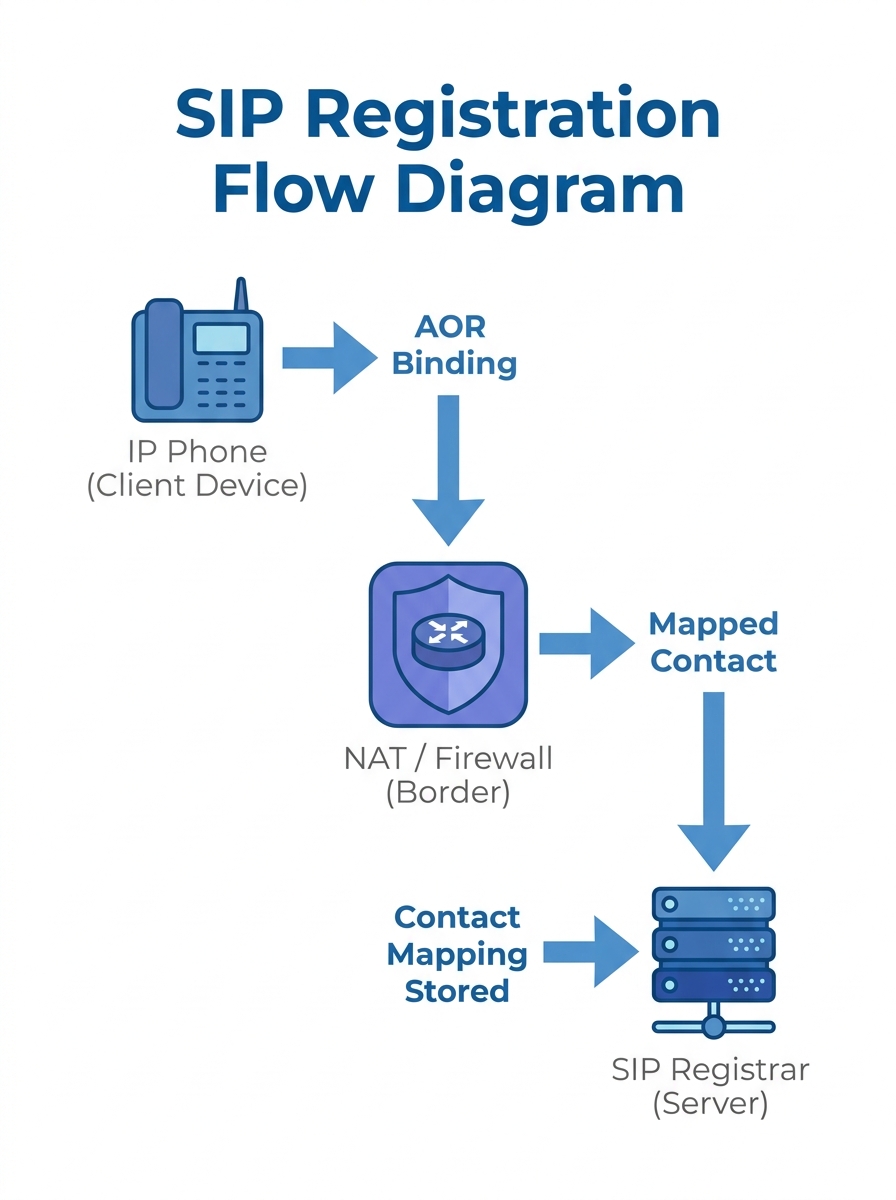
The SIP registration flow starts the instant an IP phone or ATA completes its boot sequence. The device constructs a REGISTER request and sends it to the SIP registrar’s IP address or domain, declaring two pieces of information: its identity (who it is) and its current network location (where it is). According to Plivo’s SIP documentation, “a REGISTER message creates a bond between the device and a SIP Address of Record (AOR) in the format sip:user@domain,” such as [email protected], which another endpoint can use to reach the registered device.
The distinction between the AOR and the Contact address matters. A typical SIP URI might look like [email protected], as described in VoIP Mechanic’s SIP registration walkthrough, while the Contact address appended to the REGISTER message would be [email protected], where 192.168.1.120 is the private IP of the endpoint on the local LAN. The registrar maps the public AOR to that private Contact, creating the binding that lets inbound calls find the phone.
For Philippine deployments running behind PLDT or Globe circuits with carrier-grade NAT (CGNAT), this binding introduces an immediate complication. The registrar records a private IP, but the address visible to the outside world is the ISP’s CGNAT pool address. If you’ve dealt with NAT traversal failures on enterprise VoIP, you’ve seen this exact symptom: phones register successfully but inbound calls never arrive because the binding points to an unreachable internal IP.
The 401 Challenge Loop
A well-configured registrar doesn’t accept the first REGISTER blindly. Upon receiving the initial request, it responds with a 401 Unauthorized message containing a cryptographic nonce, a one-time random string the phone must incorporate into a hashed credential. The phone then re-sends the REGISTER with an Authorization header carrying a digest computed from its username, password, realm, and that nonce.
This challenge-response cycle adds exactly one round trip to the registration process. On a Metro Manila LAN with sub-1ms latency to the PBX, the added delay is negligible. On a branch office in Zamboanga connecting over a 15ms WAN link to a centralized Cisco UCM cluster in Cebu, each round trip is noticeable when 50 phones simultaneously power on after a brownout. During that boot storm, the registrar handles 100 REGISTER messages (50 initial attempts plus 50 challenged re-sends) within a span of 3 to 8 seconds.
Award Consulting’s technical analysis of SIP registration explains that “the Call-ID is a unique identifier used in all registration attempts from a particular phone to a particular registrar, and it helps the registrar know when a registration is being refreshed.” The CSeq field, a sequential counter, ensures messages within the same dialog arrive in order. Together, Call-ID and CSeq prevent the registrar from confusing a fresh registration attempt with a stale retry from a previously rebooted phone.
Why Philippine Networks Need Shorter Expiry Timers
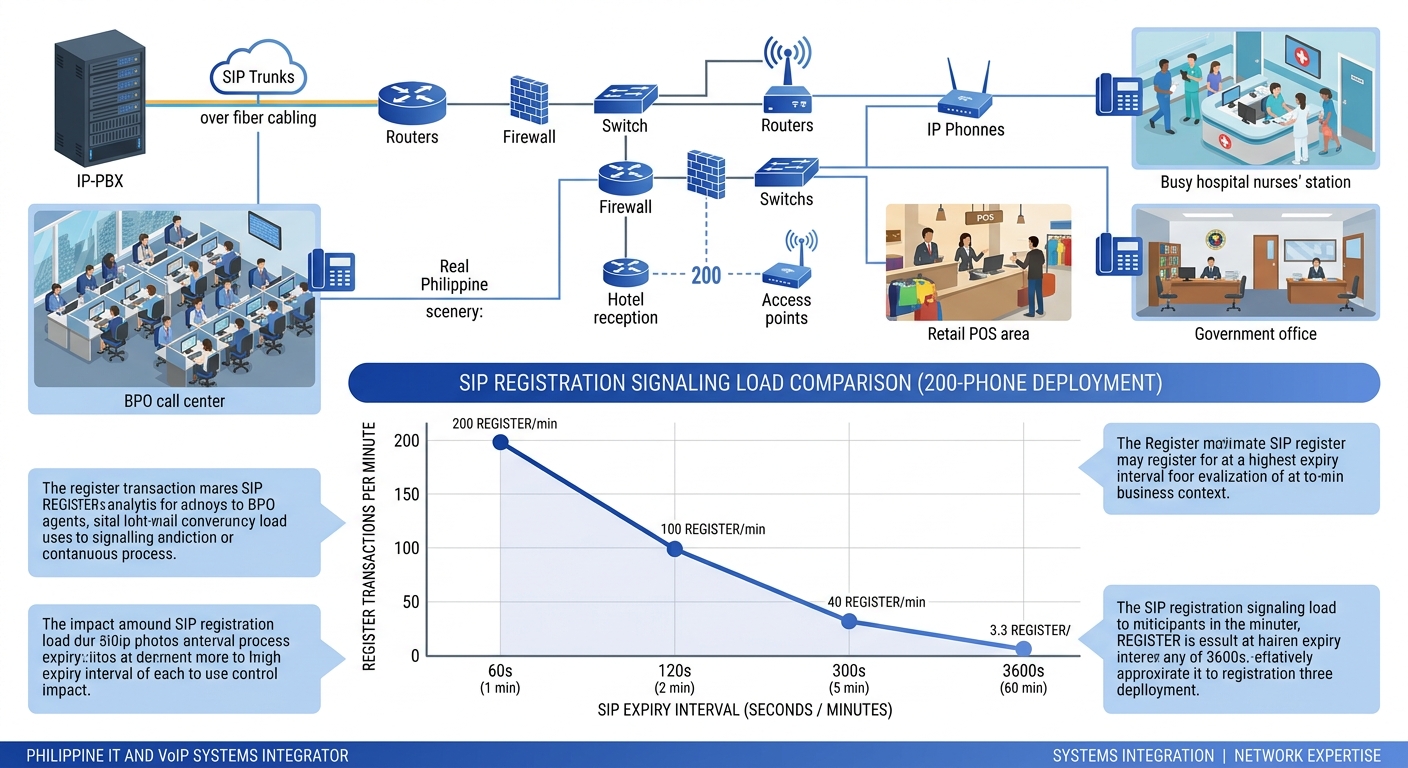
Every REGISTER message includes an Expires header, typically defaulting to 3,600 seconds (1 hour) per RFC 3261. The registrar can override this value downward in its 200 OK response. For Philippine enterprise deployments, the recommended practice is to set SIP registration expiry intervals between 120 and 300 seconds, according to field data from Philippine VoIP engineers. This is a significant deviation from the 1-hour default, driven by local ISP instability.
Why the shorter window? Philippine ISPs rotate CGNAT pool addresses more frequently than their counterparts in markets with abundant IPv4 allocations. When a CGNAT address changes mid-session, the registrar’s binding becomes stale. A 3,600-second expiry means a phone could remain “registered” with an unreachable address for up to an hour. At 120 to 300 seconds, phones re-register within 2 to 5 minutes of any IP change, cutting the window for phantom offline status dramatically.
The tradeoff is signaling volume. A 200-phone deployment with 120-second expiry intervals generates roughly 100 additional REGISTER transactions per minute compared to the same deployment at 3,600-second intervals. For a Yeastar P-Series PBX rated for 500 concurrent registrations, this additional SIP signaling load is trivial. For an undersized system in a BPO handling 300 agent seats, it can consume meaningful CPU cycles on the registrar, especially when each transaction triggers a database lookup against the user directory.
Tip: If your SIP registrar CPU spikes correlate with registration intervals rather than active call volume, check whether your Expires value is set below 60 seconds. Intervals under 60 seconds generate excessive signaling without meaningful improvement in binding freshness.
INVITE Fires and the Call Setup Begins
With registration established, the INVITE handshake kicks off when a user dials a number. The caller’s phone constructs an INVITE request containing the called party’s SIP URI in the Request-URI and the caller’s SDP (Session Description Protocol) payload in the message body. The SDP describes which codecs the caller supports (G.711, G.729, Opus), which IP address and port it wants to receive RTP audio on, and whether it supports SRTP encryption.
As RFC 3261 specifies, “INVITE can contain the media information of the caller in the message body.” This early media offer is the standard model: the caller proposes its capabilities, and the callee’s 200 OK response contains an SDP answer selecting the mutually supported codec and media parameters.
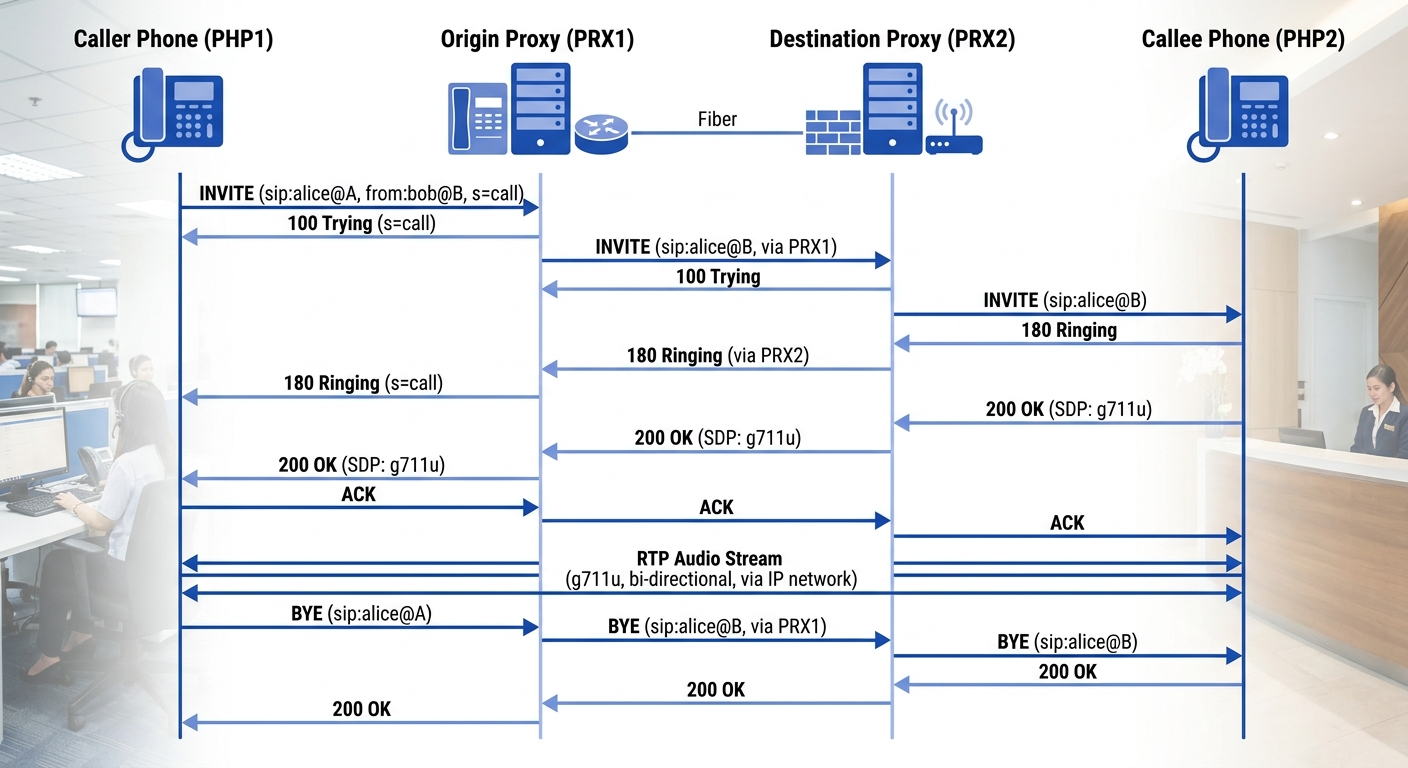
In enterprise VoIP environments, SIP calls often traverse multiple proxy servers, forming what the IETF calls the “SIP trapezoid” topology. The calling phone sends INVITE to its outbound proxy. That proxy performs a DNS or database lookup on the Request-URI domain, routes the INVITE to the callee’s inbound proxy, and that proxy forwards the INVITE to the registered Contact address of the destination phone. Each proxy in this SIP proxy architecture adds a Via header, creating a breadcrumb trail the responses follow back to the originator.
For Philippine enterprises with QoS policies configured on their network routers, the INVITE itself is a small packet (typically 800 to 1,200 bytes depending on SDP size and header count). It’s the subsequent RTP stream, not the signaling, that demands bandwidth reservation. But the INVITE’s routing path determines whether RTP will flow directly between endpoints or get forced through an intermediary, a distinction that affects both latency and call state management throughout the session.
From 180 Ringing to Audio: The Response Sequence
The response to an INVITE follows a strict numerical progression. First, the callee’s proxy or the callee itself sends a 100 Trying provisional response, which tells the caller’s proxy to stop retransmitting the INVITE. The caller’s phone receives a 180 Ringing response, triggering the local ringback tone. When the callee picks up, a 200 OK response carrying the callee’s SDP answer travels back through the proxy chain.
The caller’s phone then sends an ACK, completing what TelcoBridges’ call flow documentation describes as the three-way handshake: INVITE, 200 OK, ACK. This three-message exchange is the minimum required to establish a SIP session. The 100 Trying and 180 Ringing are provisional (1xx class) responses that don’t require their own ACKs.
RFC 3261 explains the architectural consequence of this exchange: “The endpoints have learned each other’s address from the Contact header fields through the INVITE/200 (OK) exchange, which was not known when the initial INVITE was sent. The lookups performed by the two proxies are no longer needed, so the proxies drop out of the call flow.” This proxy dropout is a defining feature of SIP’s architecture. After the initial INVITE handshake, the two phones know each other’s direct Contact addresses. Subsequent in-dialog requests (re-INVITE for hold/resume, BYE for hangup) travel directly between the endpoints, bypassing the proxy infrastructure entirely.
After the INVITE/200/ACK handshake, the two phones know each other’s direct addresses, and the proxies drop out of the call flow entirely.
This design reduces proxy load by keeping active call signaling off the proxy servers. It also means that troubleshooting mid-call failures requires packet captures at the endpoint level, not at the proxy, since re-INVITEs and BYEs never touch the proxy after initial setup.
Call State After the Handshake
Once RTP audio flows between the two endpoints, call state management shifts from the signaling layer to the dialog layer. SIP maintains state through three identifiers: the Call-ID (unique to the dialog), the From tag (identifying the caller’s side of the dialog), and the To tag (added by the callee in the 200 OK). These three values together form the dialog identifier. Any subsequent request within the same call, whether a re-INVITE to put the call on hold, an UPDATE to renegotiate codecs, or a BYE to terminate, must carry all three values.
Hold and resume operations are the most common in-dialog transactions in Philippine enterprise environments. When an agent at a BPO call center places a customer on hold, the phone sends a re-INVITE with a modified SDP that sets the media direction to “sendonly” or “inactive,” effectively muting the RTP stream from the agent’s side. Resuming the call triggers another re-INVITE restoring bidirectional media. Each of these re-INVITEs gets its own 200 OK and ACK response, following the same three-way handshake pattern as the initial call setup.
Session termination requires a BYE request from either party. The BYE travels directly to the other endpoint (proxies are out of the path at this point), and the receiving side responds with a 200 OK. The dialog state is then cleared at both endpoints. If a BYE never arrives because a network link drops or a phone loses power, the remaining endpoint relies on RTP timeout detection (typically 30 seconds of silence) or SIP session timer extensions (RFC 4028, with re-INVITE keepalives every 90 to 1,800 seconds) to detect the dead call and free resources.
For organizations running automated call quality monitoring, tracking three signaling-layer metrics provides earlier warning than RTP-level analysis alone: REGISTER success rates (below 98% indicates registration infrastructure stress), INVITE-to-200-OK latency (above 250ms means routing or endpoint problems), and ACK delivery rates (failed ACKs produce “phantom ringing” where a call appears answered but no audio flows).
Where This Lands on Philippine Enterprise Networks
Philippine enterprise networks face a specific combination of challenges that stress SIP’s assumptions. CGNAT, inconsistent firewall firmware across branch offices, and ISP maintenance windows that coincide with BPO night shifts all interact with the registration and call flow mechanics described above. The deployments that maintain reliability share consistent architectural choices: voice and data traffic on separate VLANs, SIP signaling and RTP media on their own network segment with QoS policies, and registration expiry timers calibrated to local ISP behavior rather than RFC defaults.
Enterprises handling sensitive data, particularly hospitals and banks, operate under NTC Memorandum Circular No. 05-08-2005 and DICT security guidelines. Because SIP sends authentication credentials and session metadata in plaintext by default, these organizations need TLS for signaling (SIPS, port 5061) and SRTP for media encryption. The recent active exploitation of CVE-2026-20230 in Cisco UCM underscores why SIP infrastructure can’t be treated as a sealed box. Signaling servers are internet-facing by nature, and every REGISTER and INVITE is a potential attack surface.
Understanding the registration and call flow sequence at the message level changes how Philippine IT teams approach troubleshooting. A “call won’t connect” ticket could mean the REGISTER binding is stale (expiry timer issue), the INVITE is being blocked by a firewall that doesn’t recognize SIP (ALG misconfiguration), the 200 OK’s Contact header contains a NAT’d address the caller can’t reach (NAT traversal failure), or the ACK is getting dropped by a stateful firewall that closed the pinhole too early. Each of these failures occurs at a different point in the signaling timeline, and knowing where to look in a packet capture turns a 2-hour troubleshooting session into a 15-minute one.