
The Philippine government’s FY 2025 VoIP phone procurement documents from the Office of the Solicitor General specify handset models, Wi-Fi capability, and delivery timelines. They contain no requirements for network readiness assessments, QoS policies, or VLAN segmentation. That gap between buying phones and building infrastructure is where government IP telephony Philippines projects break down.
TL;DR: Philippine government agencies treat VoIP deployment as a hardware purchase. The result is predictable: phones work in pilot, call quality collapses at scale, and staff revert to Viber and mobile calls. Five specific, correctable mistakes cause this cycle, and all five trace back to procurement documents that ignore the network.
The Pattern That Keeps Repeating
Why do so many LGU VoIP deployment projects follow the same arc? According to Kital’s network-first design analysis, “the phones work during the pilot, call quality degrades within weeks of full rollout, and staff quietly revert to mobile phones and Viber group chats.” This pattern has repeated across municipal halls, provincial capitols, and national agency offices for years.
The failure rate traces to five specific errors. Each one is fixable. But each one requires addressing the problem before procurement, not after the phones arrive.
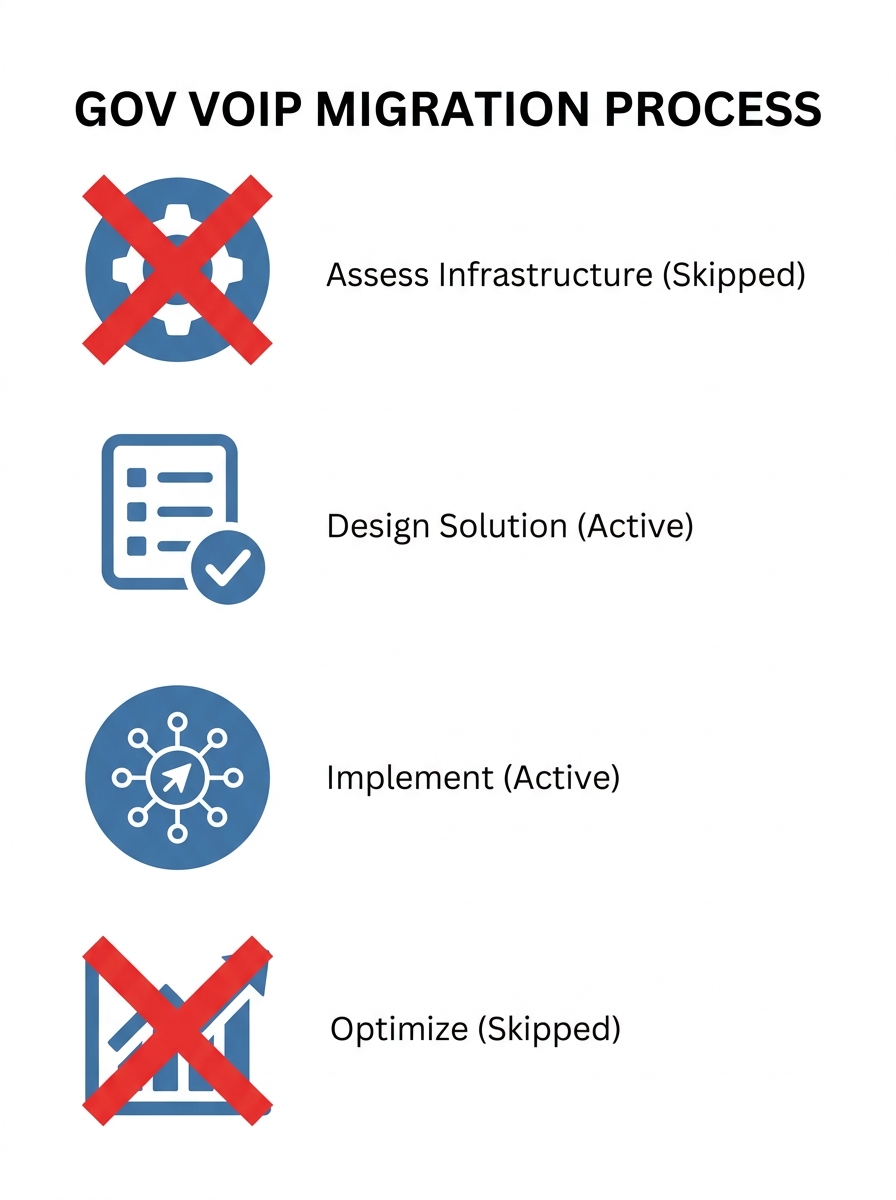
VoIP/IPT migration follows a four-stage process: assess and prepare the infrastructure, design the solution, implement it, then optimize. Philippine government projects routinely skip stage one and compress stage two into a line item on a bid document. The remaining three mistakes happen because of that foundation failure.
Mistake 1: Procurement Specs That Buy Phones Instead of Systems
The OSG’s FY 2025 bid documents for “Supply, Delivery, and Installation of Semi-Expendable Communication Equipment: Wi-Fi Enabled Voice Over IP (VOIP) Phones” focus on handset features. The procurement title itself tells the story: “communication equipment,” not “communication system.” This is the first and most damaging of the common IP telephony procurement mistakes in public sector projects.
Philippine government procurement under Republic Act 9184 evaluates bids on technical specifications and lowest compliant price. When the technical spec describes a phone (screen size, codec support, PoE compatibility), the winning bid delivers phones. When the spec describes a system (bandwidth requirements per concurrent call, QoS policy enforcement, failover architecture, SIP trunk redundancy), the winning bid delivers infrastructure.
The fix is structural. Procurement documents for public sector PBX migration need to include network assessment deliverables as mandatory bid components. Require bidders to submit a pre-deployment site survey covering switch port capacity, available bandwidth per floor, existing VLAN topology, and internet uplink redundancy. Tie payment milestones to call quality metrics (under 150ms one-way latency, under 30ms jitter, under 1% packet loss) measured 30 days after full rollout, not at handover.
Mistake 2: Ignoring QoS on Shared Government Networks
Voice traffic requires guaranteed bandwidth, low jitter (under 30ms), and one-way latency below 150ms. Data traffic doesn’t care about 200ms of delay. When both share the same switches and uplinks with no traffic prioritization, voice loses every time.
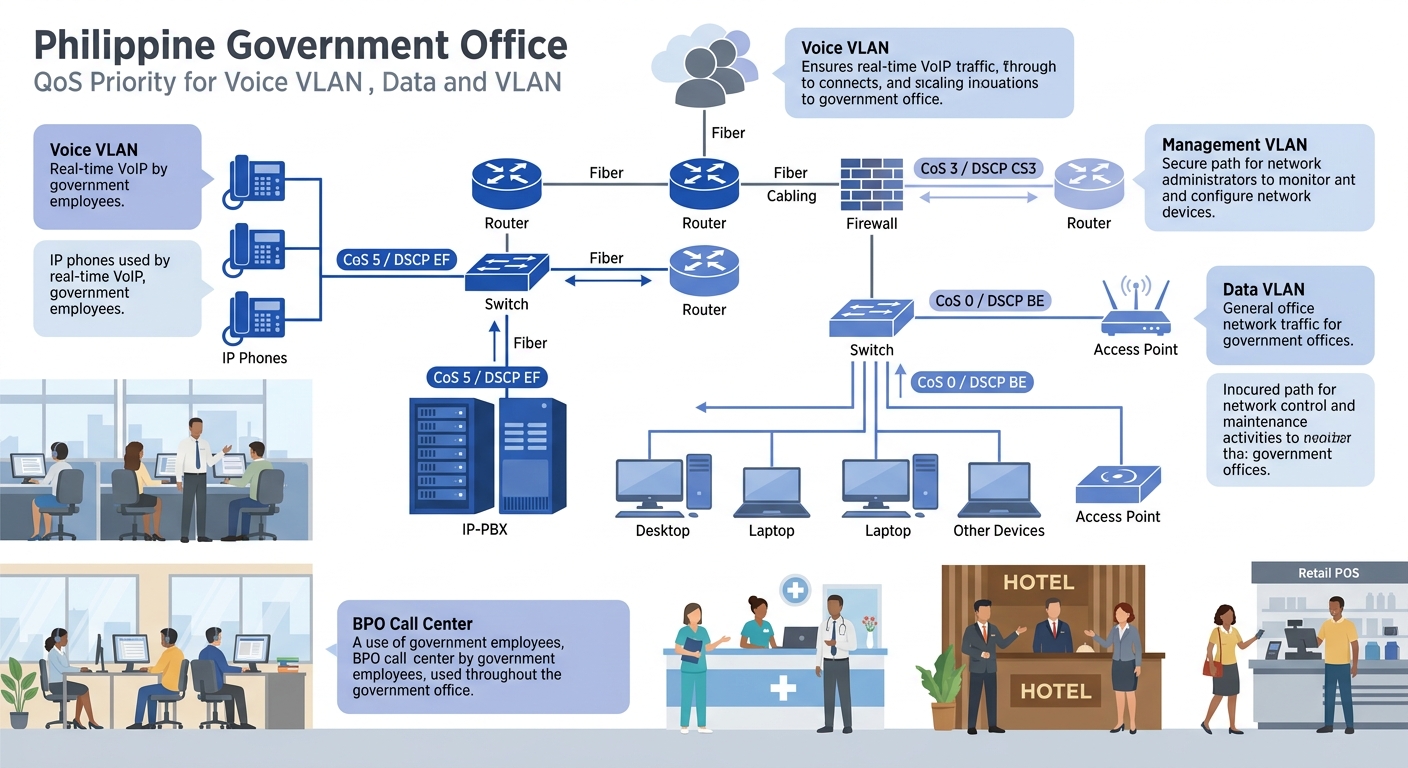
Cisco Press’s IP telephony planning guidance recommends QoS enforcement at every layer of the network to provide “end-to-end guaranteed delivery of your voice traffic.” This means configuring 802.1p priority tagging on access switches, DSCP marking on routers, and traffic shaping on WAN links. Philippine government office networks, which often run flat Layer 2 topologies with a single VLAN for all devices, are the worst possible environment for voice.
A municipality with 50 VoIP handsets and a 100 Mbps fiber uplink needs roughly 5 Mbps of dedicated bandwidth for concurrent calls using the G.711 codec (about 100 Kbps per call). That sounds small. But when 20 employees start a file download or a CCTV system pushes footage to cloud storage, that 5 Mbps disappears. Without QoS rules, the switch treats a VoIP packet and a backup packet identically.
The correction: configure at least 3 VLANs (voice, data, management) on every switch in the deployment. Assign DSCP EF (Expedited Forwarding, value 46) to all voice traffic. Set strict priority queuing on uplinks. If your existing switches don’t support 802.1Q VLAN trunking or basic QoS, they need replacement before the phones arrive. You can find detailed guidance on monitoring call quality after deployment to validate that QoS policies are actually working.
Mistake 3: No VLAN Segmentation or Voice Security Hardening
This mistake compounds Mistake 2. Without VLAN segmentation, VoIP handsets sit on the same broadcast domain as workstations, printers, and personal devices. Every device on that network can sniff SIP signaling packets, capture RTP audio streams, and intercept call metadata.
SIP, the signaling protocol used by 90% or more of modern IP PBX systems, transmits call setup data in plaintext by default. According to WCS India’s IP telephony best practices, agencies should “make a development plan of an IP telephony security program as a cross-organizational and collaborative project involving all stakeholders.” The DICT’s National Cybersecurity Plan 2023-2028 reinforces this, shifting government security toward a risk-based approach that evaluates individual organizational impact.
The Philippine Anti-Wiretapping Act of 1969 and the 1987 Constitution’s privacy protections create legal liability for agencies that fail to protect voice communications. The NTC mandates that telcos retain voice and non-voice traffic data for at least 2 months. Government agencies handling their own VoIP infrastructure inherit a similar obligation to protect call data.
Specific corrections: enable TLS encryption for SIP signaling on all endpoints and PBX servers. Enable SRTP (Secure Real-Time Transport Protocol) for voice media. Restrict SIP registration to known MAC addresses or use 802.1X port-based authentication. Deploying zero-trust network access principles for your VoIP infrastructure addresses these gaps at an architectural level. For agencies running Cisco Unified CM, pay close attention to recent critical vulnerabilities that enable unauthenticated access through unpatched systems.
Warning: Unencrypted SIP traffic on a flat government network means any compromised workstation on the LAN can record calls, extract extension directories, and map internal organizational structures. This is a national security concern, not an IT inconvenience.
Mistake 4: Single-Point-of-Failure Architectures with No Failover
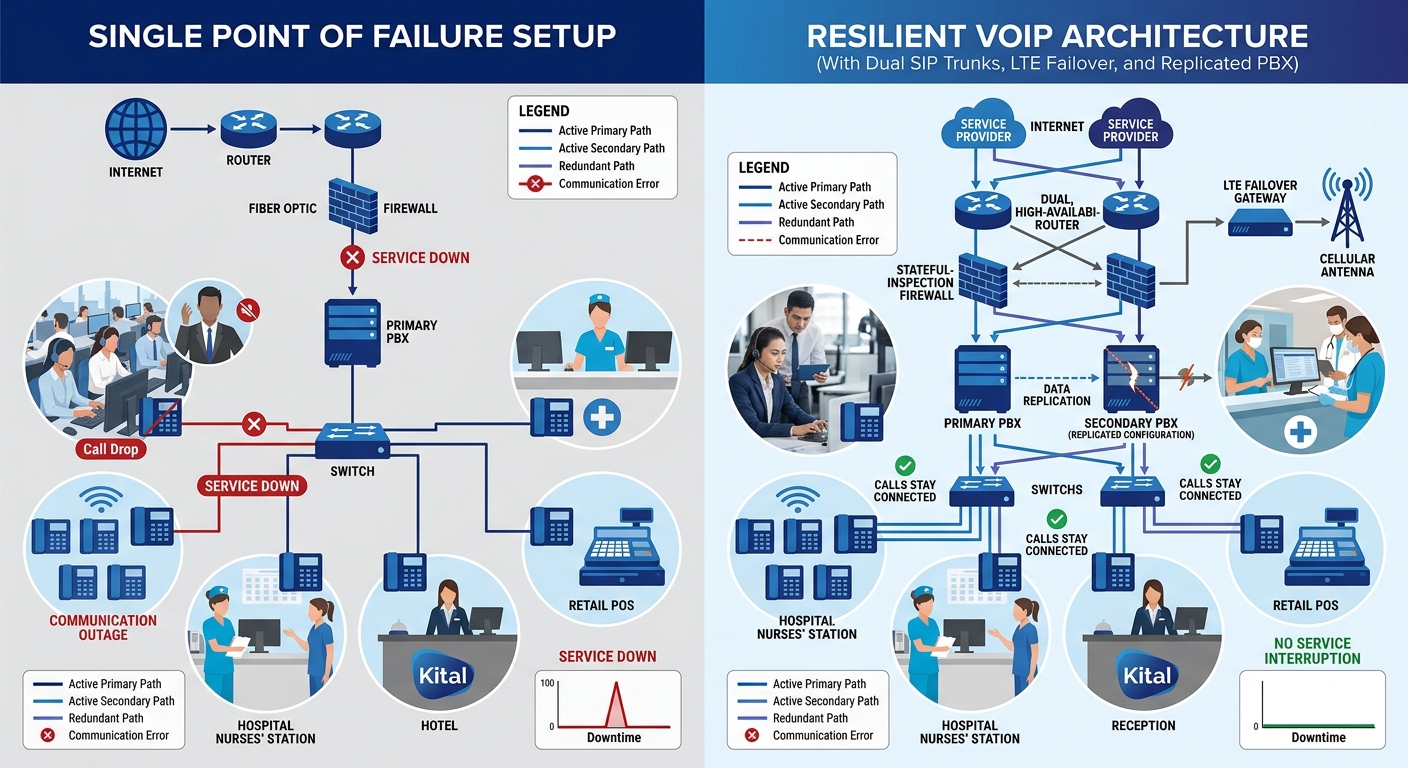
Philippine government ICT infrastructure faces typhoons, brownouts, and ISP outages that commercial buildings in Makati rarely experience. A municipal hall in a coastal Visayas town loses power and connectivity for days during storm season, not hours. Yet most LGU VoIP deployments run a single PBX server, a single SIP trunk from one provider, and no battery backup beyond whatever the UPS handles for the server room.
Kital’s deployment checklist for government agencies specifies: “Pair hardware redundancy with solid backup and recovery solutions so that configuration data, call recordings, and directory information survive a catastrophic failure.” This means at minimum a secondary PBX (or a warm-standby VM image), dual SIP trunks from separate carriers, and configuration backups stored off-site.
The DICT’s National Broadband Plan favors 4G and 5G deployment, which gives provincial agencies a cellular failover path when fixed-line connections drop. A Yeastar or Xorcom PBX with an LTE gateway can route outbound calls over cellular when the primary SIP trunk fails. Total cost for that failover path: roughly PHP 15,000 to PHP 30,000 for the gateway plus a monthly SIM plan.
We’ve written extensively about why disaster recovery plans fail during actual typhoon outages, and the lessons apply directly to government voice systems. If your PBX can’t survive 48 hours of primary ISP downtime, your agency can’t communicate during the exact emergencies when communication matters most.
Mistake 5: No Dial Plan Strategy Beyond Replicating the Old System
AudioCodes’ analysis of Webex Calling migrations found that agencies “recreating every legacy behavior” in their new system create routing conflicts and extension collisions. Their recommendation: “Map your routing early and build a future-state dial plan rather than recreating every legacy behavior. Standardize where possible.”
Philippine government agencies migrating from analog PABX systems often try to keep every 3-digit or 4-digit extension unchanged, preserve the exact ring group logic, and replicate each analog trunk’s routing rules. This approach ignores SIP’s flexibility. A modern IP PBX supports 5-digit extension plans across multiple sites, time-based routing, hunt groups, auto-attendants, and presence-based call forwarding.
Build the dial plan for the organization you want to be, not the switchboard you’re replacing. If your agency has 3 offices across Metro Manila, Cebu, and Davao, create a unified extension plan with site prefixes (2XXXX for Manila, 3XXXX for Cebu, 4XXXX for Davao). Configure inter-site calls as on-net SIP traffic instead of routing them through the PSTN. That single change can cut inter-office call costs by 80% to 100%, since on-net SIP calls travel over your existing data links.
Agencies wrestling with vendor lock-in from proprietary UC platforms face this problem in its worst form: a dial plan designed around one vendor’s quirks becomes a migration barrier when you need to switch systems 5 years later.
The procurement document is the deployment plan. If it specifies phones without specifying the network those phones need, the project has already failed before a single handset ships.
A Scoring Framework for Pre-Deployment Readiness
To avoid repeating these 5 mistakes, evaluate every government IP telephony project against what we’ll call the Government VoIP Readiness Score, a simple 5-axis check:
| Readiness Axis | Pass Criteria | Common Failure |
|---|---|---|
| Network Assessment | Bandwidth survey, switch audit, latency baseline completed before procurement | No assessment; specs list only handset models |
| QoS Configuration | Voice VLAN, DSCP marking, priority queuing documented in bid requirements | Flat network, no traffic prioritization |
| Security Hardening | TLS/SRTP required, 802.1X or MAC filtering, VLAN isolation | Plaintext SIP on shared data VLAN |
| Failover Architecture | Dual SIP trunks, backup PBX, LTE gateway, off-site config backup | Single server, single trunk, no backup |
| Dial Plan Design | Unified multi-site numbering, on-net routing, future-state extension plan | 1:1 replication of legacy analog extensions |
Score each axis 0 (not addressed), 1 (partially addressed), or 2 (fully addressed). A project scoring below 7 out of 10 should not proceed to procurement. Agencies looking for communication systems designed for Philippine government requirements can use this scorecard to evaluate any vendor’s proposal.
What the Procurement Documents Still Can’t Measure
The five mistakes above are all visible in bid documents, network diagrams, and project plans. The data points to clear gaps: missing QoS specs, absent security requirements, single-trunk architectures. But procurement documents can’t measure the human factors that determine whether a VoIP deployment actually sticks.
Change management, specifically whether staff adopt the new phones or keep using Viber, depends on training, help desk support, and executive buy-in. The GOVX.0 2026 summit’s analysis of public sector cloud migration notes that “cloud-based systems now support broader reforms tied to service access and operational stability,” but those reforms require people to use the systems. A well-built unified communications platform delivers nothing if the agency head still takes calls on a personal mobile.
The numbers tell us where projects fail technically. They don’t tell us how many government employees across the Philippines’ 1,715 municipalities quietly bypass their desk phones every day. That’s the dataset nobody has collected yet, and it’s the one that would tell us how deep the problem actually goes.