
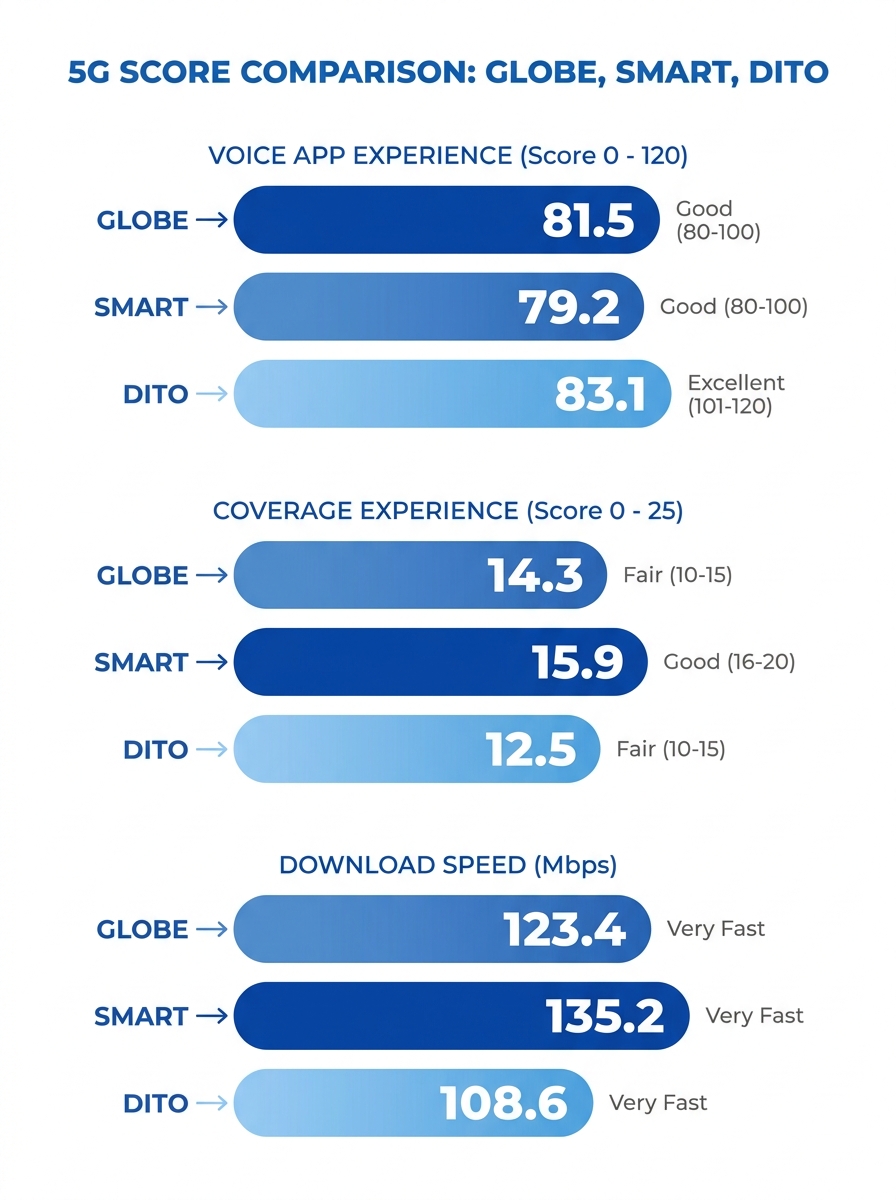
Smart’s 5G network scored 81.5 out of 100 on Opensignal’s Voice App Experience metric as of October 2025, edging out Globe and DITO in a statistically tight race. All three Philippine operators landed in the “Good” band (80–87 points) on that scale. For a country where BPO operations alone employ over 1.7 million people and depend on voice clarity for revenue, the gap between “Good” on a benchmarking index and “good enough for enterprise VoIP” matters more than the headline suggests.
This article breaks down what those numbers mean for Philippine enterprise voice performance, where the real gains from 5G VoIP migration show up, and where the marketing claims fall apart.
What the Opensignal Scores Actually Measure
The Opensignal Philippines 5G Experience Report evaluates voice quality across multiple dimensions: call setup time, call reliability, and audio clarity during active calls. The scoring model weights all three, and the 79.2–81.5 range that Globe, Smart, and DITO occupy puts them at the boundary between “Acceptable” and “Good.”
That boundary is important. An “Acceptable” score means users notice occasional quality problems. A “Good” score means they rarely do. For a consumer making a personal call, the difference is forgettable. For an enterprise running hundreds of concurrent agent calls in a Cebu BPO floor, a few points on that scale translate to measurable differences in average handle time, customer satisfaction scores, and supervisor escalation rates.
Globe leads in Coverage Experience with a score of 7.4 out of 10, compared to Smart’s 7.2 and DITO’s 3.8. That coverage gap becomes critical when you’re planning mobile network voice communication for field teams, warehouse staff, or hospital personnel who move between buildings throughout the day.
The Three 5G Features That Actually Change VoIP
Vendor marketing tends to bundle every 5G capability into a single pitch. For VoIP specifically, three features carry most of the weight.
Ultra-Low Latency
5G targets 1–2 milliseconds of radio access latency, down from the 20–30 ms typical of 4G LTE. VoIP calls become noticeably awkward above 150 ms of one-way delay. On a 4G call, you’re already burning 20–30 ms before the packet even leaves the tower. 5G claws back most of that budget, which matters when your traffic still has to traverse an IP network, hit a PBX, and reach the other party.
For enterprises running QoS configurations on their internal network, lower radio latency means you have more headroom for internal network hops before voice quality degrades.
Network Slicing
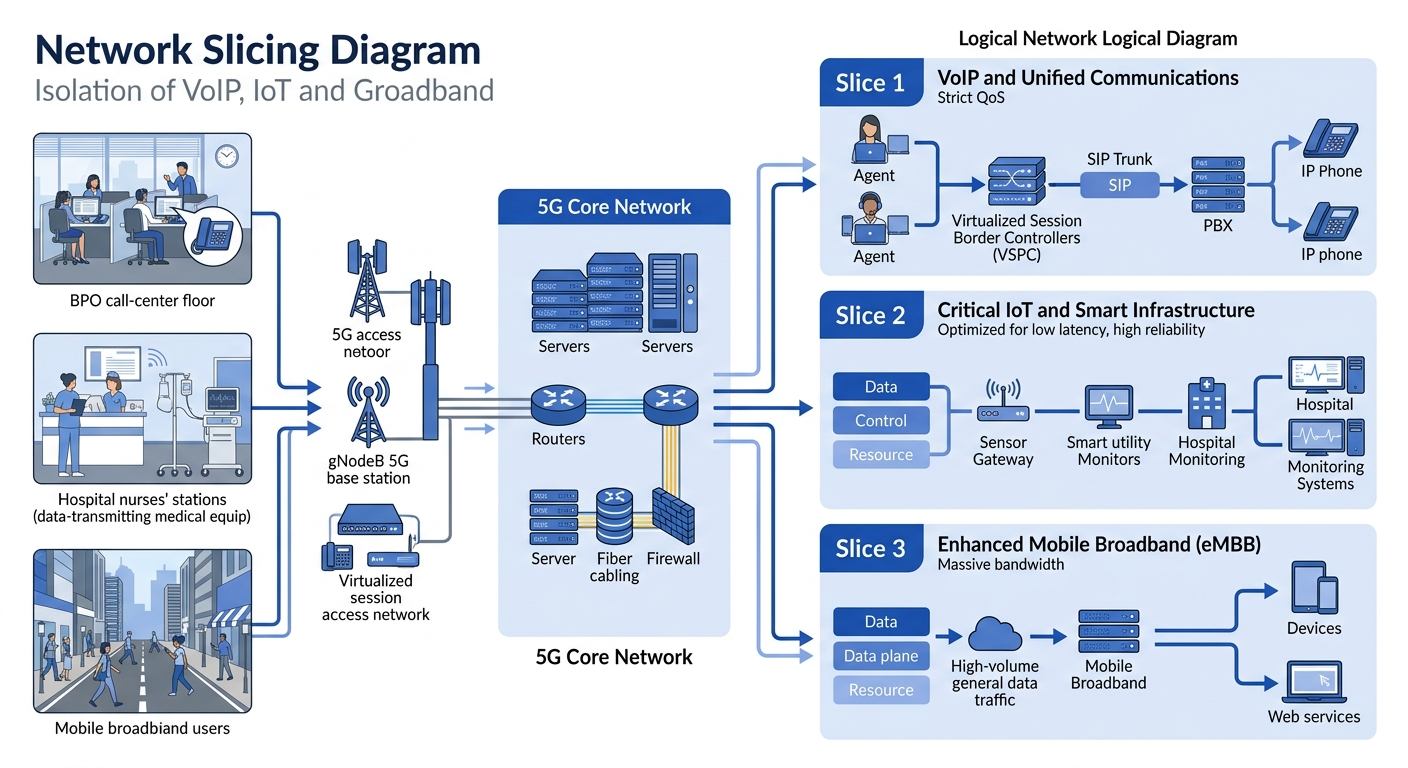
This is the feature enterprise IT teams should pay closest attention to. Network slicing lets carriers carve out a dedicated virtual network for VoIP traffic, isolated from data-heavy applications like video streaming or IoT telemetry. According to Ericsson’s analysis of voice services on 5G networks, network slicing on 5G standalone (SA) deployments enables mission-critical voice over a single physical network.
PLDT Enterprise already lists voice services including VoIP and conferencing in its 5G business portfolio. The practical question for Philippine enterprises is whether your carrier’s 5G deployment is standalone or non-standalone (NSA). NSA deployments, which rely on a 4G core with 5G radio, don’t support true network slicing. And most Philippine 5G coverage as of mid-2026 is still NSA.
Enhanced Voice Services (EVS) Codec
EVS adapts dynamically to network conditions. When your connection is strong, it delivers wideband audio that makes voices sound natural and distinct. When the connection weakens, it gracefully degrades instead of dropping the call. For call quality optimization in environments where signal strength varies (factories, hospitals, multi-story office buildings), EVS is a meaningful upgrade over the older AMR-WB codec that 4G VoLTE uses.
The 3G Sunset Forces the Timeline
The NTC has mandated a complete phase-out of 3G networks by December 31, 2026. This isn’t a suggestion. Enterprises still running 3G-dependent devices, GSM gateways, or backup cellular links need to migrate before year-end.
The regulatory deadline creates urgency for organizations that have deferred their voice infrastructure modernization. If your PBX uses GSM gateways with 3G SIM cards for failover, those gateways stop working when the towers go dark. Yeastar VoIP gateways with LTE SIM card slots are one way to maintain cellular failover on the new network, but the hardware swap needs to happen before December, not after.
Warning: If your current voice failover depends on 3G cellular gateways, test LTE/5G replacements now. Waiting until Q4 2026 risks being caught in a vendor backlog when every other enterprise makes the same switch simultaneously.
Government agencies face the same pressure. The DICT’s National Broadband Plan includes spectrum allocation policies that favor 4G and 5G deployment, and agencies still running legacy voice systems will find fewer and fewer excuses to delay. We’ve written about building resilient VoIP infrastructure for government agencies with this exact scenario in mind.
Where 5G VoIP Migration Hits Real-World Friction
The technology is promising. The deployment reality in the Philippines introduces friction that the spec sheets don’t mention.
Coverage Gaps Outside Metro Manila and Cebu
DITO’s Coverage Experience score of 3.8 out of 10 tells a blunt story. Even Globe’s leading score of 7.4 reflects the fact that 5G coverage is concentrated in dense urban areas. If your enterprise operates warehouses in Laguna, manufacturing plants in Batangas, or regional offices in Davao, don’t assume 5G will be available at every site. Run coverage audits before committing to a 5G-dependent voice architecture.
NSA vs. SA Deployment
The features that matter most for enterprise voice (network slicing, VoNR) require standalone 5G. Philippine carriers are still in mixed deployment modes. Until SA coverage is widespread, your 5G VoIP calls will often fall back to VoLTE on the 4G core, which means you’re getting better download speeds but similar voice performance to what you had before.
Handover Reliability
As Ericsson’s white paper notes, Voice over New Radio (VoNR) requires continuous NR coverage. When a user walks out of 5G range, the call needs to hand over to VoLTE without dropping. Early deployments rely on this handover being smooth, but Philippine building construction (thick concrete, metal roofing) can create coverage dead zones that force rapid handovers. Each handover is a potential call drop.
The gap between 5G’s theoretical voice quality and what a Philippine enterprise actually experiences depends less on the radio technology and more on network architecture decisions made months before the first call connects.
What to Prioritize Before You Migrate
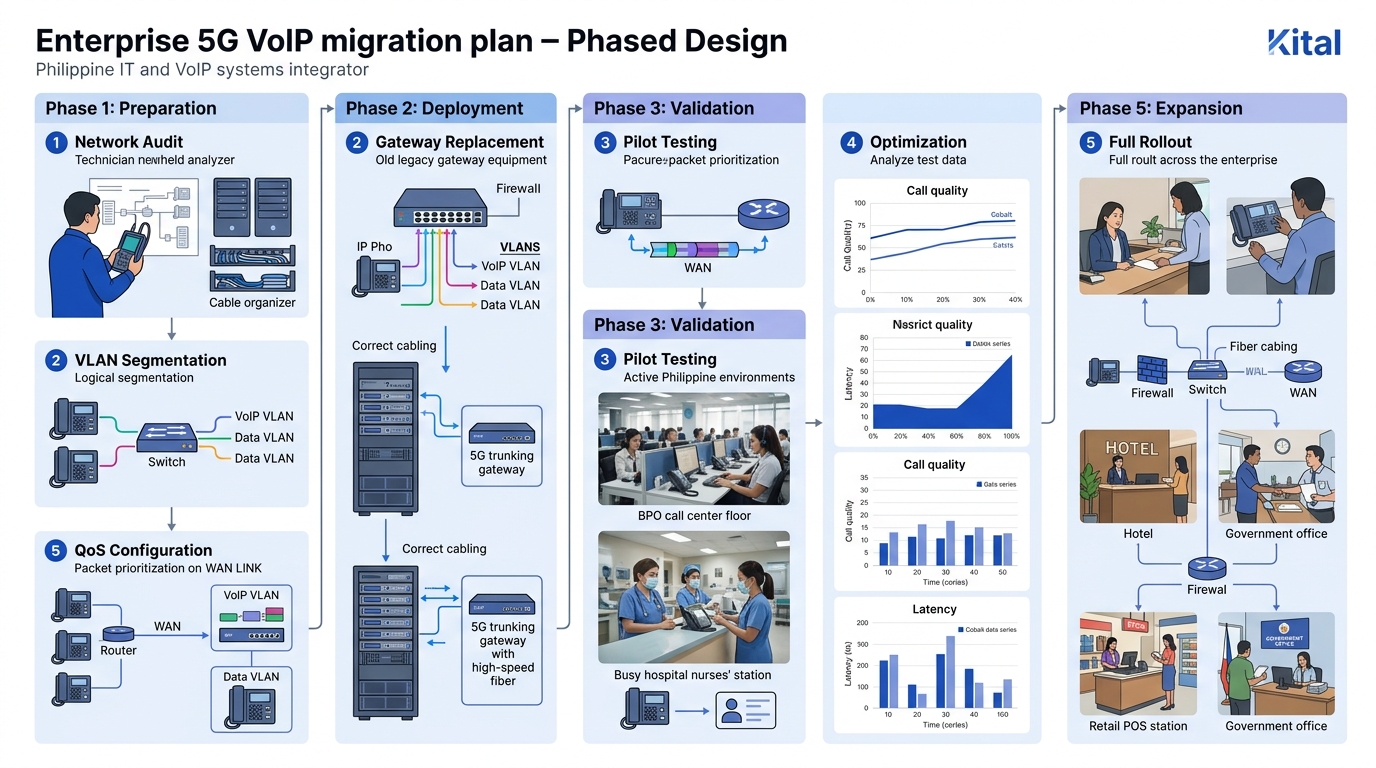
The enterprises that will get the most out of 5G VoIP are the ones that fix their internal network first. Throwing 5G connectivity at a flat, unsegmented LAN doesn’t improve voice quality. It just moves the bottleneck indoors.
Proper network segmentation and security design remains the foundation. Voice traffic should run on a dedicated VLAN, marked with DSCP 46 (Expedited Forwarding), and separated from general data and OT traffic. This is true whether your WAN link is fiber, 4G, or 5G.
For organizations in the BPO sector, where voice quality directly affects contract SLAs and client retention, the migration path involves layered investments. Contact-center technology for Philippine BPOs increasingly requires not just clear audio but integration with AI-driven routing, real-time analytics, and omnichannel platforms. 5G improves the transport layer, but the application layer needs equal attention.
And your enterprise network security posture needs to account for the expanded attack surface that 5G introduces. More connected endpoints, more SIM-based authentication, and more edge compute all create new vectors. Ericsson’s documentation highlights that VoNR benefits from 5G SA security enhancements, including stronger mutual authentication and encryption, but those protections only work if your internal policies match.
The Private 5G Question
An estimated 40% of Philippine businesses are exploring private 5G networks, according to industry projections tied to the DICT’s broadband modernization push. Private 5G gives you dedicated spectrum, local control over QoS policies, and isolation from public network congestion.
For large manufacturing facilities and factory-floor VoIP deployments, private 5G solves the coverage and reliability problem in one move. You control the radio environment, the slicing configuration, and the handover behavior. The cost is substantial, and the NTC’s spectrum allocation rules for private industrial use are still being finalized. But for mission-critical environments where a dropped call means a safety incident, the investment math works.
Smaller enterprises won’t go the private 5G route. Their path runs through carrier-managed 5G with enterprise SLAs, paired with on-premise IP-PBX systems that handle call routing, failover, and integration locally.
Questions the Numbers Still Can’t Answer
The Opensignal scores confirm that Philippine 5G voice quality is in the “Good” range. The NTC’s 3G sunset creates a hard deadline. The technology specifications promise lower latency, better codecs, and network isolation. All of that is real.
What the data can’t tell you is how your specific sites, your specific carrier, and your specific call patterns will perform after migration. A BPO floor in Quezon City running 500 concurrent calls through a Smart 5G connection will have a different experience than a hospital in Davao with 30 extensions on a Globe link.
Coverage maps don’t show indoor signal penetration. Latency benchmarks don’t account for your PBX’s processing overhead. Codec support depends on both endpoints negotiating the same standard.
The enterprises that will migrate successfully are the ones treating 5G as a transport improvement that requires infrastructure work on both sides of the radio link. Audit your indoor coverage. Segment your network. Replace your 3G gateways. Run a multi-zone pilot. Then compare the call quality metrics from your own monitoring tools against the Opensignal baselines. That comparison, grounded in your actual traffic patterns and your actual sites, is the only benchmark that matters for your business.