
Philippine factories running analog PBX lines across 10,000-square-meter production floors hit a predictable wall when they attempt a manufacturing VoIP migration: the pilot works fine in the air-conditioned admin building, then collapses the moment it reaches the stamping press aisle. Ambient noise above 85 dB, metal racking that blocks wireless signals, humidity that corrodes exposed cabling, and power fluctuations from heavy machinery all conspire to turn a promising test into a production failure.
That gap between a successful pilot and a reliable factory-wide rollout is where most Philippine manufacturers stall. They spend months evaluating PBX vendors, run a clean demo in the front office, declare victory, then watch call quality degrade across the plant within weeks of scaling up. The playbook below is designed to close that gap, section by section, for factories operating in industrial zones from Cavite and Laguna to Mactan and the Davao PHIVIDEC corridor.
Why the Admin-Office Pilot Misleads You
A pilot confined to the office area of a factory validates only a fraction of the conditions the system will face. Office environments have controlled temperatures, minimal electromagnetic interference, and predictable network traffic. Production floors operate under different physics entirely.
According to PlantTours’ research on effective communication in manufacturing environments, factory communication must overcome high background noise, language barriers across multilingual shift crews, and the constant movement of personnel between zones. Color-coded visual systems and paging supplement voice communication precisely because the acoustic environment is hostile. A VoIP pilot that ignores these conditions produces misleading results.
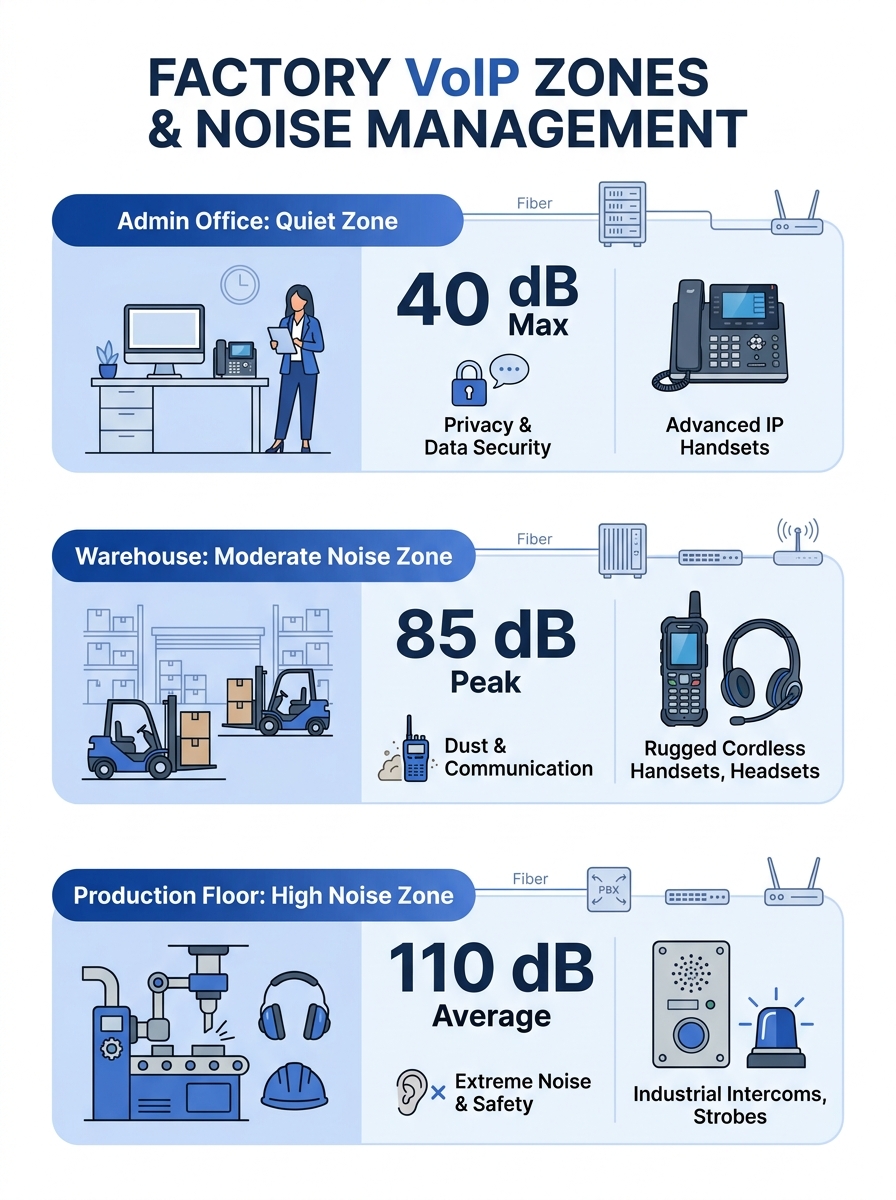
A credible pilot deployment strategy for a factory must place test endpoints in three distinct zones: the admin area, a moderate-noise zone such as a warehouse or packaging area, and a high-noise zone like a welding bay or CNC machining section. Without data from all three, you’re validating the wrong environment.
Deployment Model Selection for Philippine Industrial Zones
The deployment model question for Philippine factories comes down to internet reliability, data control requirements, and the number of sites you need to connect. Three options exist, and the right choice depends heavily on geography.
On-premise IP-PBX keeps all call processing hardware inside the factory. This model works well for single-site operations in areas where WAN connectivity remains inconsistent. Factories in provincial industrial parks sometimes have only one fiber provider and no redundant link. An on-premise system from Yeastar or Xorcom ensures internal calls between the production floor and the maintenance office continue even during an ISP outage. Kital Philippines Corporation, an accredited distributor handling PBX system sales and SIP trunking integration, works with manufacturers on exactly this kind of deployment.
Cloud PBX centralizes management and scales quickly, which suits manufacturers with multiple plants that need a unified directory and call routing. But cloud-only deployments depend entirely on your internet uplink. If your Laguna factory loses its PLDT circuit during a typhoon, your phones go silent.
Hybrid combines both. The cloud handles centralized management, reporting, and inter-site routing, while a local survivability appliance keeps internal calls running during WAN failures. For most Philippine manufacturers, hybrid is the defensible choice. If you’re evaluating the tradeoffs between on-premise and cloud architectures, our breakdown of how to select a PBX system for your business covers the financial and operational considerations in detail.
Network Assessment Before You Touch a Single Handset
VoIP traffic is unforgiving. A 200-millisecond delay that goes unnoticed in a file transfer creates audible echo and talk-over on a voice call. A 1% packet loss rate that barely affects email makes speech unintelligible. Your factory’s existing network must be assessed against voice-specific benchmarks before any hardware ships.
Start with a Layer 2 and Layer 3 audit of every switch, router, and access point between the server room and the farthest production-floor endpoint. Document VLAN configurations, port speeds, PoE budgets, and uplink utilization during peak production hours. Many Philippine factories run flat networks where SCADA traffic, ERP transactions, and office browsing share the same broadcast domain. VoIP injected into that environment will compete with machine-to-machine traffic for bandwidth, and it will lose.
Separating voice into its own VLAN with dedicated QoS policies is non-negotiable. DSCP value 46 (Expedited Forwarding) on voice packets ensures routers and switches prioritize them above bulk data. Our step-by-step guide on configuring QoS for VoIP on Philippine networks walks through the switch-level settings for Cisco and Fortinet gear commonly deployed in local industrial environments.
And the physical layer matters as much as the logical one. Cat5e cabling that has been running through cable trays above a heat-treatment oven for eight years may have degraded shielding. Test every run with a cable certifier before assuming it can carry PoE and voice traffic simultaneously.
Warning: Don’t skip the PoE power budget check. A 24-port PoE switch rated at 185 watts can power roughly 24 standard IP phones at 7 watts each, but adding a few IP paging speakers at 25 watts each will push you past the budget. Phones will randomly drop off the network, and the symptoms look like a VoIP problem when the real cause is electrical.
Hardware That Survives the Production Floor
Standard office IP phones are designed for desks, cubicles, and conference rooms. They don’t belong next to a conveyor belt. Production-line telephony requires endpoint hardware rated for the conditions it will face.
For high-noise areas, wall-mounted IP phones with 90 dB+ ringers and visual call indicators are the baseline. Fanvil IP phones offer industrial-rated SIP endpoints with weatherproof housings and loud ringers that cut through ambient factory noise. Pair these with overhead IP paging speakers for broadcast announcements across an entire bay.
Supervisors and maintenance crews need mobility. DECT cordless handsets or Wi-Fi phones allow them to roam between production lines without missing calls. For personnel who spend their shift moving between the warehouse, the loading dock, and the floor, Jabra headsets with active noise cancellation and Bluetooth connectivity to a softphone app provide hands-free communication without the bulk of a handheld radio.
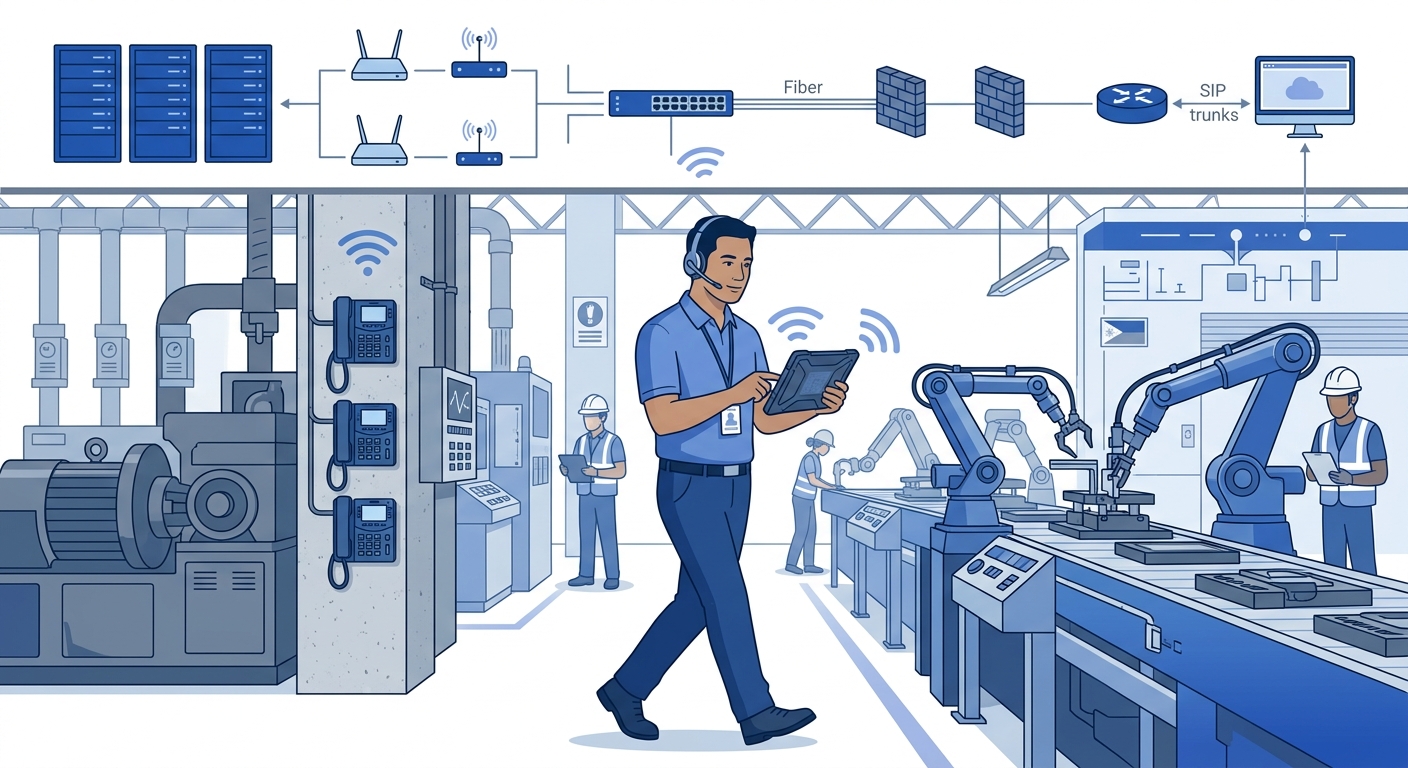
Push-to-talk functionality bridging VoIP and two-way radio systems is worth evaluating for factories that already use Motorola or Hytera radios on the floor. Digital two-way radios remain a mainstay in noisy, rugged environments because they deliver instant coordination. A well-designed VoIP system doesn’t replace radios entirely; it bridges them into the same communication fabric so a call from the admin office can reach a technician on a radio channel.
The Phased Rollout Sequence
Scaling from pilot to full production should follow a defined sequence. Jumping from 15 test endpoints to 200 in a single weekend invites chaos.
Phase 1: Expand the pilot to one full production shift. Keep the original pilot zone but extend it to cover all endpoints that shift requires, including floor phones, paging, and supervisor handsets. Run this for two to four weeks. Collect call-quality metrics (jitter, latency, packet loss) from the PBX dashboard and document every user complaint.
Phase 2: Add the remaining shifts. Different shifts have different network load profiles. The night shift may share bandwidth with automated backup jobs. The morning shift coincides with peak ERP transaction volume when raw materials are received and production orders are released. Each shift must be validated independently.
Phase 3: Extend to adjacent departments. Warehouse, shipping, receiving, and quality control each have their own communication patterns. QC inspectors may need to conference-call with a supplier’s engineering team while standing on the floor next to a rejected batch. Shipping coordinators need direct lines to trucking dispatchers. Map these workflows before deploying endpoints.
Phase 4: Integrate with operational systems. Connect the PBX to your maintenance ticketing system so a work order can trigger an automated call or page to the assigned technician, including priority level and location. Link it to your ERP’s production scheduling module so shift supervisors receive automated notifications when a line changeover is due.
A VoIP system on a factory floor is an operational tool, not a telecom upgrade. Treat it like you’d treat a new piece of production equipment: commission it in phases, validate each phase under load, and don’t sign off until the people using it daily confirm it works.
Industrial PBX Integration with Legacy Systems
Few Philippine factories are greenfield sites with no existing telephony. Most have a mix of analog PBX lines, intercom systems, and public address setups that have been accumulating for years. The VoIP migration has to coexist with these legacy systems during the transition and, in some cases, permanently.
FXO gateways convert analog trunk lines from PLDT or Globe into SIP channels that your IP-PBX can route. FXS gateways do the reverse, allowing legacy analog phones or intercom stations to connect to the new IP system. Yeastar’s TG series gateways and Xorcom’s Astribank modules both handle this conversion reliably. Plan your gateway port count carefully: count every analog line and device in the facility, add 20% headroom for lines you’ll discover during the migration that nobody documented, and spec accordingly.
PA system integration is a common sticking point. Many factories have 100-volt line PA systems wired throughout the plant for emergency announcements. Your IP-PBX needs a SIP-to-analog paging adapter or an IP-based paging controller that can zone announcements by area. The ability to page “Bay 3 only” rather than the entire plant reduces noise fatigue and keeps workers from tuning out announcements.
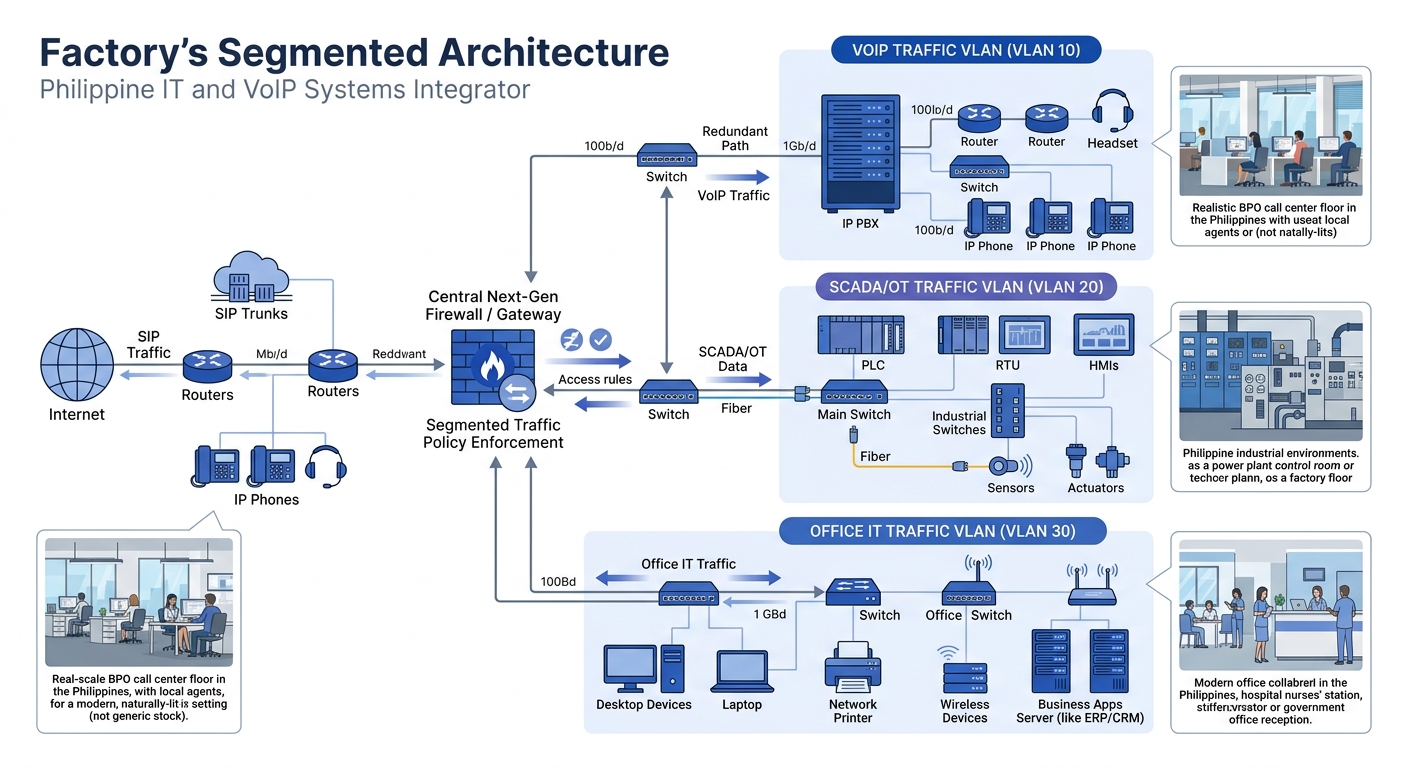
Network segmentation deserves special attention during this integration work. Voice traffic, SCADA/OT traffic, and general IT traffic should sit on separate VLANs with firewall rules controlling what can cross between them. Our analysis of why unified communications strategies fail without network segmentation explains the security rationale in depth, and the same principles apply to a factory where a compromised endpoint on the office network should never be able to reach a PLC on the production floor.
Training Across Shifts and Languages
Philippine factories typically employ workers who speak Tagalog, Bisaya, Ilonggo, and English in varying combinations. Training materials for the new phone system need to account for this. A laminated quick-reference card mounted next to each wall phone, showing how to transfer a call, initiate a page, and reach the maintenance hotline, does more than a two-hour classroom session that half the shift couldn’t attend because they were running the line.
Hands-on training during shift handovers, where the outgoing shift demonstrates to the incoming shift, creates peer-to-peer knowledge transfer that sticks. Designate one “phone champion” per shift who becomes the first point of contact for questions. This person doesn’t need to be a manager; they need to be someone comfortable with the technology who their coworkers trust enough to ask for help.
Resilience Planning for Philippine Conditions
Typhoons, flooding, and extended power outages are operational realities for factories outside Metro Manila. Your VoIP resilience plan needs to address three failure scenarios.
ISP failure: A hybrid deployment with local survivability keeps internal calls running. External calls can fail over to a cellular trunk via a GSM/LTE gateway. Yeastar’s TG series supports GSM SIM cards that activate automatically when the primary SIP trunk goes down.
Power failure: IP phones powered by PoE switches will die when the switch loses power. Ensure your network switches are on UPS-backed circuits with enough runtime to outlast a generator startup sequence. For critical paging endpoints, dedicate a separate UPS.
Physical damage: Keep a small stock of spare IP phones, a spare gateway module, and a documented configuration backup on-site. A configuration restore to a replacement PBX appliance should take under an hour. Veeam or native PBX backup utilities can automate daily config snapshots to an off-site location.
Sangoma’s manufacturing VoIP implementation research confirms that hybrid setups with LTE failover are becoming the standard recommendation for factories where communication downtime translates directly into production losses.
What Still Isn’t Settled
Several open questions remain for Philippine manufacturers moving through this migration.
Spectrum allocation for industrial Wi-Fi is an ongoing concern. Wi-Fi 6E on the 6 GHz band promises less interference for voice-over-Wi-Fi endpoints, but Philippine NTC spectrum allocations for industrial use in that band haven’t been finalized for all device classes. Factories deploying Wi-Fi phones today should plan for a potential hardware refresh when regulatory clarity arrives.
Integration with emerging automation systems is another evolving area. As factories adopt more IoT sensors and edge computing for predictive maintenance, the boundary between the voice network and the OT network will blur. Machine-generated alerts routed through the PBX as automated voice calls or pages are already technically feasible, but the safety frameworks and interaction protocols for these human-machine communication flows are still being developed across the industry.
Vendor consolidation pressure is real. Philippine manufacturers often end up with one vendor for the PBX, another for the network switches, a third for the wireless infrastructure, and a fourth for the paging system. Each vendor points at the others when call quality degrades. Consolidating under fewer vendors, or working with a systems integrator who owns the entire communication stack end-to-end, reduces finger-pointing and speeds up troubleshooting. The tradeoff is reduced flexibility and potential vendor lock-in, and there’s no universally correct answer for where to draw that line.
The factories that get this migration right will treat their factory floor communications system the way they treat any capital equipment investment: with a documented specification, a phased commissioning plan, acceptance criteria measured under real operating conditions, and a maintenance schedule that extends well beyond the go-live date.