
Fanvil X3U desk phones run about $80 per unit. A hosted VoIP subscription with softphone access costs $10 to $30 per user per month. On a spreadsheet, software wins every time. But spreadsheets don’t account for brownouts, and in Philippine offices, the first power interruption reveals which deployment model you should have picked. The PoE-powered desk phones keep ringing on UPS battery for another 45 minutes while every softphone on the floor goes silent the moment the Wi-Fi access point drops.
That gap between spreadsheet logic and deployment reality is where this decision actually lives. The two categories reached feature parity years ago. What they haven’t reached is infrastructure parity, security parity, or failure-mode parity across the specific conditions Philippine enterprises operate in. This is the chronological story of how the decision framework shifted, where it went wrong, and what it looks like stripped of vendor marketing.
When Hardware Was the Only Serious Option
Philippine enterprises that adopted IP telephony before 2020 had limited practical options. BPO call centers in Makati, Cebu IT Park, and Davao standardized on Polycom VVX handsets and Cisco SPA series phones because the alternatives weren’t mature enough. Softphone applications existed, but they were unreliable over the fixed broadband connections available at the time, and IT departments didn’t trust them for production call center traffic carrying SLA-bound client communications.
The logic was straightforward. Hardware phones connected via Ethernet to PoE switches, received power and data over the same cable, and operated independently of the user’s workstation. If an agent’s PC crashed, their phone stayed up. If someone installed bad software on their laptop, it didn’t corrupt the voice path. The isolation was a feature, not a limitation.
Polycom’s lineup offered affordable options from entry-level single-line models to conference phones, and the Philippine market absorbed them heavily. Hotels, hospitals, and government agencies followed similar patterns, deploying enterprise phone systems with physical handsets on every desk and at every nurse station.
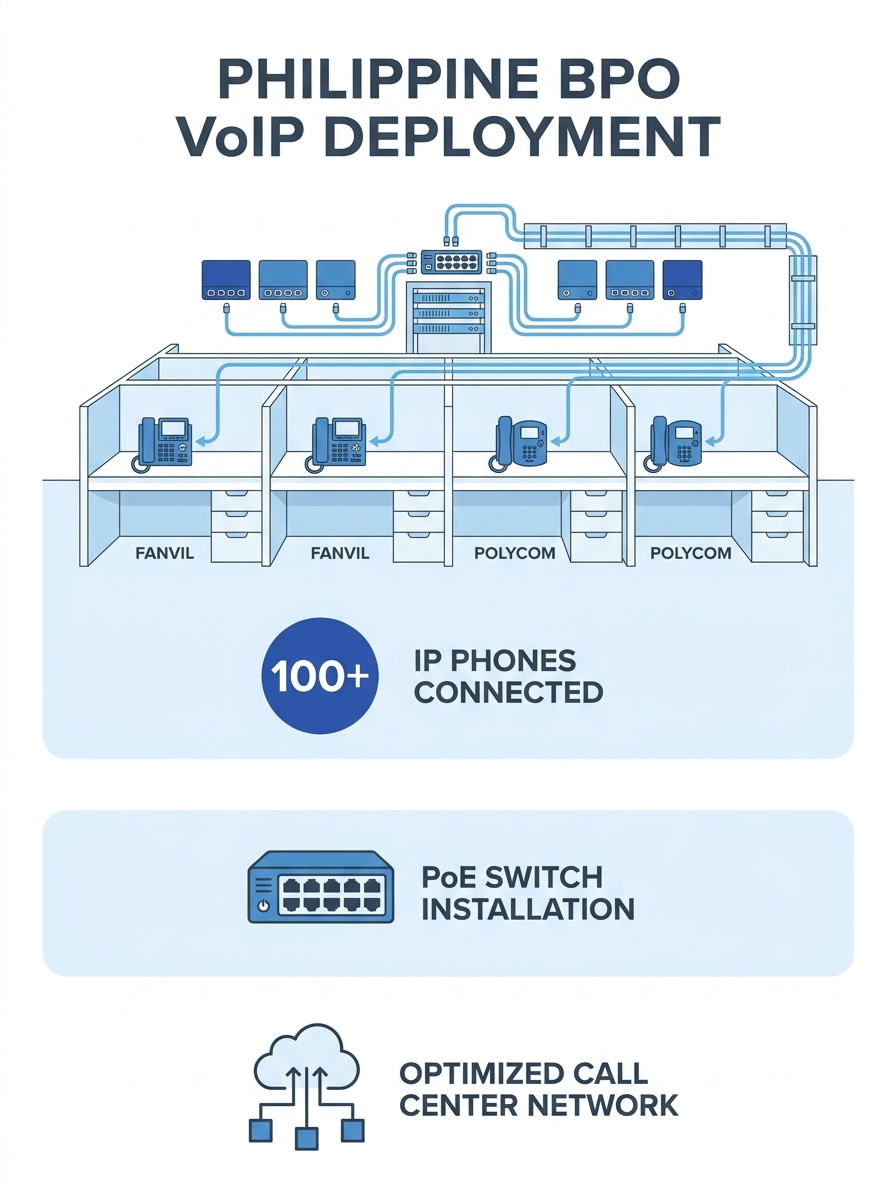
The cost model was high up front but simple to budget. You bought the phones, installed them, and ran them for five to seven years. Maintenance meant replacing a handset occasionally. The PBX sat in the server room, managed by your own team, and the responsibility for keeping it running was yours.
The Softphone Surge and What It Revealed
The shift started accelerating around 2021-2022 when pandemic-era remote work forced Philippine companies to confront an obvious problem: desk phones don’t travel home with employees. Softphone applications from providers like 3CX, Yeastar Linkus, and various UCaaS platforms suddenly went from “nice to have” to the only way hybrid workers could take business calls.
Adoption was fast. Deployment was easy. An IT admin could provision a new softphone user in minutes, compared to the days-long process of ordering, configuring, and physically installing a desk phone. Software-based VoIP solutions proved far more flexible than their hardware counterparts, and the cost savings were genuine. No handsets to buy, no cabling to run, no PoE switches to upgrade.
But the speed of adoption outpaced the infrastructure planning needed to support it. Companies that had carefully configured QoS policies for their VLAN-segmented desk phone traffic suddenly had softphones running on the same network segment as YouTube streams, file downloads, and backup jobs. Call quality degraded. Jitter climbed. IT tickets about “choppy calls” multiplied.
The softphone itself worked fine. The network it was riding on did not.
The Network Problem Nobody Solved First
Philippine broadband infrastructure adds a layer of difficulty that makes VoIP hardware vs software decisions more consequential than they’d be in markets with consistently reliable connectivity. G.711 codec traffic needs about 87 kbps per call including overhead. G.729 compresses that down to roughly 30 kbps. These are small numbers, but they demand consistent, low-jitter delivery that many Philippine ISP connections can’t guarantee during peak hours.
For enterprises that had already invested in structured cabling and network infrastructure, hardware phones on dedicated VLANs continued performing well. The voice traffic was isolated, prioritized, and didn’t compete with data workloads. Softphones sharing the general-purpose network had no such protection.
The softphone itself worked fine. The network it was riding on did not.
The pattern showed up consistently across verticals. A hospital in Quezon City running Yeastar S-series PBX with Fanvil handsets reported stable call quality even during peak hours. The same hospital’s administrative staff using softphones on laptops connected over Wi-Fi reported frequent audio dropouts. Same PBX, same SIP trunk, same codec. Different transport path, different result.
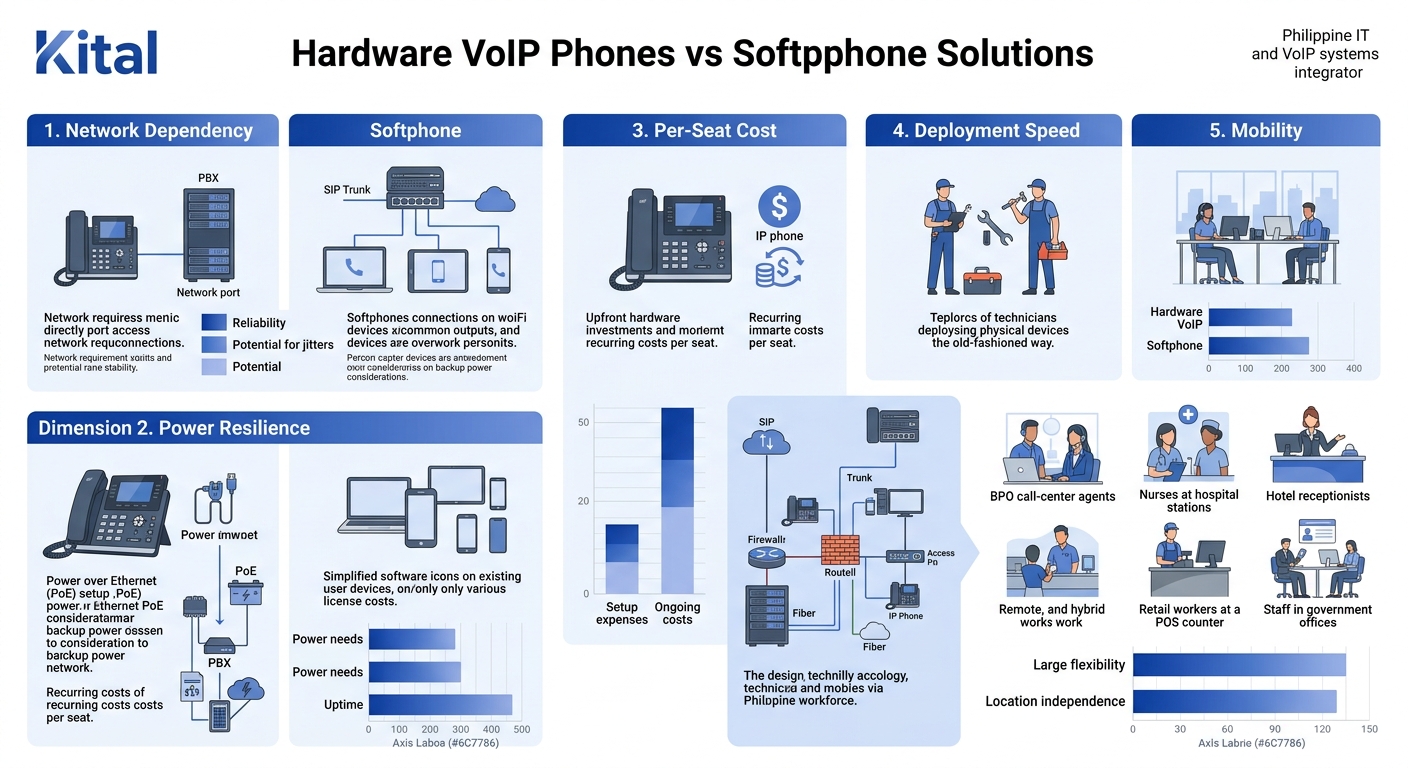
This is where the framework for choosing between hardware and software VoIP started to separate from the feature comparison charts. The question wasn’t “can this softphone do three-way calling?” It was “can your network deliver consistent sub-150ms latency and under 1% packet loss to every endpoint running this softphone?”
QoS Became the Actual Dividing Line
The enterprises that made softphones work well in the Philippines did one thing differently: they treated the network upgrade as part of the VoIP project, not a separate initiative. Configuring QoS policies for voice traffic on routers and switches was the prerequisite, and organizations that skipped this step paid for it in dropped calls and frustrated users.
The technical requirements aren’t exotic. Strict Priority Queueing or Low-Latency Queueing ensures voice packets get guaranteed bandwidth even during peak network demand. DSCP tagging marks voice traffic so switches and routers can identify it. VLAN segmentation keeps voice and data traffic on separate broadcast domains. These are standard configurations on managed switches from Cisco, Fortinet, and similar vendors.
But here’s what matters for the hardware-vs-software decision: hardware phones connected via Ethernet to a PoE switch on a voice VLAN get these QoS protections automatically. Softphones running on a laptop connected via Wi-Fi to a general-purpose SSID typically don’t. The laptop’s traffic gets treated the same as every other device on that access point.
You can fix this. Wi-Fi 6 access points with WMM (Wi-Fi Multimedia) support can prioritize voice traffic. You can deploy separate SSIDs for voice-capable devices. You can configure endpoint-level DSCP marking. But each of these adds complexity, cost, and maintenance burden that partially erodes the cost advantage softphones had on the spreadsheet.
For organizations evaluating unified communications platforms that bundle voice, video, messaging, and collaboration, the QoS challenge multiplies. A Jabra Engage headset paired with a softphone on a well-configured network delivers excellent call quality. The same headset on a congested Wi-Fi network with no traffic prioritization delivers an experience that makes callers think they’re talking through a tunnel.
The Hybrid Model That Emerged
By mid-2025, the Philippine enterprises that had tried both pure hardware and pure software deployments largely converged on a hybrid approach. The pattern became predictable across BPO operations, hotel front desks, and government agencies.
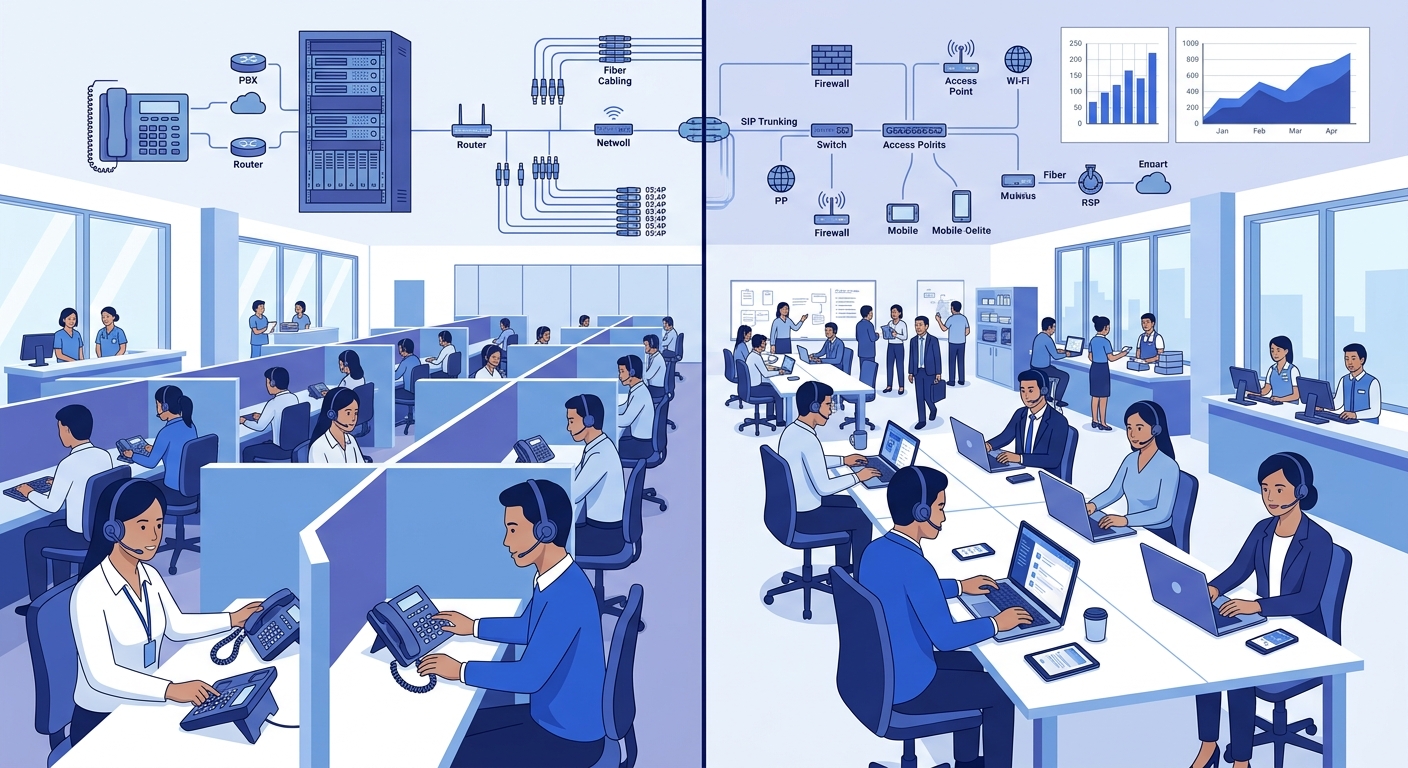
Fixed stations got hardware phones. Call center agent desks, reception areas, nurse stations, hotel front desks, and security posts where someone sits in the same location for an entire shift. These environments benefit from dedicated audio hardware with echo cancellation tuned for the specific acoustic environment, physical buttons for speed dials and BLF (Busy Lamp Field), and Ethernet-based QoS guarantees.
Mobile and hybrid workers got softphones. Account managers, field technicians, work-from-home agents, and anyone whose location changes throughout the day. These users need their extension on their phone or laptop, and a desk phone sitting in an empty office doesn’t serve them.
Conference rooms got purpose-built devices. Polycom or Yealink conference phones with built-in microphone arrays outperform any laptop microphone in a room with four or more participants.
This isn’t a compromise position. It’s an acknowledgment that the VoIP hardware vs software decision isn’t a single company-wide choice. It’s a per-role, per-location decision driven by how well your network can support each endpoint type and how predictable each user’s working environment is.
The cost model for this hybrid approach typically works out to hardware phones at $80 to $200 per fixed station, softphone licenses included with the PBX subscription at no additional per-seat cost, and network infrastructure investment in QoS configuration and potentially Wi-Fi upgrades. Organizations already thinking about resilient VoIP infrastructure from a network-first perspective found the hybrid model natural to adopt.
Where the Decision Sits Today
The Philippine enterprise telephony landscape has settled into a pattern that would have surprised the “software will replace everything” advocates of 2022. Hardware desk phones haven’t disappeared. They’ve consolidated into the use cases where they genuinely outperform software alternatives: high-volume call handling, environments with unreliable power or network conditions, and locations where audio quality is tied to revenue (call centers handling international clients, hotel reservation lines, telemedicine consultations).
Software solutions have taken over everywhere else, and they’ll continue expanding. AI-powered features like real-time transcription, sentiment analysis, and intelligent call routing are arriving exclusively through software-based platforms. The gap between what a UC platform can do versus standalone VoIP grows wider every quarter, and those capabilities live in software, not in handset firmware.
Tip: If you’re evaluating IP phone selection for a new deployment, start with your network audit, not your handset catalog. Map every endpoint location, measure available bandwidth and jitter during peak hours, and determine whether each location has wired Ethernet access or depends on Wi-Fi. That data will tell you which seats need hardware phones and which can run softphones successfully.
The decision framework that actually works for Philippine enterprises treats network reliability as the independent variable and endpoint type as the dependent one. Where your network can guarantee consistent QoS to a wireless endpoint, softphones are the better choice for their flexibility and lower cost. Where it can’t, or where power resilience matters because your UPS covers the network closet but not every desk’s Wi-Fi access point, hardware phones remain the more reliable option.
Philippine regulatory context adds another consideration. NTC permit requirements and DICT guidelines for government agencies often specify equipment inventories and physical security controls that are easier to satisfy with trackable hardware assets than with software installed on personal devices. Agencies running VoIP deployments with compliance requirements tend to favor hardware for roles handling sensitive communications, even when softphones would be technically adequate.
The vendors pushing an all-software or all-hardware narrative are selling their catalog, not solving your deployment problem. The enterprises getting this right in the Philippines are the ones that stopped asking “hardware or software?” and started asking “what does the network at each seat actually support?” That reframing turns an ideological debate into a technical measurement exercise, and measurement exercises have answers.