
Consumer VoIP platforms cap out between 20 and 50 concurrent sessions, lack SIP trunk redundancy, and provide no on-site survivability when Philippine internet circuits drop. Enterprise-grade IP telephony scales to thousands of extensions with QoS enforcement, CRM integration, and IVR routing. The real question is which enterprise architecture fits your growth curve: on-premises, cloud, or hybrid.
TL;DR: Consumer VoIP works below 20 seats but breaks under enterprise load. On-premises IP PBX delivers full control and survivability at high capital cost. Cloud and hybrid PBX scales fastest for distributed Philippine operations but depends on circuit quality. Your concurrent session count, IT staffing, and provincial reach determine the right pick.
Philippine PBX modernization is accelerating alongside broader infrastructure investment. The Asian Infrastructure Investment Bank provided $400 million in co-financing for the Philippines’ First Digital Transformation Development Policy Loan, and in March 2026, NTT DATA and TELKHA announced a strategic partnership targeting enterprise and public-sector digital modernization nationwide. That macro environment makes the choice between consumer VoIP and enterprise communication architecture urgent. Fiber is reaching more provinces, DICT is pushing digitization mandates, and organizations that locked into the wrong phone system two years ago are already feeling the ceiling.
Three paths sit in front of every Philippine IT team weighing IP telephony scalability: consumer-grade VoIP services, on-premises enterprise IP PBX appliances, and cloud or hybrid PBX platforms. Each solves a different problem. Each breaks in a different way.
Consumer VoIP: Cheap Entry, Hard Ceiling
Consumer VoIP services charge per seat, require zero on-site hardware, and activate in hours. For a 5-person law office in Makati or a 12-seat startup in BGC, that speed is the whole point. The monthly cost per user runs between PHP 500 and PHP 1,500, with no PBX appliance to rack and no trunk to configure.
The trouble starts around seat 20. Consumer VoIP platforms typically support 10 to 50 concurrent sessions before call quality degrades, because they don’t expose QoS controls at the network layer. You can’t tag RTP packets with DSCP 46 (Expedited Forwarding) if the platform doesn’t support it, and most consumer services don’t. When your office LAN is also carrying file transfers and video streaming, voice packets compete for bandwidth equally. The result: jitter above 30ms, audible clipping, and dropped calls during peak hours. If you’ve ever troubleshot call quality issues on Philippine networks, you’ve seen this pattern.
Integration is the second gap. Enterprise workflows need the phone system connected to CRM, help desk, call recording, and IVR platforms. According to industry analysis of scalable VoIP features, scalable growth demands intelligent provisioning systems that adapt to evolving telecom requirements without manual intervention. Consumer VoIP offers none of that. You get a softphone, a dial pad, maybe a basic auto-attendant. No SIP trunk failover. No survivability appliance for when your ISP goes down during a typhoon. No multi-site extension routing.
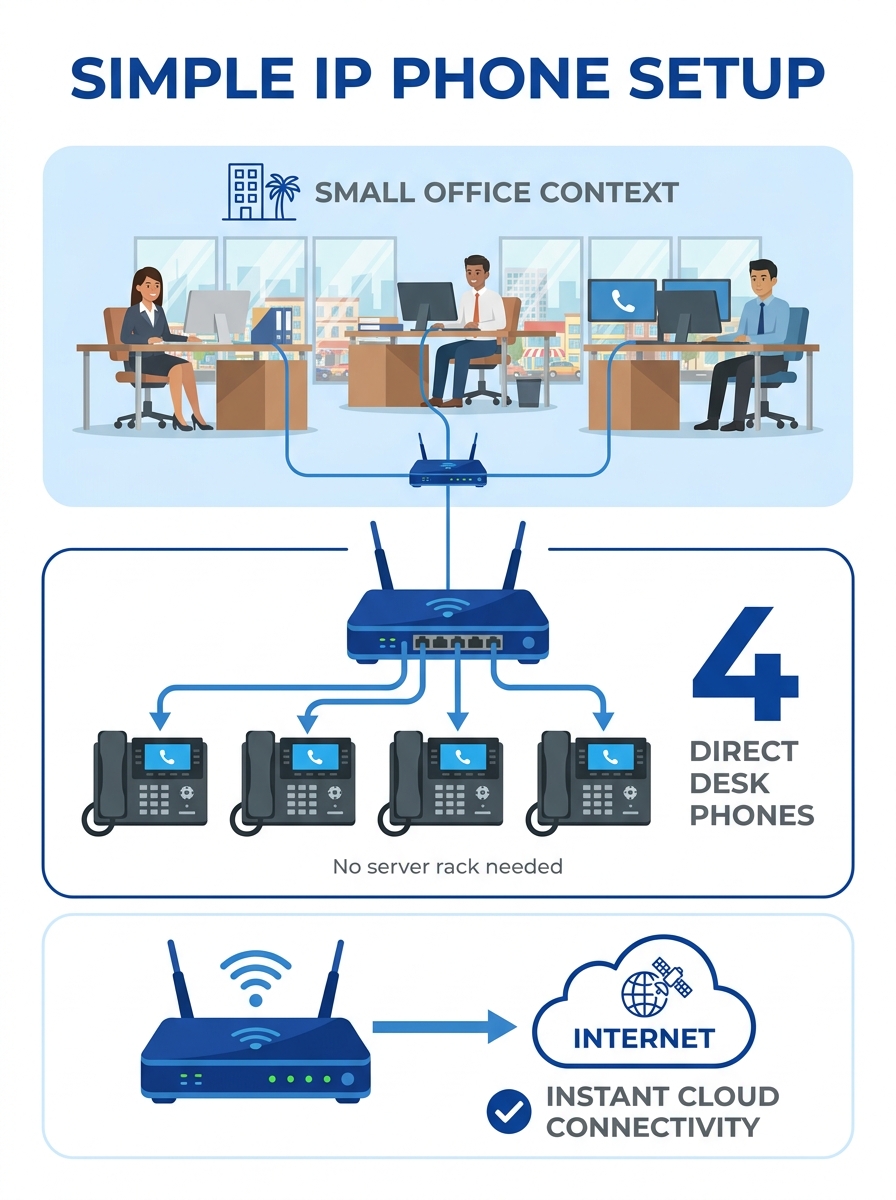
For organizations that will stay below 20 seats, don’t need CRM integration, and operate from a single location with reliable fiber, consumer VoIP handles the job at minimal cost. Everyone else hits the ceiling fast.
On-Premises Enterprise IP PBX: Full Control, Heavy Lift
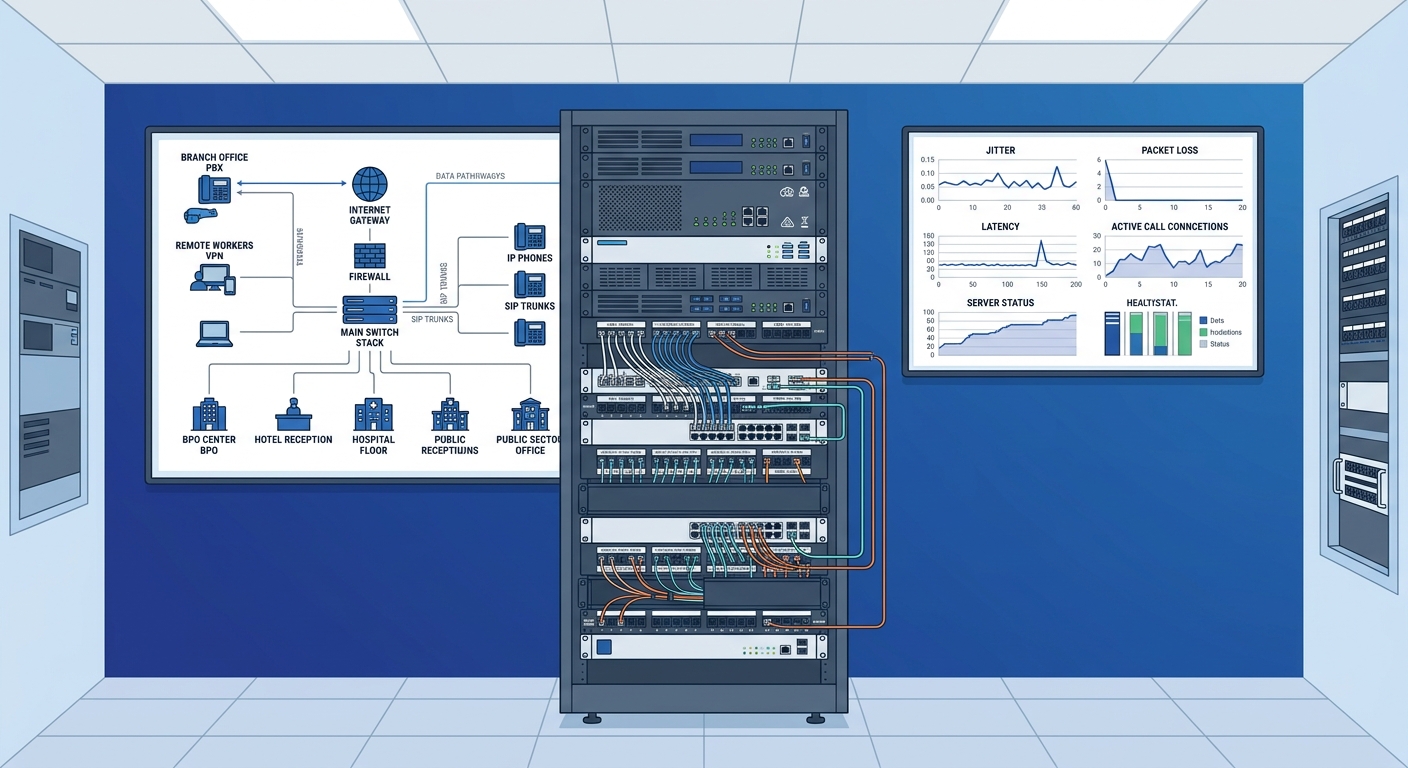
On-premises IP PBX appliances from vendors like Cisco (Unified Communications Manager), Yeastar (P-Series), or Asterisk-based builds give IT teams direct control over every layer of the phone system. SIP trunk configuration, codec selection, call recording, IVR trees, extension provisioning, QoS policies, firewall rules: everything lives on hardware you own, in a server room you manage.
That control matters in regulated environments. Philippine hospitals handling patient data need call recording with retention policies. Government agencies subject to NTC registration and DICT mandates need audit trails that cloud vendors may not provide in the format regulators expect. BPO operations running 500+ concurrent agent sessions need deterministic call routing with sub-150ms latency, and they need the system to survive an internet outage by falling back to PSTN trunks automatically. A regional bank consolidated 18 branch PBX systems into a hybrid UC platform and achieved 99.99% call uptime precisely because it could control failover at the appliance level.
The cost profile is front-loaded. A Yeastar P-Series appliance supporting 100 to 500 extensions runs between PHP 150,000 and PHP 800,000 for hardware alone, before SIP trunk contracts, Fanvil or Cisco desk phones at PHP 4,000 to PHP 25,000 per handset, and structured cabling. Cisco UCM deployments for 1,000+ seats can exceed PHP 5 million in licensing and hardware. You also need at least one staff member (realistically two) who can manage SIP trunks, configure QoS policies on your routers, and troubleshoot registration failures at 2 AM.
Scaling adds cost in discrete jumps. Adding 50 seats means provisioning new licenses, potentially adding a second PBX node for clustering, buying more handsets, and running cable. The per-seat marginal cost drops as you grow, but every expansion requires a procurement cycle and a maintenance window. Organizations running hospital communication systems or communication systems for Philippine government agencies often accept this tradeoff because regulatory compliance and survivability outweigh the capital burden.
The question for on-premises IP PBX is whether your IT team can absorb the operational load of running a telephony system alongside everything else they already manage.
Where on-premises IP PBX breaks: organizations expanding to provincial sites. Shipping an appliance to a Cebu or Davao branch, configuring VPN tunnels for SIP traffic, and maintaining uptime across unreliable provincial circuits turns every new site into a mini-project. The technical distinctions between IP telephony and VoIP become very concrete at this point. As TechTarget’s analysis notes, IP telephony most often appears in a business context referring to the full software and hardware stack, while VoIP describes the transport layer. On-premises deployments give you the full stack. They also give you the full maintenance burden.
Cloud and Hybrid PBX: Scaling Without the Server Room
Cloud PBX runs the call control platform in a data center, not your office. Yeastar’s cloud edition, Microsoft Teams Phone with Direct Routing, or hosted Asterisk platforms handle SIP registration, call routing, IVR, and voicemail from a multi-tenant architecture where multiple businesses share the same infrastructure but operate in securely isolated environments. According to Yeastar’s deployment architecture documentation, this model operates like a high-rise apartment building: shared facilities, separate units.
Why does this matter for Philippine enterprises expanding beyond Metro Manila? Because adding a 15-person branch in Iloilo or a 30-seat call center in Clark doesn’t require shipping hardware. You provision extensions in the admin portal, ship IP phones or configure softphones, and the branch connects to the same PBX cluster over the internet. Scaling from 100 to 300 seats takes days, not weeks. Per-seat monthly costs run PHP 800 to PHP 2,500 depending on features and vendor, with no capital outlay for PBX hardware.
The hybrid variant places a survivability appliance at each major site. If the WAN link to the cloud PBX drops, the local appliance takes over call processing using cached extension data and local PSTN trunks. This matters everywhere outside Manila’s fiber-dense core. Provincial circuits from Converge, PLDT, or Globe still drop below 99.5% uptime in some areas, and when that happens, a pure-cloud PBX goes silent. Hybrid architectures pair cloud scalability with on-site resilience. If your organization is planning for business continuity and disaster recovery, the hybrid model addresses the specific failure mode that pure-cloud deployments ignore.
Cloud PBX also absorbs the QoS problem differently. Because the call control plane lives in the provider’s data center, the provider handles server-side processing, codec transcoding, and recording. Your responsibility narrows to ensuring your LAN and WAN circuits can carry RTP traffic with packet loss below 1% and jitter below 30ms. SD-WAN overlays can prioritize voice traffic across multiple ISP links, which is why Australian enterprises adopted integrated Cloud PBX and SD-WAN platforms at a 68% rate. Philippine enterprises with 3 or more sites should evaluate the same combination.
The limitation: you depend on the vendor’s uptime, their security posture, and their roadmap. Vendor lock-in is real. Migrating 500 extensions from one cloud PBX provider to another involves porting numbers, retraining users, and rebuilding IVR trees from scratch. And cloud PBX pricing compounds over time. A 200-seat deployment at PHP 1,800 per seat per month costs PHP 360,000 monthly, or PHP 4.32 million annually. Over 5 years, that exceeds the capital cost of many on-premises systems. If you’re evaluating pilot programs for VoIP migration, run the 5-year total cost of ownership calculation before committing.
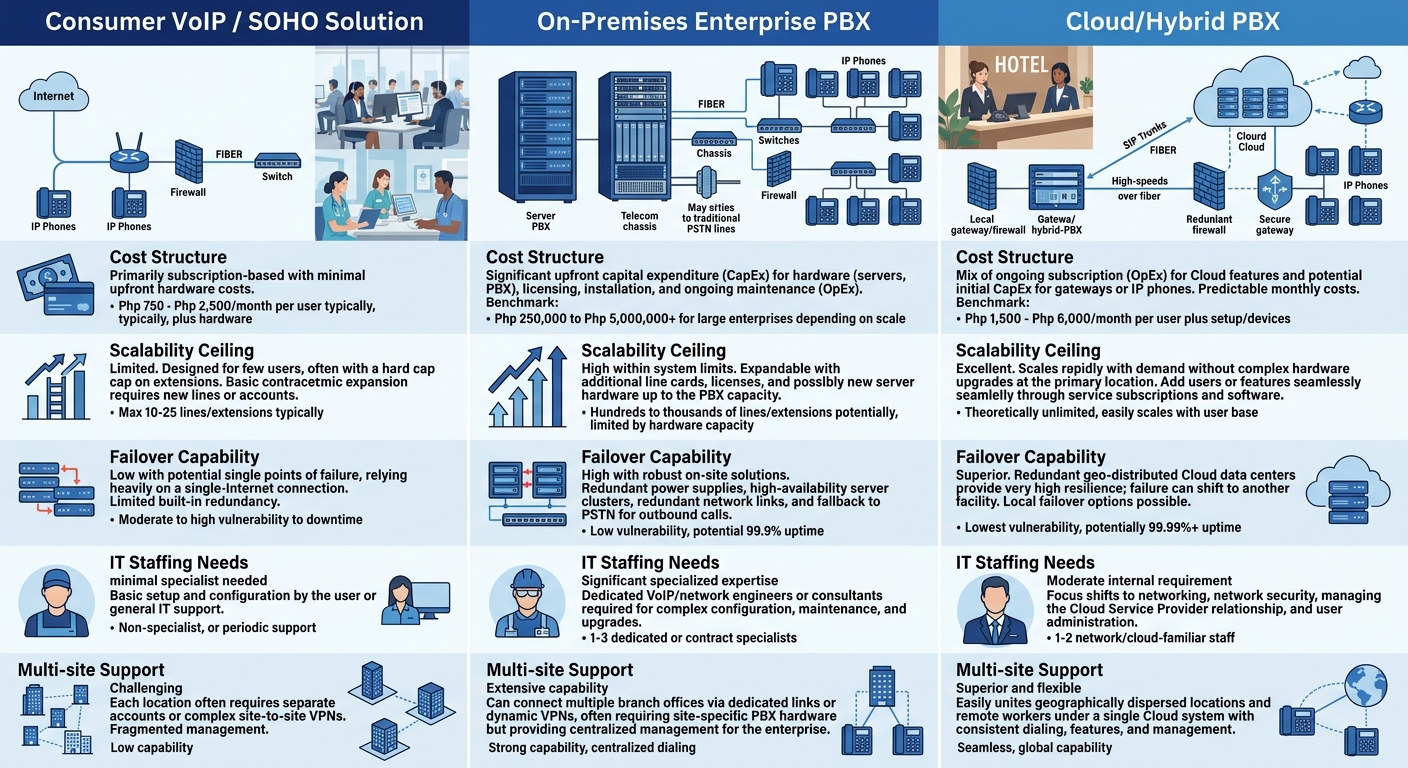
| Feature | Consumer VoIP | On-Premises Enterprise PBX | Cloud / Hybrid PBX |
|---|---|---|---|
| Max concurrent sessions | 10–50 | 500–10,000+ (hardware-dependent) | 500–10,000+ (license-dependent) |
| Capital cost | None | PHP 150K–5M+ | None (hybrid appliance: PHP 50K–200K per site) |
| Monthly per-seat cost | PHP 500–1,500 | PHP 0 (after capex) | PHP 800–2,500 |
| Scaling speed | Instant (within limits) | Weeks (procurement + config) | Days (portal provisioning) |
| QoS / DSCP control | No | Full | LAN-side only (WAN via SD-WAN) |
| SIP trunk failover | No | Yes (with PSTN fallback) | Yes (hybrid mode with local survivability) |
| CRM / IVR integration | Basic or none | Full API / CTI access | Vendor-dependent API access |
| On-site survivability | None | Full | Hybrid only |
| IT staff required | 0 | 1–3 dedicated | 0.5–1 (hybrid: 1–2) |
| 5-year TCO (200 seats) | PHP 12M–18M | PHP 3M–8M | PHP 9.6M–30M |
Who Should Pick Which
The choice between VoIP vs IP telephony for growth maps to three variables: your concurrent session count right now, your IT team’s capacity, and how many sites you’ll operate within 3 years.
Pick consumer VoIP if you have fewer than 20 seats, operate from a single office with reliable fiber, don’t need CRM integration or call recording, and won’t grow past 50 seats. You’ll save on capital and administrative overhead. The moment you cross 20 concurrent calls or add a second location, you’ve outgrown the platform.
Pick on-premises enterprise IP PBX if you run 100+ seats from 1 to 3 sites, employ IT staff who can manage SIP infrastructure, need regulatory compliance with local data storage, or operate in a vertical where call survivability during ISP outages is non-negotiable. Hospitals, government agencies, and BPO operations with concentrated seat counts in a single facility get the best return from this model. The capital investment is significant, but the 5-year TCO is often the lowest of the three options at scale.
Pick cloud or hybrid PBX if you’re expanding to 4 or more sites across Philippine provinces, lack dedicated telephony staff, or need to scale seat count by 50% or more within 18 months. Hybrid deployments with local survivability appliances solve the provincial circuit reliability problem while keeping the management plane centralized. Watch the 5-year TCO: monthly per-seat costs compound, and switching providers later is expensive.
Warning: Don’t confuse VoIP (the transport protocol) with IP telephony (the full enterprise system). Every enterprise PBX uses VoIP underneath, but the system-level features that enable IP telephony scalability — trunk failover, QoS enforcement, IVR routing, CRM integration — exist only in enterprise-grade platforms. Buying “VoIP” when you need IP telephony is the single most common procurement mistake Philippine IT teams make during PBX modernization.
The honest answer is that most Philippine enterprises with 50 to 200 seats and growth ambitions land on cloud or hybrid PBX because it avoids the capital spike and scales geographically. Organizations above 300 seats in regulated industries gravitate toward on-premises because the 5-year economics favor it and compliance demands local control. Consumer VoIP serves the smallest tier and nothing above it. Match the architecture to the growth plan you actually have, not the one the vendor’s sales deck assumes.