
Filipino cloud communications provider Telavi presented analytics on July 8 showing that approximately 30 percent of incoming business calls to Philippine businesses go unanswered, with the company estimating that a single retailer receiving nearly 3,000 monthly calls loses roughly P1 million in potential sales from unreached customers, according to Rappler.
TL;DR: Telavi CEO Erwin Co said at a Manila media briefing that 85 percent of callers whose calls go unanswered never call back, creating invisible revenue losses that cloud-based phone systems could prevent by routing calls to employees regardless of location.
The findings reflect what Co described as an “overlooked business problem” that predates the pandemic but has become more visible as companies evaluate their customer-facing infrastructure. “What you don’t know won’t hurt you. But actually, it hurts,” Co said during the briefing, explaining that businesses typically track completed sales but rarely measure how many potential customers abandon contact attempts after failed calls.
The analytics are drawn from organizations using Telavi’s cloud PBX platform rather than an industry-wide survey, but Co said the 30-percent pattern has appeared consistently across the company’s customer base in retail, healthcare, education, logistics, banking, and government sectors.
The Revenue Impact of Unanswered Calls
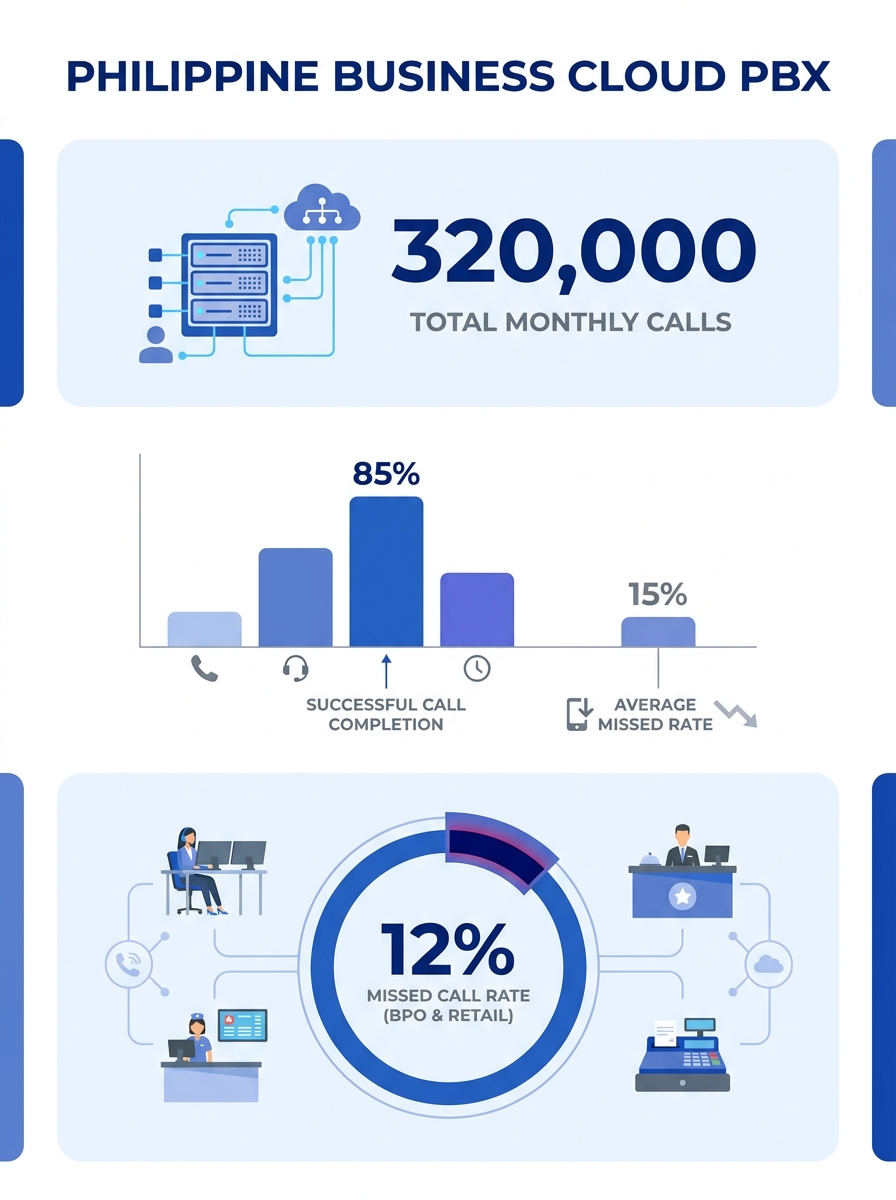
Telavi’s analysis focused on the conversion gap between inbound call volume and actual customer interactions. In the retailer example cited during the briefing, the company calculated that roughly 900 of 3,000 monthly inbound calls went unanswered. With 85 percent of those callers never attempting contact again, the retailer was losing an estimated 765 potential customer interactions each month.
The P1-million monthly revenue estimate assumes an average transaction value and conversion rate based on the retailer’s historical sales data. Co acknowledged the figure represents a projection rather than confirmed lost revenue, but said the pattern holds across customer verticals: businesses know their completed transactions but remain unaware of contact attempts that failed before reaching an employee.
The problem stems from traditional business telephone systems designed around physical office infrastructure. Legacy private branch exchange (PBX) systems route incoming calls to desk phones within an office, but cannot redirect calls to employees working remotely, traveling between branch locations, or temporarily away from their desks. When a call reaches an unmanned phone, it rings unanswered or routes to voicemail, creating what Telavi describes as invisible customer disconnection.
Cloud-Based Systems Route Calls Across Devices and Locations
Cloud PBX and Voice over Internet Protocol (VoIP) platforms address the reach problem by treating phone calls as internet data rather than copper-wire signals. Employees can answer business calls from smartphones, laptops, or tablets regardless of physical location, with calls automatically redirecting to other available staff members if the primary recipient is unavailable.
The unified communications approach integrates voice, messaging, customer relationship management software, and analytics into a single platform accessible from multiple devices. Telavi’s system also provides call-tracking data that legacy phone systems typically cannot capture, allowing businesses to monitor inbound call volume, response times, and missed-call patterns.
Richard Domingo, marketing and communications manager at barbershop chain Bruno’s Barbers, said during the briefing that his company’s branches “were too busy to answer calls” and “were losing bookings and receiving negative feedback” before adopting Telavi’s platform. Domingo said conversion rates improved after implementing the cloud-based system, though he did not provide specific figures.
The Unified Communications as a Service (UCaaS) industry is projected to grow 20 percent annually through 2030, according to the source article. Co said adoption accelerated during COVID-19 as companies supported remote work, but demand has continued in hybrid work environments where employees split time between offices and other locations.
AI-Powered Customer Engagement Enters Cloud Telecom
Telavi recently introduced an artificial intelligence layer that handles routine customer inquiries through messaging channels before transferring complex requests to human staff, Co said. The AI component represents what Co called “the next stage” for cloud communications platforms serving Philippine businesses.
Co said Telavi serves retailers, hospitals, schools, logistics providers, banks, and government agencies. The company did not disclose total customer count, annual revenue, or employee headcount during the briefing.
Philippine enterprises evaluating VoIP migration face network readiness requirements including bandwidth allocation, quality-of-service configuration, and session border controller deployment. Businesses moving from legacy PBX to cloud platforms typically follow a phased rollout to validate call quality and system integration before full deployment.
The Takeaway
Telavi’s 30-percent unanswered-call figure—while based on its own customer analytics rather than independent research—highlights a measurement gap that Philippine SMBs rarely quantify. Traditional phone systems provide no visibility into failed contact attempts, making missed-call volume an invisible metric until businesses deploy platforms that track every inbound attempt.
For Philippine IT managers evaluating telecom modernization, the business case extends beyond remote-work flexibility. Cloud PBX platforms deliver call-routing logic that legacy systems cannot match: automatic redirection to available staff, multi-device accessibility, and analytics that surface customer-reach failures. The P1-million monthly loss estimate for a single retailer may be modeled rather than empirical, but the underlying dynamic is straightforward—customers who cannot reach a business by phone move to competitors who answer.
The UCaaS market’s 20-percent annual growth through 2030 suggests that Philippine enterprises are treating business telephony as an infrastructure upgrade rather than a discretionary expense. Companies that still route inbound calls exclusively to office desk phones are competing against businesses where every employee carries the company phone line in their pocket.