
Cisco’s IM & Presence Service runs as a dedicated cluster, syncing availability data through SIP SUBSCRIBE/NOTIFY exchanges. On Microsoft Teams, presence is a cloud-native signal processed through Azure’s global infrastructure. Yeastar’s P-Series takes a third path, embedding presence directly into PBX firmware with zero external dependencies. All three produce identical-looking green dots on a user’s screen. The engineering underneath them, and what that means for Philippine enterprises managing availability across multiple offices, couldn’t be more different.
If you’re evaluating UC system components for a deployment spanning Metro Manila, Cebu, or Davao, the presence layer is probably the last thing you’re thinking about. Phones, bandwidth, QoS policies, and licensing costs tend to dominate the conversation. But presence architecture determines whether your 300-person organization can actually see who’s available before transferring a call, whether managers know when their direct reports are reachable, and whether your chat and telephony systems agree on a user’s status at any given moment. As the NoJitter editorial team puts it, unified communications is a solution that integrates human interaction with enterprise IT systems, and presence is the connective tissue that makes that integration feel natural.
This article breaks down three enterprise collaboration architecture approaches to presence, weighing the tradeoffs that matter for Philippine deployments specifically.
Why Presence Architecture Deserves Its Own Evaluation
Presence sounds simple: available, busy, away, do not disturb, offline. Five states. How complicated can it be?
The complication lives in propagation. When an agent at a BPO call center in Quezon City picks up a phone call, that “on a call” status needs to propagate to their Microsoft Teams client, their Cisco desk phone’s buddy list, their manager’s dashboard, and the contact center routing engine. If any of those systems disagree about the agent’s current state, calls get routed to people who can’t answer them, chat messages pile up unread, and the organization’s responsiveness degrades in ways that don’t show up on a network monitoring dashboard.
The architecture you pick determines how fast and reliably that propagation happens. It also determines where presence data lives, who controls it, and what happens when a WAN link between your Manila headquarters and your Cebu branch goes down.
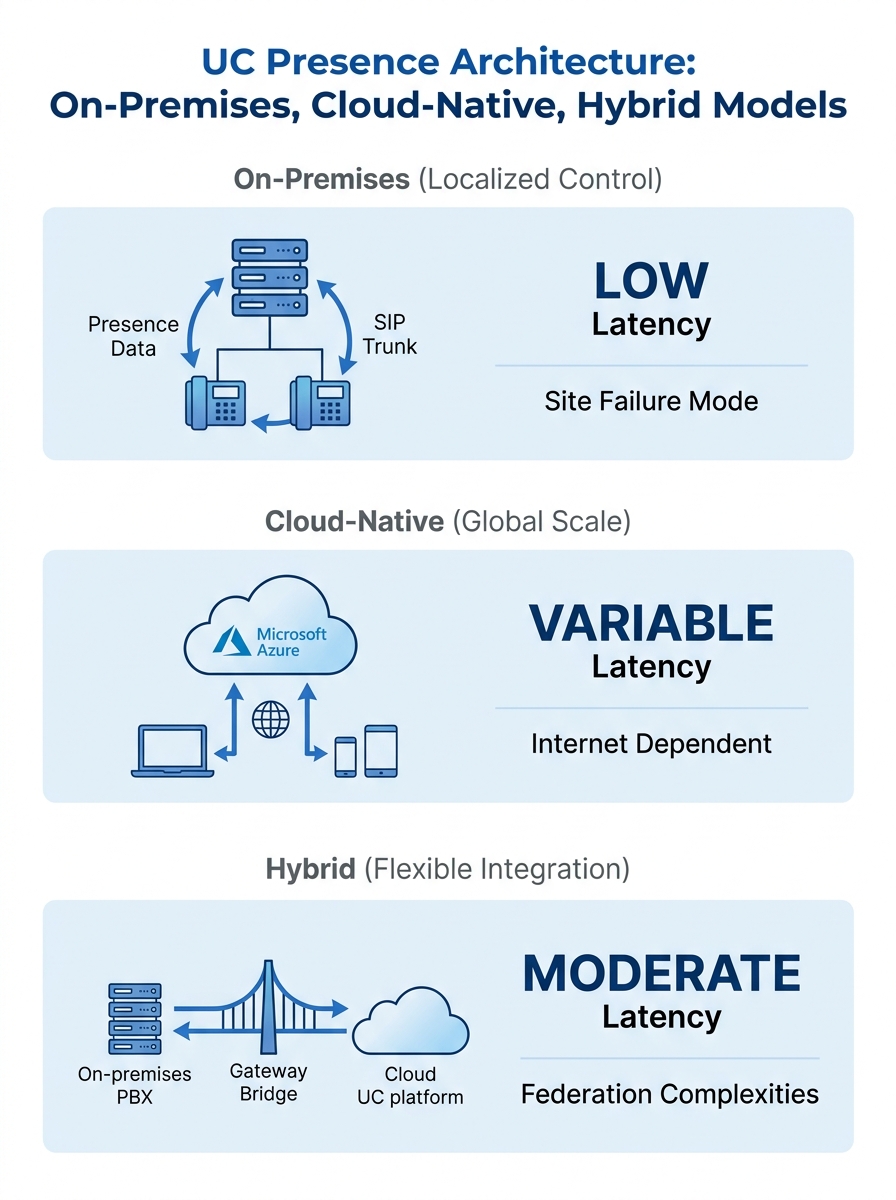
On-Premises Presence Servers
The traditional enterprise approach deploys a dedicated presence server alongside your IP-PBX. Cisco’s Unified Communications Manager IM & Presence Service is the canonical example, running on a Cisco UCS platform as part of the BE7000 or virtualized on your own hardware. Yeastar’s P-Series offers a scaled-down version of the same idea for mid-market deployments.
How It Works
The presence server maintains a subscription model. Each endpoint (desk phone, softphone, Jabra headset with presence integration) registers with the server and subscribes to the status of contacts it cares about. When a user’s state changes, the server pushes NOTIFY messages to all subscribers. Everything stays on your LAN or WAN, with no dependency on external cloud infrastructure.
Where This Shines for Philippine Deployments
Latency and control are the two big wins. Presence updates propagate within milliseconds on a well-configured local network, which matters for contact center environments where routing decisions depend on real-time agent status. You also retain full control over presence data, which can be relevant for government agencies and financial institutions operating under the Data Privacy Act of 2012.
If you’ve already invested in an on-premises PBX and your telecom infrastructure budget was built around CAPEX purchasing, the presence server fits naturally into that model. Cisco’s licensing bundles presence with CUCM, so you may already own it without realizing it.
The Tradeoffs
Complexity scales with size. A multi-site deployment across Manila and Davao requires presence server clustering, inter-cluster peering, and careful DNS configuration. If your IT team consists of three people, that’s a significant operational burden. Firmware updates, certificate management, and capacity planning all fall on you.
And here’s the less obvious problem: on-premises presence servers don’t natively understand what’s happening in cloud applications. If half your team uses Microsoft Teams for chat while the phone system runs on Cisco, those two presence states won’t synchronize without middleware or custom integration work.
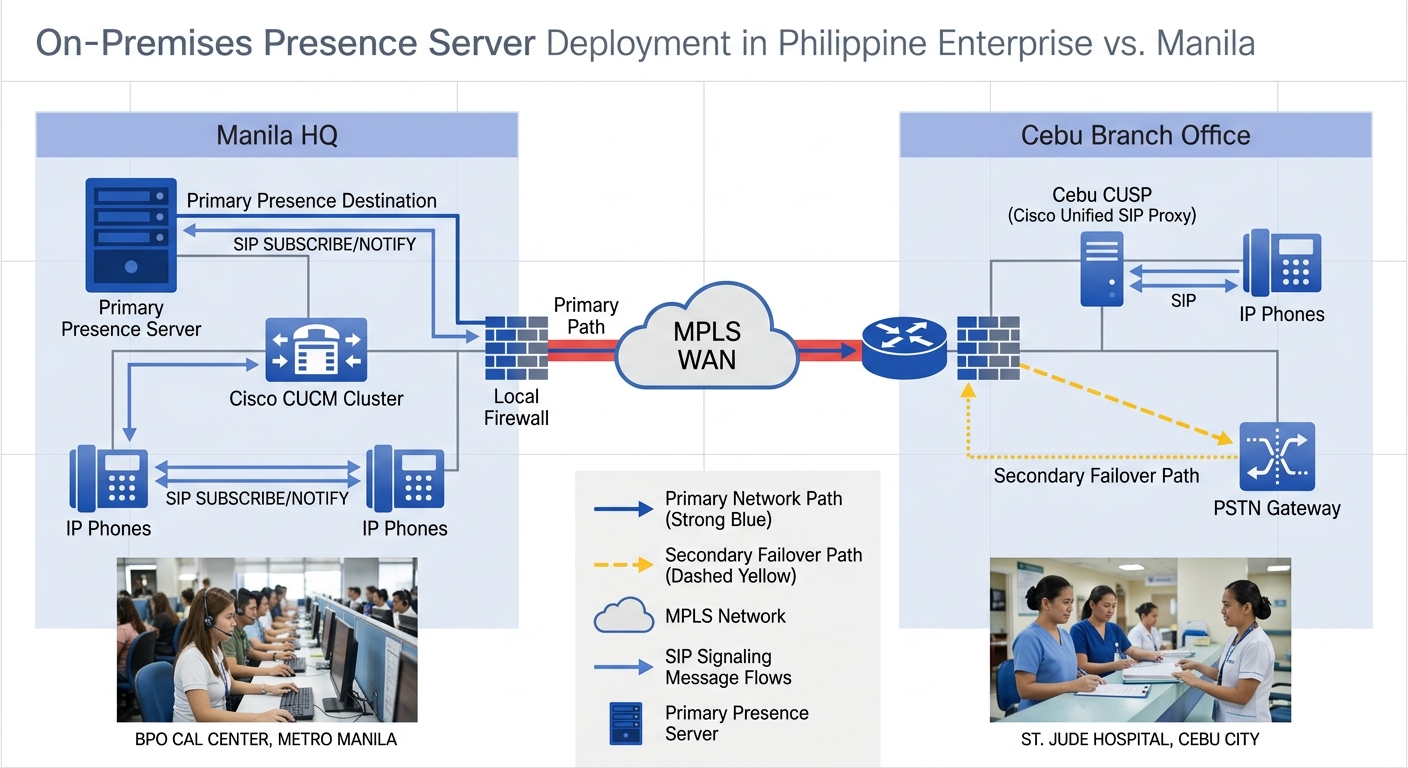
Cloud-Native UCaaS Presence
Microsoft Teams, Zoom, and similar UCaaS platforms handle presence as a built-in service running in the provider’s cloud. There’s no separate presence server to deploy. The platform observes calendar entries, call states, application activity, and manual status selections, then pushes a unified presence indicator to every client.
How It Works
Presence in Teams, for example, is determined by a combination of signals: Outlook calendar data, Teams call state, desktop activity detection, and user-set overrides. The aggregation engine runs in Azure and pushes state changes to connected clients over persistent WebSocket connections. AI-driven contextual awareness is increasingly part of this layer, with platforms automatically setting “focusing” or “presenting” statuses based on app usage patterns.
Where This Shines for Philippine Deployments
Simplicity and mobile reach stand out. A BPO operation with agents working from home in Pampanga, a satellite office in Cebu, and headquarters in Makati gets consistent presence across every location without any inter-site configuration. Mobile workers on Android or iOS see and broadcast presence identically to desk-based colleagues.
For organizations that have already gone all-in on a single UCaaS platform, this model eliminates an entire category of infrastructure management. No clustering, no SIP subscriptions to debug, no certificate rotations. The provider handles it. IBM’s implementation of cross-platform UC presence reportedly delivered a 30% increase in team productivity by ensuring employees could see real-time availability regardless of their device or location.
Presence architecture determines whether your organization can actually see who’s available before transferring a call, and whether your chat and telephony systems agree on a user’s status at any given moment.
The Tradeoffs
Internet dependency is the obvious one. When your PLDT or Globe circuit drops, cloud presence goes dark. For Philippine enterprises outside Metro Manila, where connectivity to rural sites remains a work in progress, this creates a single point of failure that you can’t engineer around with local hardware alone.
Data sovereignty is the second concern. Presence data in Teams flows through Microsoft’s nearest Azure region (likely Singapore or Hong Kong for Philippine tenants). For government agencies, hospitals handling patient data, or any organization subject to NTC or DICT oversight, this raises questions about where employee activity metadata is being processed and stored.
There’s also the vendor lock-in problem. If your desk phones are Fanvil or Yeastar endpoints, their native presence won’t automatically sync with Teams or Zoom. You’ll need SIP gateway integrations or third-party connectors, and those introduce their own latency and failure modes. We’ve written extensively about the gap between UC platforms and actual organizational readiness, and presence federation is one of the areas where that gap becomes tangible.
Hybrid Federation Across On-Prem and Cloud
The third option acknowledges reality: many Philippine enterprises don’t have the luxury of a clean, single-vendor environment. A hospital might run a Yeastar PBX for its main switchboard, Microsoft Teams for administrative staff chat, and a Cisco contact center for patient scheduling. Hybrid federation attempts to bridge presence across these systems so that a nurse checking Teams can see whether the front desk (on the PBX) is available before transferring a patient call.
How It Works
Federation relies on standards-based protocols (primarily SIP and XMPP) or vendor-specific connectors to share presence between domains. Cisco’s approach uses inter-domain federation between CUCM IM & Presence and external platforms. Microsoft offers Direct Routing and certified SBC (Session Border Controller) integrations that can carry presence alongside call signaling.
In practice, you’re deploying a gateway layer — an SBC from a vendor like AudioCodes or Ribbon — that translates presence states between the on-prem and cloud environments. The SBC handles the protocol conversion, maps status values (since “busy” on a PBX and “in a call” on Teams aren’t always equivalent), and manages the subscription relationships.
Where This Shines for Philippine Deployments
This is the pragmatic choice for organizations in the middle of a migration. If you’ve been running an on-premises PBX and you’re gradually shifting users to UCaaS, hybrid federation lets you maintain presence continuity during the transition. It’s also the right model for multi-office availability management when different branches run different systems — a common scenario for Philippine enterprises that have grown through acquisition or have branches with varying levels of network infrastructure.
Organizations that have worked through integrating VoIP across multiple offices on public networks will recognize the pattern: you’re essentially building an overlay network for presence, similar to how you’d build one for call signaling.
The Tradeoffs
Complexity is the dominant cost. You’re managing presence logic in three places: the on-prem server, the cloud platform, and the gateway between them. Debugging why a user shows “available” on Teams but “offline” on the PBX requires tracing through SBC logs, SIP message flows, and potentially Azure service health dashboards simultaneously.
Warning: Hybrid presence federation adds an SBC as a potential single point of failure. Budget for SBC redundancy (active/standby pair) the same way you would for your internet gateway.
Latency is also higher. A presence change on the PBX has to traverse the SBC, hit the cloud API, and propagate to cloud clients. In testing, this can add 2-5 seconds of delay compared to native presence in either environment alone. For contact center routing, that delay can mean the difference between a call reaching an available agent and hitting voicemail.
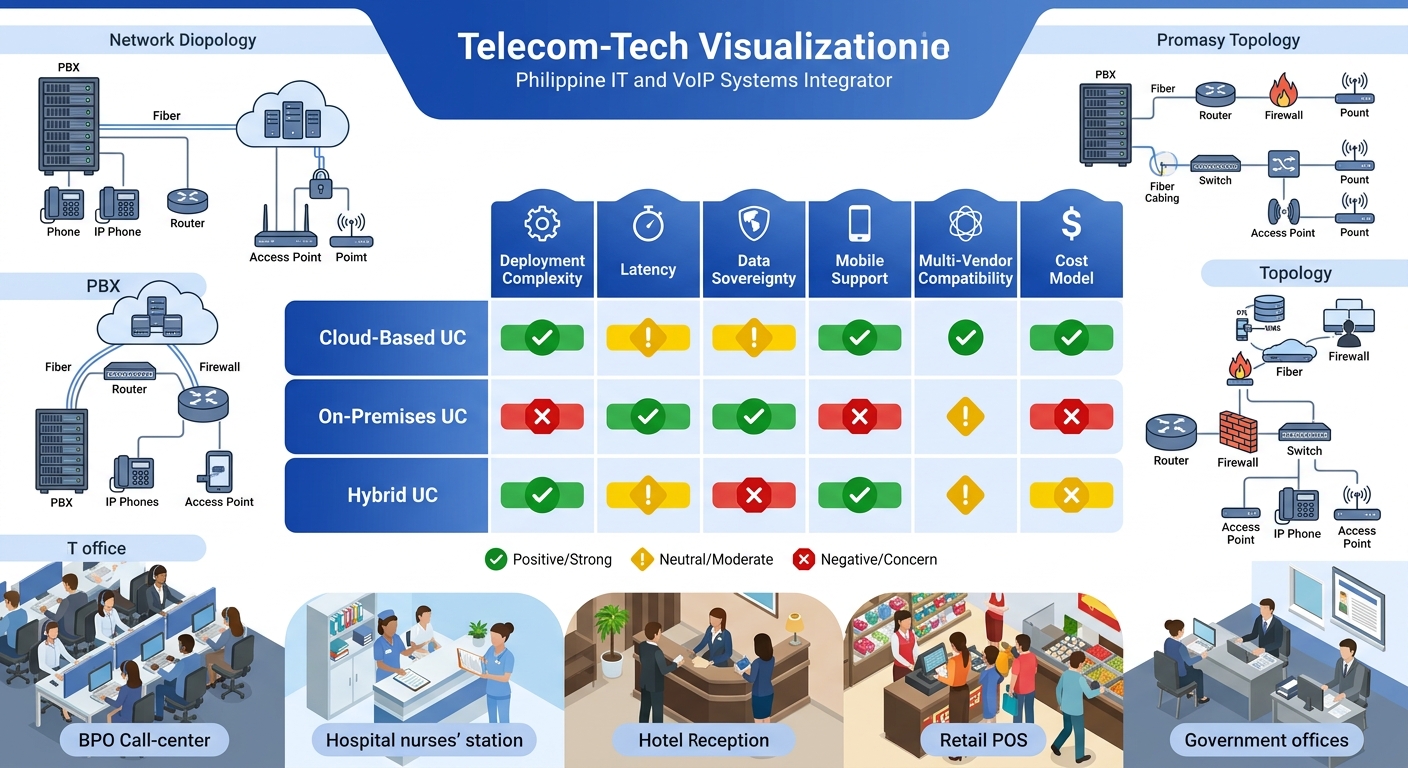
How To Choose Between These Three
The decision tree for Philippine enterprises maps to three variables: your current infrastructure, your compliance requirements, and your IT team’s operational capacity.
If you’re a government agency, a hospital with patient data concerns, or a financial institution where data sovereignty is non-negotiable, on-premises presence is the defensible choice. You control where the data lives, you control the propagation path, and you can demonstrate compliance in an audit without referencing a third-party cloud provider’s data processing agreement. The cost is operational complexity and the need for internal expertise with Cisco or Yeastar platforms.
If you’re a BPO operation, a school, or a mid-market company that has standardized on a single UCaaS platform, cloud-native presence is the obvious path. You eliminate infrastructure management, get mobile presence for free, and benefit from AI-driven contextual status updates. The cost is internet dependency and the need to ensure your WAN can handle real-time signaling even during peak hours. Before committing, verify that your network can actually sustain the quality your UC platform demands.
If you’re somewhere in between — running a mix of on-prem telephony and cloud collaboration, or migrating from one to the other — hybrid federation is the realistic choice. It’s more expensive to operate and slower to propagate, but it acknowledges the multi-vendor reality of most Philippine enterprise collaboration architecture deployments. Budget for an SBC pair, allocate time for protocol debugging, and plan to eventually sunset the complexity by completing your migration in one direction.
The honest assessment is that Philippine UC infrastructure decisions around presence get made by default far too often. IT teams pick a PBX, pick a collaboration platform, and assume the green dots will sort themselves out. They rarely do. The presence layer is where your phone system, your chat platform, and your contact center either agree on reality or quietly contradict each other. Choosing its architecture deliberately, rather than inheriting it as a side effect, is what separates a UC deployment that works from one that merely exists.