
Average contact center wait time at Philippine Airlines dropped to under one minute after the airline deployed voice AI across its customer service lines. Monthly costs fell by 30%. The raw material behind that result was the same SIP signaling data that Philippine enterprise PBXs have generated for over a decade, sitting in log files, mostly ignored.
SIP Signaling Was Always Rich Data
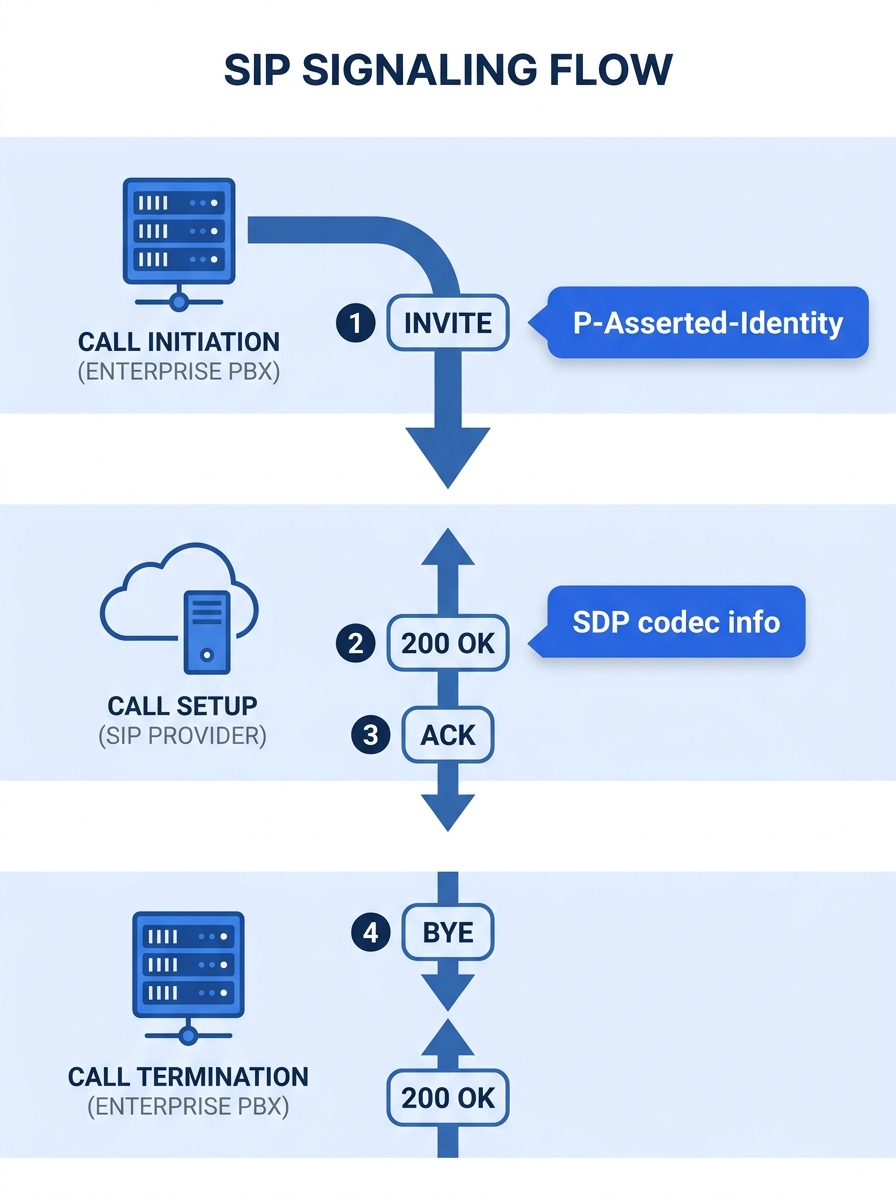
Every VoIP call starts with SIP. The protocol handles session setup, teardown, and modification. Each INVITE, BYE, and re-INVITE message carries metadata: caller identity, codec negotiation, route paths, timestamps, response codes. A medium-sized Philippine BPO running 500 concurrent seats generates thousands of SIP dialogs per hour. For years, that data fed CDR (call detail record) reports and nothing more. Call duration. Caller ID. Destination. Timestamp.
The signaling layer held far more information than anyone extracted from it. The problem was analytical. SIP headers contain fields like P-Asserted-Identity, Via routes, and SDP media descriptors that reveal network topology, call routing decisions, and codec quality hints. But parsing that data at scale required tooling that most on-premise PBX deployments in Makati or Cebu IT Park didn’t have. Yeastar P-Series or Cisco CUCM platforms logged everything. Almost nobody used it.
If you’ve already mapped out how SIP call signaling works in enterprise deployments, the AI layer is the logical next step: the same protocol fields that define a call’s path now feed models that optimize, protect, and interpret that path.
Machine Learning Hit the Signaling Layer
An IEEE-published study proposed a machine learning methodology for predicting SIP signaling sessions using Bayesian inference. The researchers built models that represented statistical relationships between individual SIP messages and full dialog sequences. The goal was twofold: predict abnormal message sequences to prevent SIP-based attacks, and spot patterns that indicated call quality degradation before users noticed.
This work mattered for Philippine deployments because SIP intelligence at the signaling layer sits upstream of everything else. If you can predict that a dialog sequence will fail based on the first three messages, you can reroute the call before it drops. A 2025 systematic literature review found that ML-based network traffic prediction models reduce latency by 15–25% through dynamic routing. For enterprises running voice traffic over congested PLDT or Globe links between Manila and provincial offices, that margin decides whether a call completes cleanly or dies mid-sentence.
Mobileum’s VoIP and SIP fraud detection platform took a parallel path. Their system uses AI and machine learning to block unauthorized traffic patterns, signaling manipulation, and malicious activity in real time. Given that 20% of VoIP deployments have historically been vulnerable to breaches like session hijacking, this kind of SIP-layer intelligence became a security requirement for Philippine banks and government agencies.
Transcription and Sentiment Changed What Supervisors Could See
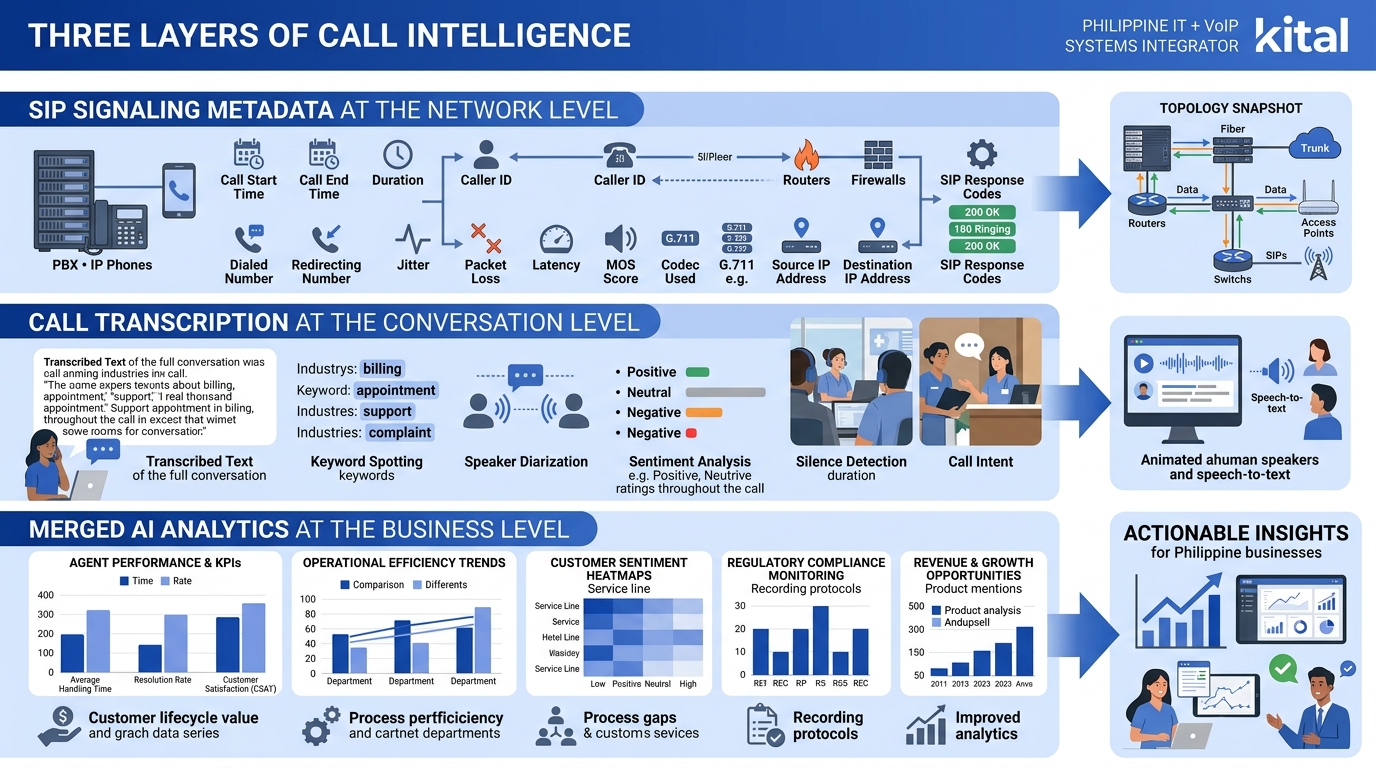
The signaling layer tells you what happened at the network level. Transcription tells you what happened in the conversation. When these two data streams merge, you get enterprise VoIP context that neither provides alone.
Amazon Transcribe Call Analytics summarizes interactions by capturing the reason for the call, steps taken to resolve the issue, and recommended next steps. Supervisors review summaries instead of listening to full recordings. For a 200-seat call center in Alabang handling 4,000 calls per day, that’s the difference between sampling 2% of calls and reviewing 100%.
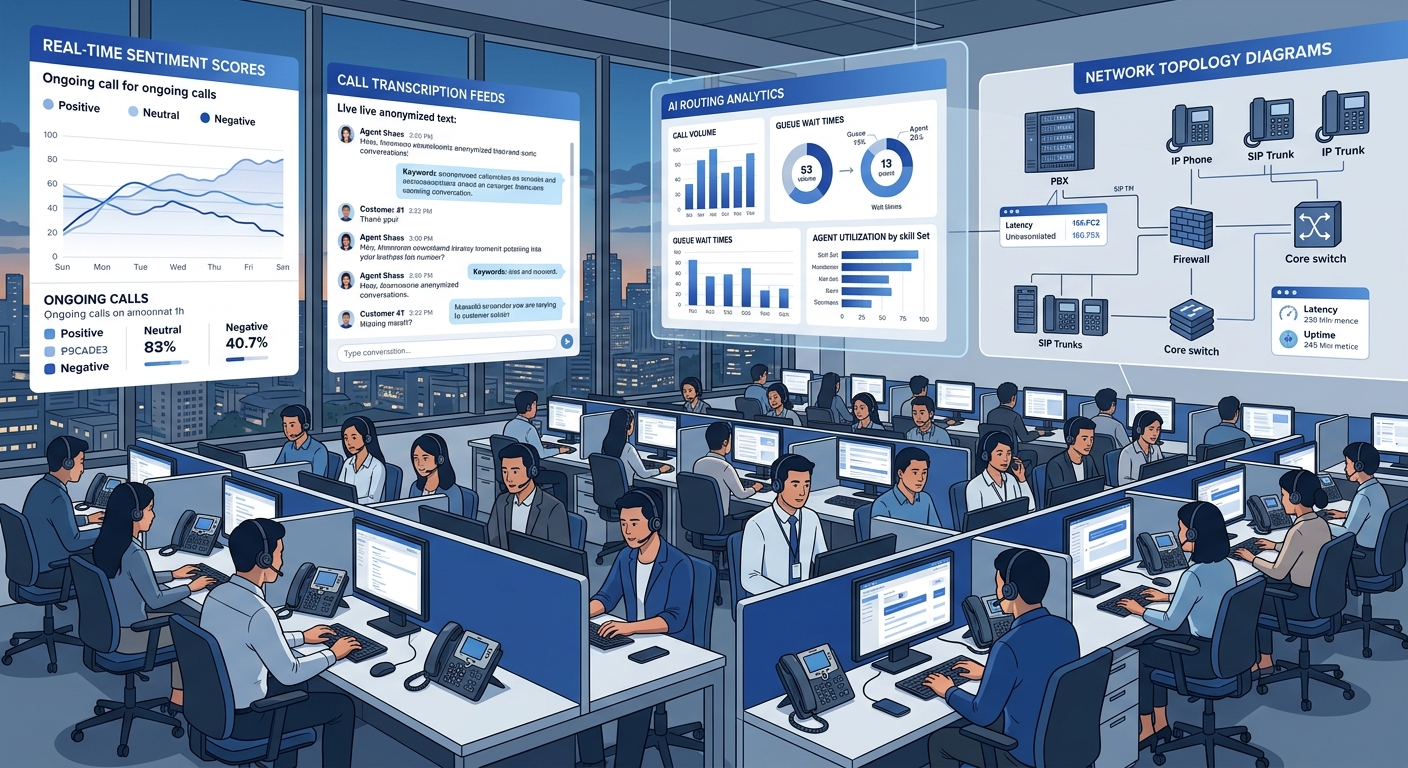
Dialpad pushed further with live sentiment analysis. Their AI monitors active conversations in real time, flagging calls where customer frustration is rising. Managers see a dashboard of all live calls with sentiment scores updated second by second. “AI Live Coach Cards can be configured to surface relevant notes automatically based on topics mentioned in the conversation,” Dialpad’s documentation states, “helping agents stay informed without disrupting the flow of the call.”
Call transcription automation at this scale turns unstructured voice data into searchable, analyzable text. A hospital network in Cebu can search three months of patient intake calls for mentions of “insurance denial” and find 347 instances in under a minute. A bank with 15 branches can flag every call where an agent failed to read the required compliance disclosure. The raw audio was always there. Automated transcription made it usable.
When SIP metadata and conversation transcripts merge into a single analytics layer, every call becomes a data point that feeds staffing models, compliance audits, and product decisions.
Philippine Airlines Became the Local Proof Point
PAL’s voice AI deployment got attention because the numbers were specific and public. According to Computer Weekly’s reporting, average contact center wait times fell to under one minute after deployment. Monthly customer service costs dropped by roughly 30%. The airline set a target of reaching what it calls a “super AI agent state” by April 2026, where 80% of tasks handled by live agents would be fully automated.
Before the AI layer, password resets alone accounted for 10–15% of airline support calls. These are low-complexity, high-volume interactions that eat agent time without building customer relationships. AI-powered call analytics identified them as the obvious first automation target. Voice AI now handles them without human intervention.
The PAL case matters for Philippine business communications because it demonstrated that AI-driven call intelligence works in a Filipino customer service context. Tagalog-English code-switching, regional accents, and local consumer expectations were all part of the operating environment. It wasn’t a Silicon Valley pilot. It was deployed over the same telco infrastructure that every Manila enterprise uses daily.
The BPO Sector Followed at Scale
A Stanford Digital Economy Laboratory and MIT Sloan School of Management study found that AI assistants increased Filipino BPO agents’ productivity by 13.8%, measured by customer issues resolved per hour. The AI provided live recommendations during chats, cutting time per interaction and increasing resolved volume. That study tracked real agents at real Philippine outsourcing firms.
The IT and Business Process Association of the Philippines (IBPAP) reports that 56% of back-office BPO companies are actively integrating AI tools. Among those firms, 8% have already reduced headcount due to automation. But the sector’s overall trajectory points upward: growth projections run from $38 billion in 2024 to $60 billion by 2028, with over one million new jobs expected.
Laurent Junique, CEO of TDCX (a Fortune Southeast Asia 500 BPO provider), framed AI as part of the industry’s natural progression: “There’s been several waves of automation… navigating toward getting the more complex work and retiring the more simple tasks.”
Local providers are building for this market. Lgorithm Solutions offers AI VoIP platforms with predictive dialing, real-time voice analytics, and intelligent call routing based on agent skills, language proficiency, and historical interactions. Plans from providers like FreJun start at $14.49 per user per month, putting AI-powered call analytics within reach of mid-market Philippine enterprises that previously couldn’t justify the spend.
If your team is building out analytics dashboards that tie to staffing decisions, AI call intelligence feeds directly into those models. And for BPOs already modeling Erlang capacity for staffing efficiency, real-time call data from AI systems gives those models inputs that CDRs alone never could.
Info: AI SIP connectors analyze caller intent, past interactions, and business rules to route calls to the right department or agent in real time. This turns SIP from a signaling protocol into a decision-making layer that reduces wait times and improves first-call resolution.
Where the Data Looks Today
Philippine enterprise VoIP sits at an inflection point. The infrastructure is mature enough to support AI-driven call intelligence, but structural gaps remain. A UNESCO AI readiness assessment gave the Philippines a score of 0.00 in supercomputing capacity and quality of engineering education. Venture capital availability for AI startups scored just 6.00 out of 100. These numbers explain why most Philippine deployments rely on international platforms like AWS Transcribe, Dialpad, or Vapi rather than locally built AI engines.
The government’s response has been legislative. House Bill 7396 proposed creating the Artificial Intelligence Development Authority (AIDA) to regulate and promote AI adoption. The National AI Strategy Roadmap focuses on education, digital infrastructure, and public-private partnerships. Neither has produced measurable changes in enterprise AI adoption yet, but they signal regulatory direction that IT decision-makers should track.
What has changed is the cost curve. Call transcription automation that required custom NLP pipelines and dedicated GPU servers three years ago now ships as a standard feature in cloud PBX platforms. Sentiment analysis runs as a real-time service. SIP intelligence that once demanded packet capture expertise is available through AI SIP connectors that plug into existing trunk configurations.
For organizations already converting call quality complaints into network intelligence, the AI layer adds business context to what was previously a network-level diagnostic. The SIP INVITE that triggered a complaint now carries attached transcription, sentiment score, resolution outcome, and agent performance data. The call itself becomes a business object you can query, trend, and act on. The signaling data has been flowing through your infrastructure for years. The organizations gaining an edge are the ones that finally started reading it.