
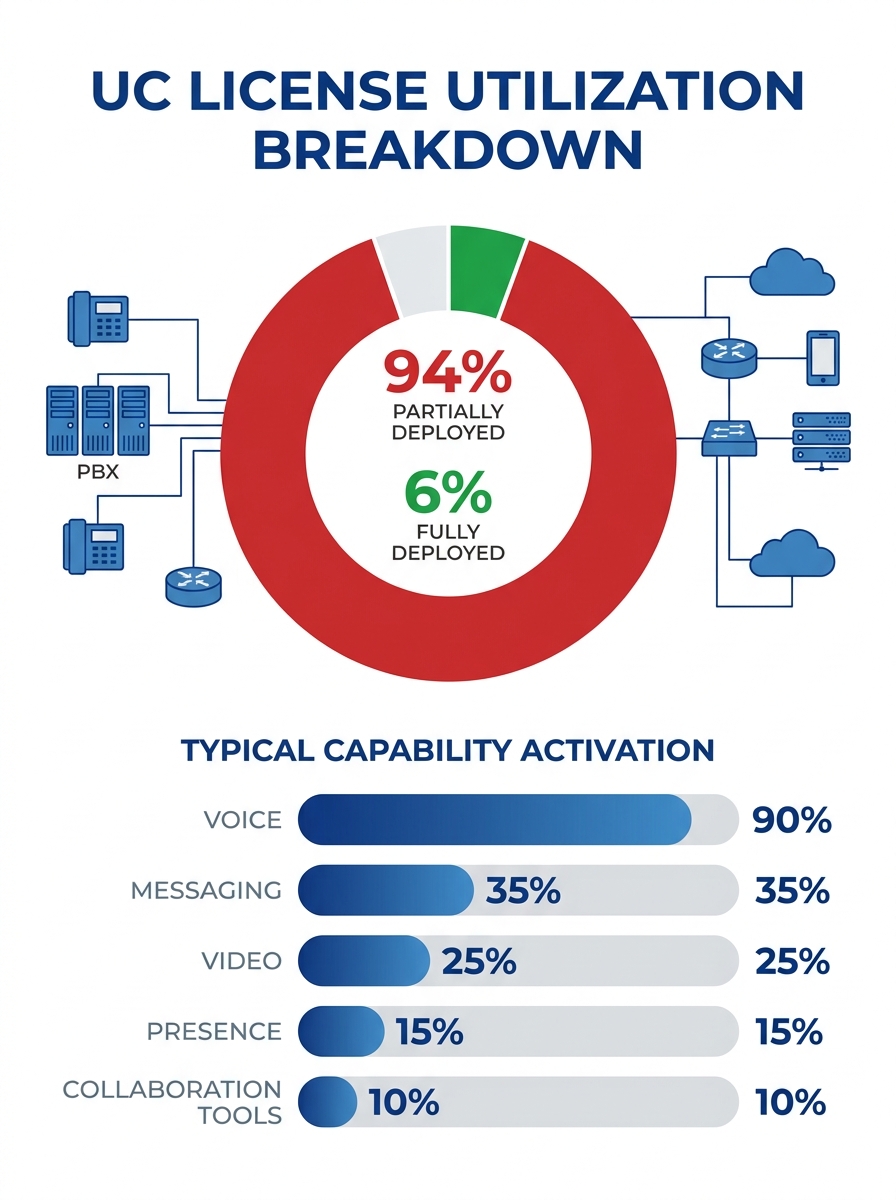
The standard sequence for unified communications adoption (executive buy-in, platform purchase, then employee training) produces the opposite of what it promises. A Wainhouse Research survey found that only 6% of enterprises have deployed 100% of their purchased UC licenses, meaning 94% of organizations are paying for capabilities their people never touch. Philippine enterprises following this buy-first, train-later playbook are burning budget while their employees quietly revert to Viber group chats and personal cell phones.
TL;DR: UC deployments fail because organizations treat change management as a post-purchase afterthought instead of a pre-purchase requirement. A phased migration planning approach with role-based training before platform cutover closes the gap between UC spending and actual employee adoption. The fix is sequencing: assess readiness first, train second, deploy third.
94% of UC Licenses Sit Unused, and Philippine Enterprises Are No Exception
Why does the gap between UC spending and UC usage remain so wide? Because procurement and adoption are treated as the same event. They aren’t. Wainhouse Research data, analyzed by Vyopta, shows the UC market is growing at 13.2% annually while only 6% of surveyed enterprises have deployed all their purchased licenses. The remaining 94% have paid for features that sit dormant, never activated, never trained on.
In the Philippine context, this waste compounds fast. A mid-sized BPO in Cebu or a hospital network in Davao typically signs a 3-year UC contract covering voice, video, messaging, and presence features. The IT team configures the PBX and SIP trunks, lights up the voice component, and declares the project complete. Video conferencing sits dormant. Presence indicators go unset. Messaging defaults to whatever consumer app the team was already using.
The financial math is ugly. If an organization deploys 40% of purchased UC capabilities, it’s paying a 60% premium for infrastructure that delivers zero productivity return. For a 200-seat deployment running PHP 450 per user per month, that works out to roughly PHP 1.6 million per year in wasted licensing alone. Multiply that across a multi-site enterprise operating four branch offices and the figure crosses PHP 6 million annually.
The platforms themselves aren’t failing. When we’ve helped organizations plan multi-site PBX consolidation and cutover schedules, the network and telephony components typically perform as designed within weeks. The breakdown happens on the human side: employees weren’t consulted about their workflows, training happened once in a two-hour block six weeks after go-live, and managers never reinforced the new tools because nobody told them their teams were expected to stop using the old ones.
Vyopta’s analysis also flagged that expanding mobile UC services face key challenges around reliability and quality of service, with equipment costs, bandwidth constraints, and the tax on internal support teams following closely behind. Each of those issues worsens when the organization’s change management framework didn’t account for them before signing the contract.
Training Timed to Platform Launch Is Training Timed to Fail
TechTarget’s analysis of successful UC initiatives names a specific formula: “user-centric design plus targeted enablement plus measurable outcomes.” The word that matters most there is “targeted.” Generic training sessions that walk 150 employees through the same feature list produce generic results, which is to say, poor ones.
Willis Towers Watson research on organizational communication reveals the decay pattern clearly: 68% of senior managers receive clear messaging about major organizational decisions, but that figure drops to 53% among middle managers and falls to 40% among first-line supervisors. In a Philippine enterprise where the frontline supervisor is the person who actually decides whether the call center floor uses the new UC softphone or keeps the old desk phone, losing 60% of your message before it reaches that decision-maker guarantees adoption failure.
The employee training strategy that works looks different from what Philippine IT teams typically execute. UnifiedCommunications.com’s change management framework breaks adoption into five distinct components: organization readiness for change, stakeholder mapping, cultural assessment, training needs analysis, and change impact evaluation. Training appears fourth in that sequence, not first. Three separate diagnostic steps happen before anyone opens a training manual.
As TechTarget’s UC adoption research puts it: “Frame UC adoption as a strategic change initiative designed to reshape how work gets done,” not as a software rollout with a help-desk ticket queue attached.
UC Today’s research on technology training strategies reinforces this through the concept of internal champions. Effective champions “normalize uncertainty instead of pretending the tools are obvious,” and the best feature training is delivered at the moment someone is actually stuck, not weeks before they encounter the problem. A call center agent in Makati doesn’t need to learn conference bridge management on day one. She needs it the first time a client asks to add a third party to a live call.
This evidence supports a three-phase approach I’m calling the Ready-Map-Train (RMT) sequence:
Phase 1 — Ready. Assess organizational change capacity, identify resistance patterns, and confirm executive sponsors before procurement begins. If your organization recently survived an ERP migration or a major policy overhaul, your people may already be change-fatigued. We’ve written about evaluating your organization’s actual change capacity before choosing a UC platform, and the principle applies here directly. Organizations that clearly communicate goals before launch are 3.5 times more likely to report successful transformations, according to AIM Business School research on change management in Philippine organizations.
Phase 2 — Map. Build stakeholder maps that identify who influences tool adoption at each organizational layer. In a Philippine hospital, that’s the head nurse on each floor, not the CIO. In a BPO, it’s the team lead managing 15 agents, not the operations director. The stakeholder map should also capture which communication channels each group actually trusts. If your Cebu team lives in a group chat, that’s where migration announcements should appear first.
Phase 3 — Train. Deliver role-specific, workflow-specific training in short modules timed to actual deployment phases. The accounting team gets invoicing-related UC workflows. The facilities team gets intercom and paging features. Nobody sits through a feature they’ll never use. This structure prevents the 70% failure rate that plagues change initiatives where training is treated as a checkbox rather than a phased capability-building program.
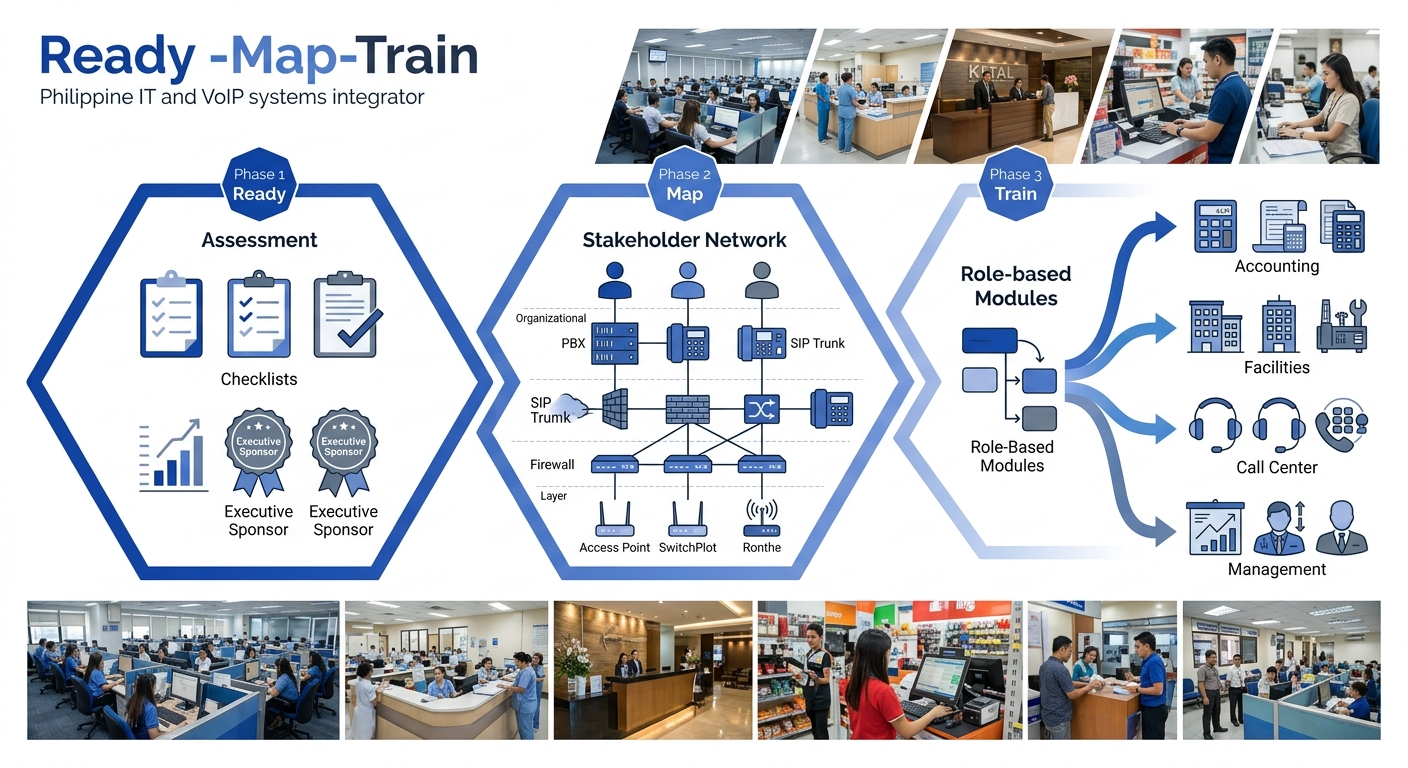
Training appears fourth in the five-component UC adoption sequence. Three separate diagnostic steps happen before anyone opens a training manual.
Big-Bang Cutovers Destroy What Phased Migration Planning Preserves
Philippine enterprises default to big-bang cutovers because they appear cheaper and faster. You schedule a weekend, swap the PBX, flip the SIP trunks, and Monday morning the new system is live. The theory is clean. The practice is destructive.
Arthur D. Little’s analysis of network migration strategies identifies that a well-designed phased migration planning process, covering supplier negotiation, communication strategies, service quality maintenance, and active stakeholder engagement, optimizes the net present value of the entire transition. Big-bang approaches skip every one of these elements in favor of speed.
Phased migration, as defined by Circles’ research on telco data migration, involves splitting the deployment into segments and migrating them in multiple shorter maintenance windows. A market-led variant triggers migration when a user takes a specific action, further reducing disruption by aligning the cutover with natural workflow breakpoints.
For a Philippine enterprise with offices in Metro Manila, Cebu, and Davao, here’s how the three approaches compare:
| Migration Approach | Downtime Risk | Change Absorption | Cost Profile | Best Fit |
|---|---|---|---|---|
| Big-Bang | High (single failure point) | Very low (all users disrupted at once) | Lower upfront, higher remediation | Single-site, under 50 users |
| Cohort/Phased | Low (segmented windows) | High (each group adapts before next wave) | Moderate, spread over 3-6 months | Multi-site, 50-500 users |
| Market-Led | Minimal (user-triggered) | Highest (migration at natural breakpoints) | Highest upfront (dual systems run longer) | Large enterprises, 500+ users |
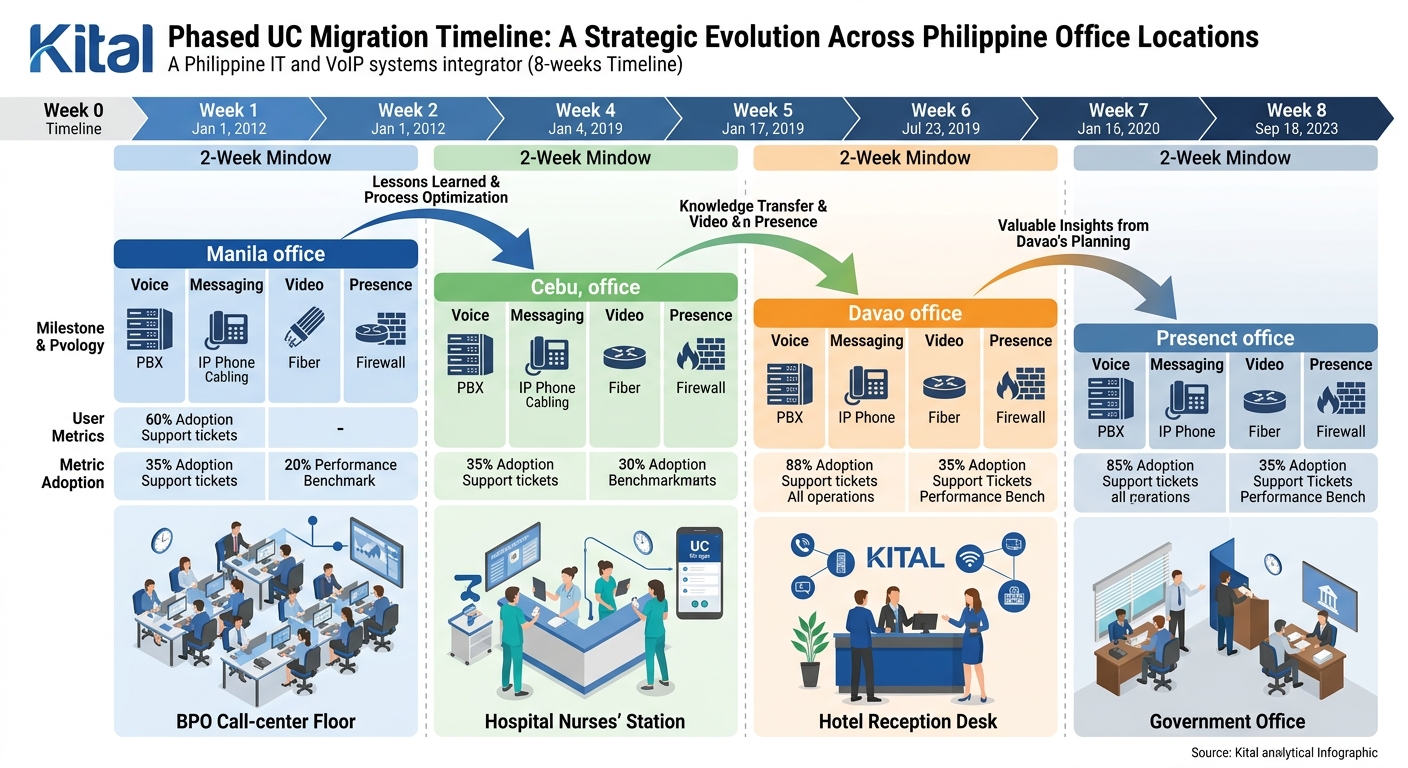
The cohort approach pairs well with Yeastar P-Series systems that can run legacy analog trunks alongside SIP on the same platform during transition. This dual-stack capability means the Cebu office migrates in week one, Manila headquarters in week three, and Davao in week five. Each site’s lessons feed the next site’s deployment playbook. Mistakes caught in Cebu, like discovering that the nursing staff needs physical handset buttons rather than softphones, get corrected before Manila goes live.
Warning: Running dual systems during phased migration increases short-term complexity. Budget 15-20% additional IT support hours per site during the overlap window, and assign a dedicated point person at each location. The alternative, a failed big-bang cutover that takes your phones offline for a full business day, costs significantly more in lost revenue and employee trust.
When you examine the full difference between unified communications and standalone VoIP, phased migration planning matters even more. UC deployments touch video, messaging, presence, and collaboration on top of voice. Each capability layer has its own adoption curve. Deploying all layers simultaneously across all sites is a recipe for the partial adoption that produces 94% license waste.
The Claim, Revisited
The buy-first, train-later sequence for unified communications adoption produces the 94% waste rate that Wainhouse Research documented. Philippine enterprises face this problem with an additional complication: the communication gap between Manila headquarters and provincial branch offices mirrors the 68%-to-40% message decay that Willis Towers Watson identified globally. By the time a UC deployment mandate reaches a team lead in a Davao satellite office, the original purpose, the training resources, and the executive sponsorship behind it have all degraded.
The fix isn’t better technology or more expensive platforms. The platforms available today, from cloud UCaaS to on-premise IP-PBX, have more than enough capability for any Philippine enterprise use case. The fix is sequencing. Assess readiness before procurement. Map stakeholders before training. Train by role and workflow, not by feature list. And phase the migration so each site’s experience informs the next.
Philippine organizations that reorder these steps, putting the change management framework ahead of the purchase order, will stop paying for capabilities their people never use. The Ready-Map-Train sequence isn’t complicated, and it doesn’t require expensive consultants. It requires the discipline to treat unified communications adoption as an organizational change problem first and a technology problem second. The 94% waste rate persists because that discipline is rare, but the enterprises that exercise it will capture the full return on every license they buy.