
Consolidating multiple standalone PBX systems into a single IP telephony platform requires a minimum of 100 kbps symmetric bandwidth per concurrent call at each site, a dual-ISP WAN strategy per location, and a phased cutover sequence that uses temporary DID numbers to prevent service interruptions during number porting.
TL;DR: Philippine enterprises running separate PBX units across 3+ offices pay for duplicated trunk lines, separate maintenance contracts, and fragmented extension directories. A structured PBX consolidation eliminates that overhead, but the cutover sequence determines whether calls drop during migration. The Three-Gate Cutover Model outlined here gives you the decision checkpoints.
Why Separate PBX Systems per Site Cost More Than the Hardware
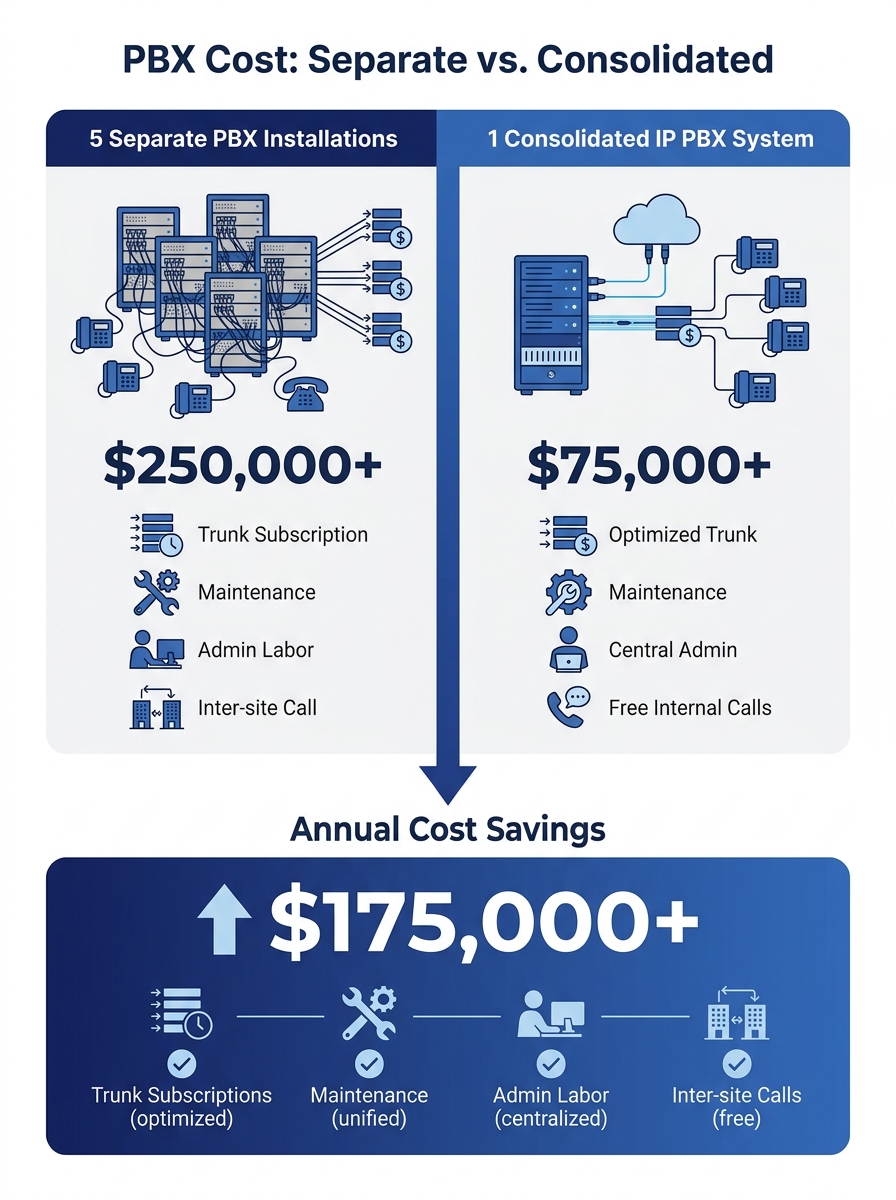
Each standalone PBX installation carries its own trunk lines, its own maintenance contract, and its own administrator. For an enterprise with 5 branch offices spread across Metro Manila, Cebu, and Davao, that means 5 separate PRI or SIP trunk subscriptions, 5 firmware update cycles, and 5 isolated dial plans. Inter-site calls route through the PSTN, incurring per-minute charges on every internal conversation.
Mushroom Networks recommends a multi-WAN strategy where dependency on ISPs is spread over at least 2 providers for any deployment carrying mission-critical VoIP services. Under a consolidated PBX model, those 5 branch WAN links still need redundancy, but the trunk lines collapse into a single SIP trunk pool managed from one location. A 20-seat office eliminating dedicated on-site trunks and maintenance contracts can recover roughly $800 per month in direct costs, according to Viirtue’s 2025 UCaaS migration analysis.
Multiply that across 5 sites and the arithmetic shifts significantly: $4,000 per month, $48,000 per year, before counting the labor savings from managing one PBX admin interface instead of five.
Bandwidth and QoS: The Network Foundation
Every enterprise telephony migration starts with bandwidth math. The standard planning figure is 100 kbps of symmetric bandwidth per concurrent G.711 call, plus a 20% overhead buffer for signaling, jitter buffer recovery, and network management traffic. A 50-seat branch office where 30% of staff are on calls simultaneously needs 30 concurrent call paths × 100 kbps × 1.2 = 3.6 Mbps of dedicated voice bandwidth. That’s the floor, not the ceiling.
QoS configuration determines whether that bandwidth actually protects voice quality. Voice packets (DSCP EF, decimal 46) need priority queuing at every hop between the branch site and the central PBX or SIP trunk termination point. If your branch in Davao connects over a shared MPLS or internet VPN to a data center in Makati, every router and switch in that path has to honor the same QoS markings. A single misconfigured switch port resets DSCP to 0, and voice quality degrades to whatever the congested default queue allows.
The deeper issue for Philippine deployments is last-mile variability. Fiber availability differs sharply between BGC and a secondary city like General Santos. Enterprises planning a multi-site VoIP cutover across public networks need site-by-site WAN assessments, not a single bandwidth template applied everywhere. Run a 72-hour packet capture at each location before finalizing your IP telephony deployment sequencing. Measure jitter (target: under 30 ms), packet loss (target: under 1%), and round-trip latency (target: under 150 ms one-way to the central PBX).
Tip: Test during each site’s peak traffic window, typically 10:00 AM to 12:00 PM and 2:00 PM to 4:00 PM for Philippine office environments. Off-peak measurements understate congestion by 40-60%.
The Three-Gate Cutover Model
A zero-downtime network migration plan includes assessment, detailed design, risk mitigation strategies, phased or parallel migration, automation tools, rollback procedures, and post-migration validation, according to NetworkersHome’s migration design framework. For multi-site PBX consolidation specifically, these elements map to three decision gates. Each gate must pass before the next phase begins.
Gate 1: Parallel Infrastructure Stand-Up. Deploy the new IP PBX (on-premises or cloud-hosted) alongside the existing legacy systems. Configure SIP trunks, extension numbering plans, voicemail, IVR trees, and call recording on the new platform. Run internal test calls for a minimum of 5 business days. Every analog device needs an FXS gateway mapped and tested. ClearlyIP’s VoIP Failover Gateway, for instance, provides 6 built-in FXS ports and 4G wireless backup for fax machines, elevator phones, and alarm dialers that can’t migrate to SIP endpoints.
Gate 2: Phased User Migration. Move one site at a time, starting with the smallest or least call-intensive branch. Users at the migrated site switch to the new platform while all other sites remain on legacy. Inter-site calling between old and new platforms routes through a temporary SIP interconnect. This phase typically runs 1-2 weeks per site. During this window, temporary DID numbers prevent service loss while number porting completes. Submit the Letter of Authorization (LOA) to the releasing carrier early, because Philippine PSTN number ports through NTC-regulated carriers can take 7-15 business days.
Gate 3: Legacy Decommission. Only after all sites are live on the consolidated platform, all numbers are ported, and post-migration call quality validation passes for 10+ consecutive business days do you cancel the old trunk lines and power down legacy PBX hardware. Premature cancellation is the single most common cause of service loss during PBX consolidation.
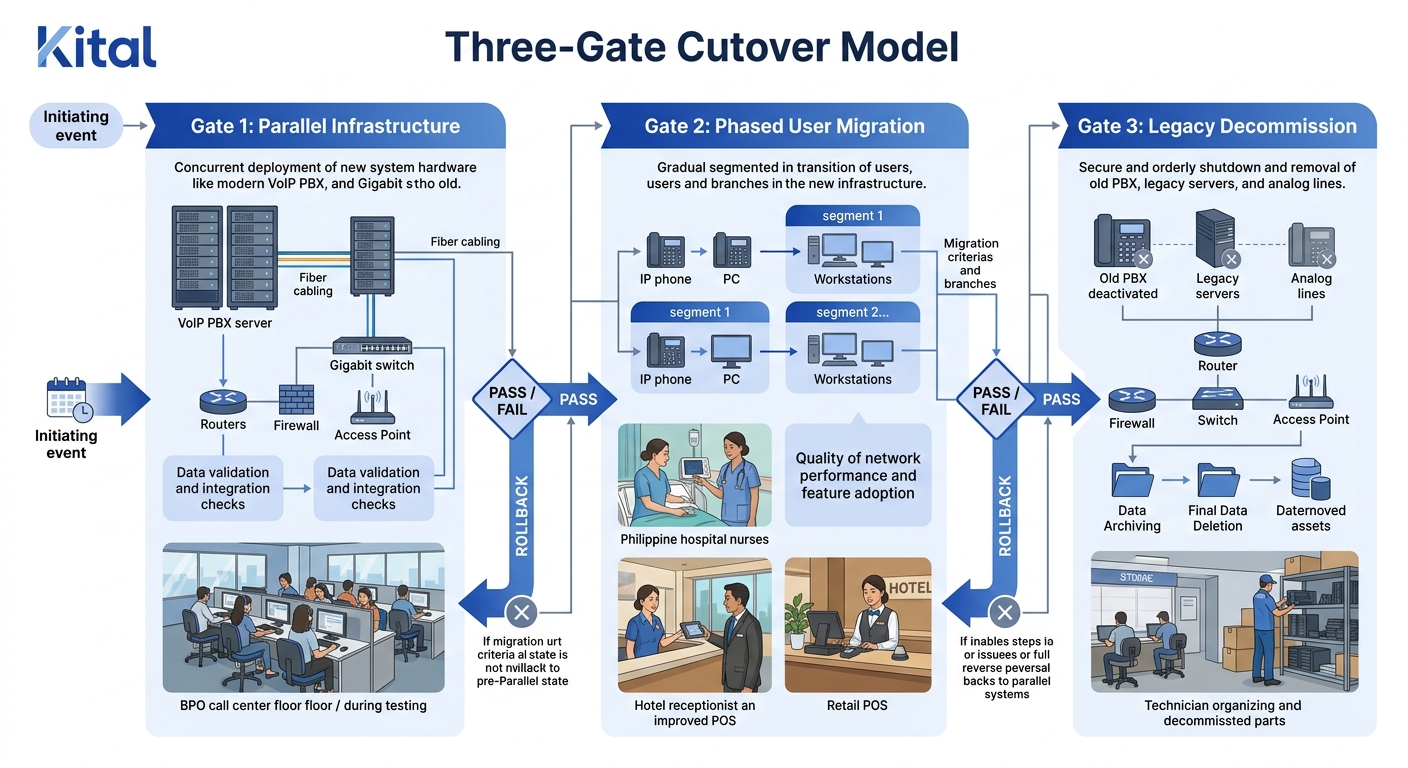
Premature cancellation of legacy trunk lines is the single most common cause of service loss during PBX consolidation. Keep the old system running until the new platform proves itself over 10+ business days.
Network Failover Planning for the Consolidated Platform
Consolidation concentrates risk. When 5 separate PBX systems each fail independently, only one site goes down at a time. When a single consolidated PBX fails, every site loses dial tone. Network failover planning has to account for this shifted risk profile.
In a SIP failover scenario, if the primary SIP trunk connection fails, the telephony system automatically fails over to a secondary SIP trunk provisioned for this purpose. For Philippine enterprises, that means contracting SIP trunks from at least 2 different carriers. Your PBX’s SIP trunk failover configuration should detect trunk loss within 3-5 seconds and reroute without user intervention.
At the WAN level, each branch site should maintain dual ISP links with automatic failover. SD-WAN appliances from Fortinet or Cisco Meraki can monitor path quality in real time and shift voice traffic to the healthier link when jitter or packet loss crosses configured thresholds. A solid intelligent failover architecture for Philippine telecom environments typically pairs a fiber primary with an LTE backup, which covers branch offices with under 20 concurrent call paths.
Mitel’s enterprise IP telephony documentation notes that voice resiliency is prioritized through failover routing, geo-redundancy, and survivability mechanisms. For enterprises with a Metro Manila primary data center, a secondary PBX node in Cebu or Clark provides geographic redundancy. If the primary node goes offline, the secondary takes over endpoint registration within 15-30 seconds, depending on SIP registration timeout settings.
| Failover Layer | Primary | Secondary | Target Failover Time |
|---|---|---|---|
| SIP Trunk | PLDT SIP | Globe or Eastern Telecom SIP | 3-5 seconds |
| WAN per Branch | Fiber ISP | LTE backup via SD-WAN | 5-15 seconds |
| PBX Platform | Makati data center | Cebu/Clark secondary node | 15-30 seconds |
| Endpoint Registration | Primary PBX node | Survivable branch gateway | 30-60 seconds |
Deployment Sequencing Across Philippine Geography
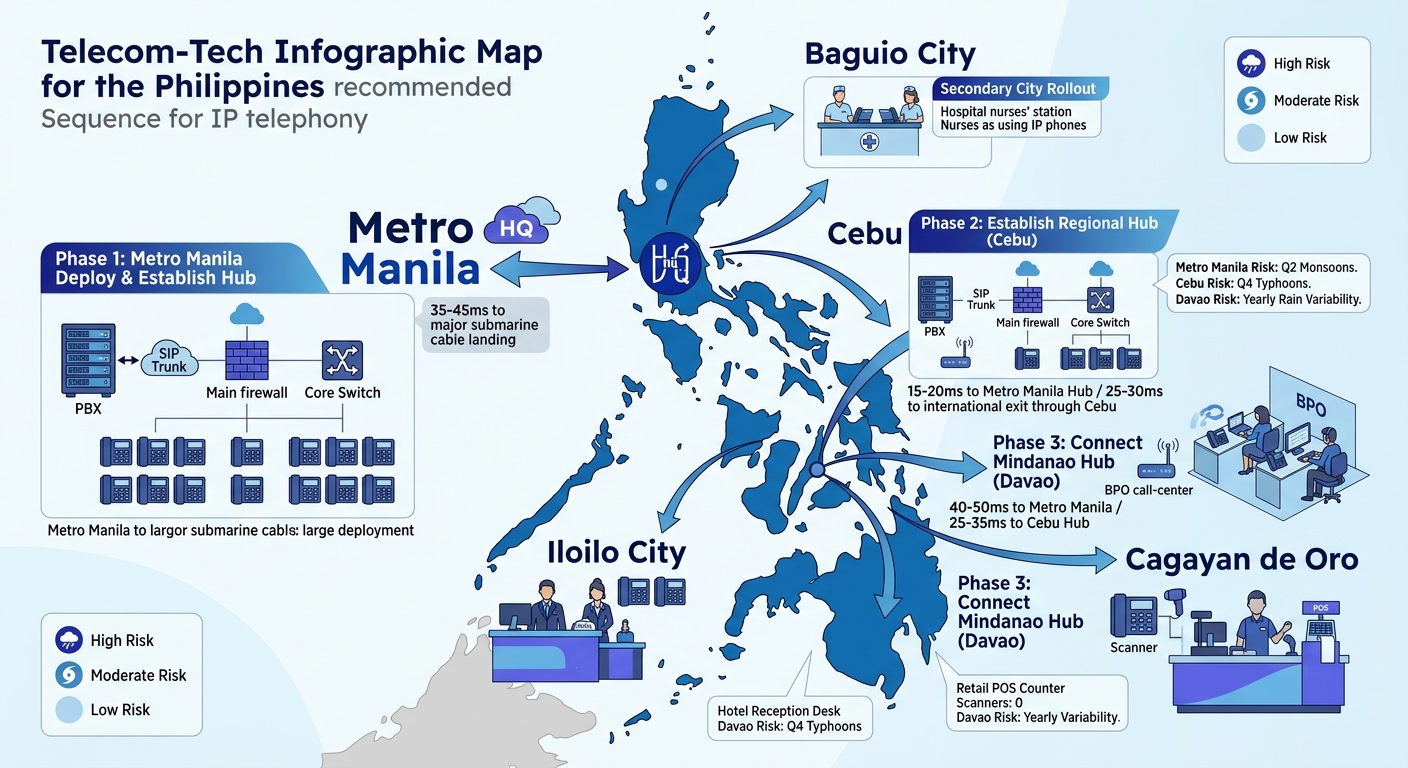
Philippine enterprises with offices spread across Luzon, Visayas, and Mindanao face latency constraints that affect site ordering. A centralized PBX in a Makati data center serves Metro Manila branches with under 5 ms latency. A Cebu branch adds 15-25 ms. A Davao branch sits at 20-35 ms. A General Santos or Zamboanga site can hit 40-60 ms over commercial internet links.
The deployment sequencing should follow a proximity-first model: consolidate Metro Manila sites first (lowest latency, highest bandwidth availability, easiest to troubleshoot), then Cebu and Visayas, then Mindanao. Each tier validates that the consolidated PBX handles the additional load before the next tier migrates.
For sites where latency exceeds 100 ms or bandwidth drops below the required concurrent-call threshold, a survivable remote gateway (SRG) at the branch provides local dial tone if the WAN link degrades. Yeastar’s S-series and Xorcom’s multi-tenant PBX appliances distributed through Philippine partners can function in this survivability role, maintaining a cached copy of the dial plan and routing local calls even when the central PBX is unreachable.
The sequencing also needs to respect Philippine business calendar constraints. Avoid cutovers during BIR filing deadlines (April 15, quarterly deadlines), peak BPO seasons (Q4 for US-market-serving operations), and typhoon season peaks from October through December, when WAN links in Visayas and Mindanao are most vulnerable to weather-related outages.
Post-Migration Validation: What to Measure and For How Long
Track these metrics at every site for a minimum of 10 business days after each site cutover:
- Mean Opinion Score (MOS): Target 4.0+ on a 1-5 scale. Scores below 3.5 indicate perceptible degradation that generates user complaints.
- Call Setup Time: SIP INVITE to 200 OK should complete in under 3 seconds. Values above 5 seconds signal registration issues or overloaded SIP proxies.
- Failed Call Rate: Anything above 2% warrants investigation before proceeding to the next site migration.
- One-way Audio Incidents: These almost always point to NAT traversal or firewall misconfiguration.
- Voicemail and IVR Functionality: Confirm auto-attendant menus, voicemail-to-email delivery, and call recording operate as configured.
If your enterprise already uses call quality metrics as diagnostic tools, feed post-migration data into your existing monitoring framework. Compare pre-migration baselines captured during Gate 1 to post-migration actuals. Any metric that degrades by more than 15% from baseline triggers a root-cause investigation before you migrate the next site.
Training matters here, too. The migration playbook for multi-office bank environments showed that structured 30-minute user sessions on new handset features, softphone interfaces, and voicemail access reduce helpdesk ticket volume by up to 60% in the first month after cutover.
What The Data Doesn’t Tell Us
The bandwidth calculations, failover timings, and cost projections above come from vendor documentation and controlled deployment environments. Philippine enterprise networks add variables that no vendor whitepaper fully captures: the reliability gap between a PLDT fiber link in Makati and a regional ISP connection in Cagayan de Oro, the NTC response window that can stretch from days to weeks during regulatory backlogs, or the reality that a “dual ISP” strategy in some provincial cities means two connections riding the same physical fiber route to the same exchange.
The 100 kbps-per-call figure assumes a clean network. Philippine offices running bandwidth-heavy applications like cloud ERP, video surveillance backhaul, and multi-floor CCTV streams often have less headroom than the spec sheet suggests. And the $800-per-site-per-month savings estimate comes from US market pricing; Philippine trunk and maintenance costs follow different structures, so your actual ROI will vary by carrier contract and existing PABX depreciation schedule.
What the numbers do confirm is the structural advantage of consolidation: fewer systems to manage, fewer trunk contracts to maintain, faster inter-site calling, and a single platform to secure. Whether your enterprise realizes those advantages without service loss depends on whether you treat the cutover as a gated project with validation windows at every stage, or try to compress it into a single weekend.