
Globe Telecom launched commercial satellite-to-mobile service on July 8 using Starlink’s direct-to-cell technology, enabling text, voice, and data connectivity in areas beyond terrestrial cellular tower coverage, according to the company’s statement. The service uses low-Earth orbit satellites to reach compatible mobile devices where traditional network infrastructure does not exist.
TL;DR: Globe Telecom commercially deployed Starlink satellite-to-mobile service on July 8, extending connectivity beyond cellular tower reach via low-Earth orbit satellites for text, voice, and data in previously unserved areas.
The deployment makes Globe the first Philippine carrier to commercialize direct-to-cell satellite technology following National Telecommunications Commission approval received in June 2026. Globe had previously received NTC authorization for the Starlink partnership last month, clearing regulatory requirements for the satellite-to-mobile service rollout.
Pricing and Subscriber Access
Globe Prepaid and TM subscribers can access the satellite service for P99. Postpaid customers on Plan 1,499 and higher plans receive the service as part of their subscription, while Globe Platinum subscribers have automatic eligibility, according to the company’s pricing structure.
The service operates through Space Exploration Technologies Corp.’s Starlink constellation, which positions satellites in low-Earth orbit to provide direct connectivity to standard mobile devices without requiring specialized hardware. Compatible devices connect to the satellite network automatically when terrestrial cellular signals are unavailable.
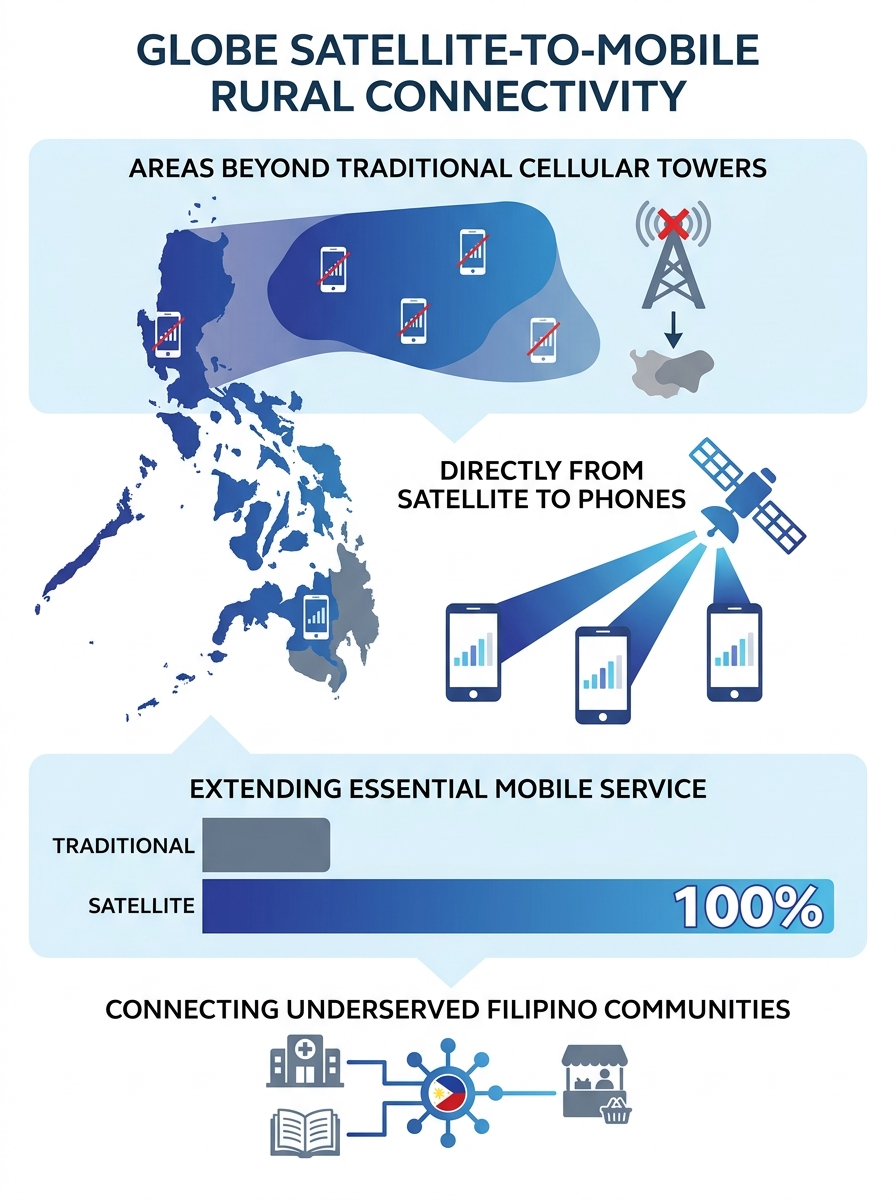
“Reliable connectivity today is no longer just about convenience. It gives people confidence to move forward, pursue opportunities, and stay connected during the moments that matter most,” said Eric Leif Tanbauco, Globe Vice-President for Consumer Mobile Business, in the company’s statement. “Connectivity should not stop where towers end.”
Service Capabilities in Remote Areas
The satellite-powered network enables messaging, app-based calls, navigation, digital payments, and other internet-dependent services in locations without traditional mobile network infrastructure. Globe indicated that users with compatible devices can access these functions seamlessly when moving between terrestrial cellular coverage and satellite service areas.
The direct-to-cell technology differs from traditional satellite phones by working with standard smartphones that meet technical compatibility requirements. Globe has not disclosed specific device models eligible for the service or the total addressable coverage area beyond cellular tower reach.
The Philippines’ archipelagic geography presents persistent connectivity challenges for enterprises operating in remote island locations, mountainous regions, and offshore installations. Traditional terrestrial network buildouts face economic constraints in low-population-density areas where tower construction and fiber backhaul costs exceed projected revenue.
What This Means for IT Managers
Satellite-to-mobile services create viable backup connectivity options for business continuity planning across industries dependent on field operations. BPO contact centers with satellite office locations, logistics companies tracking shipments through remote routes, and agricultural enterprises monitoring rural operations gain fallback communication paths when primary terrestrial networks fail or remain unavailable.
The P99 prepaid pricing structure allows IT departments to provision satellite connectivity for field staff without committing to enterprise-level satellite service contracts. Organizations running hybrid unified communications architectures can integrate satellite-to-mobile as a tertiary failover layer beneath primary fiber and backup LTE connections, particularly for remote government offices and island-based facilities.
Philippine enterprises evaluating network redundancy should assess which operational locations fall outside terrestrial coverage and whether satellite-to-mobile meets latency and bandwidth requirements for business-critical applications. The technology serves text, voice, and basic data services but may not support bandwidth-intensive VoIP traffic or real-time collaboration tools at the quality levels delivered by terrestrial infrastructure.