
PLDT Inc. filed prospectus documents June 22 to sell nearly half of VITRO REIT in an initial public offering that could raise as much as P24.2 billion at P11 per share, creating the Philippines’ first publicly traded data center real estate investment trust, according to regulatory disclosures published by InsiderPH. The offering involves up to 1.913 billion shares plus a 286.96-million-share over-allotment option and would value the business at approximately P49 billion.
TL;DR: PLDT filed June 22 for a P24.2-billion IPO of VITRO REIT, the country’s first data center REIT, selling nearly 49 percent at P11 per share with UBS and BPI Capital as joint coordinators.
The transaction follows regulatory expansion of REIT rules earlier this year to include digital infrastructure assets such as data centers, opening the category beyond the office, retail, and industrial properties that have dominated Philippine REIT listings since the framework launched. PLDT chair and CEO Manuel V. Pangilinan had previously indicated the offering could occur by the fourth quarter of 2026.
Initial Portfolio Comprises Eight Facilities With 24 MW Capacity
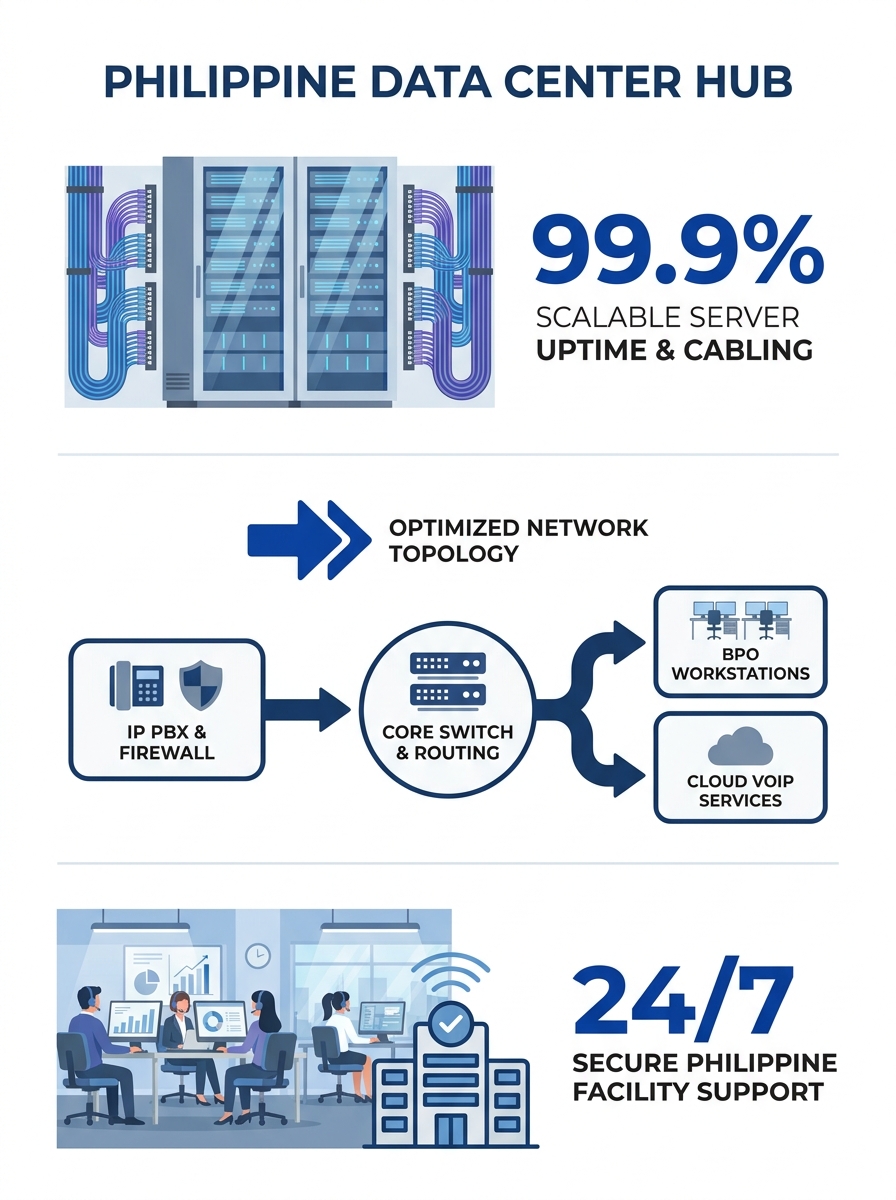
VITRO REIT’s starting asset base consists of eight operating data centers with approximately 24 megawatts of IT-ready capacity distributed across the country. The facilities serve enterprise, cloud, and hyperscale customers, according to the filing. “Today’s filing marks an important step in our efforts to unlock value from PLDT Group’s digital infrastructure portfolio while supporting the continued expansion of VITRO REIT’s data center platform,” said Victor S. Genuino, ePLDT president and CEO, in a statement accompanying the disclosure.
The REIT structure requires distribution of at least 90 percent of distributable income as dividends, positioning VITRO REIT as a yield vehicle tied to data center lease revenue. Philippine enterprises evaluating business continuity communication plans increasingly require on-premise or locally co-located redundancy for unified communications infrastructure, driving demand for third-party data center capacity in Metro Manila, Cebu, and Davao.
Proceeds Directed to ePLDT for Debt Reduction Under Reinvestment Plan
The offering consists entirely of secondary shares sold by ePLDT, the PLDT unit that currently owns VITRO REIT. All proceeds will therefore go to ePLDT rather than the REIT itself. The selling shareholder plans to allocate a portion of the capital to debt repayment under its reinvestment plan, the prospectus shows. Additional funds will support expansion of the group’s data center footprint as demand scales for cloud storage, artificial intelligence workloads, and enterprise hosting services.
At the top of the P11 price range, the public float would reach nearly 49 percent of VITRO REIT’s total outstanding shares. The offering ranks among the largest IPO candidates currently moving through the Philippine Securities and Exchange Commission pipeline. UBS AG Singapore Branch and BPI Capital Corp. are serving as joint global coordinators and joint bookrunners for the transaction.
Regulatory Approval Expands REIT Framework to Digital Infrastructure Assets
The Securities and Exchange Commission amended REIT regulations in recent months to explicitly permit data centers, telecommunications towers, and other digital infrastructure within the investment trust structure. Previously, qualifying assets centered on traditional real estate classes such as office buildings, shopping malls, and logistics warehouses. The rule change aligns Philippine REIT policy with regional markets where data center REITs have operated for years.
Investors will monitor whether PLDT injects additional facilities into VITRO REIT over time. The group has been building out data center capacity to support enterprise migration from on-premise infrastructure to co-located or hosted environments. Philippine IT managers deploying structured cabling infrastructure in third-party data centers require compliance with TIA-942 standards for power, cooling, and network redundancy, specifications that VITRO REIT’s facilities are positioned to meet.
Public Market Debut Follows GCash IPO Filing Earlier This Month
VITRO REIT’s listing would follow closely behind GCash’s $1-billion IPO filing, which InsiderPH reported June 17 as the largest offering in Philippine Stock Exchange history. Both transactions reflect a pickup in capital markets activity after two years of subdued IPO volume. The data center REIT introduces a new investment category distinct from consumer fintech, potentially appealing to institutional investors seeking infrastructure-linked dividend yields.
The eight initial assets represent a subset of ePLDT’s broader data center portfolio. The reinvestment of IPO proceeds into debt reduction and capacity expansion suggests the parent company is balancing near-term deleveraging with longer-term growth in the hyperscale segment. PLDT’s broader telecommunications infrastructure includes fiber networks supporting enterprise SD-WAN deployments and IP telephony systems across business and government accounts.
What This Means for IT Managers
Philippine IT managers budgeting for cloud PBX, unified communications, or disaster recovery infrastructure in 2026 should track VITRO REIT’s asset injection pipeline and capacity expansion plans. If PLDT follows through with adding more facilities to the publicly traded REIT, those properties will operate under dividend-distribution mandates that prioritize occupancy and utilization, potentially stabilizing pricing and service-level commitments for enterprise co-location customers. The REIT structure also introduces financial transparency that private data center operators typically do not disclose, giving IT procurement teams benchmarking data on lease rates, power costs, and capacity utilization across the portfolio.
The IPO timing aligns with accelerating enterprise migration from on-premise telephony to hosted or hybrid UC platforms that require low-latency, carrier-neutral co-location within Metro Manila, Cebu, or Davao. Shops evaluating third-party data center partnerships for voice infrastructure should confirm whether prospective facilities meet TIA-942 Tier III or Tier IV specifications for redundant power, cooling, and network paths, the same standards institutional investors will scrutinize when the REIT begins reporting quarterly metrics. The offering also signals that PLDT views data center infrastructure as a standalone asset class with returns competitive enough to attract public equity capital, a recognition that may drive additional capacity investment across the sector.
Finally, IT managers should note that proceeds from the offering flow to ePLDT for debt reduction rather than to VITRO REIT for capital expenditure. Future capacity expansion will therefore depend on either PLDT injecting more properties into the REIT or the trust raising its own project financing. Shops planning multi-year co-location commitments should ask prospective data center vendors how they fund expansion and whether capacity roadmaps are backed by parent-company capital or third-party debt.