
Philippine government agencies running analog PBX systems need a hybrid UC architecture that connects legacy handsets to SIP-based IP telephony through ATA gateways and multi-port VoIP media gateways, deployed on-premise to meet data sovereignty rules. Full rip-and-replace is neither budget-feasible nor procurement-compliant for the majority of offices.
TL;DR: Government offices can’t discard working analog phone infrastructure due to procurement constraints, compliance mandates, and limited capital budgets. A hybrid IP telephony deployment using ATA devices and FXO/FXS gateways lets agencies modernize voice services incrementally while maintaining PSTN lifeline capability and satisfying NTC and DICT oversight requirements.
The Philippine government restructured its PHP 6.5 billion connectivity budget to expand free WiFi sites, distribute SIM cards, and partner with Starlink for remote internet access. Those allocations address broadband access. They do not address the analog PBX systems handling internal voice traffic across hundreds of national agencies, LGU offices, provincial hospitals, and municipal halls. The result is a two-speed problem: external connectivity improves while internal telephony stays frozen in place, often on equipment installed 10 to 15 years ago.
This gap between Philippine telecom modernization goals and actual office-level voice infrastructure is where government UC architecture planning begins. And the architecture that works for these agencies looks fundamentally different from what a private-sector enterprise deploys.
The Analog-to-IP Gap in Government Offices
Government procurement rules in the Philippines make bundled UC platform purchases difficult. COA audit requirements, the Government Procurement Reform Act (RA 9184), and multi-year budget cycling mean that a single large-scale phone system replacement can take 18 to 24 months just to get through bidding. Meanwhile, the existing analog PBX continues to work. Calls connect. Extensions ring. Maintenance staff know how to swap cards and patch trunk lines. There’s no operational emergency forcing a change.
But the limitations compound year over year. Analog PBX systems have no voicemail-to-email. No call recording for compliance. No integration with government email or collaboration platforms. No centralized directory spanning multiple office locations. No remote extension capability for field workers. And when the PBX vendor discontinues spare parts, the agency faces a sudden forced migration with no preparation.
The five critical mistakes government agencies make with IP telephony typically trace back to this pattern: deferred modernization followed by a rushed, poorly scoped deployment. A hybrid architecture prevents that scenario by letting agencies migrate in phases rather than all at once.
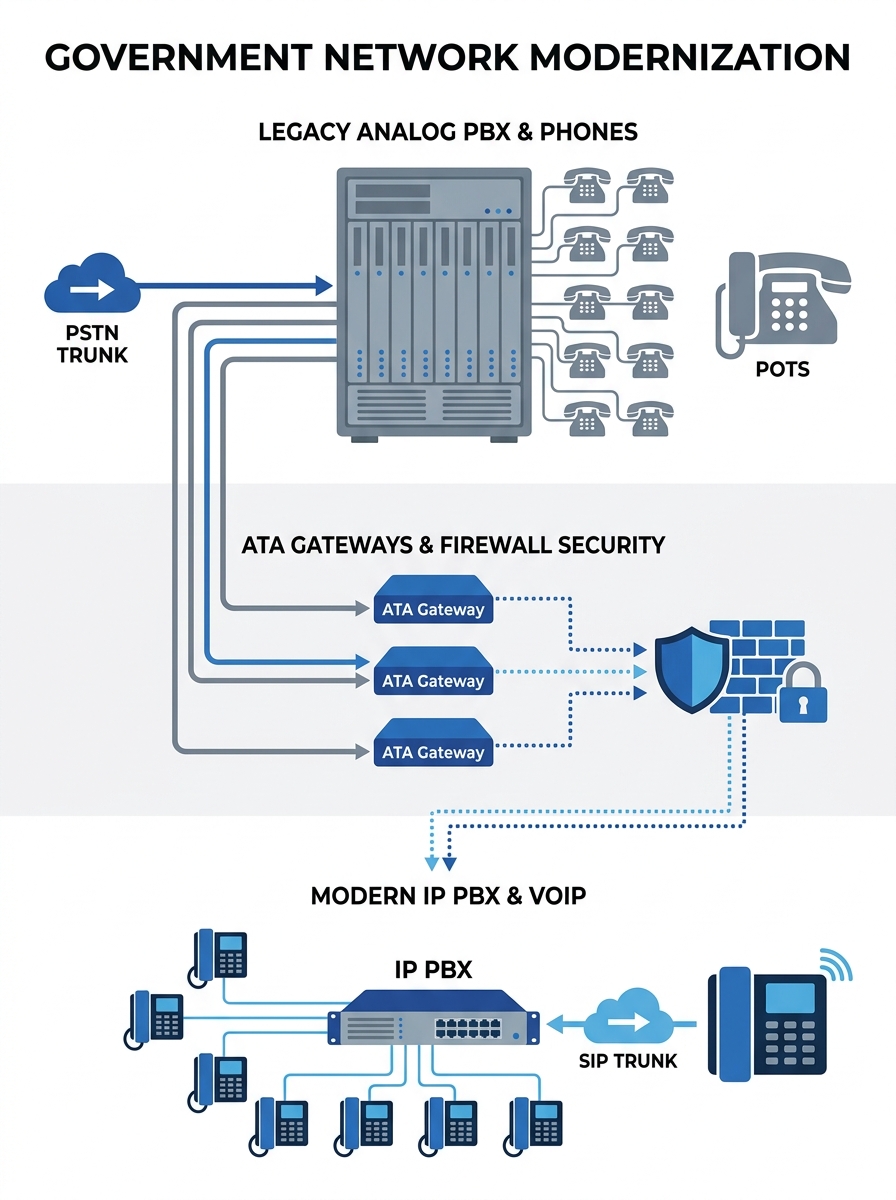
How Hybrid Architecture Bridges Analog and IP
UCaaS architecture is based on a modular design that allows individual components to be developed, deployed, and managed independently, according to a 123NET architectural guide. For government agencies, this modular principle applies to the on-premise layer: you don’t replace every component simultaneously. You introduce IP telephony alongside the analog system, connect them through gateways, and shift traffic gradually.
A standard hybrid IP telephony deployment for a government office with 50 to 200 analog extensions uses three core components:
- An IP PBX server (Yeastar P-Series, Cisco Unified CM, or Asterisk-based) that handles SIP registration, call routing, voicemail, and call recording.
- FXO gateways (Grandstream GXW4200 series or Yeastar TA series) that connect existing PSTN trunk lines to the IP PBX, preserving the agency’s published phone numbers.
- FXS ATA devices that connect individual analog handsets or groups of handsets to SIP extensions on the IP PBX.
The Grandstream HT813, for example, integrates both an FXO and FXS port, enabling the hybrid ATA to support remote calling to and from the PSTN line while simultaneously registering an analog phone as a SIP endpoint. That dual-port ATA gateway design is particularly useful for small satellite offices or barangay halls where deploying a full gateway would be overkill.
The phased approach works because it doesn’t require forklift replacement. An agency can convert 20 extensions in the first quarter, 40 in the next, and continue until the analog PBX carries zero traffic. At that point, decommissioning it is a formality.
ATA Gateway Design for Multi-Site Government Deployments
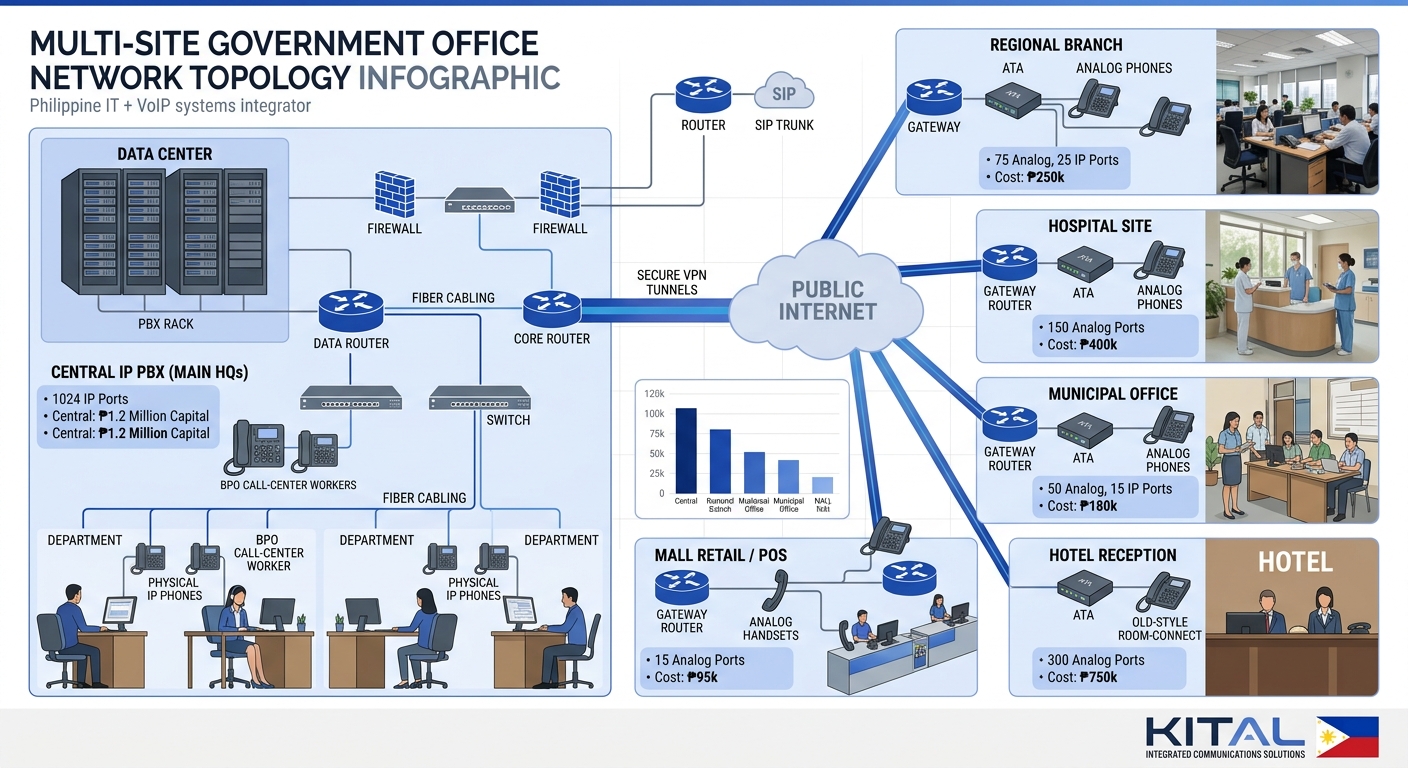
Why does ATA gateway design matter at the architecture level? Because Philippine government agencies rarely occupy a single building. A provincial government might have an executive building, a legislative wing, a treasury office across the street, and 3 to 5 satellite offices in neighboring municipalities. Each location may have its own small analog PBX or a set of direct PSTN lines.
| Component | Capacity | Use Case | Typical Unit Cost (PHP) |
|---|---|---|---|
| Grandstream HT813 (single FXO + FXS) | 1 analog phone, 1 PSTN line | Barangay halls, satellite offices | 3,500–4,200 |
| Grandstream HT814 (4-port FXS ATA) | 4 analog phones | Small departments, guard stations | 5,800–7,000 |
| Yeastar TA1610 (16-port FXO gateway) | 16 PSTN trunk lines | Main office trunk integration | 42,000–55,000 |
| Yeastar TA2400 (24-port FXS gateway) | 24 analog phones | Floor-level deployment, large offices | 58,000–68,000 |
| Grandstream GXW4248 (48-port FXS gateway) | 48 analog phones | Building-wide analog preservation | 85,000–105,000 |
For a provincial government with 120 analog extensions across 4 locations, a practical ATA gateway design might use one 24-port FXS gateway at the main building (handling 24 of the busiest extensions first), two 4-port ATAs at each satellite office, and a 16-port FXO gateway to absorb all existing PSTN trunks. Total gateway hardware cost falls in the PHP 120,000 to 180,000 range, well within a single annual capital outlay budget line.
Agencies that need detailed guidance on configuring ATAs for caller ID validation and registration should treat that configuration step as part of the gateway deployment, not an afterthought. Misconfigured caller ID on government lines creates real problems: constituents see unknown numbers and don’t answer, defeating the purpose of the phone system entirely.
Data Sovereignty Demands On-Premise Control
For regulated sectors including government, on-premise UC platforms remain the dominant choice to maintain control over call data and comply with Philippine data privacy and sovereignty requirements. The Data Privacy Act of 2012 (RA 10173) and NPC issuances require government agencies to know where personal data resides and who can access it. Call recordings containing citizen information, voicemail messages from constituents, and call detail records all qualify as personal data.
Cloud-hosted UC platforms store this data in offshore data centers. That creates a compliance exposure that most agency data protection officers (DPOs) will flag. An on-premise IP PBX keeps call recordings, CDRs, and voicemail files on local servers inside the agency’s physical perimeter. The total cost of ownership comparison between hardware and software VoIP for government consistently favors on-premise when compliance costs are factored in, because cloud deployments require additional contractual safeguards, data processing agreements, and ongoing audit documentation.
An on-premise IP PBX keeps call recordings, CDRs, and voicemail files on local servers inside the agency’s physical perimeter, satisfying data sovereignty requirements that cloud-hosted platforms struggle to meet without extensive contractual safeguards.
Cisco’s UCM Cloud for Government (formerly HCS-G) offers a FedRAMP-equivalent model, but Philippine agencies don’t operate under FedRAMP. The relevant frameworks are DICT’s cloud-first policy guidelines and NPC’s data processing rules, and neither provides a pre-approved list of compliant UC cloud providers. Until that regulatory clarity arrives, on-premise hybrid deployments remain the safer procurement path.
Network Hardening and QoS for Voice Traffic
Adding IP telephony to a government network without adjusting QoS settings produces exactly the result you’d expect: choppy audio during peak hours, dropped calls when someone downloads a large file, and one-way audio caused by misconfigured NAT. Government networks often run flat Layer 2 topologies with no VLAN segmentation, meaning voice and data traffic compete for the same bandwidth.
A minimum viable network preparation for hybrid IP telephony deployment includes 3 changes:
- VLAN segmentation separating voice traffic (VLAN 10, for example) from data traffic (VLAN 20) and guest/public WiFi (VLAN 30). This prevents a public WiFi user from saturating the same broadcast domain that carries SIP signaling.
- QoS policies on the edge switch and router prioritizing RTP voice packets (DSCP EF, value 46) over all other traffic. The step-by-step QoS configuration guide for VoIP on enterprise networks applies directly to government deployments running Cisco or Fortinet edge equipment.
- Firewall rules permitting SIP (UDP 5060/5061) and RTP (UDP 10000–20000) traffic between the IP PBX and all gateway/ATA devices, while blocking those ports from the public-facing interface. Agencies using enterprise-grade Fortinet security appliances can create dedicated VoIP security policies that inspect SIP headers without introducing latency on media streams.
The enterprise VoIP security hardening checklist covers 15 controls that map well to government deployments. At minimum, agencies should disable SIP guest access, enforce digest authentication on every extension, restrict international dialing to authorized extensions only, and enable fail2ban or equivalent brute-force protection on the IP PBX.
Warning: Government networks running flat Layer 2 with no VLAN segmentation will experience voice quality degradation the moment IP telephony traffic competes with data. Segment the network before deploying the first ATA.
Phased Migration Sequencing
Sangoma’s government UC guide recommends that government teams evaluate when it makes sense to replace legacy communication systems based on measurable improvements, not technology trends. For Philippine agencies, the evaluation criteria are practical: Can the existing PBX still get parts? Does the vendor still provide support? Are there regulatory requirements (call recording, audit trails) the analog system can’t meet?
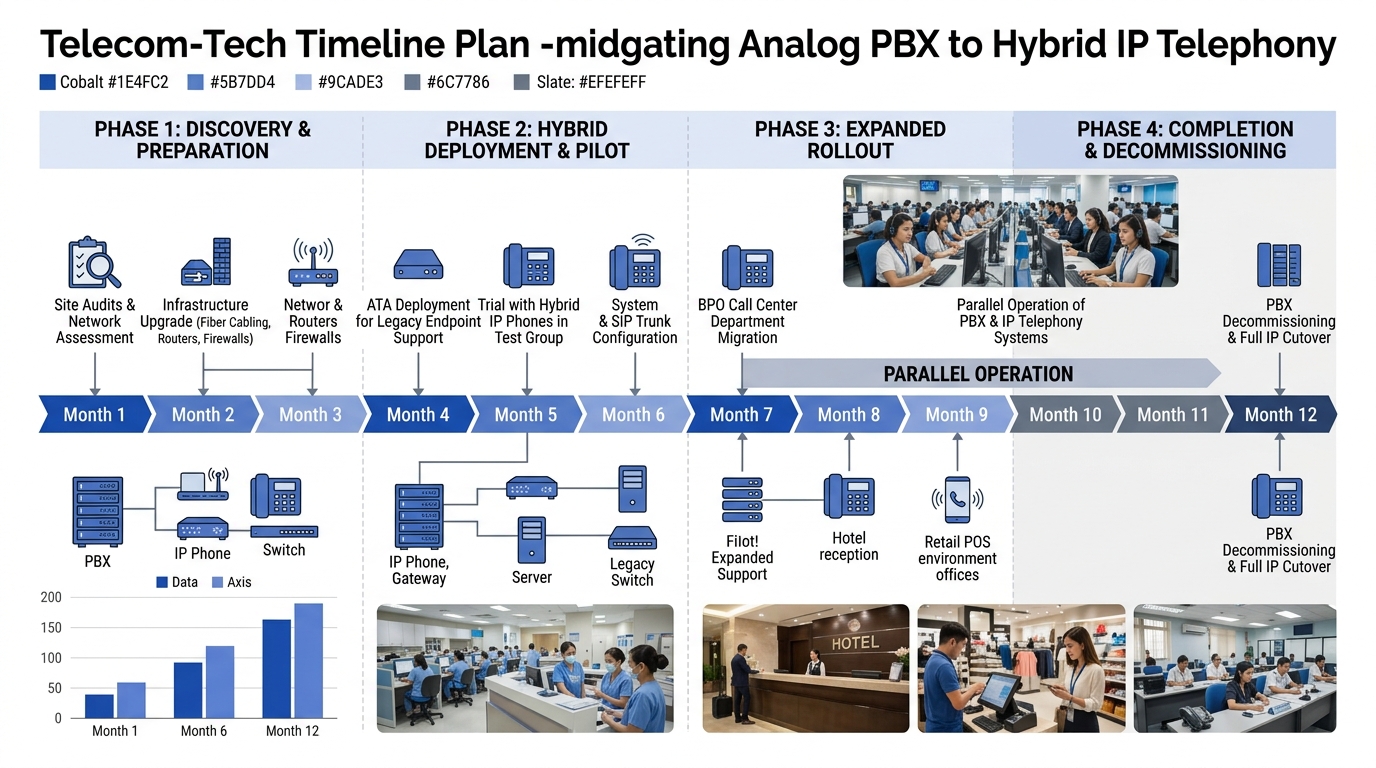
A proven 4-phase sequence for legacy PBX integration works as follows:
Phase 1 (Month 1–2): Deploy the IP PBX server and connect it to existing PSTN trunks via FXO gateways. Run both systems in parallel. New IP phones for 10–15 key staff (executives, department heads, reception). No analog phones are removed.
Phase 2 (Month 3–4): Deploy FXS ATAs for the next 30–50 analog extensions. These handsets keep their existing numbers but now route through the IP PBX. Call recording and voicemail become available for these extensions.
Phase 3 (Month 5–8): Convert remaining analog extensions. Begin pilot testing of advanced UC features like ring groups, auto-attendant IVR, and conference bridges. Train staff on new capabilities.
Phase 4 (Month 9–12): Decommission the analog PBX. Port remaining PSTN numbers to SIP trunks if desired. Finalize disaster recovery configuration with PSTN failover through retained FXO gateway lines.
Cisco’s migration documentation notes that during parallel operation, one IP phone can download firmware and distribute it locally to other IP phones through peer-to-peer provisioning, reducing bandwidth consumption during large-scale rollouts across government offices with limited WAN capacity. This feature is relevant for agencies managing 5 or more branch offices from a central IT team.
Remaining Questions
Several factors in Philippine government UC architecture remain unresolved. The DICT cloud-first policy encourages agencies to consider cloud hosting, but provides no accreditation framework for UC-specific cloud providers, leaving agency DPOs to make compliance judgments without regulatory guidance. The NTC’s registration requirements for IP-based voice services apply to carriers, and whether government agencies operating internal SIP trunks between buildings need NTC permits remains ambiguous in practice.
Budget sustainability is another open thread. A hybrid IP telephony deployment has low initial capital costs compared to full replacement, but ongoing costs for SIP trunk subscriptions, IP PBX software maintenance, and network security solutions require annual operating budget allocations that some agencies haven’t structured. The gap between capex procurement (which RA 9184 handles well) and opex subscription billing (which many government accounting offices treat awkwardly) continues to slow adoption.
And the workforce question persists. Government IT staff trained on analog PBX maintenance need SIP protocol knowledge, VLAN configuration skills, and IP PBX administration training. Without that investment, the hybrid architecture works on paper but degrades in practice because nobody on staff can troubleshoot a failed SIP registration or a codec mismatch. The technology is ready. The procurement path exists. The regulatory and human-capacity gaps are what determine whether a given agency’s migration succeeds or stalls.