
The global Unified Communications as a Service market reached $23 billion in 2025 and is projected to continue expanding through 2030, driven by enterprise migration from on-premises PBX systems to AI-powered cloud platforms, according to market data published by Cytranet. Analyst firm Metrigy reported that less than half of telephony seats worldwide remain on customer-owned infrastructure, marking an inflection point in cloud adoption for business communications.
TL;DR: The UCaaS market grew to $23 billion in 2025 as enterprises replace legacy PBX systems with cloud platforms that integrate AI-driven call routing, analytics, and customer engagement tools.
Cloud Migration Accelerates as On-Premises PBX Deployments Decline
On-premises PBX and unified communications infrastructure declined in 2025 while UCaaS subscription revenue grew, according to Metrigy’s analysis of the global telephony market. The shift reflects businesses abandoning hardware-dependent phone systems in favor of internet-based platforms that support distributed workforces.
Traditional phone systems require on-site servers, carrier contracts, and dedicated administration staff. Philippine enterprises operating across Metro Manila, Cebu, and Davao face additional challenges: limited vendor support outside the capital region, costly hardware refreshes, and difficulty scaling capacity during BPO seasonal peaks. Hospital communication systems in multi-campus medical facilities and hotel telephony solutions in provincial resort properties increasingly favor cloud platforms that centralize administration while distributing calling capacity.
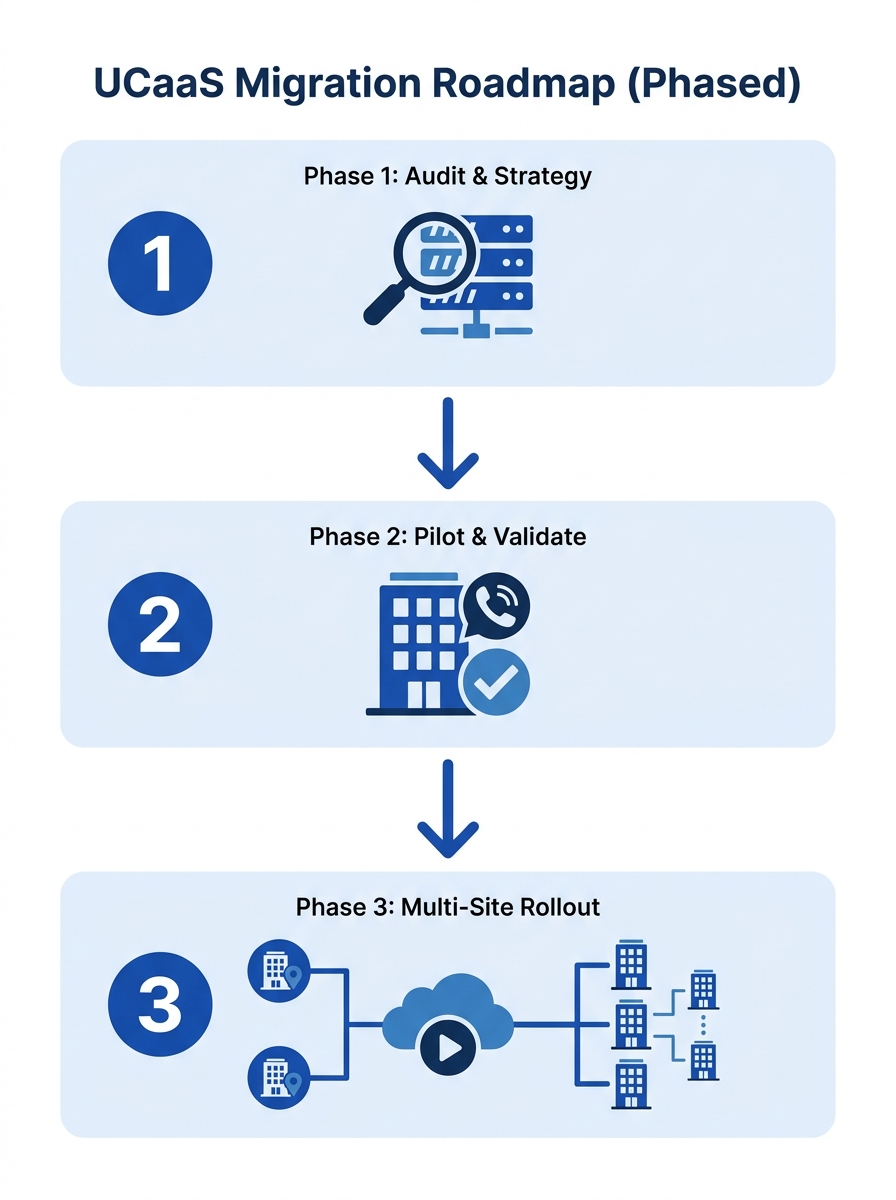
The market transition is uneven. Large organizations often migrate in phases, starting with cloud calling at greenfield locations before consolidating contact center operations and retiring legacy infrastructure. Small and medium enterprises typically complete full replacements within 12 to 18 months.
AI Integration Expands UCaaS Beyond Cloud Calling
UCaaS platforms now bundle AI capabilities that extend beyond voice transmission to include automated call routing, real-time transcription, post-call summaries, sentiment analysis, and CRM integration. These features transform unified communications from a telephony replacement into a customer engagement platform.
The source report identifies several AI-driven functions entering mainstream UCaaS offerings: AI receptionists that handle inbound call triage, agent assist tools that surface knowledge base articles during live conversations, automated call summaries that populate CRM records, analytics engines that track response times and call volume patterns, and workflow automation that triggers follow-up tasks based on conversation outcomes.
Philippine BPO operations handling technical support and customer service for North American and European clients now evaluate UCaaS vendors based on multilingual AI capabilities and AI-driven call intelligence that flags escalation triggers. Financial institutions require secure communications for Philippine banks that meet regulatory audit requirements while supporting AI-powered fraud detection.
Hybrid Work Models Sustain Demand for Multi-Device Mobility
Remote and hybrid work arrangements persisted beyond the pandemic because businesses identified cost savings and recruitment advantages in flexible location policies. UCaaS adoption tracks this shift as employees require consistent access to calling, messaging, and conferencing tools across office, home, and mobile environments.
The source report notes that mobility has transitioned from optional feature to core requirement. Employees need to transfer calls, access voicemail, participate in video conferences, and retrieve customer context without losing functionality when moving between devices or locations.
For Philippine enterprises, hybrid work introduces network complexity. Multi-site PBX consolidation requires symmetric bandwidth allocation per concurrent call, dual-ISP strategies at each location, and quality-of-service policies that prioritize voice traffic over general internet use. Government agencies deploying resilient VoIP infrastructure must balance security requirements with mobile access for field personnel.
Market Forecast Variations Reflect Category Definition Differences
Analyst projections for UCaaS market size through 2030 vary significantly depending on scope definition. Some firms count only cloud telephony subscriptions and seat licenses. Others include adjacent categories: team collaboration platforms, contact center as a service, customer engagement software, managed communications services, and AI infrastructure.
The source report explains that this spread reveals market evolution rather than forecasting error. Basic cloud calling is maturing toward commodity pricing while broader communications platform capabilities grow rapidly. Businesses buying UCaaS in 2026 evaluate vendors based on integration depth, AI functionality, and workflow automation, not simply call quality and uptime.
Philippine IT decision-makers comparing UCaaS vendors should clarify which components factor into quoted pricing: desk phone provisioning, mobile clients, video conferencing seats, contact center licenses, API access, CRM connectors, analytics dashboards, and AI features. A platform marketed as comprehensive UCaaS may bundle some capabilities while charging separately for others.
Tool Consolidation Drives Vendor Selection
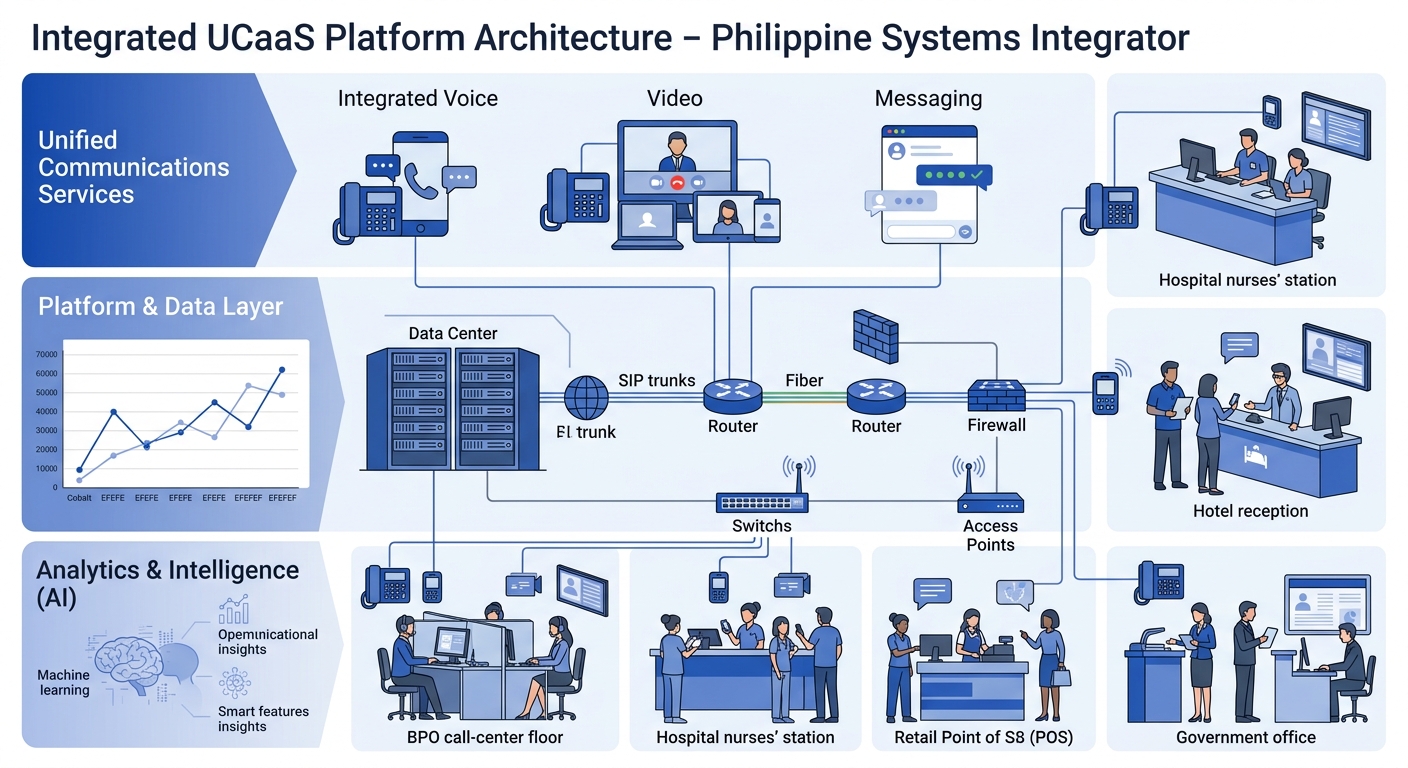
Enterprises using separate platforms for phone service, video conferencing, team chat, and contact center operations face integration complexity, redundant administrative overhead, and inconsistent user experience. UCaaS consolidation addresses these pain points by delivering multiple communication channels through a unified interface.
The source report identifies tool sprawl as a primary driver of UCaaS adoption. Businesses want fewer disconnected systems, single-vendor support contracts, and integrated reporting across communication channels. This trend favors platforms that combine voice, video, messaging, and customer engagement in one subscription rather than best-of-breed vendors requiring custom integration.
Philippine enterprises evaluating unified communications architecture should inventory existing communication tools, licensing costs, and integration touchpoints before issuing RFPs. A UCaaS migration that reduces seven platforms to two delivers tangible operational benefits beyond monthly subscription savings.
Context and Outlook
The UCaaS market expansion through 2030 reflects structural changes in how Philippine businesses operate rather than simple cloud adoption trends. Distributed workforces, AI-powered customer service, and integrated communication workflows have moved from competitive advantages to baseline operational requirements.
For Philippine IT managers evaluating enterprise-grade telecom infrastructure, the market shift presents both opportunity and risk. Vendors positioning UCaaS as a pure telephony replacement underestimate the platform’s strategic role in customer engagement and employee productivity. Platforms that integrate UC analytics dashboards with business systems deliver measurable improvements in response times, call resolution rates, and workforce utilization.
The growth forecast assumes continued enterprise cloud migration, but Philippine buyers should assess readiness factors: internet bandwidth sufficiency at all locations, backup connectivity options, internal change management capacity, and vendor support depth in Southeast Asia. A UCaaS platform that meets technical requirements but lacks local implementation partners risks stalled deployments and user adoption failures.