
Philippine government agencies can modernize their operating layer communications through three realistic paths: retrofitting legacy PBX with SIP trunks, migrating to cloud UCaaS, or deploying agentic UC platforms with AI-driven automation. The right choice depends on each agency’s budget cycle, existing infrastructure age, and timeline for AI-powered workflows.
TL;DR: Government UC modernization in the Philippines comes down to three options — legacy PBX retrofit, full cloud UCaaS, or agentic networks with AI reasoning. Cloud UCaaS wins on speed and cost for most agencies. Agentic platforms win for agencies with complex cross-department workflows, but demand mature network security and structured cabling first.
The DICT’s first-ever Digital Connectivity Infrastructure Masterplan marks fiber backbone completion and submarine cable expansion as national priorities. That masterplan addresses the physical layer. The communications layer — how agencies talk, share data, and run automated workflows on top of that fiber — is a separate decision that most agencies haven’t locked down yet.
According to a March 2026 TelcoStrategy analysis, 90% of enterprises worldwide will rely on cloud platforms for telephony by 2028. That’s up from 30% in 2025. Gartner projects that 40% of enterprise applications will include task-specific AI agents by the end of 2026. These numbers matter for Philippine government planners because they signal where vendor support and investment will concentrate over the next 3–5 years.
The three approaches below represent genuine forks in the road. Each carries different risks on procurement, digital resilience Philippines agencies can actually maintain, and long-term enterprise transformation potential.
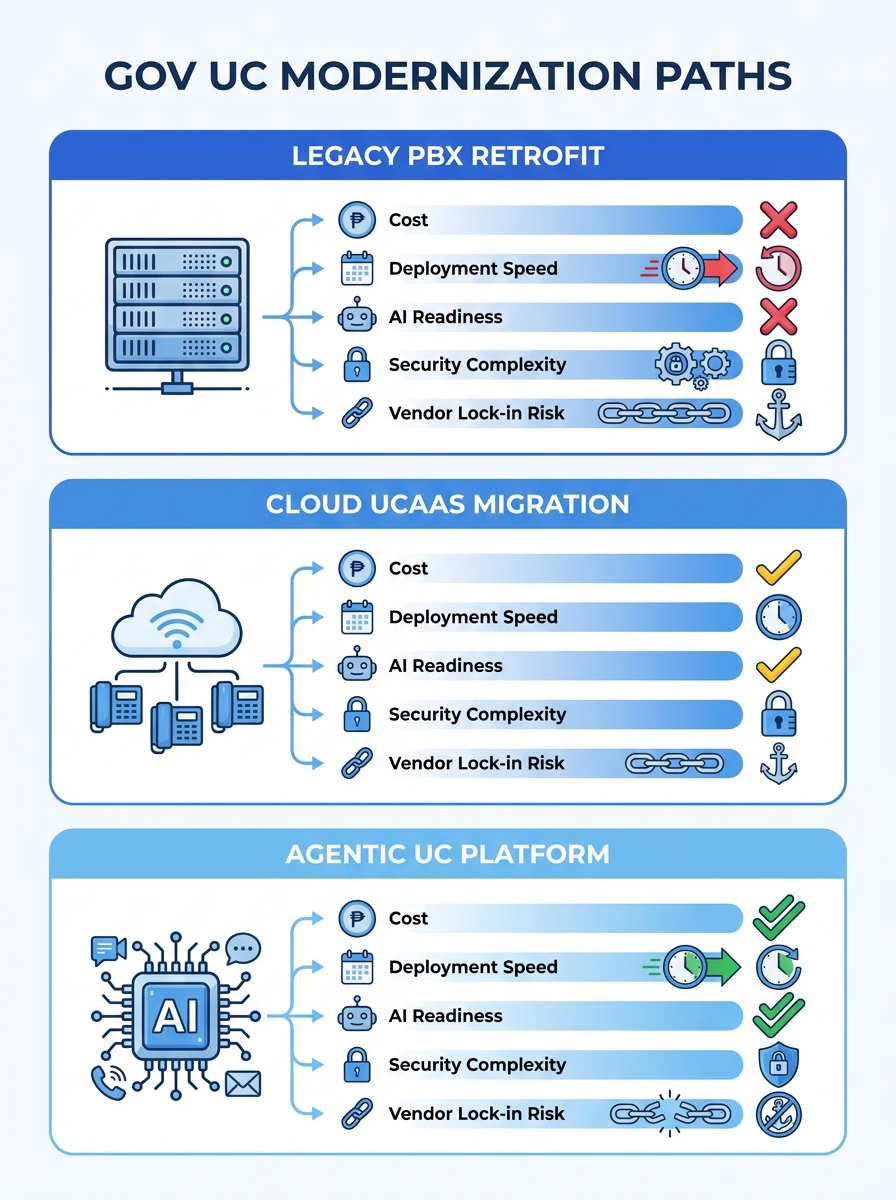
Legacy PBX Retrofit With SIP Trunk Add-Ons
This is the path of least administrative friction. An agency keeps its existing PBX hardware, adds SIP trunks for IP connectivity, and layers basic VoIP features on top. Procurement is simpler because the agency isn’t buying a new platform — it’s extending an existing one.
The cost profile is attractive upfront. SIP trunk provisioning for a 50-seat government office runs between PHP 15,000 and PHP 40,000 per month, depending on call volume and trunk provider. There’s no large capital expenditure for new hardware. The agency’s telephone numbers stay the same, and staff retraining is minimal.
But the tradeoffs compound fast. Legacy PBX systems were stitched together over years with, as one UC migration analysis from Aress Software describes, “undocumented hacks, legacy dependencies, and well-meaning workarounds that nobody remembers setting up.” Every SIP trunk bolt-on adds a new integration point that the agency’s IT staff — often just 2–4 people — must maintain.
This path also delivers zero AI capability. There’s no presence data, no automated call routing based on agent availability, and no integration with messaging or video. The Philippines recorded 624,400 leaked accounts in Q1 2026, a 76.8% surge in data breaches year-on-year. Legacy PBX systems with SIP bolt-ons lack the encryption and zero-trust architecture needed to withstand that threat environment. Agencies pursuing this path will need separate enterprise network security investments to close the gap.
Warning: SIP trunk retrofits on aging PBX hardware often create single points of failure. If the PBX controller board fails, the entire agency goes dark — no phones, no fax, no conferencing. Agencies with only one physical site are especially vulnerable.
Best fit: Small agencies (under 30 seats) with tight budgets, minimal cross-department collaboration needs, and no near-term AI plans. Regional field offices that answer phones and route calls to a central office fall into this category.
Full Cloud UCaaS Migration
Cloud UCaaS replaces the PBX entirely. The agency subscribes to a hosted platform — Cisco Webex Calling, Microsoft Teams Phone, Yeastar P-Series Cloud Edition, or similar — and all voice, video, messaging, and presence data flows through the provider’s infrastructure.
Deployment speed is the biggest advantage. A 200-seat agency can go live on UCaaS in 8–12 weeks, compared to 6–9 months for an on-premises UC build. Monthly per-seat costs typically range from PHP 800 to PHP 2,500, depending on the platform tier and whether the agency bundles contact center features.
UCaaS also delivers immediate gains in cross-agency collaboration. When UCaaS and contact center platforms converge, agents resolve citizen inquiries 25% faster because context follows the conversation across channels. For agencies handling high volumes of public-facing calls — PhilHealth, SSS, LTO — that’s a measurable service improvement.
David Smith of InFlow Analysis has emphasized that “the business value of agentic AI must be tied to core operational KPIs” rather than technology hype. For government agencies evaluating UCaaS, those KPIs are concrete: first-contact resolution rate, average call handling time, and citizen satisfaction scores.
The procurement problem, though, is real. Philippine government procurement follows RA 9184, which favors competitive bidding with detailed technical specifications. UCaaS subscriptions are operational expenses, not capital expenditures, and many budget officers aren’t set up to process recurring SaaS fees across fiscal years. Agencies that got caught in this gap during earlier cloud email migrations know the pain.
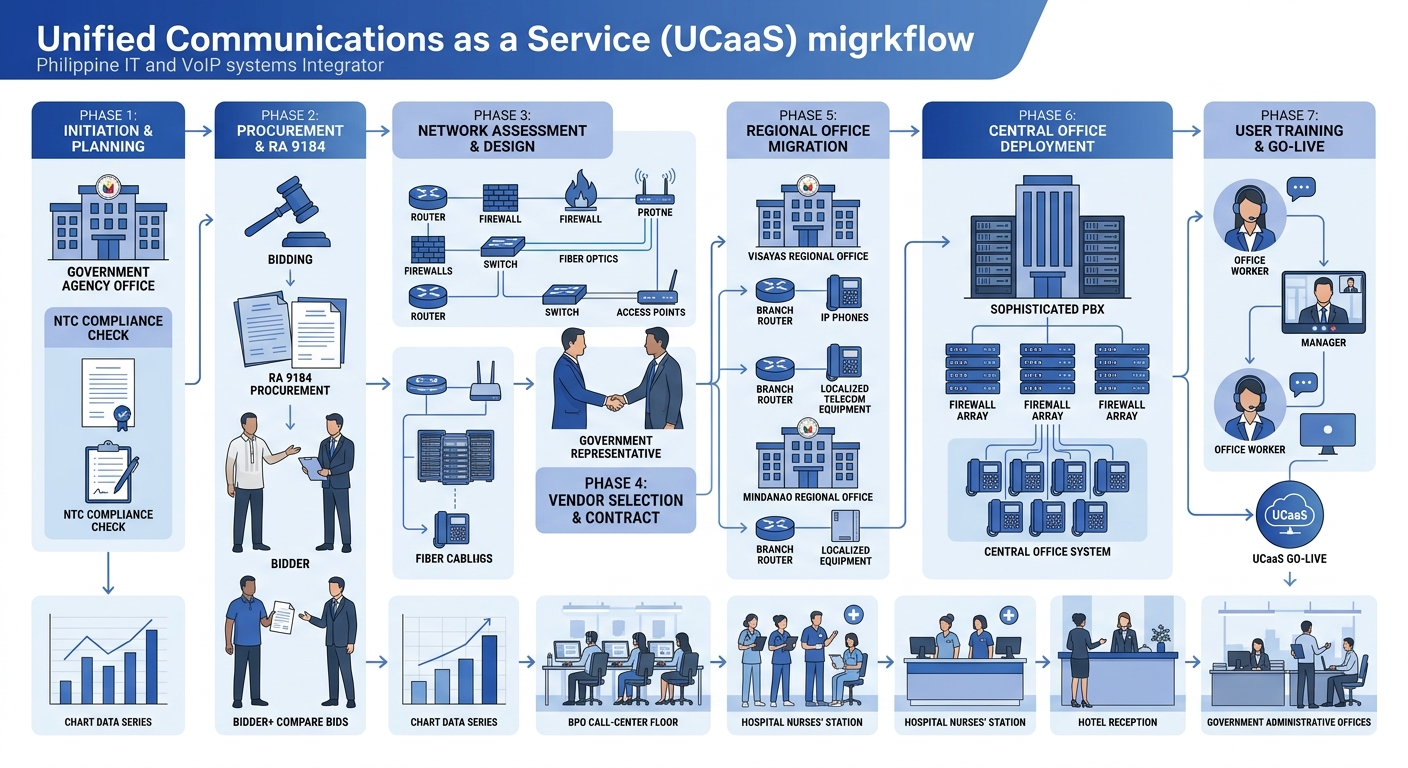
Security is the second concern. The Government Cyber Resilience Summit identified balancing national security with data privacy rights as a key governance challenge. Cloud UCaaS platforms store call recordings, chat logs, and presence data on provider infrastructure. Agencies handling classified or sensitive information need to verify data residency — where the servers physically sit — and confirm compliance with DICT and NPC requirements. Zero-trust architectures built into enterprise-grade UCaaS platforms address most of these concerns, but the agency must actually configure them. Default settings are rarely enough.
For agencies that need guidance on building resilient VoIP infrastructure with a network-first approach, the pre-migration network assessment is the critical first step. Without adequate bandwidth, QoS configuration, and proper network cabling infrastructure, UCaaS will deliver worse call quality than the old PBX it replaced.
Best fit: Mid-size agencies (30–500 seats) with existing internet bandwidth of at least 100 Mbps symmetrical, budget officers comfortable with OpEx subscription models, and a need for video conferencing and messaging alongside voice.
Agentic UC Platforms With AI Reasoning
Agentic networks represent the third path — and the most ambitious. An agentic UC platform doesn’t just carry voice and video traffic. It includes an AI reasoning layer that can plan actions, execute tasks, and adapt based on outcomes. This is the architecture where government UC modernization meets genuine automation.
Brosamer from Block stated plainly at a 2026 industry forum: “What matters is that these agents are coordinated through defined workflows.” That coordination is the hard part. An agentic UC platform requires, as Itential’s architecture analysis describes, “a distinct agentic reasoning layer, a deterministic execution layer that governs how reasoning becomes action, and a connectivity layer broad enough to operate across the full heterogeneity of enterprise infrastructure.”
What does this look like in a Philippine government context? Consider a DSWD field office processing social welfare applications. An agentic UC system could receive a citizen call, pull up the caller’s case status from the database, summarize the pending requirements, route the call to the correct case worker based on real-time availability, and draft a follow-up SMS — all without manual intervention from the first responder. Gartner’s projection that 40% of enterprise applications will include task-specific AI agents by end of 2026 suggests this capability is moving from pilot to production faster than procurement cycles typically allow.
An agentic platform doesn’t just carry calls. It reasons about them — routing, summarizing, escalating, and following up without waiting for a human to click through five screens.
The cost is the obvious barrier. Agentic UC platforms from vendors like Cisco, Salesforce (Agentforce), and Microsoft (Copilot + Teams) carry per-agent licensing fees that can reach PHP 5,000–PHP 12,000 per seat per month. That’s 3–5x the cost of standard UCaaS. Implementation timelines stretch to 12–18 months because the reasoning layer needs training data, workflow mapping, and integration with existing government databases.
Bain & Company’s three-layer agentic platform model stresses that real-time streaming pipelines must complement batch processing so agents operate on current data. For government agencies, “current data” means live citizen records, updated case files, and real-time personnel availability. Agencies without clean, structured data — and that describes most Philippine LGUs — will spend 40–60% of their implementation budget on data preparation alone.
Security demands also escalate. Agentic systems make autonomous decisions, which means authorization models must be granular. Kovi, a security architect, has noted that “just-in-time authorization” is essential for agentic systems because traditional role-based permissions can’t anticipate every decision an AI agent might make. Agencies pursuing this path should expect to invest separately in digital resilience and intelligent failover systems to protect the expanded attack surface.
We’ve explored how agentic networks reshape enterprise UC architecture in the private sector. Government adoption follows the same technical principles but adds procurement complexity, data sovereignty requirements, and civil service change management constraints.
Best fit: Large national agencies (500+ seats) with dedicated IT departments of 10 or more staff, existing data warehouses or case management systems with API access, and executive sponsorship willing to fund an 18-month implementation. NGA central offices — not regional satellites — are the realistic starting point.
Side-by-Side: Three Paths at a Glance
| Attribute | PBX + SIP Retrofit | Cloud UCaaS | Agentic UC Platform |
|---|---|---|---|
| Monthly cost per seat | PHP 300–800 | PHP 800–2,500 | PHP 5,000–12,000 |
| Deployment timeline | 2–4 weeks | 8–12 weeks | 12–18 months |
| AI capability | None | Basic (transcription, summaries) | Full (reasoning, task execution) |
| Minimum bandwidth | 2 Mbps symmetrical | 100 Mbps symmetrical | 200 Mbps+ symmetrical |
| IT staff required | 1–2 | 2–4 | 10+ |
| Procurement model | CapEx (one-time) | OpEx (monthly SaaS) | Hybrid CapEx + OpEx |
| Data residency control | Full (on-premises) | Depends on provider | Depends on deployment model |
| Vendor examples | Yeastar S-Series, Fanvil | Cisco Webex, MS Teams | Salesforce Agentforce, Cisco AI |
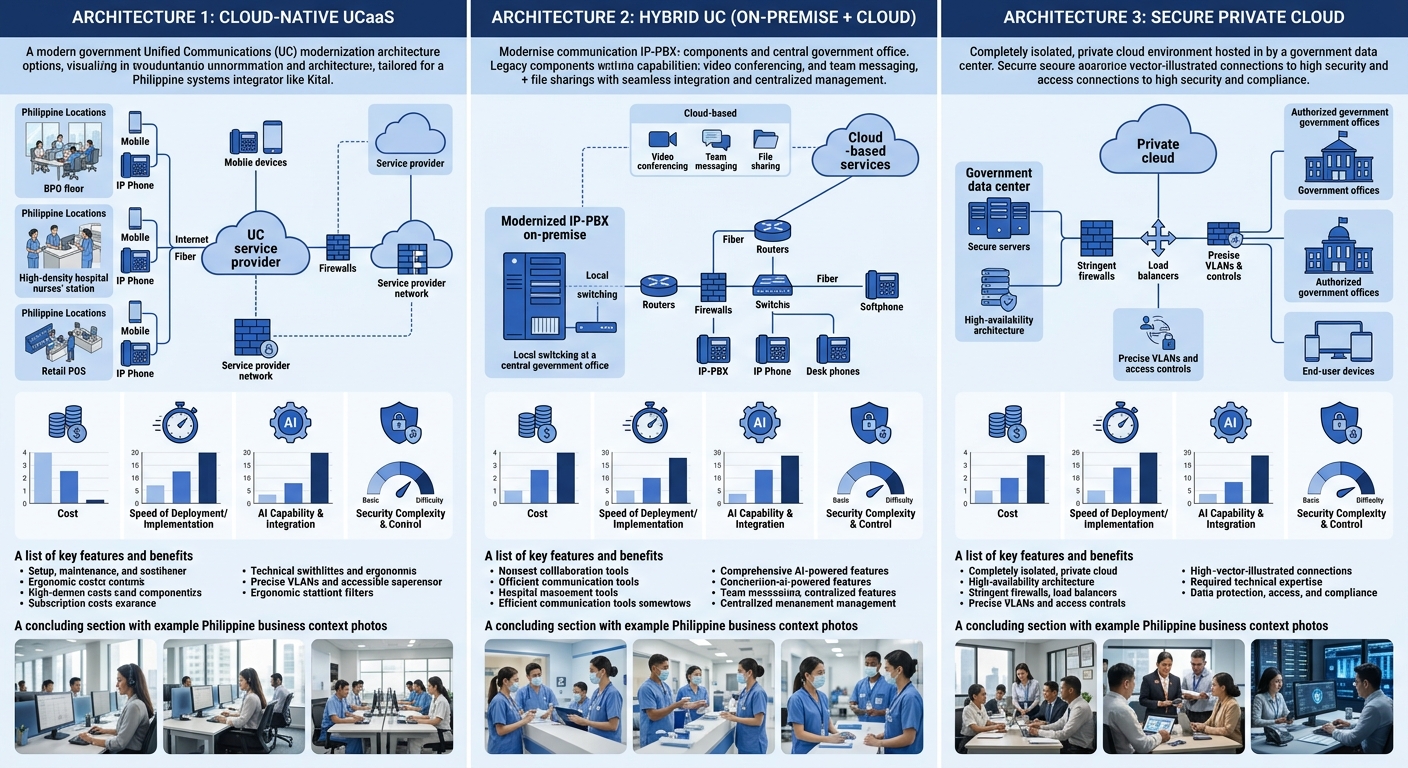
How To Choose Between These Three
The honest answer depends on two variables: your agency’s current infrastructure maturity and your 5-year mandate.
If your agency still runs analog lines or an aging PBX with no IP capability, the SIP trunk retrofit buys you 2–3 years of basic functionality while you plan the real migration. Treat it as a bridge, not a destination. Every peso spent here is a sunk cost against the cloud or agentic path.
If your agency has reliable 100 Mbps+ internet, an IT team that can manage a SaaS subscription, and a budget officer who understands OpEx models, cloud UCaaS is the strongest default. It delivers 80% of the value at 20% of the complexity. When you’re ready to add UC features beyond basic VoIP, the platform already supports it.
If your agency processes thousands of citizen interactions daily, maintains structured case databases, and has executive backing for a multi-year build, the agentic UC platform is the correct long-term bet. But go in with realistic expectations — Bain’s analysis confirms that data governance controls, metadata capture, and cross-domain access rules must be built into the pipelines from day one. Skipping that step produces an AI system that reasons on stale or wrong data, which is worse than no AI at all.
The operating layer communications decision your agency makes this budget cycle will shape service delivery for the next decade. The DICT’s fiber backbone gives you the physical foundation. The PCO’s mandate for a unified government messaging system gives you the policy cover. The architecture you pick determines whether that foundation carries a modern, AI-capable platform — or another generation of workarounds stitched together with good intentions and undocumented configurations.