
Three failover architectures dominate Philippine enterprise telecom today: SD-WAN with cellular backup, active-active multi-path routing, and SIP trunk failover with geographic redundancy. Each carries different cost, complexity, and recovery-time tradeoffs that depend on your downtime tolerance, site count, and budget.
TL;DR: SD-WAN cellular failover suits most mid-market Philippine businesses at PHP 15,000–40,000/month per site. Active-active multi-path delivers sub-second recovery but costs 2–3x more. SIP trunk geographic redundancy is the best fit for VoIP-heavy operations like BPO centers and hospitals where voice uptime defines revenue.
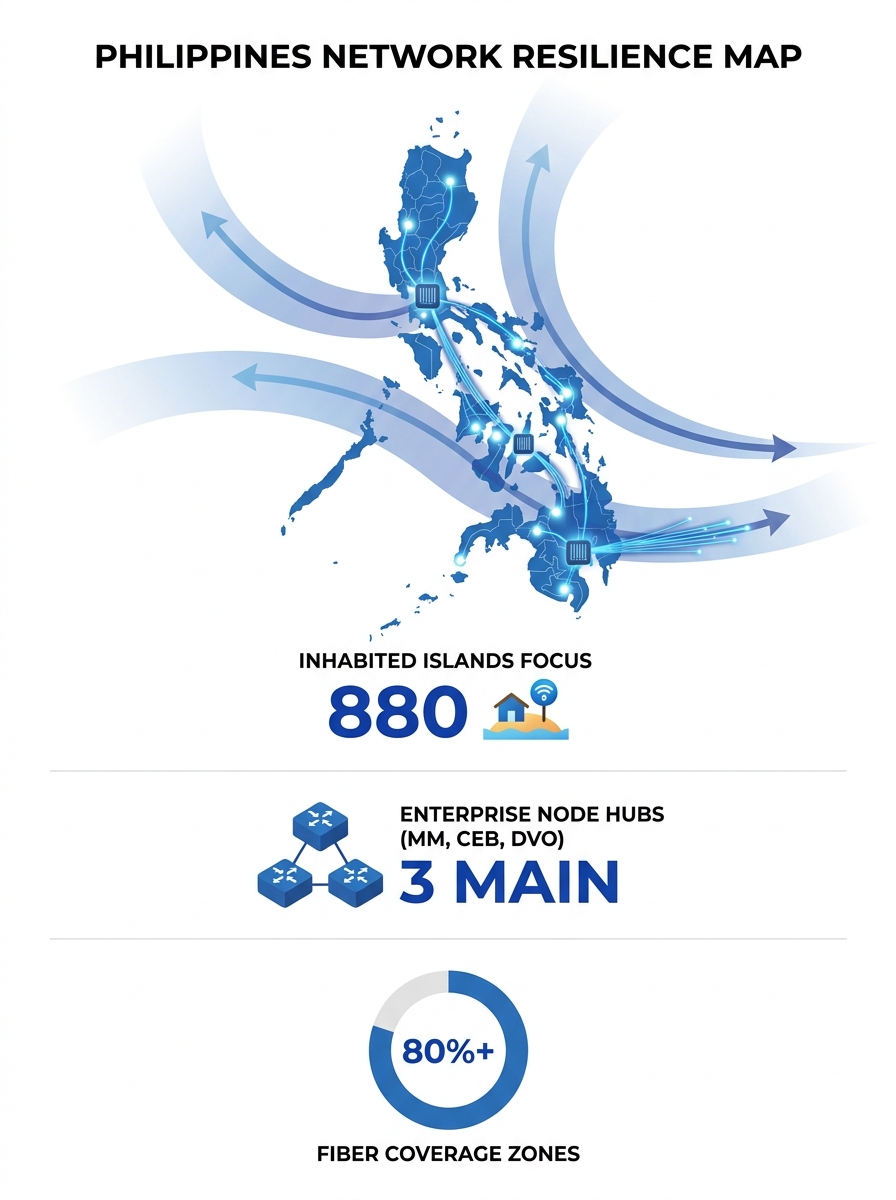
The Philippines spans 880 inhabited islands. Typhoons hit an average of 20 times per year. Fixed broadband costs over 11% of gross national income per capita, compared to a 3% regional average across Southeast Asia, according to World Bank data on Philippine digital connectivity. And while 89% of the population lives within 25 km of fiber, that proximity doesn’t guarantee reliable last-mile delivery. These conditions make intelligent backup architecture essential for any enterprise that depends on voice and data.
The World Bank approved EUR 268.22 million in October 2024 for the Philippines Digital Infrastructure Project. That funding targets climate-resilient broadband and government fiber backbone networks, according to IMARC Group’s Philippines telecom market report. But government investment alone won’t protect your enterprise voice traffic during the next outage. You need your own failover plan, and the three architectures below represent your realistic options.
SD-WAN with Cellular Failover
SD-WAN with cellular backup is the most accessible failover option for Philippine mid-market businesses. It pairs your primary wired ISP connection with a 4G or 5G cellular link from a separate carrier. When the primary path degrades or drops, traffic shifts to cellular within 1–3 seconds. Total cost runs PHP 15,000–40,000 per month per site, depending on your cellular data plan and appliance choice.
The core principle is dual-layer redundancy. Your wired ISP and cellular carrier use completely independent infrastructure. A fiber cut from a typhoon won’t affect the cellular tower, and a tower outage won’t affect your fiber. Ericsson’s 2025 failover analysis confirms that SD-WAN changed failover strategies by using active-active links that monitor performance and reroute traffic dynamically. The SD-WAN controller checks latency, jitter, and packet loss every 500 milliseconds to 2 seconds across both paths. If your fiber latency spikes above 150 ms or packet loss exceeds 1%, traffic moves to cellular automatically.
For a 50-seat BPO call center in Makati running 200 concurrent SIP sessions, an SD-WAN setup handles 80–120 Mbps of voice traffic on the primary link. The cellular backup provides 30–50 Mbps on a good 5G connection, enough for 60–80 concurrent calls at the G.711 codec rate of 87.2 Kbps per call. That’s a 60% capacity reduction during failover, which means you’ll need to queue or redirect some calls. But you stay operational.
The tradeoff is cellular bandwidth limits. During a regional disaster, cell towers get congested fast. The 98 Philippine cities with 5G coverage as of 2022 offer better capacity than 4G-only areas. Outside Metro Manila, Cebu, or Davao, your cellular fallback may deliver only 5–15 Mbps under load. That supports roughly 15–40 simultaneous voice calls. For businesses already tracking call quality metrics across their VoIP infrastructure, this capacity ceiling is the number to stress-test against.
Warning: Cellular failover doesn’t help if your on-premise IP-PBX itself goes down. SD-WAN protects the WAN link, not the voice platform. Pair it with a cloud-hosted backup PBX or a Yeastar hot-standby unit to cover both failure modes.
Active-Active Multi-Path Routing
Active-active multi-path sends traffic across two or more WAN connections simultaneously. Both links carry live production traffic all the time. When one fails, the surviving link absorbs the load with zero switchover delay. Recovery time drops below 1 second. This is the architecture that achieves 99.999% uptime, or 5.26 minutes of total downtime per year, according to Ecosmob’s analysis of VoIP high availability.
How does this differ from SD-WAN cellular failover? In an SD-WAN setup, one link is primary and the other is standby. You pay for cellular capacity you use only during outages. In active-active, both links work continuously. You get full bandwidth from both connections during normal operations and lose only 50% capacity when one link fails. For a site with two 100 Mbps fiber connections from PLDT and Converge, that means 200 Mbps normally and 100 Mbps during a single-link failure.
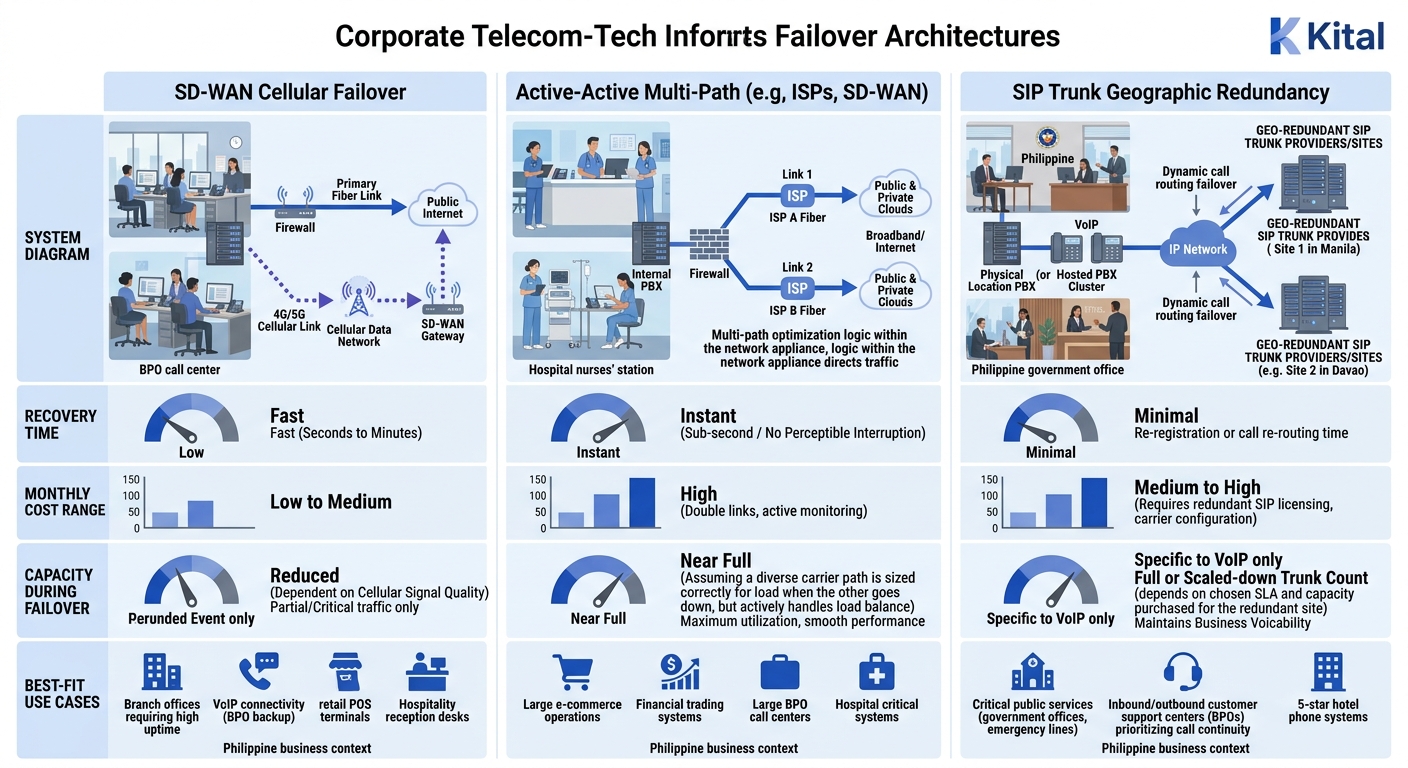
Active-active requires dual ISP contracts with physically separate entry points into your building, plus routing protocols (HSRP or VRRP) that handle the transition. Hardware costs run higher. You need enterprise-grade routers from Cisco or Fortinet at each site (PHP 80,000–250,000 per device), plus two ISP subscriptions. Monthly operating cost lands at PHP 35,000–90,000 per site, roughly 2–3x the SD-WAN cellular option.
The Philippine-specific challenge is physical path diversity. If both ISPs run fiber through the same underground conduit on EDSA, a single construction accident takes out both links. You need to verify that your two ISPs enter your building through different routes. The Internet Society’s Philippine resilience assessment flags this exact issue: internet usage growth doesn’t reflect the health of the core network underneath. True telecom infrastructure redundancy demands diverse physical paths, not just diverse provider contracts.
For organizations running secure government IT infrastructure or multi-branch banking operations, active-active is the standard recommendation. The cost premium buys sub-second failover and eliminates the bandwidth ceiling that limits cellular backup.
SIP Trunk Failover with Geographic Redundancy
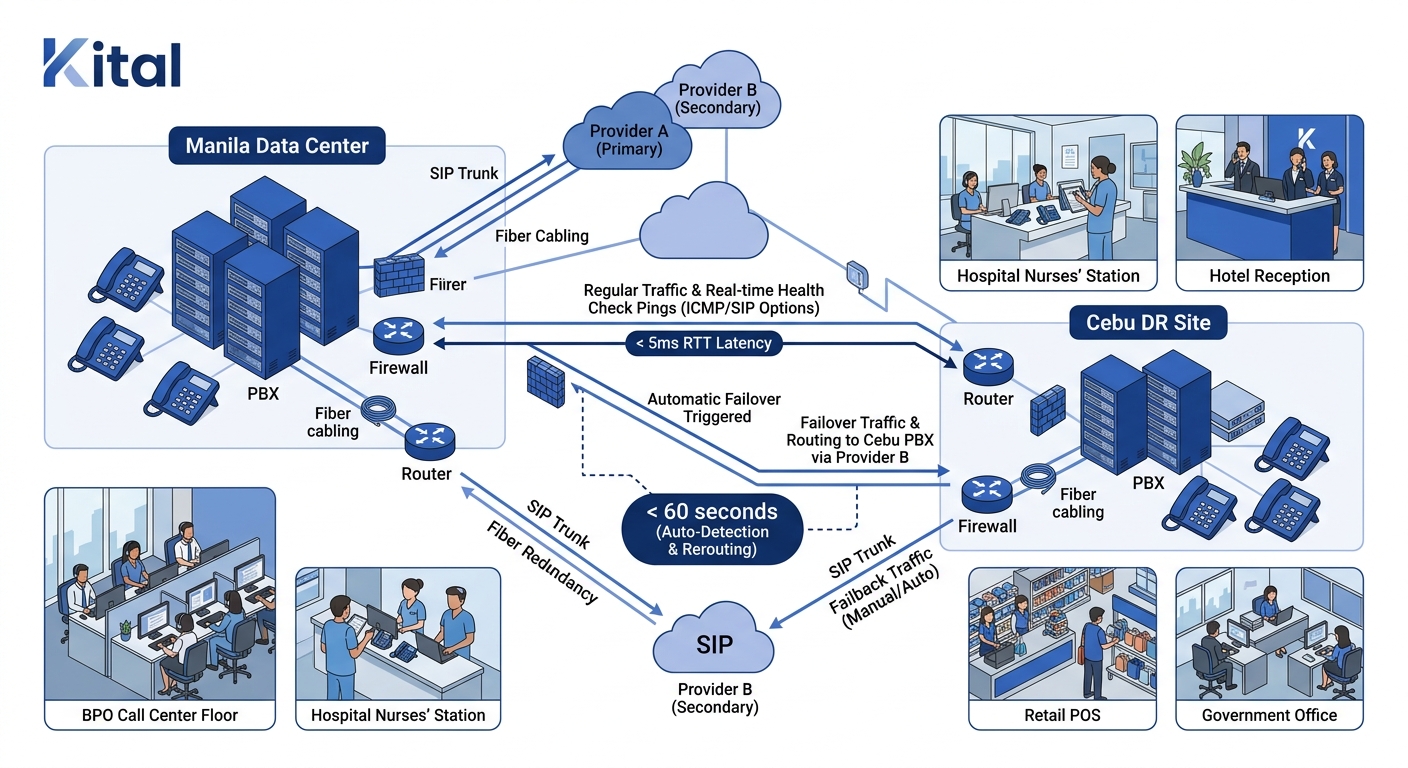
The third approach targets VoIP specifically. SIP trunk failover distributes your voice traffic across two or more SIP providers, with IP-PBX systems deployed in geographically separate locations. If your Manila PBX loses connectivity, calls route to your Cebu PBX within 3–8 seconds. Your callers hear one extra ring, not a disconnect tone.
This architecture works at the application layer. SD-WAN and active-active protect the network pipe. SIP trunk failover protects the voice service itself. You configure your IP-PBX (Yeastar, Cisco, or Asterisk-based) with primary and secondary SIP trunk registrations. When the primary trunk returns SIP 503 (Service Unavailable) or fails to respond within 2–4 seconds, the PBX re-registers on the backup trunk and re-routes active calls automatically.
According to TechTarget’s VoIP redundancy design guide, effective VoIP resilience requires redundancy at both the VoIP layer and the network layer. That’s why SIP trunk failover works best when combined with one of the two network-layer approaches above. A BPO center in Cebu running 500 agent seats with SIP trunk failover plus SD-WAN cellular backup covers three failure modes: ISP outage (SD-WAN handles it), SIP provider outage (trunk failover handles it), and local PBX failure (geographic redundancy handles it).
Cost depends on your scale. A two-site setup with Yeastar P-Series PBX systems, dual SIP trunks, and a warm-standby database runs PHP 250,000–600,000 in upfront hardware and PHP 20,000–45,000/month in SIP trunk fees. Larger deployments with Cisco UCM clusters and sub-second database failover push into PHP 2–5 million upfront. But for a BPO operation where one hour of downtime costs $2.5 million in penalties and lost client trust, the math works clearly in favor of redundancy.
Organizations running hospital communication systems face similar stakes. A voice outage during a medical emergency isn’t a productivity problem. It’s a patient safety risk. Geographic SIP trunk failover ensures that even if Typhoon Carina floods your primary data center, your voice services keep running from a secondary site.
For a BPO operation where one hour of downtime costs $2.5 million in penalties, the math on geographic SIP trunk failover works itself out in a single avoided incident.
Enterprises already managing multi-office VoIP integration across public networks will recognize the architectural pattern here. The key addition is automated health-checking. Your PBX should run SIP OPTIONS pings to each trunk every 10–30 seconds. If three consecutive pings fail (a 30–90 second window), the system declares the trunk dead and switches. Predictive monitoring cuts that detection window further by watching for jitter spikes or registration delays that signal trouble 2–5 minutes before a full outage hits.
Side-by-Side Comparison
| Feature | SD-WAN + Cellular | Active-Active Multi-Path | SIP Trunk Geographic Redundancy |
|---|---|---|---|
| Recovery time | 1–3 seconds | Below 1 second | 3–8 seconds |
| Monthly cost per site | PHP 15,000–40,000 | PHP 35,000–90,000 | PHP 20,000–45,000 (SIP trunks only) |
| Upfront hardware | PHP 30,000–80,000 | PHP 80,000–250,000 | PHP 250,000–600,000 (two-site) |
| Capacity during failover | 30–60% of normal | 50% of normal | 100% (if secondary site is fully provisioned) |
| Protects against | ISP/WAN failure | ISP/WAN failure, physical path damage | SIP provider failure, PBX failure, site-level disaster |
| Best fit | Single-site offices, 10–50 seats | Multi-branch enterprises, banks, government | BPO centers, hospitals, 100+ seat operations |
| Complexity | Low to medium | Medium to high | High |
| Key Philippine risk | Cell tower congestion during typhoons | Finding physically diverse ISP paths | Inter-island latency on backup site |
How to Choose Between These Three
The decision comes down to three variables: your per-hour cost of downtime, your geographic footprint, and your voice traffic volume.
If your business runs fewer than 50 seats at a single site and your downtime cost stays below PHP 100,000 per hour, SD-WAN with cellular failover gives you the best ratio of protection to cost. You get 1–3 second recovery, independent network paths, and a manageable monthly spend. This covers most SME offices, smaller hotel properties, and school administration networks across the Philippines.
If you operate multiple branches, handle sensitive data, or need sub-second recovery, active-active multi-path is the appropriate investment. Banks migrating from legacy PBX to VoIP across multiple offices should default to this tier. The 2–3x cost premium over SD-WAN buys continuous dual-link operation and eliminates the cellular bandwidth ceiling entirely.
If voice is your core revenue driver (BPO, contact centers, emergency services), layer SIP trunk failover with geographic redundancy on top of either network-layer option. The upfront cost is highest of the three, but it addresses failure modes that network-layer VoIP failover systems can’t touch: SIP provider outages, PBX hardware failures, and entire-site disasters. The country’s projected 159 million mobile subscribers and 10.8 million broadband subscribers will only increase pressure on Philippine network reliability, making these investments more defensible each year.
And for any of these approaches, the architecture only works if you test it. Run a failover drill at least once per quarter. Pull the primary link during business hours and measure actual recovery time against your design target. The gap between designed failover and real failover is where your digital resilience either holds or breaks.