
PLDT Enterprise reported P12.4 billion in first-quarter revenues, a 4% year-over-year increase driven by demand for ICT services and AI-ready data center capacity, according to the company’s May 16 disclosure. The Corporate Data and ICT segment accounted for 75% of total revenues at P9.3 billion, with ICT services growing 17% as Philippine enterprises expanded managed IT, cloud, and data analytics deployments.
TL;DR: PLDT Enterprise’s Q1 2026 revenues reached P12.4 billion, up 4% year-over-year, with ICT services climbing 17% and managed IT rising 79% as enterprises shifted to cloud-based and analytics-driven platforms.
The revenue uptick reflects sustained enterprise spending on digital infrastructure despite broader market uncertainty. PLDT Enterprise’s ICT segment posted the strongest gains within the corporate portfolio, signaling that Philippine businesses continue to prioritize network modernization and cloud migration over legacy connectivity products.
ICT Services Drive Segment Growth
The Corporate Data and ICT segment generated P9.3 billion in Q1 2026, a 5% increase from the prior-year period. Within that segment, ICT services climbed 17%, with managed IT services surging 79% and data and AI services advancing 31%. “The shift toward managed and analytics-driven platforms is increasing solution stickiness and positioning ICT as our primary engine of growth,” the company said in its disclosure.
Cloud services also contributed to the segment’s expansion as enterprises migrated workloads from on-premises infrastructure. The company did not break out cloud revenue separately but noted rising adoption across multi-site deployments and hybrid architectures. Philippine enterprises evaluating unified communications platforms and cloud-based collaboration tools are increasingly selecting managed service bundles that integrate connectivity, security, and application-layer support rather than purchasing standalone connectivity products.
Fiber connections increased 6% during the quarter, while SD-WAN lines grew 17% as businesses expanded multi-site operations. The SD-WAN growth rate outpaced traditional fiber, indicating that enterprises are layering intelligent routing and application-aware traffic management onto existing connectivity footprints. PLDT Enterprise’s earlier deployment of agentic AI tools for its sales teams positions the company to recommend hybrid network designs that combine fiber, SD-WAN, and cloud connectivity based on application requirements rather than default topologies.
Data Center Business Adds 10% Revenue Gain
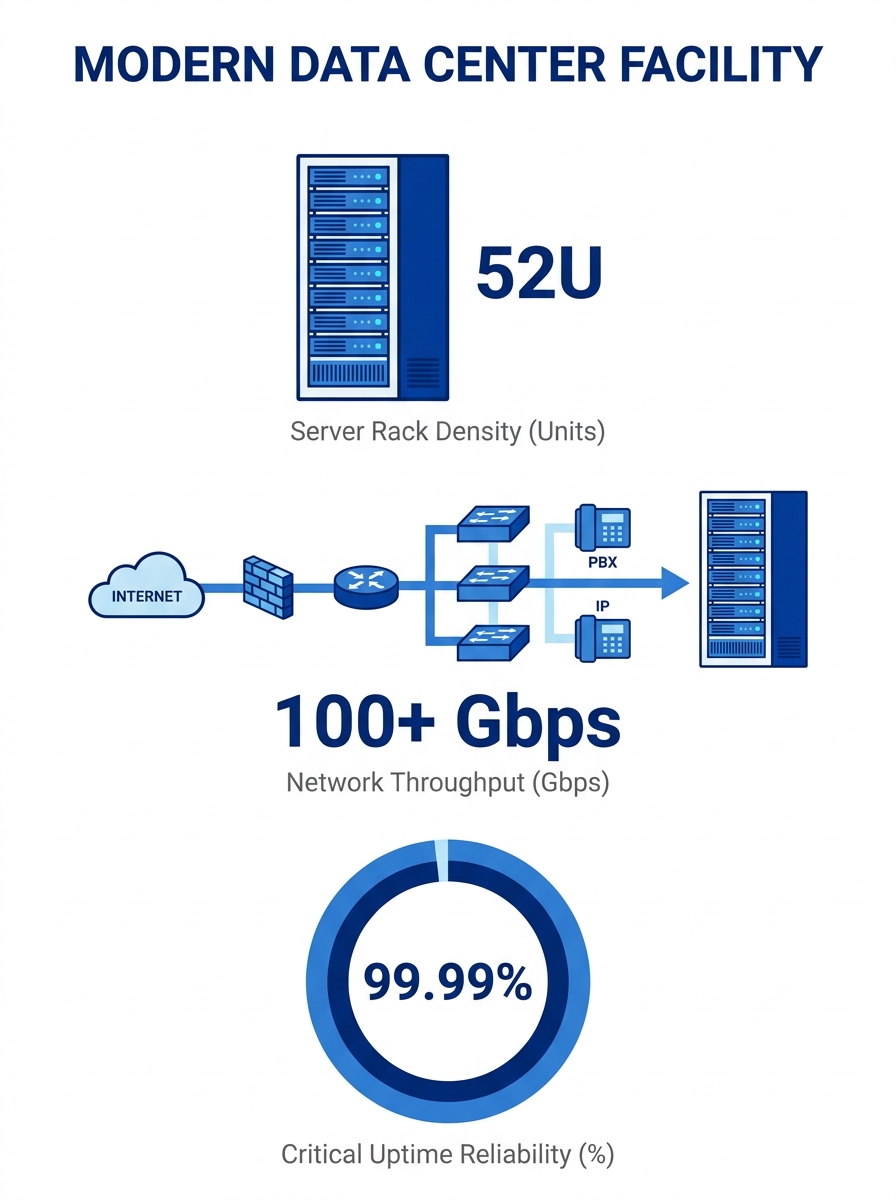
PLDT Enterprise’s data center operations posted a 10% revenue increase in Q1 2026, supported by expanded capacity at VITRO Santa Rosa, which the company describes as the Philippines’ first AI-ready hyperscale data center. The facility provides GPU-accelerated compute infrastructure and high-density power delivery designed for training and inference workloads. Demand for AI-ready colocation and managed compute services is accelerating as Philippine enterprises move beyond proof-of-concept AI projects into production deployments that require dedicated infrastructure.
The company formed VITRO Inc. as a separate subsidiary in March 2024 to manage its data center portfolio, which includes facilities in Pasig, Parañaque, and Santa Rosa. PLDT’s data center strategy targets enterprises running latency-sensitive applications, regulatory workloads that require Philippine-domiciled data, and AI training clusters that demand high-bandwidth GPU interconnects.
Fixed business revenues remained flat during the quarter, though PLDT Enterprise indicated that enterprises continue investing in network modernization. The flat fixed-line performance suggests that revenue is shifting from traditional voice and basic connectivity products toward managed services and infrastructure-as-a-service offerings. Philippine IT managers planning multi-year network refreshes are prioritizing platforms that bundle fiber, SD-WAN, security, and cloud connectivity under managed contracts rather than purchasing circuit capacity alone.
Wireless Services Grow 13% on Messaging and IoT
PLDT Enterprise’s wireless business grew 13% in Q1 2026, driven by application-to-person messaging, Bizload services, and Internet of Things offerings. A2P messaging revenue typically derives from two-factor authentication, appointment reminders, marketing campaigns, and transactional alerts sent by banks, retail chains, and government agencies. The 13% wireless growth rate exceeded the overall 4% revenue increase, indicating that enterprises are expanding mobile-based services alongside fixed infrastructure investments.
IoT revenue growth aligns with broader adoption of connected devices in logistics, retail, manufacturing, and building management applications. Philippine enterprises deploying IoT sensors for inventory tracking, environmental monitoring, and asset management require cellular connectivity with predictable latency, dedicated IP addressing, and support for MQTT or CoAP protocols. PLDT Enterprise’s IoT offerings compete with specialized MVNOs and direct carrier contracts; the 13% wireless growth suggests the company is winning share among enterprises seeking integrated IoT, connectivity, and management platforms.
The Takeaway
PLDT Enterprise’s Q1 2026 performance confirms that Philippine enterprises are spending on ICT services, cloud migration, and AI-ready infrastructure despite uncertainty in other market segments. The 79% surge in managed IT services and 31% gain in data and AI services signal a structural shift: businesses are outsourcing infrastructure operations and buying bundled platforms rather than assembling point products. For IT managers evaluating telecom providers, PLDT Enterprise’s revenue mix indicates growing enterprise demand for integrated ICT stacks that combine connectivity, compute, security, and management under single-vendor contracts.
The 17% SD-WAN growth rate and 10% data center revenue increase suggest that enterprises are modernizing network architectures and consolidating workloads in Philippine-domiciled facilities with AI compute capacity. Organizations planning infrastructure refreshes should evaluate whether their current provider portfolios can deliver managed SD-WAN, hyperscale colocation, and GPU-accelerated compute—or whether those capabilities require multi-vendor procurement. PLDT Enterprise’s segment results offer a demand-side benchmark for sizing ICT budgets and justifying managed-service spend as enterprises shift from CapEx-heavy network builds to OpEx-based platform consumption.