
Philippine BPOs choosing a call center capacity planning method face three realistic options: the classic Erlang C formula run in a spreadsheet, a modified Erlang C layered with shrinkage and occupancy adjustments, or a full AI-driven workforce management platform. Each trades accuracy, cost, and operational complexity differently depending on seat count and call volume patterns.
TL;DR: Raw Erlang C underestimates staffing needs by 25–35% because it ignores shrinkage and occupancy. Modified Erlang C closes most of that gap for under 500 seats. AI-driven WFM platforms add the most value above 500 seats, where interval-by-interval recalculation justifies their licensing cost.
What Erlang C Actually Calculates (and What It Leaves Out)
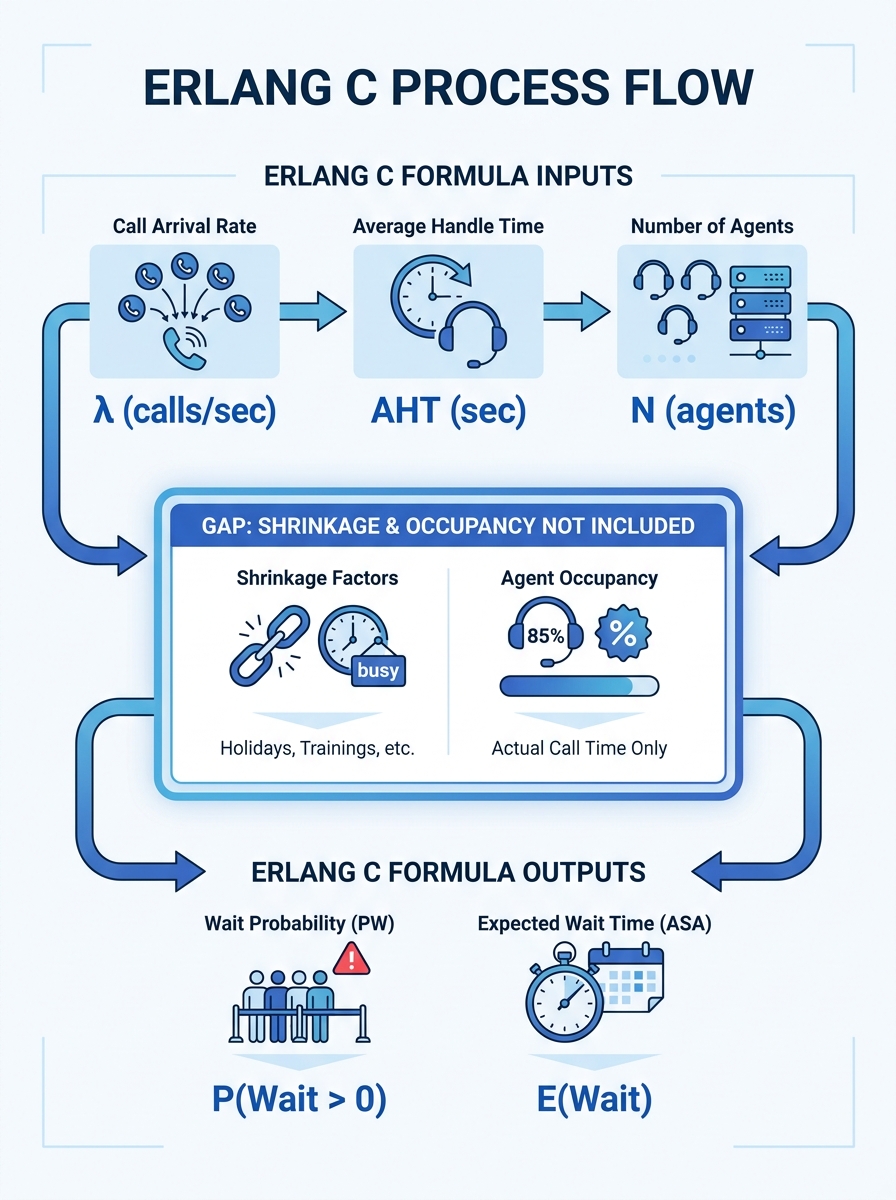
The Erlang C formula is a mathematical model used in call centers to calculate the probability that a caller will have to wait for an agent, as TechTarget’s telecommunications reference defines it. Danish mathematician Agner Erlang conceived the model in 1917, and it has survived more than a century as the backbone of traffic modeling in telephony. The formula takes three inputs: call arrival rate (calls per interval), average handle time (AHT, in seconds), and the number of available agents. From these, it outputs the probability a caller enters a queue and the expected wait time.
For a Philippine BPO handling 200 calls per half-hour with a 240-second AHT and a target service level of 80% answered within 20 seconds (the industry-standard 80/20 SLA), Erlang C might return a requirement of 30 agents. That number reflects a mathematically ideal scenario where every one of those 30 agents is logged in and available for the full 30-minute interval.
The problem is obvious to any operations manager who has run a floor in Makati or Cebu IT Park. Agents take bathroom breaks. They attend coaching sessions. They call in sick. The Erlang C model treats agent availability as 100%, which means it systematically underestimates the bodies you need to schedule. That gap between the formula’s output and reality is where the three approaches diverge.
Approach One: Raw Erlang C in a Spreadsheet
Why would anyone still run the basic formula without adjustments? Two reasons: speed and zero cost. Free online Erlang C calculators from callcentretools.com and similar sites let a workforce planner punch in call volume, AHT, and target SLA, then get an agent count in seconds. For a small team of 15–50 seats handling a single skill queue, this gives a reasonable starting estimate.
The tradeoffs surface fast at Philippine BPO scale. A 200-seat operation running 24/7 with an AHT of 360 seconds and 1,200 calls per hour will get an Erlang C output that assumes all 200 agents are perpetually available. Shrinkage in Philippine call centers typically runs 25% to 35% once you account for breaks, training, attrition-related vacancies, and absenteeism. Ignoring that range means you’re short 50 to 70 agents on any given shift. Service levels collapse from the target 80/20 to something closer to 60/40, and average speed of answer climbs past 45 seconds.
Raw Erlang C also assumes infinite caller patience. Real Philippine BPO clients track abandon rates at the 30-second and 60-second marks. When callers hang up before reaching an agent, the formula’s queue-length predictions become unreliable. For outbound campaigns and blended queues, the model breaks down further because it was designed for inbound-only, single-queue environments.
Where it works: Teams under 50 seats, single-skill queues, preliminary staffing estimates before budget approval. If you’re standing up a new campaign and need a fast headcount for a proposal deck, raw Erlang C gives you a defensible floor number.
Where it fails: Any operation above 100 seats, multi-skill routing, blended inbound/outbound programs, and any scenario where your shrinkage exceeds 20%.
Approach Two: Modified Erlang C with Real-World Overlays
The staffing formula published by ViciStack’s engineering blog captures the modification most experienced WFM analysts apply: Required staff = (Erlang_C_agents × (1 + multi_skill_factor)) / (1 – shrinkage_rate) / min(target_occupancy, 1.0). This formula takes the raw Erlang C output and layers three corrections on top of it.
Shrinkage adjustment. If your floor runs at 30% shrinkage (a realistic midpoint for Philippine BPOs with 12–18% annual attrition rates), dividing by 0.70 inflates your staffing requirement by 43%. The 30-agent Erlang C output from the earlier example becomes 43 scheduled agents.
Occupancy cap. Occupancy rate measures the percentage of logged-in time an agent spends handling contacts versus sitting idle. The optimal range is 85% to 90%. Pushing occupancy above 90% correlates with increased agent burnout, higher error rates, and turnover spikes that compound your shrinkage problem. Dividing by a 0.85 occupancy target adds another 18% to headcount.
Multi-skill factor. BPOs running agents across 2–3 queues (e.g., voice plus email, or English plus basic Tagalog support) need a multi-skill buffer. A factor of 0.10 to 0.15 is common, adding 10–15% to the base.
The combined effect: that original 30-agent Erlang C output becomes 56–60 scheduled agents after all three overlays. ViciStack’s guidance is direct: don’t try to optimize for both staffing and occupancy simultaneously in one formula. Calculate them separately and overlay.
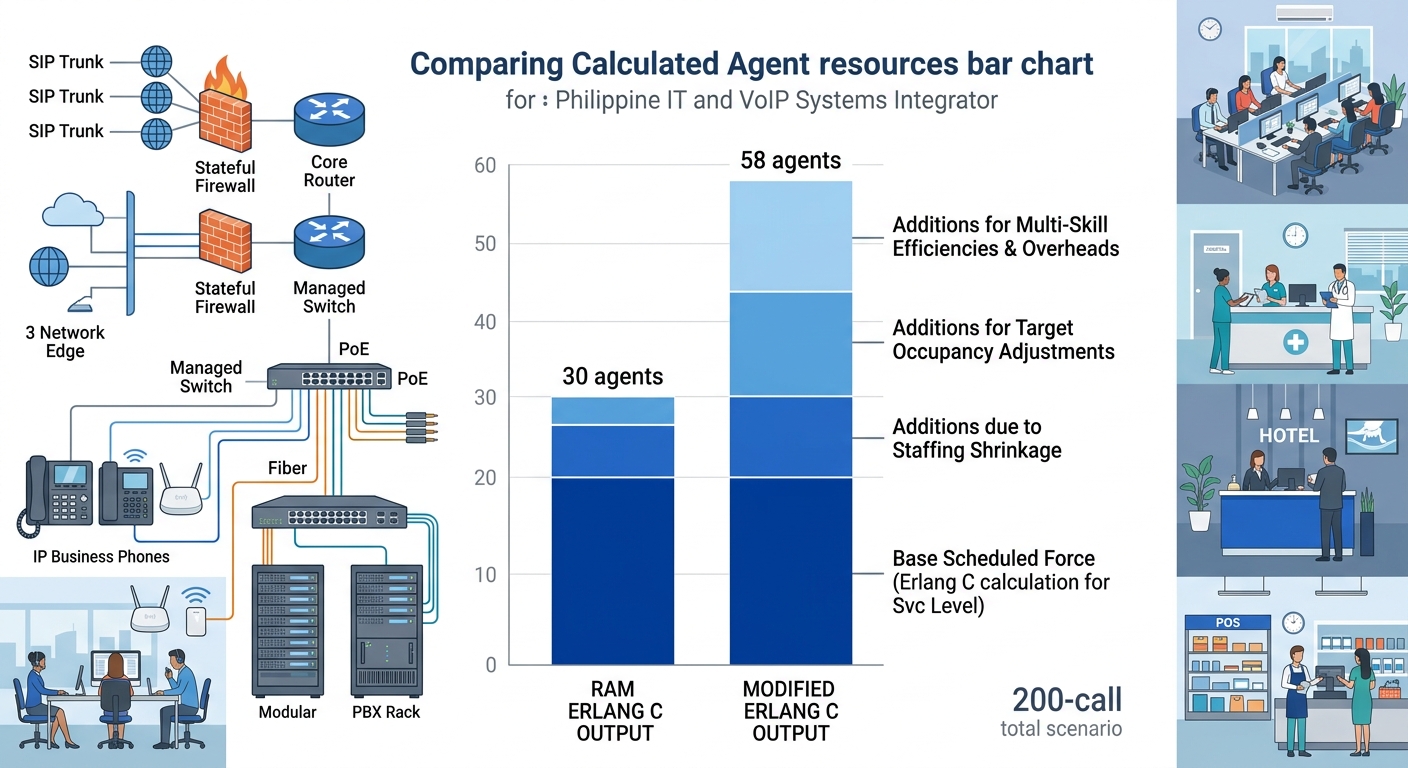
A 30% shrinkage rate and 85% occupancy cap together inflate the raw Erlang C headcount by nearly 100%. Ignoring either one means your floor is understaffed before the first call arrives.
This modified approach works well for operations between 50 and 500 seats. It requires a spreadsheet or a simple internal tool, minimal licensing cost, and a WFM analyst who understands the inputs. Philippine BPO operations using this method on enterprise phone systems with SIP trunking can pull AHT and call volume directly from CDR (call detail record) exports, running recalculations weekly or per campaign change.
The limitation is granularity. Modified Erlang C still operates on interval averages, typically 15-minute or 30-minute blocks. It doesn’t react to intra-day demand spikes in real time, and it can’t account for agent skill-level differences, schedule adherence variations, or the learning curves of newly hired agents.
Approach Three: AI-Driven Workforce Management Platforms
Cloud-based VoIP platforms with integrated WFM modules represent the third option, and by 2026 most Philippine BPOs above 500 seats have adopted them. These systems apply the SIPP (Stationary Independent Period by Period) method, recalculating staffing needs per 15-minute interval throughout the day using rolling historical data, seasonal trend analysis, and real-time adherence feeds.
Forbes Advisor’s workforce management guide highlights RingCentral as an example: the platform analyzes all customer interactions, tracks sentiment, identifies patterns in average call handle time, and monitors first-contact resolution and queue times. This goes beyond Erlang C’s three-input model into territory where 15+ variables feed each staffing decision.
As Lgorithm Solutions noted in their 2026 industry analysis, “By 2026, VoIP platforms enriched with AI and analytics will be essential tools for delivering world-class customer experiences.” That’s a vendor perspective, but the underlying capability is real. AI-driven WFM tools offer three things the spreadsheet approaches can’t:
- Predictive volume forecasting that ingests 12–24 months of historical data, weights seasonal patterns (holiday peaks, campaign launches), and produces interval-level demand projections with documented accuracy rates of 95–98% for stable accounts.
- Dynamic intra-day management that detects when actual call volume deviates from forecast by more than 10% and triggers automated alerts, voluntary overtime offers, or queue-priority changes within minutes.
- Schedule optimization using linear programming to assign shifts that respect Philippine labor law constraints (8-hour base, mandatory rest days, night differential requirements) while minimizing overstaffing during off-peak intervals.
When you’re building out a multi-site operation and need to plan your telecom budget across locations in Metro Manila, Cebu, and Davao, AI-driven WFM integration with your VoIP platform eliminates the manual reconciliation between telephony data and workforce schedules. The phone system’s CDRs feed directly into the forecasting engine. Philippine telecom providers report average uptime of 99.95% for enterprise SIP services, which means the data pipeline from call platform to WFM tool stays reliable.
The cost is significant. Enterprise WFM platforms from NICE, Verint, or Calabrio run PHP 800–2,500 per agent per month depending on module selection. For a 200-seat operation, that’s PHP 160,000–500,000 monthly before implementation and training costs. A 1,000-seat operation absorbs the per-agent cost more easily, and the efficiency gains (typically 8–12% reduction in overstaffing, 15–20% improvement in schedule adherence) generate measurable ROI.
Warning: AI-driven WFM platforms require clean, consistent CDR data to forecast accurately. If your [call quality monitoring](/blog/voip-call-quality-degradation-troubleshooting) infrastructure produces gaps or inconsistencies in call records, fix the data pipeline before investing in a WFM tool. Garbage in, garbage out applies here with expensive consequences.
Three Approaches Compared
| Factor | Raw Erlang C | Modified Erlang C | AI-Driven WFM |
|---|---|---|---|
| Cost | Free (online calculators) | Minimal (spreadsheet + analyst time) | PHP 800–2,500/agent/month |
| Accuracy at 50 seats | ±25–35% understaffed | ±5–10% | ±3–5% (overkill for this size) |
| Accuracy at 500+ seats | Unusable without overlays | ±10–15% | ±3–5% |
| Shrinkage handling | None | Manual overlay (25–35% range) | Automated, dynamic |
| Occupancy control | None | Manual cap (85–90% target) | Real-time monitoring |
| Multi-skill support | Single queue only | Manual factor (10–15% buffer) | Skill-based routing integrated |
| Forecast granularity | 30-min intervals, static | 15–30-min intervals, weekly refresh | 15-min intervals, continuous |
| Implementation time | Minutes | 1–2 weeks | 2–4 months |
| Best for | Quick estimates, small teams | 50–500 seats, stable volumes | 500+ seats, complex routing |
Who Should Pick Which
The decision maps cleanly to three variables: seat count, routing complexity, and budget.
Philippine BPOs running fewer than 50 seats on a single program with predictable volume should use raw Erlang C for initial estimates, then manually add a 30% shrinkage buffer. The math takes 10 minutes. The margin of error is acceptable when you’re scheduling 8–12 agents per shift and can adjust week-to-week based on actual abandon rates.
Operations between 50 and 500 seats get the best return from modified Erlang C. At this scale, the 1.9 million-strong Philippine BPO workforce means you’re competing for talent in Makati, BGC, Cebu, and Clark. Every overstaffed hour bleeds PHP 150–300 per idle agent in loaded labor cost. Every understaffed hour risks SLA penalties that run 5–15% of monthly billing. The modified formula, refreshed weekly with actual CDR data from your contact-center technology, closes the accuracy gap enough to keep both costs manageable.
Above 500 seats, or for any operation running blended inbound/outbound across 3+ skill queues, AI-driven WFM platforms pay for themselves. The 8–12% reduction in overstaffing at 1,000 seats translates to 80–120 agent-hours saved daily. At a loaded cost of PHP 250/hour, that’s PHP 20,000–30,000 per day in recovered efficiency. Annual savings of PHP 7–11 million dwarf the platform licensing cost.
The Philippine IT-BPM workforce is projected to exceed 2 million by 2028, and the industry contributes nearly 10% of GDP. The VoIP staffing optimization methods that got operations here won’t disappear. Erlang C remains the mathematical foundation under every WFM platform’s forecasting engine. Understanding where the formula’s assumptions break down, and choosing the right correction layer for your scale, is what separates a BPO that hits 80/20 consistently from one that explains SLA misses to clients every month.