
ANSI/TIA-942-C, revised May 2024, mandates 800mm minimum cabinet width across all distribution areas, formalizes ASHRAE A1–A4 and H1 thermal classes, and classifies micro-edge data centers for the first time. Philippine colocation facilities built before this revision face measurable compliance gaps in cabling infrastructure, cooling envelopes, and pathway redundancy.
TL;DR: TIA-942-C’s 2024 update tightens structured cabling requirements for data centers at every tier level. Philippine operators targeting Tier 3 or Tier 4 ratings need dual physically separated cabling pathways, 800mm-wide cabinets in distribution areas, and ASHRAE-compliant thermal management — a tall order in a tropical country where most existing builds predate these specs.
The Rating System and What It Demands of Cabling Infrastructure
TIA-942 uses a four-level rating system (Rated 1 through Rated 4) that governs physical construction, electrical power, cooling systems, monitoring, security, redundancy, maintainability, and commissioning. The standard was first published in 2005 and has gone through multiple revisions, including Addendum 1 in March 2008 (covering coaxial cabling specifications) and Addendum 2 in February 2010 (harmonizing with 2008 ASHRAE environmental guidelines). The May 2024 TIA-942-C revision is the most significant update in a decade.
Each rating level imposes specific cabling constraints. Rated 1 facilities operate with a single cabling pathway and no redundancy, delivering a baseline uptime target of 99.671%. Rated 2 adds partial redundancy at the component level (N+1) but still runs on a single pathway, pushing uptime to 99.741%. The jump to Rated 3 is where data center structured cabling requirements fundamentally change: dual pathways become mandatory, with one active and one available, achieving 99.982% uptime with concurrent maintainability. Rated 4 requires both pathways to be active simultaneously, fault-tolerant by design, targeting 99.995% uptime.
The distinction between Rated 2 and Rated 3 matters enormously for Philippine colocation standards because the majority of smaller regional facilities in Cebu, Davao, and provincial areas operate at Rated 1 or Rated 2 levels. Upgrading to Rated 3 requires physical infrastructure changes, not configuration adjustments.
| Rating | Redundancy Model | Cabling Pathways | Concurrent Maintainability | Target Uptime |
|---|---|---|---|---|
| Rated 1 | None | Single | No | 99.671% |
| Rated 2 | N+1 components | Single | No | 99.741% |
| Rated 3 | N+1 system | Dual (one active) | Yes | 99.982% |
| Rated 4 | 2N or 2N+1 | Dual (both active) | Yes (fault-tolerant) | 99.995% |
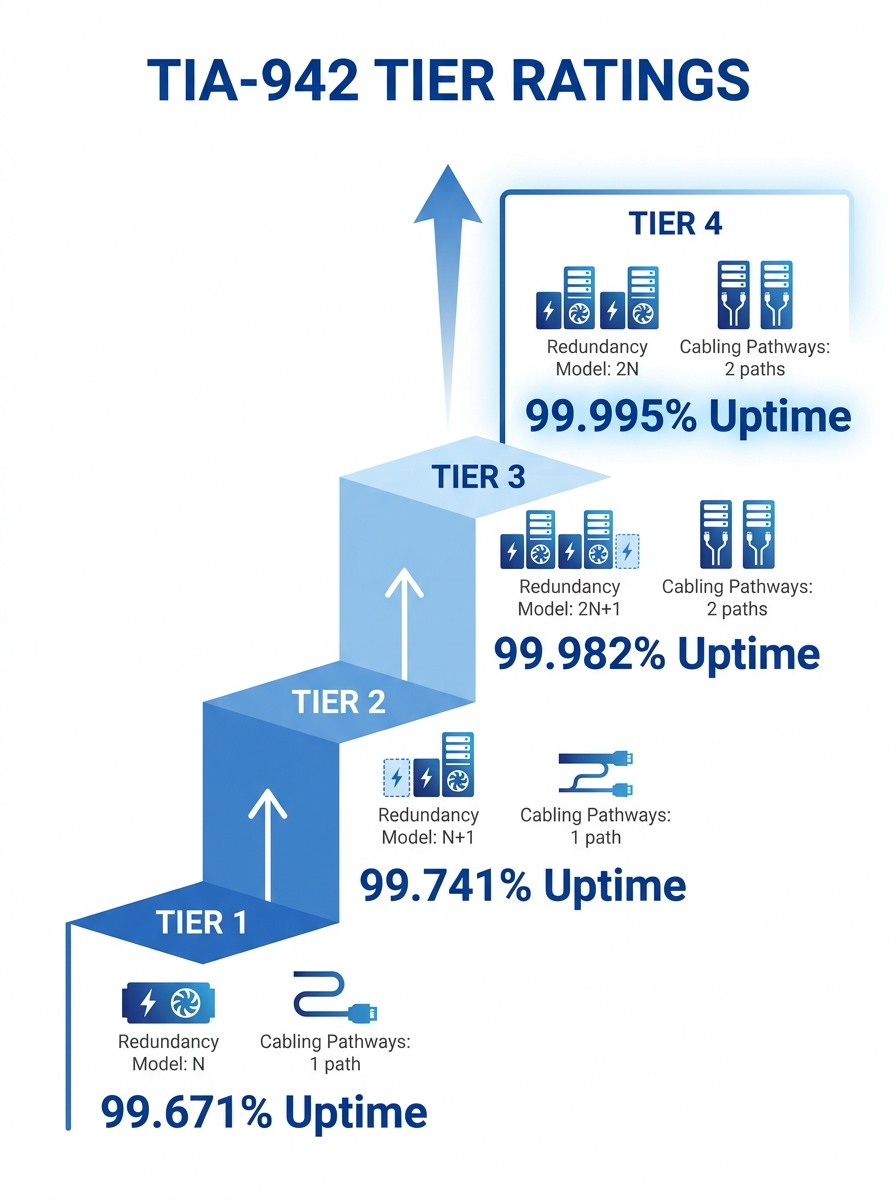
For organizations evaluating how AI workloads are driving data center architectural decisions, the cabling tier classification determines whether a facility can actually support the failover patterns those workloads require.
Why 800mm Cabinets Changed the Design Conversation
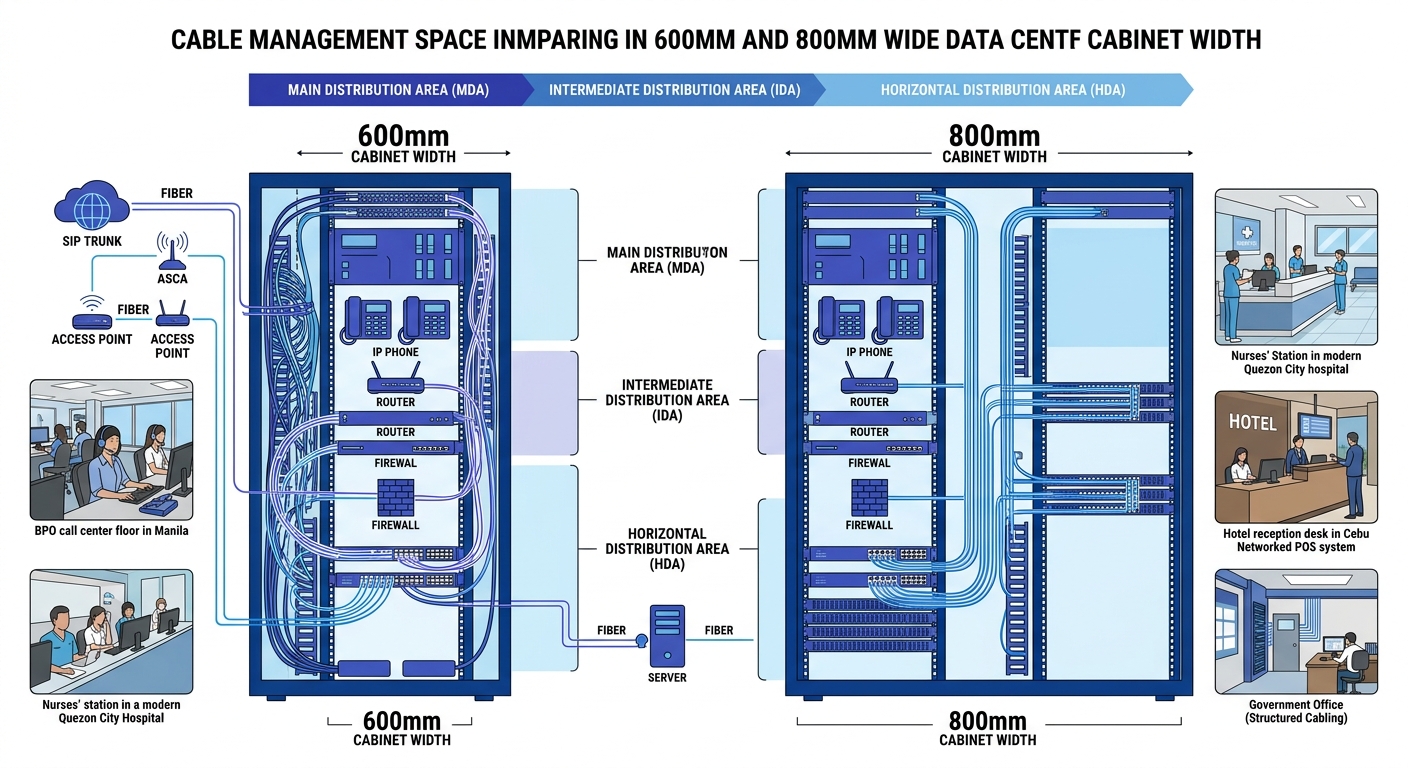
TIA-942-C mandates that cabinets in the Main Distribution Area (MDA), Intermediate Distribution Area (IDA), and Horizontal Distribution Area (HDA) must be at least 800mm wide, roughly 31.5 inches. This replaces the widely used 600mm (24-inch) racks that remain the default in many Philippine data centers built between 2010 and 2020.
The reasoning is practical, not arbitrary. High-density cabling for 400G and 800G networks requires significantly more fiber per rack unit. At 600mm width, cable management becomes physically impossible at the densities TIA-942-C anticipates. Patch panels crowd together, bend radius violations become common, and airflow through the cabinet degrades as cables fill available space.
On the connector side, TIA-942-C still requires LC and MPO connectors at the Equipment Outlet (EO). But the revision now permits any TIA-568.3 compliant optical connector in distributor areas, including Very Small Form Factor (VSFF) connectors that support massive fiber counts in tighter physical footprints. For Philippine colocation providers advertising AI-ready infrastructure, this connector flexibility matters. Equinix’s Philippine facilities already market advanced cooling, interconnection, and cloud connectivity features aligned with global compliance standards. Operators without equivalent physical plant face a widening gap.
The recognized media under TIA-942 include single-mode optical fiber cable per ANSI/TIA/EIA-568-C.3, multimode fiber, Category 6A or higher copper cabling, and 75-ohm coaxial cable per Telcordia GR-139-CORE for legacy broadcast and signaling applications. Direct-attach cabling is recommended only within or between adjacent cabinets; structured cabling remains the requirement for longer runs to manage tray capacity and protect future upgrade paths.
Pathway Redundancy Separates Rated 3 From Rated 4
Why does the path architecture matter more than raw component quality? Because a single point of physical failure in a cabling pathway can take down an entire facility, regardless of how premium the fiber or copper is.
Rated 3 and Rated 4 certifications require physically separated and redundant pathways for data transmission. If Main Path A is severed or damaged, Backup Path B must handle the traffic instantly. At Rated 3, one path is active while the second stands by. At Rated 4, both paths carry traffic simultaneously, and either can absorb the full load of the other without degradation.
For data center design in the Philippines, this dual-pathway requirement interacts with local building constraints in specific ways. Metro Manila’s commercial real estate footprint often forces data centers into multi-floor layouts, where vertical pathway separation is expensive and structurally complex. Facilities in Makati, Taguig, and Quezon City frequently occupy converted office or warehouse space where adding a second physically independent pathway means running conduit through floors or walls that weren’t designed for it.
Jonathan Jew’s presentation at the 2017 BICSI Philippines conference detailed how TIA-942 and BICSI-002 complement each other on exactly this point. TIA-942 defines the cabling requirements; BICSI-002 provides design and implementation guidance for the physical plant around them, covering structural, electrical, and mechanical subsystems. Philippine facility designers who follow only one standard without the other tend to build cabling that meets spec on paper but fails in practice because the surrounding infrastructure can’t support it.
Warning: Cabling tier classification upgrades from Rated 2 to Rated 3 are physical construction projects, not IT projects. Budget for conduit routing, fire barrier penetrations, and structural assessment before commissioning new pathway runs.
Organizations that have already invested in building resilient telecom infrastructure at the network layer understand that resilience has to extend through the physical layer as well. A redundant SIP trunk configuration means nothing if both trunks terminate through the same cable pathway.
Tropical Ambient Temperatures Against ASHRAE Envelopes
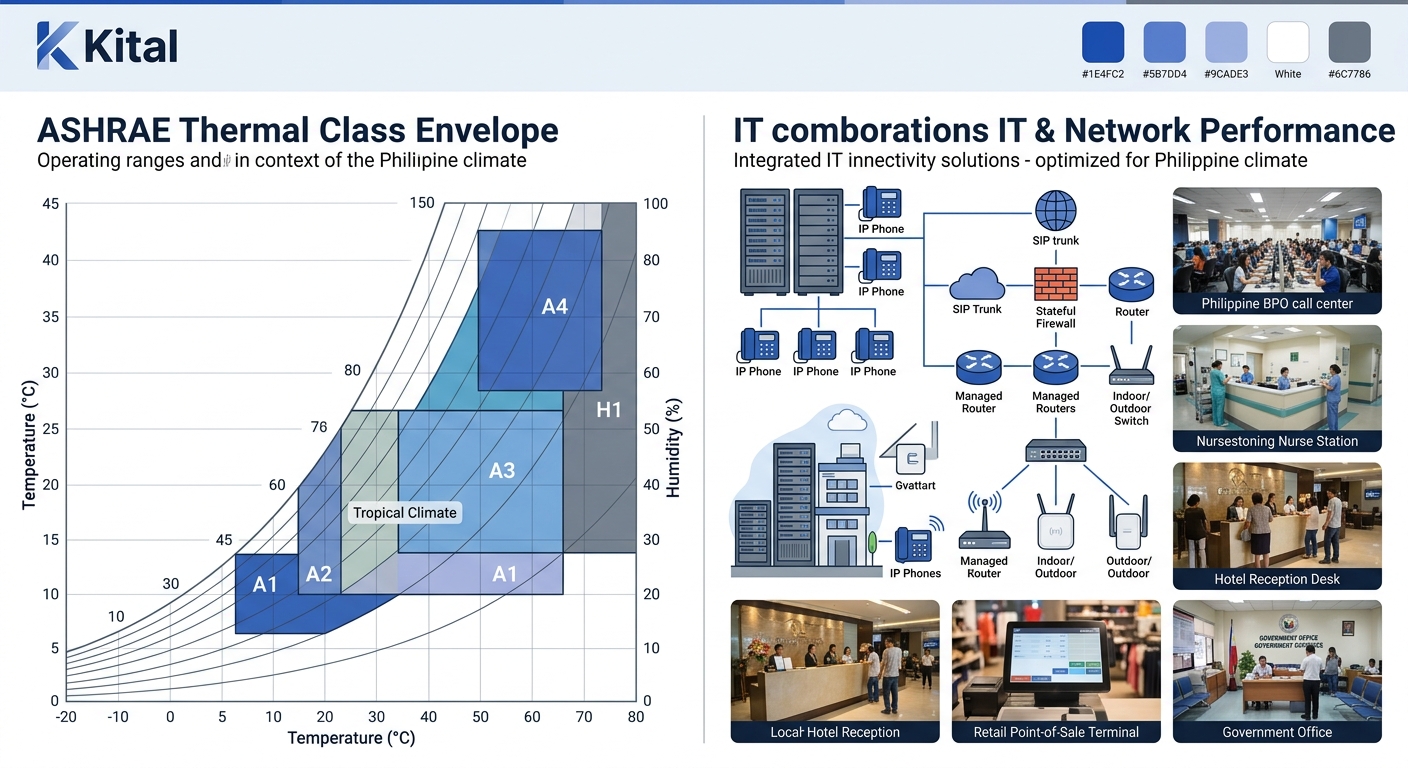
TIA-942-C adopts ASHRAE TC 9.9 Thermal Guidelines, requiring compliance with temperature and humidity envelopes for classes A1 through A4 and the new High Density H1 class for air-cooled equipment. The standard also incorporates guidance for direct-to-chip and immersion cooling.
The Philippines sits squarely in the tropical band where these thermal envelopes face their hardest test. Average outdoor temperatures in Metro Manila hover between 26°C and 34°C year-round, with humidity regularly exceeding 80%. Singapore has confronted this same challenge head-on: the Infocomm Media Development Authority (IMDA) launched a tropical data center sustainability standard with sustainability as, in the words of Singapore’s government, “a paramount design factor in digital infrastructure so that we grow our digital economy in line with our long-term climate commitments.”
The National University of Singapore (NUS) and Nanyang Technological University (NTU) have operated the Singapore Tropical Data Centre Testbed (STDCT) since June 2021. Per NUS, “The STDCT is an infrastructure that supports a comprehensive research programme to develop cooling solutions for the sustainable operation of DCs in the tropics.” Research from this testbed on air free-cooled tropical data center performance has produced specific recommendations for IT equipment selection and cooling architecture in environments where ambient air temperature makes traditional free-cooling impractical.
Philippine data center operators can draw directly from Singapore’s STDCT findings. ASHRAE class A1 equipment, designed for the most controlled environments (15°C–32°C at the inlet), leaves minimal headroom in a tropical facility. Class A3 and A4 equipment tolerates inlet temperatures up to 40°C and 45°C respectively, but with shorter allowable exposure durations and tighter humidity controls. The H1 class, introduced for high-density AI compute racks, assumes direct liquid cooling is part of the thermal design.
A redundant SIP trunk configuration means nothing if both trunks terminate through the same cable pathway routed through a single conduit.
The thermal discussion connects directly to cabling because elevated ambient temperatures degrade cable performance. Fiber optic cable is less sensitive than copper to heat, but patch cord jacket materials, connector adhesives, and cable tray proximity to hot aisle exhaust all affect long-term reliability. TIA-942-C’s floor loading minimum of 5 kPA (100 lb/ft²) for small computer rooms under 20 square meters also constrains cooling equipment placement in the tight footprints common to Philippine provincial facilities.
Three-Axis Tropical Compliance Check
Philippine facility operators and enterprise buyers evaluating colocation providers can assess TIA-942-C readiness through what we’ll call the Three-Axis Tropical Compliance Check: pathway architecture, thermal envelope fit, and connector-media readiness.
Pathway Architecture asks: does the facility have physically separated dual cabling pathways? Are they documented, labeled, and testable independently? Can maintenance occur on one pathway without interrupting the other? Rated 3 facilities answer yes to all three. Rated 4 facilities answer yes and both pathways carry production traffic simultaneously.
Thermal Envelope Fit asks: what ASHRAE class does the facility target, and what is the measured delta between outdoor ambient temperature and cold aisle inlet temperature across 12 months of operation? Facilities in Metro Manila, Cebu, or Davao that target A1-class compliance need mechanical cooling systems capable of maintaining a 26°C cold aisle when outdoor air sits at 34°C with 85% relative humidity. The 8°C delta and dehumidification load define the facility’s real energy cost.
Connector-Media Readiness asks: does the structured cabling plant support the connector types and fiber counts TIA-942-C requires? Facilities still running 600mm racks with legacy LC-only patch panels in distribution areas will struggle to accommodate the density that 400G and 800G optics demand. The 800mm cabinet width, VSFF connector capability, and single-mode fiber backbone are the three physical prerequisites.
This framework gives enterprises comparing cloud and on-premise infrastructure costs a concrete checklist for evaluating whether a Philippine colocation facility’s physical layer actually matches its marketing tier.
Where the Standard Goes Silent on Philippine Conditions
TIA-942-C is a global standard. It doesn’t address NTC (National Telecommunications Commission) registration requirements for telecommunications facilities, DICT (Department of Information and Communications Technology) policy alignment, or the Philippine Building Code’s seismic zone classifications that affect cable tray anchoring and pathway routing through multi-story structures. The tiering system doesn’t require the use of any specific technologies or design choices, which means two Rated 3 facilities can look very different in practice.
The standard also doesn’t account for the fragmented last-mile connectivity landscape in the Philippines. A data center with impeccable internal cabling but only one carrier entrance is functionally a Rated 1 facility from the telecommunications perspective, regardless of its internal pathway architecture. TIA-942 Addendum 2 noted that data centers equipped with diverse telecommunications facilities can continue operating under catastrophic conditions, but “diverse” remains undefined in the Philippine regulatory context, where PLDT’s ICT and data center growth dominates certain geographic areas.
DITO Telecommunity’s March 2025 colocation management agreement signals that the Philippine market is diversifying, but the pace of new facility construction still outstrips the pace of standards adoption. The numbers in TIA-942-C are specific: 800mm, 5 kPA, A1–A4, H1, dual pathways. Whether Philippine facilities meet those numbers depends on whether buyers start demanding proof instead of accepting tier labels at face value. The data that would settle this question, a public audit of Philippine colocation facilities against TIA-942-C requirements, doesn’t exist yet.