
Fifteen enterprise telephony security controls, grouped into three layers, separate a hardened Philippine VoIP deployment from one exposed on day one. Network isolation, authentication with toll fraud prevention, and encryption plus active monitoring each address different threat vectors. Network-layer controls block the widest attack surface per hour of implementation effort.
TL;DR: VoIP security hardening in the Philippines requires controls across three layers: network isolation (VLANs, SBCs, firewalls, physical access, ACLs), authentication and toll fraud lockdowns (MFA, RBAC, SIP credentials, dialing restrictions, extension governance), and encryption with monitoring (TLS/SRTP, IDS/IPS, firmware cycles, pen tests, CDR anomaly alerts). Sequence matters — start with network controls, then layer authentication on top, then encryption and monitoring.
The three layers aren’t interchangeable. Each demands different skill sets and carries different maintenance overhead. A BPO in Makati with 500 SIP endpoints faces different priorities than a provincial hospital running 40 Fanvil handsets. This SIP security checklist breaks down all 15 controls so your team can sequence them correctly before go-live, regardless of scale.
The average cost of a data breach reached $4.44 million in 2025, and ransomware accounted for 44% of those breaches, up from 32% the year before. Philippine enterprises operating call centers, hospitals, and government offices under the Data Privacy Act of 2012 (RA 10173) face both financial exposure and regulatory risk if their VoIP infrastructure ships unprotected.
Five Network-Layer Controls That Block the Widest Attack Surface
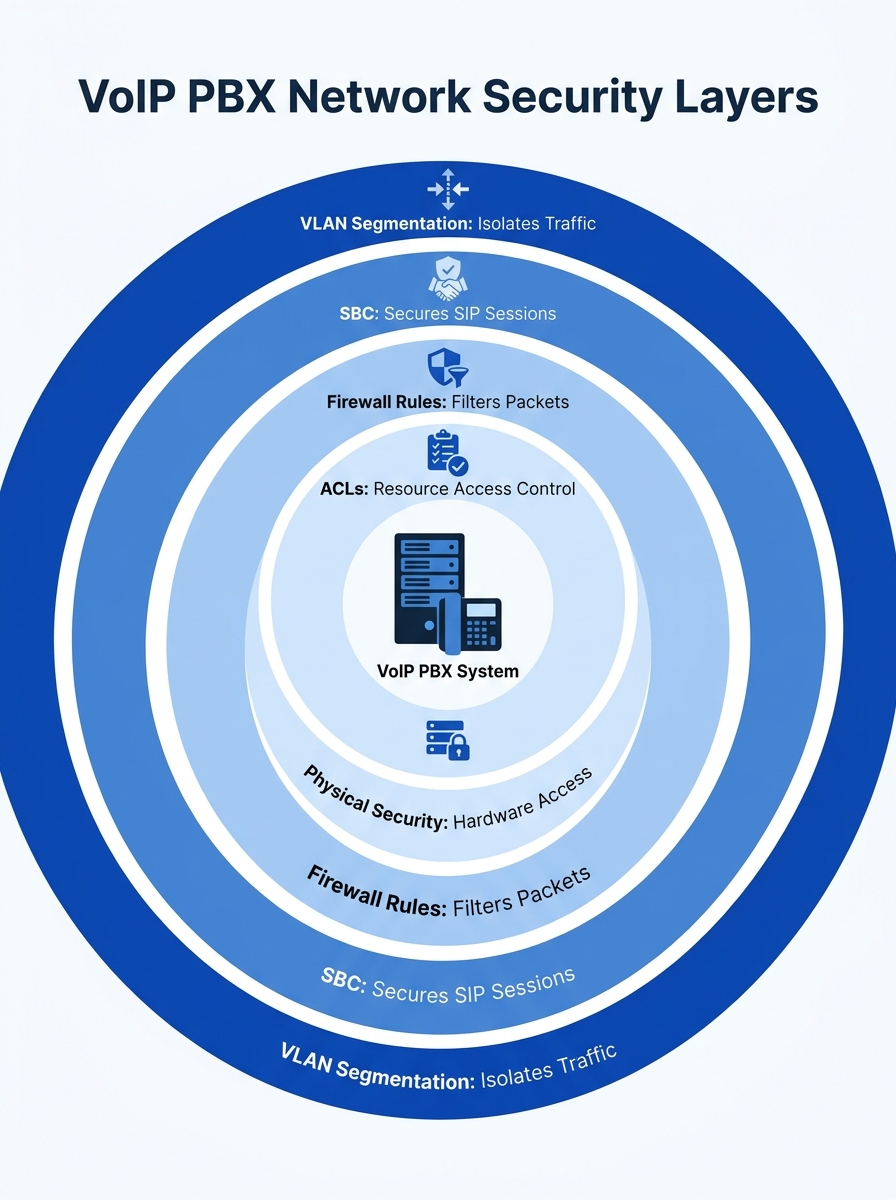
VoIP VLAN segmentation, Session Border Controllers, firewall rules, physical access restrictions, and inter-VLAN ACLs form the first defensive perimeter. These five controls prevent attackers from reaching SIP endpoints in the first place, which is why they belong at the top of any enterprise telephony security controls checklist.
Control 1: Dedicated Voice VLANs
Every voice endpoint belongs on a VLAN isolated from data traffic. According to VoIP VLAN best practices research, restricting data flow between VLANs fortifies security while allowing controlled inter-VLAN routing where needed. A Cisco or Fortinet switch tagging voice traffic on VLAN 100 and data on VLAN 200 keeps broadcast storms, ARP spoofing, and lateral movement from reaching your phones.
But avoid going overboard. Excessive segmentation complicates ACL management and creates policy sprawl. For a 200-seat Philippine BPO, 2 to 4 voice VLANs segmented by floor or department is practical. Thirty micro-VLANs across a single building is not.
Control 2: Session Border Controller Deployment
An SBC sits between your IP-PBX and the public SIP trunk, inspecting every SIP INVITE, REGISTER, and OPTIONS message before it touches your internal network. If you’ve read about SBC placement and failover design patterns, you know the SBC also handles topology hiding, so external callers never see your internal IP addressing scheme. For Philippine enterprises connected to PLDT, Globe, or Converge SIP trunks, the SBC is the single control that prevents SIP scanning attacks from mapping your infrastructure.
Control 3: VoIP-Aware Firewall Rules
Standard firewall rules that permit “any” on SIP port 5060 (unencrypted) or 5061 (TLS-encrypted) are functionally useless. Pin your firewall rules to specific source IP ranges: your SBC’s external interface, your SIP trunk provider’s signaling gateways, and nothing else. A Fortinet FortiGate or Cisco ASA configured with SIP Application Layer Gateway (ALG) inspection can detect malformed SIP headers that scanning tools use to probe for vulnerabilities.
Control 4: Physical Security for VoIP Components
According to NIST Special Publication 800-58, organizations “should ensure that adequate physical security is in place to restrict access to VoIP network components,” including “barriers, locks, access control systems, and guards” as the first line of defense. This matters in Philippine office environments where IDF closets often double as storage rooms. A compromised switch port in an unlocked wiring closet gives an attacker direct Layer 2 access to your voice VLAN.
Control 5: Inter-VLAN Access Control Lists
Even with separate VLANs, routing between them without ACLs defeats the purpose. Restrict inter-VLAN traffic so that only your IP-PBX management interface can reach voice VLANs on specific ports (SIP signaling, RTP media ranges, provisioning). Block everything else. If your structured cabling infrastructure is clean and properly documented, applying these ACLs is straightforward. If your cabling is a mess, you’ll misidentify endpoints and lock out legitimate traffic.
Authentication and Toll Fraud Lockdowns Across Five Access Points
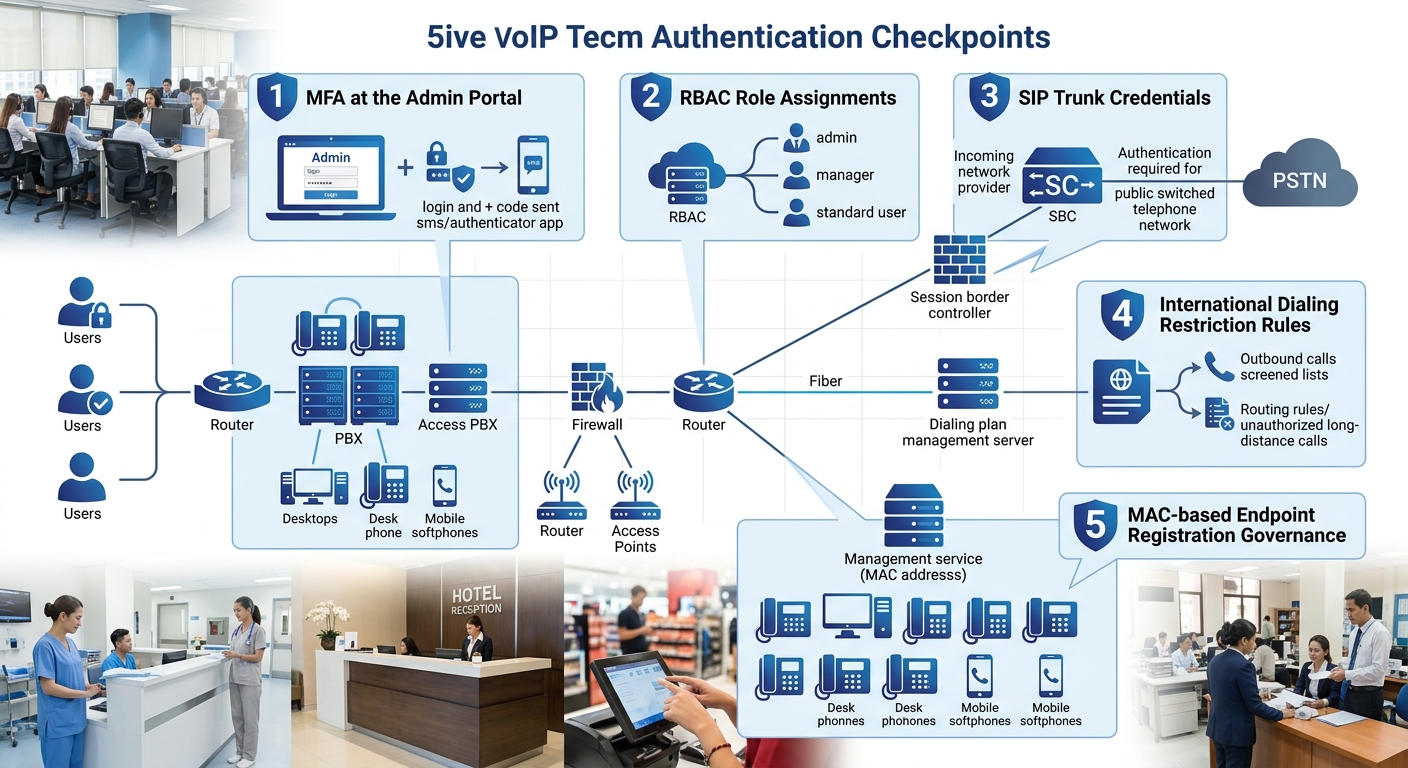
Why does toll fraud remain the single most financially damaging VoIP attack vector? Because authentication controls are the ones Philippine IT teams most often defer until after go-live. These five controls govern who can register endpoints, place calls, and modify system configuration.
The Datadome toll fraud prevention guide identifies a foundational best practice: “restricting unauthorized internal PBX extensions from accessing international networks” and “assigning an administrator responsibility for authorizing extensions.” Toll fraud prevention in enterprise environments starts here.
Control 6: Multi-Factor Authentication for Admin Access
Every Yeastar, Cisco, or Asterisk-based PBX management portal needs MFA enabled. A compromised admin password gives an attacker the ability to create rogue extensions, modify call routing, and open international trunk access. This is the exact attack chain behind most toll fraud incidents. Pair MFA with role-based access so that your help desk team can reset voicemail PINs without touching trunk configuration.
Control 7: Role-Based Access Control
RBAC limits the blast radius when any single credential is compromised. Define at minimum three roles: system administrator (full access), telephony engineer (call routing and extension management), and operator (CDR viewing and basic monitoring). Philippine BPOs often run with a single shared admin account across 5 to 10 IT staff members. That’s an audit failure waiting to happen under NPC regulations.
Control 8: SIP Trunk Authentication Hardening
Your SIP trunk registers with your provider using credentials that should never be the defaults. Change SIP registration passwords to 20+ character random strings. Restrict registration by source IP so that only your SBC’s external address can authenticate. If your provider supports digest authentication with nonce expiration, enable it. The SIP trunk failover guide for Asterisk-based systems covers how to maintain these credentials across primary and backup trunks without introducing authentication gaps during failover.
Control 9: International and Premium-Rate Dialing Restrictions
Lock international dialing to specific extensions or user groups with documented business justification. Block premium-rate number ranges (090x, international 1-900 prefixes) at the PBX dial plan level. A 500-seat Philippine call center that serves only domestic customers has zero business reason to permit unrestricted international dialing from every extension. Seventy-four percent of security leaders already cite AI-powered threats as a significant concern, and AI-generated vishing calls now probe PBX systems for exploitable extensions more efficiently than manual scans.
Control 10: Extension Registration Governance
Disable auto-provisioning for unknown MAC addresses. Every SIP endpoint that registers with your PBX should match a whitelist of known device MAC addresses and IP ranges. When an unrecognized device attempts to register, the system should log the attempt, reject it, and alert your monitoring team. This single control stops rogue softphone registrations, which account for a large share of internal toll fraud incidents.
Encryption and Active Monitoring — the Five Controls Most Teams Defer
TLS for signaling, SRTP for media, intrusion detection, firmware lifecycle management, and CDR-based anomaly detection complete the 15-control checklist. These are the controls that catch attacks the first two layers missed, and they generate the forensic evidence you’ll need when something does go wrong. Teams deploying zero-trust network access for VoIP will find these controls are prerequisites, not optional additions.
Control 11: TLS for All SIP Signaling
Unencrypted SIP on port 5060 transmits credentials, caller IDs, and call metadata in plaintext. Switch all SIP signaling to TLS 1.2 at minimum, with TLS 1.3 preferred. Both your IP-PBX and your SBC need matching certificate configurations. Self-signed certificates work for internal lab testing. Production environments should use certificates from a trusted CA, especially if you’re interconnecting with Microsoft Teams Direct Routing, where certificate trust chain failures cause immediate registration drops.
Control 12: SRTP for Voice Media
TLS protects signaling; SRTP protects the actual audio. Without SRTP, anyone with a packet capture on your network can reconstruct voice conversations using free tools like Wireshark. Enable SRTP on every endpoint and trunk. Fanvil, Yeastar, and Cisco endpoints all support SRTP, but it’s disabled by default on most. Your provisioning templates need to enforce it.
Control 13: Intrusion Detection and Prevention
Deploy IDS/IPS rules tuned for SIP-specific attacks: SIP INVITE floods, REGISTER brute-force attempts, and malformed SIP header injection. The Springer research on SIP attack taxonomies documents threats including denial-of-service floods, eavesdropping, and call hijacking, and recommends that the taxonomy “be used as a baseline model to evaluate a SIP product” against known attack vectors. A Fortinet FortiGate with IPS signatures for VoIP or a dedicated SBC with built-in SIP anomaly detection covers this requirement.
Control 14: Firmware and Software Lifecycle Management
Unpatched VoIP endpoints are the easiest targets. The critical SSRF vulnerability in Cisco Unified CM that enabled unauthenticated root access is a concrete example of what happens when firmware cycles slip. Establish a 30-day patch evaluation window: test on a staging cluster, validate call quality and registration stability, then push to production. Seventy-five percent of small businesses experienced at least one cyberattack in 2025, and unpatched devices were the entry point in a disproportionate share of those incidents.
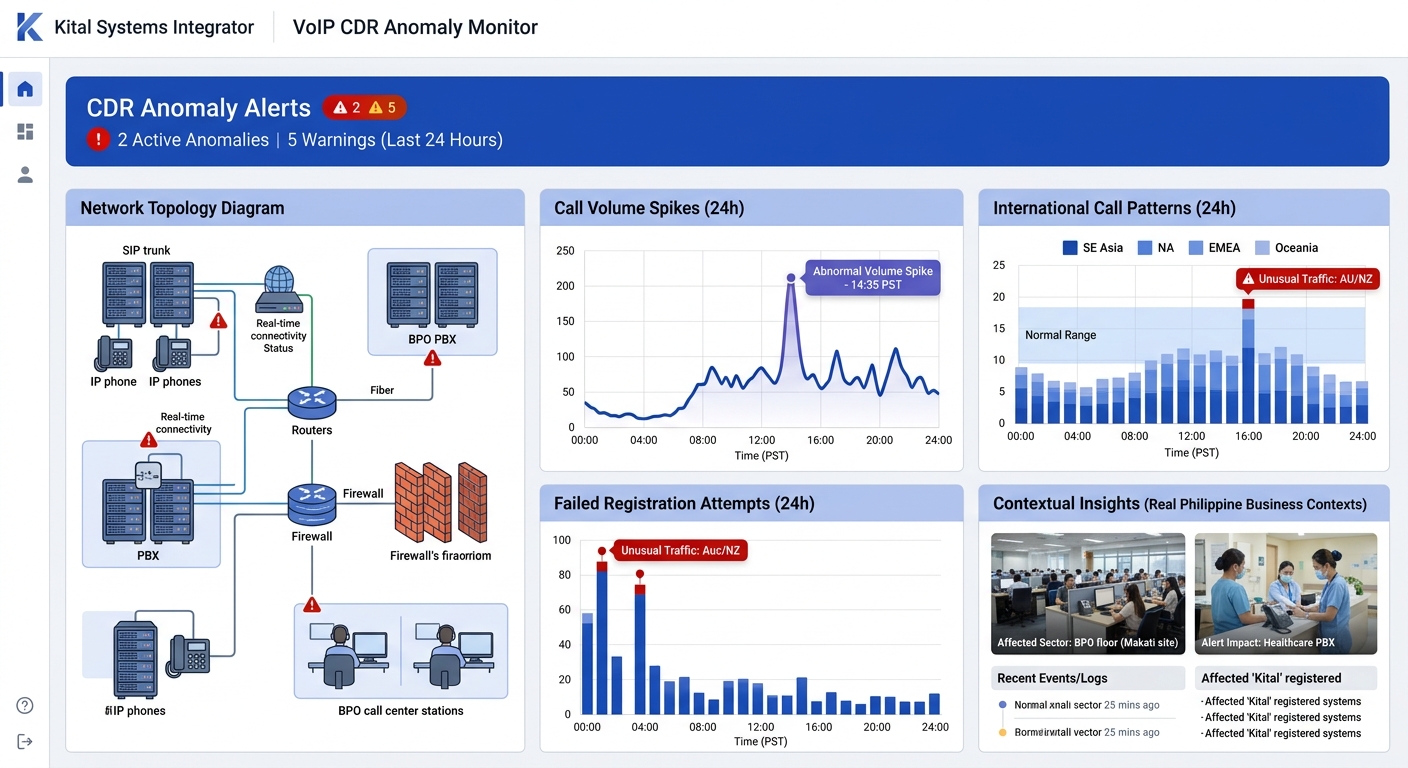
Control 15: CDR-Based Anomaly Detection
Call Detail Records are your audit trail. Build automated alerts for anomalies: calls to new international destinations, calls exceeding 60 minutes to premium-rate numbers, spikes in failed registration attempts outside business hours, or any extension placing more than 50 calls per hour. These CDR patterns are the earliest indicator of toll fraud in progress, often appearing 4 to 8 hours before the fraudulent charges hit your carrier invoice.
CDR anomaly alerts are your earliest toll fraud warning — they typically fire 4 to 8 hours before fraudulent charges appear on your carrier invoice.
How the Three Layers Compare
| Attribute | Network-Layer Isolation | Authentication & Toll Fraud | Encryption & Monitoring |
|---|---|---|---|
| Controls covered | VLANs, SBC, firewall rules, physical security, ACLs | MFA, RBAC, SIP auth, dialing restrictions, MAC governance | TLS, SRTP, IDS/IPS, firmware patching, CDR alerts |
| Primary threat blocked | Unauthorized network access, SIP scanning, lateral movement | Credential theft, toll fraud, rogue extensions | Eavesdropping, call hijacking, zero-day exploits |
| Deployment complexity | Moderate (network reconfiguration required) | Low to moderate (software and policy changes) | Moderate to high (certificate management, IDS tuning) |
| Ongoing maintenance | Low (ACLs and VLANs are stable once set) | Medium (password rotation, role reviews quarterly) | High (firmware cycles, IDS signature updates, CDR monitoring) |
| Skill set required | Network engineering (Cisco, Fortinet switching) | PBX administration, security policy | Security operations, PKI, log analysis |
| Philippine-specific priority | Highest for BPOs and multi-floor offices | Highest for government and hospitals (RA 10173 compliance) | Highest for financial services and insurance |
Warning: Don’t treat these layers as sequential phases you can stretch across months. All 15 controls should be in place before go-live. The comparison above helps you allocate your team’s time during the implementation window, with network-layer controls getting first attention because they take the most calendar days to deploy.
Who Should Prioritize Which Layer
Philippine BPOs with hundreds of SIP endpoints on shared campus networks should front-load network-layer isolation. The density of endpoints per floor, combined with shared data and voice traffic on flat networks, makes VoIP VLAN segmentation the control that delivers the most immediate risk reduction. If your organization recently consolidated multiple branch PBX systems into a single platform, network-layer controls are doubly important because a single compromised trunk now affects every location.
Government agencies and hospitals bound by NPC data privacy enforcement should weight authentication and toll fraud prevention enterprise controls heavily. These organizations face regulatory scrutiny if patient or citizen call data leaks through a compromised admin account. The pattern of common IP telephony deployment mistakes in Philippine government consistently includes absent MFA on PBX admin portals and unrestricted international dialing on every extension.
Financial services firms, insurance companies, and any organization handling sensitive client conversations over VoIP need encryption and monitoring controls at parity with network-layer isolation. A recorded, unencrypted SIP call containing account numbers or medical information is a Data Privacy Act violation the moment it’s intercepted.
The honest answer for most Philippine enterprises is that you need all three layers before your first production call traverses the trunk. The 15 controls in this checklist aren’t a menu where you pick your favorites. They’re a minimum baseline. Teams that treat VoIP security hardening in the Philippines as a post-deployment cleanup project will learn that attackers don’t wait for your second sprint either.