
Vodia Networks released Version 70 of its PBX platform on June 9, 2026, introducing external presence-information sharing between separate PBX systems and tenants, according to the company’s announcement. The Boston-based unified communications provider positioned the capability as enabling busy-lamp-field visibility across distributed deployments where organizations run multiple PBX instances—either multi-tenant environments on a single server or physically separate systems at different locations.
TL;DR: Vodia Networks released V70 of its PBX platform with external presence sharing across separate systems and tenants, plus multi-core media processing supporting over 1,000 concurrent calls per server and a redesigned admin interface.
The feature addresses a long-standing visibility gap in organizations that operate multiple PBX deployments split by department, office, or service-provider tenant structure. Traditional PBX presence monitoring stops at the boundary of a single system; V70 extends it across internet-reachable instances.
How External Presence Sharing Works
V70 enables presence-data exchange between two tenants on the same PBX hardware or across physically separate PBX servers in different locations, Vodia stated in the release. The systems must maintain internet connectivity to each other for the presence feed. Once configured, users can monitor external-account status through the existing BLF interface on their desk phones or softphone clients.
The platform also exposes a REST API endpoint for pushing presence updates from external applications, creating integration hooks for custom communication workflows or third-party systems that need to signal user availability.
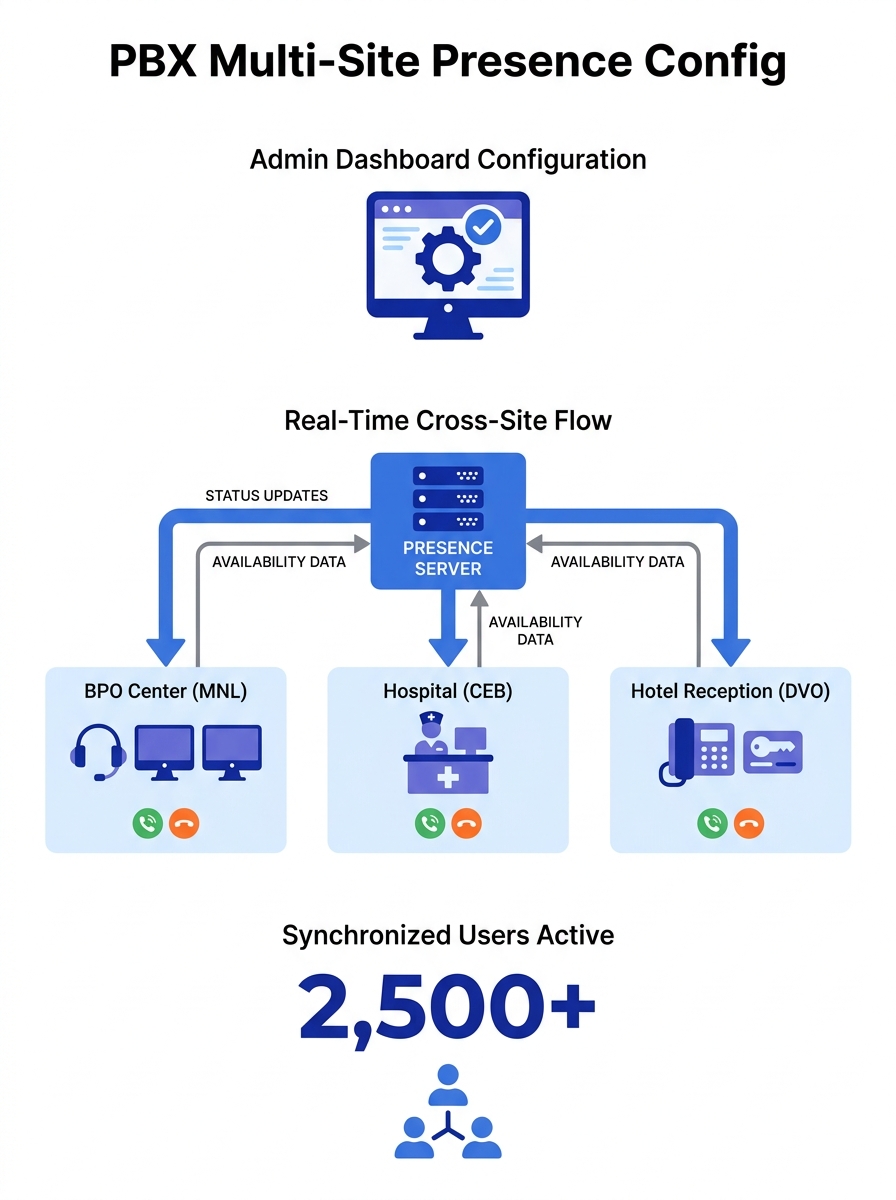
Use cases Vodia highlighted include businesses with employees distributed across multiple sites, organizations that run separate PBX systems by department or office, service providers managing distinct tenant instances, and teams requiring real-time visibility into extension availability across those boundaries.
V70 Scalability and Architecture Changes
Beyond presence sharing, Version 70 introduces multi-core CPU utilization for media processing, enabling a single server to handle more than 1,000 simultaneous calls, according to the announcement. Earlier Vodia releases processed media on a single core, creating a bottleneck on higher-density deployments.
The update ships with a redesigned admin interface built on newer web technologies. Vodia did not specify the framework but described the refresh as a complete rebuild rather than incremental UI updates.
V70 adds snapshot-based configuration backup and restoration through a file-system approach, allowing administrators to roll back PBX state to a previous point. The platform now supports centralized remote provisioning for multi-site deployments and cross-tenant BLF status sharing even when external presence sync is not configured.
Documentation for the new features is available on Vodia’s support portal. The company provided a sales contact email and a U.S. phone number but did not disclose Version 70 licensing terms, pricing tiers, or upgrade paths for existing customers in the announcement.
Competitive Positioning in Multi-Tenant PBX Market
Vodia competes in a segment where hosted PBX vendors increasingly target service providers running multi-tenant platforms. External presence sharing puts V70 on feature parity with some cloud-native UC platforms that already federate presence across organizational boundaries—though most require those organizations to reside within the same vendor ecosystem.
The challenge for IT teams evaluating vendor lock-in risks in unified communications is that cross-vendor presence federation remains rare. Vodia’s approach keeps presence visibility within Vodia-managed systems but extends it across discrete deployments—useful for organizations that standardized on the platform but installed it in segmented topologies.
Philippine enterprises running distributed PBX infrastructure—common among multi-branch banks, hotel chains with separate property-level systems, and BPO operators managing client-segregated telephony—gain inter-system visibility without forcing a full consolidation. That said, presence sharing does not replace the availability and failover benefits of true multi-site PBX consolidation onto a single redundant platform.
What This Means for IT Managers
If your organization runs multiple Vodia PBX instances—whether for tenant isolation, departmental separation, or simply because you inherited site-by-site deployments—V70’s external presence sharing closes the visibility gap that forces users to manually check extension status across systems. The feature requires stable internet connectivity between PBX servers and assumes both run V70, so partial upgrades will not unlock cross-system monitoring.
The multi-core media processing improvement matters if you’re hitting call-density limits on existing hardware. Supporting 1,000+ concurrent calls on a single server shifts the economics for mid-sized deployments, though you still need to evaluate network bandwidth, SIP trunk capacity, and whether concentrating that many calls on one box aligns with your disaster recovery and resilience posture.
The redesigned admin interface and snapshot rollback features reduce operational overhead, but they do not eliminate the root question: whether maintaining separate PBX systems—even with shared presence—delivers better outcomes than consolidating onto fewer, more resilient platforms. V70 makes distributed Vodia deployments more manageable; it does not make fragmentation an architectural virtue.