
The global market for AI in the BPO industry is projected to hit $3.5 billion this year, according to MicroSourcing’s Philippines Outsourcing Industry Report. That figure lands differently when you consider what IBPAP reported in April 2025: over 60% of Philippine call centers had already implemented some form of AI, with adoption expected to reach 85% by the end of 2026.
The gap between 60% and 85% is where the interesting decisions live. And this month’s developments, from 3CX shipping Agentic AI to the Philippine government designating New Clark City as an AI economic zone, are compressing the timeline for those decisions.
3CX V20 Update 8 Ships Agentic AI
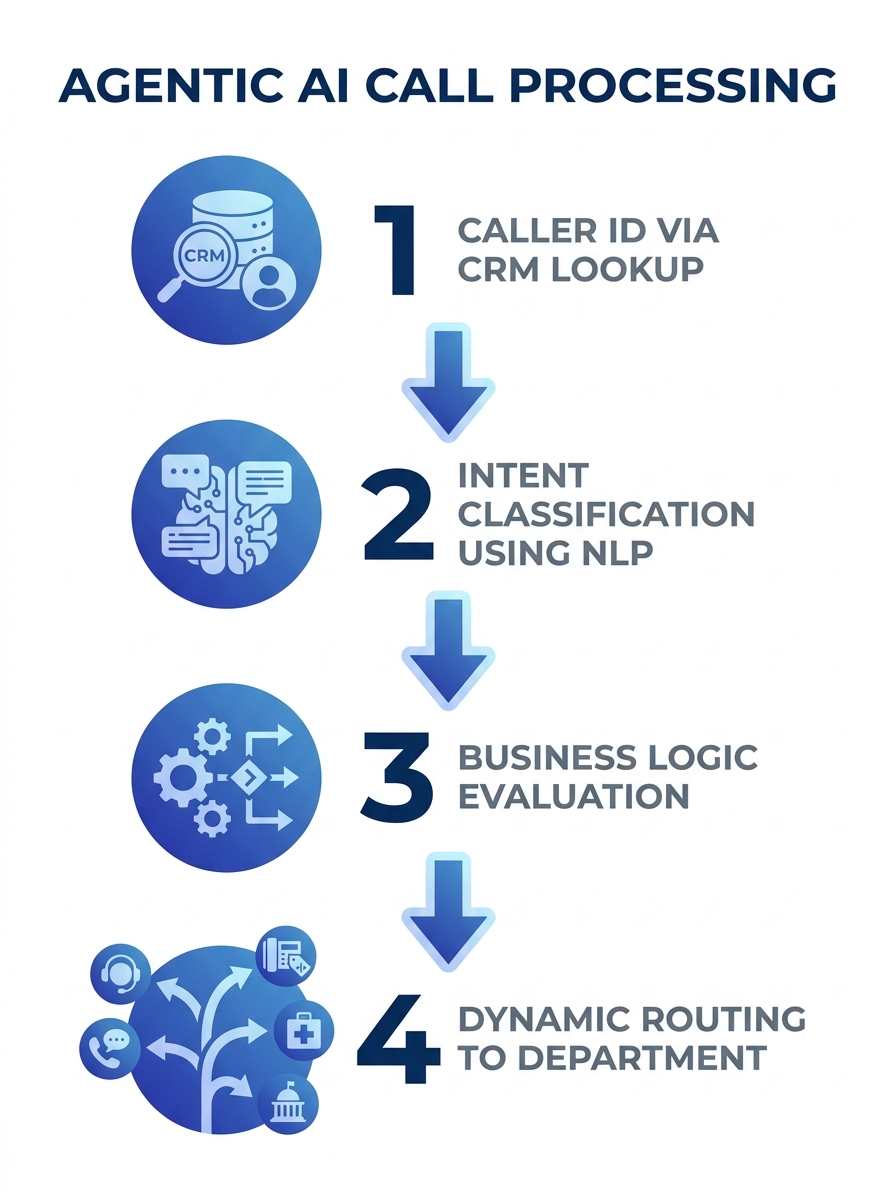
On February 24, 2026, 3CX released V20 Update 8 Final, and the headline feature is what they call Agentic AI. This goes beyond the basic AI transcription and sentiment analysis that most contact center platforms have offered since 2024. Agentic AI enables autonomous multi-step workflows: call screening, real-time business-logic application, knowledge retrieval, and dynamic routing decisions, all without a human operator in the loop.
Three features stand out for Philippine BPO operations:
- AI Call Screening works across Windows, Android, iOS, and web clients. The AI agent identifies the caller, determines intent, and makes a routing decision before a human agent picks up.
- AI Receptionist now pulls caller context from CRM integrations (Google Workspace, Microsoft 365), supports multi-language responses, and routes calls with department-aware logic. For a BPO handling a U.S. healthcare account and an Australian retail account on the same floor, this kind of contextual awareness matters.
- AI Personal Assistant (PA) manages executive-level calls by enforcing availability rules and trusted caller lists, useful for team leads and operations managers who are constantly in meetings.
The update also introduced on-premise and private cloud transcription using OpenAI’s gpt-5-mini as the default model. That’s a data sovereignty play. Philippine BPOs serving regulated industries in the U.S. (HIPAA), EU (GDPR), and Australia need transcription that doesn’t route audio through third-party cloud endpoints. Running it on-premise solves that.
If your operation runs on 3CX, this update is worth evaluating immediately. If you’re on Yeastar P-Series or another PBX platform, the feature set gives you a benchmark for what to demand from your vendor.
How Intelligent Call Routing Actually Works
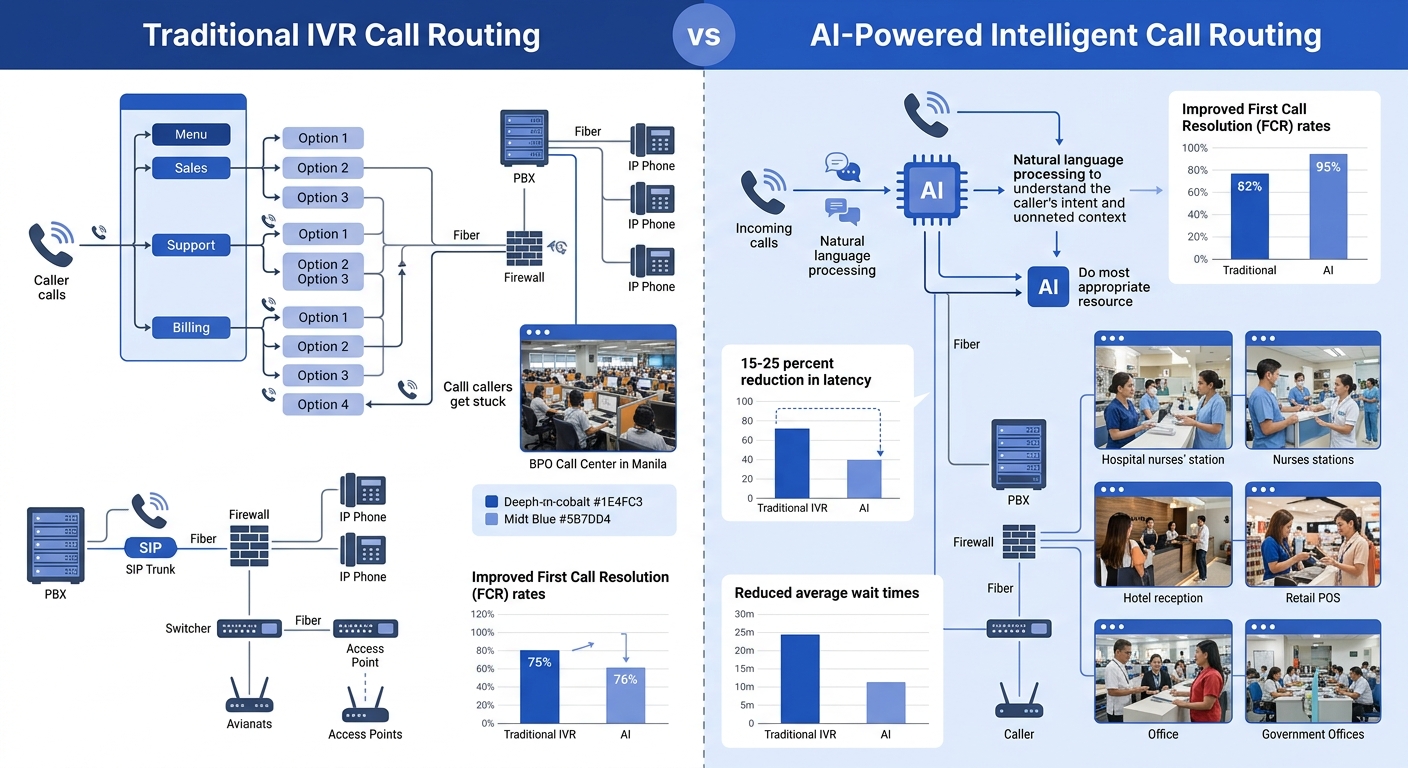
Intelligent call routing (ICR) replaces the old touch-tone IVR tree with real-time analysis. Verint defines it as technology that automatically directs incoming calls to the most suitable agent or resource based on various data points and predefined rules.
The “various data points” part is where AI-powered VoIP diverges from traditional ACD (automatic call distribution). A conventional ACD routes based on queue position and agent availability. An AI-driven system adds layers:
- Caller intent, extracted from natural language input. Landis Technologies, for example, builds AI classification blocks directly into their IVR designer, letting callers say “I need to update my shipping address” instead of navigating a menu tree.
- Historical interaction data, including previous call topics, resolution outcomes, and the specific agent who handled the last interaction.
- Sentiment analysis in real time, which can escalate a frustrated caller to a senior agent before the conversation deteriorates.
- Agent skill matching, factoring in language proficiency, product knowledge, and current cognitive load based on how many calls the agent has handled in the last hour.
A 2025 systematic literature review published through ACM found that machine-learning-based network traffic prediction models reduce VoIP latency by 15–25% through optimized routing. That’s a network-layer improvement, but it compounds with application-layer intelligent routing. When both your network paths and your agent assignments are being optimized simultaneously, the reduction in average handle time becomes significant.
The practical effect, as Talkdesk documents in their Navigator product overview, is that AI routing reduces wait times, improves first contact resolution (FCR), and increases customer satisfaction by connecting inquiries to the right resource on the first try.
Philippine BPO Adoption by the Numbers
The Philippine BPO sector generated $35.5 billion in revenue in 2024 and employs roughly 1.7 million Filipinos. The industry’s competitive advantage has historically been labor cost and English proficiency. That dynamic is shifting.
IBPAP’s data showing 85% expected AI adoption by end of 2026 tells one story. The qualitative data tells another. BPO employees interviewed by Rest of World said AI co-pilots made them more efficient. The programs recognize what’s being said, pull up customer history, and suggest solutions and follow-up questions in real time. Agents who spoke to Fortune agreed the technology makes them faster but said it “isn’t ready to replace them.”
Gartner projects that by 2026, one in ten agent interactions will be fully automated, with AI handling up to 70% of routine inquiries. The remaining 30% involves complex complaints, emotional conversations, and multi-system troubleshooting that still require human judgment. Philippine BPOs that implement intelligent call routing well will route that 70% away from human agents entirely, freeing their workforce for the interactions that actually require skill and empathy.
The industry is shifting from a labor-cost advantage model to what analysts call Intelligence Arbitrage, where value comes from AI-augmented human expertise rather than cheap seats.
Teleperformance Philippines recognized this early. They launched the TP AI Academy to train agents in AI fundamentals and data analytics, creating new job titles like “AI Conversation Supervisor” and “Emotional Resolution Specialist.” The conversational AI industry as a whole claims $80 billion in projected global contact center labor cost reduction by the end of 2026, a figure that includes competing BPO markets in India, Eastern Europe, and Latin America.
For companies evaluating whether to adopt cloud-based telephony platforms, these numbers sharpen the urgency. A contact center running on legacy on-premise PBX hardware can’t plug into AI routing APIs without significant middleware investment. Cloud and hybrid platforms built on open standards give you that integration path natively.
New Clark City and the Infrastructure Equation
This week’s announcement that New Clark City in Tarlac will become a 4,000-acre AI hub under the US-led Pax Silica initiative has real infrastructure implications for BPO operations outside Metro Manila. The zone is designed for AI and advanced manufacturing, which means high-density fiber, redundant power, and data center capacity, exactly the infrastructure that contact center automation demands.
Philippine telecommunications outside Metro Manila and Cebu has historically suffered from inconsistent bandwidth and power reliability. If you’ve ever troubleshot network congestion at a provincial BPO site, you know that AI-powered VoIP features mean nothing when your trunk lines can’t sustain consistent QoS. New Clark City’s buildout could change that equation for operations in Central Luzon.
The timing is relevant. Lgorithm Solutions, a local provider, is already pushing cloud-first AI VoIP platforms with predictive dialing, real-time voice analytics, and intelligent call routing based on agent skills, language, and historical interactions. These features demand stable, low-latency connections. Government infrastructure investment and private-sector AI adoption are converging in ways that didn’t exist even 18 months ago.
What Implementation Looks Like at 200–500 Seats
For a mid-size Philippine BPO, implementing intelligent call routing typically follows this sequence:
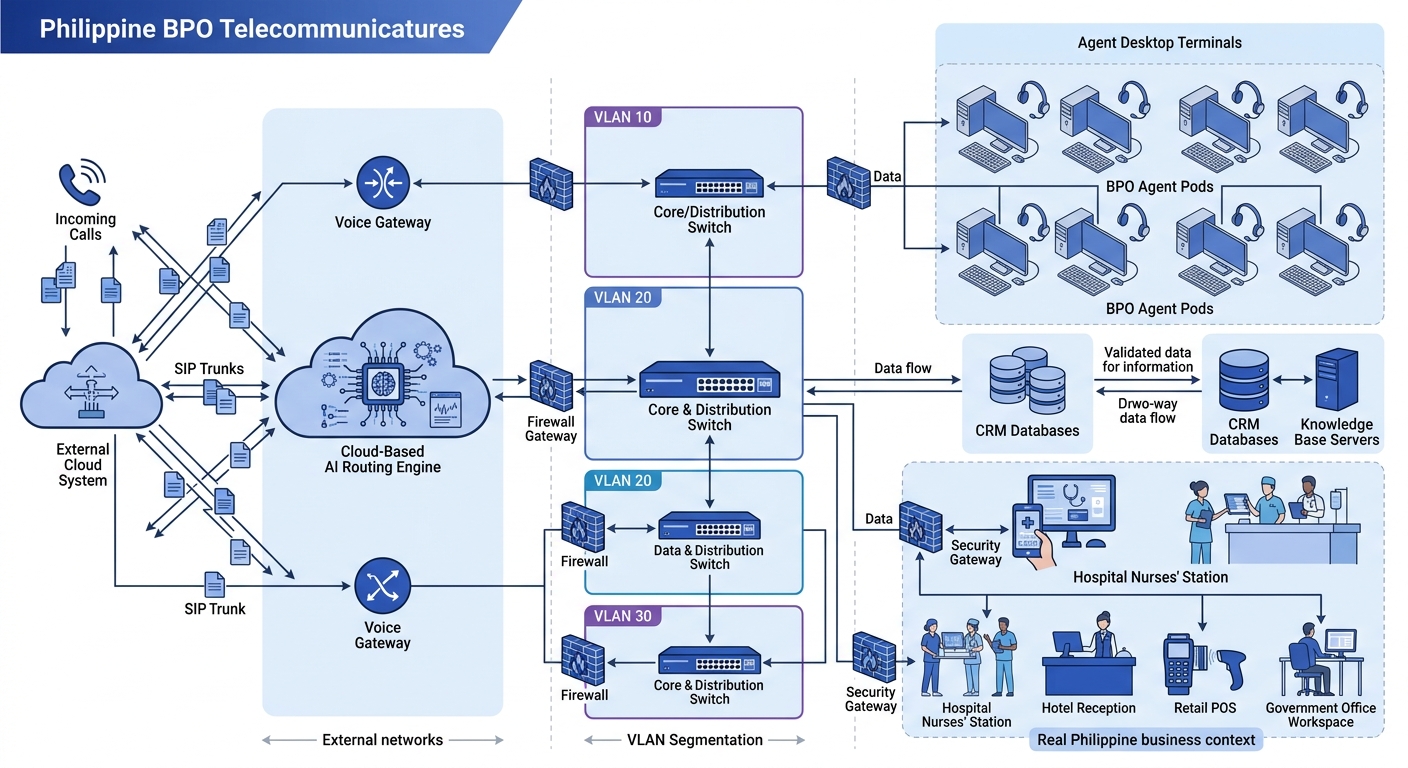
- Audit your current PBX and trunk architecture. If you’re on a proprietary system with no API exposure, you’ll need to migrate or add a SIP gateway layer. Yeastar’s P-Series and 3CX both support REST APIs and webhook integrations that AI routing platforms require.
- Choose your AI routing engine. Some platforms build it in (3CX Agentic AI, Talkdesk Navigator). Others require you to integrate third-party NLP services (Google Dialogflow, Microsoft Azure Bot Service) with your existing PBX via SIP trunking.
- Map your call flows against actual data. Pull three months of CDR (call detail records) and categorize by intent, resolution type, and handle time. This tells you which call types are candidates for full automation and which need skill-based routing to human agents.
- Pilot on a single account or campaign. Don’t roll AI routing across all your client accounts simultaneously. Pick one with high call volume and relatively predictable intent categories. Measure FCR, average handle time, and CSAT scores for 30 days before expanding.
- Address your network layer. AI-powered VoIP features add processing overhead. Real-time sentiment analysis, CRM lookups, and NLP classification all consume bandwidth and introduce latency if your network can’t handle it. The 15–25% latency reduction from ML-optimized routing only materializes if your underlying infrastructure can support it.
Tip: Before deploying AI routing, run a packet capture during peak hours to baseline your jitter, latency, and packet loss. If jitter exceeds 30ms or packet loss tops 1%, fix the network first. The AI features won’t compensate for bad infrastructure.
Organizations already using CRM tools for customer engagement have half the data foundation in place. The CRM becomes the contextual backbone that AI routing queries in real time: caller history, account status, open tickets, preferred language.
And securing your VoIP infrastructure becomes more critical as you add AI endpoints. Every API call between your PBX and an AI service is an attack surface. mTLS, API key rotation, and network segmentation between voice and data VLANs should be non-negotiable.
What the Numbers Still Can’t Answer
The $3.5 billion market projection, the 85% adoption target, the 70% automation threshold: these are aggregate figures. They don’t tell you whether your specific operation, with your specific client contracts, your specific agent skill mix, and your specific NTC compliance requirements, will see a positive ROI from AI-powered call routing within 12 months.
The workforce question remains genuinely unresolved. Filipino call center agents consistently say AI makes them better at their jobs. Whether it also makes fewer of them necessary is a question the current data dances around. IBPAP is bullish on net employment growth. The agents themselves are cautiously optimistic. The answer likely depends on whether Philippine BPO call centers position AI as a tool that lets them handle more volume per seat or as a tool that lets them handle the same volume with fewer seats.
The data available today points clearly in one direction for the technology itself: AI-powered VoIP with intelligent call routing works, it’s getting cheaper, and Philippine-specific infrastructure is catching up. The strategic question each operation needs to answer is whether they’re building toward Intelligence Arbitrage or simply automating their way to thinner margins.