
Yeastar released P-Series PBX version 25.1 on August 18, 2026, adding SMS message delivery and third-party tool invocation capabilities to its AI receptionist platform through Model Context Protocol (MCP) integration, according to the vendor’s release announcement. The update allows AI voice agents to send appointment confirmations, order tracking updates, and service follow-ups directly during customer calls without manual intervention, while the MCP framework enables secure connections to external CRM, ERP, and inventory systems.
TL;DR: Yeastar’s P-Series V25.1 equips AI receptionists with automated SMS sending and secure third-party tool access via Model Context Protocol, enabling end-to-end business automation for appointment booking, order confirmation, and customer service workflows.
The general availability release follows alpha and beta testing cycles and targets businesses seeking to automate customer engagement touchpoints across voice and text channels. Philippine enterprises deploying Yeastar PBX systems can now configure AI agents to handle multi-step workflows—such as scheduling a service appointment, confirming details via SMS, and updating a calendar system—within a single phone interaction.
AI Receptionist Gains SMS and Tool Integration
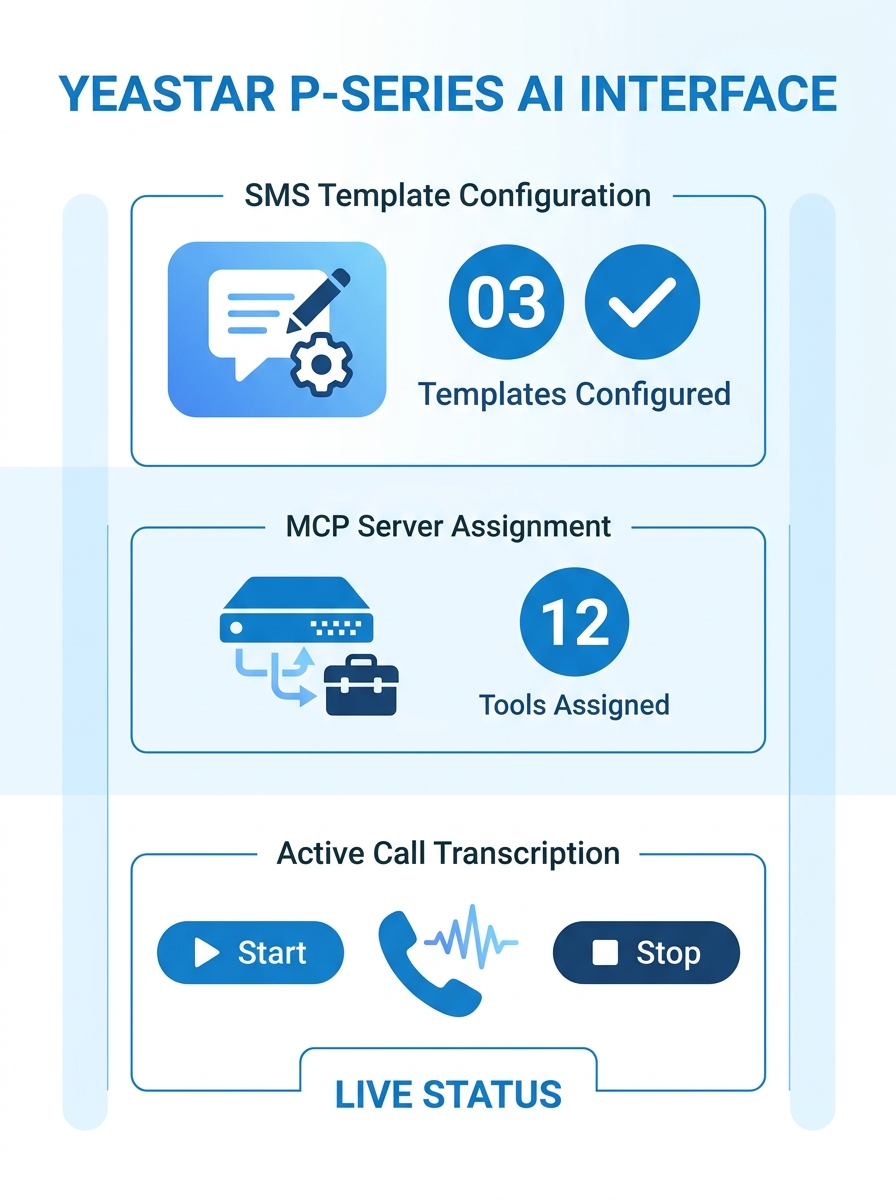
The AI receptionist SMS feature detects predefined trigger conditions during live calls and automatically invokes the PBX SMS API to send text confirmations. The system extracts customer details such as name, appointment time, address, and phone number directly from the conversation and populates variables in pre-built or custom SMS templates. Yeastar provides official templates for appointment confirmations, order tracking, product information requests, and support tickets, with each virtual agent supporting up to 10 custom sending rules.
For BPO call centers handling high-volume customer inquiries, the SMS confirmation capability reduces follow-up call volume by delivering instant written confirmation of service requests or scheduled callbacks. Hospital communication systems can use the feature to send appointment reminders, prescription pickup notifications, or test result availability alerts immediately after a patient call concludes.
Model Context Protocol integration introduces a gateway layer between AI receptionists and external business tools. Administrators register MCP servers, import tool bundles, define execution rules, and assign specific tools to designated AI receptionists with granular permission controls. During calls, AI agents invoke authorized tools—such as checking inventory availability in an ERP system or updating a customer record in a CRM platform—and receive results that inform the conversation flow. All tool invocations, execution times, results, and exceptions are logged to the call detail record for enterprise audit and troubleshooting purposes.
The MCP approach addresses security concerns in direct API integration by centralizing access control and eliminating the need to expose third-party credentials to the AI layer. A single AI receptionist can invoke tools from multiple vendors, enabling workflows that span CRM lookups, inventory checks, and calendar updates within the same call. As a standardized protocol, MCP allows businesses to import out-of-the-box third-party service integrations without internal development resources.
Direct Chat Links and Transcription Controls
P-Series V25.1 generates shareable live chat URLs that enable customers to initiate web chat or voice calls with a single click, eliminating website navigation steps. Businesses can embed these URLs in email signatures, sales outreach messages, or marketing campaign materials to convert every outbound touchpoint into an active communication channel. The feature extends live chat deployment beyond embedded website widgets to any channel where a hyperlink can be shared.
For hotel telephony solutions, direct chat URLs embedded in booking confirmation emails or reservation follow-ups allow guests to reach front desk staff or concierge services instantly without searching for contact information on a property website.
The automatic call transcription control update introduces multi-dimensional configuration rules based on call direction—internal, inbound, or outbound—and target entity, including extensions, trunks, and ring groups. Administrators can configure transcription policies to ensure compliance-critical conversations in sectors such as healthcare and legal services are reliably captured. Agents can dial a feature code (*09 by default) to start transcription during an active call for hands-free record creation.
The release note documentation is available separately for Cloud Edition, Appliance Edition, and Software Edition deployments. Yeastar positions the update as addressing friction points in customer engagement workflows where manual steps such as follow-up SMS sending or CRM data entry delay service completion and increase operational costs. The vendor states that businesses with high appointment-booking volumes or order-confirmation requirements see the most immediate impact from automated SMS delivery.
What This Means for IT Managers
Philippine enterprises evaluating unified communications platforms now have access to AI-driven automation capabilities that previously required custom development or third-party integration services. The combination of SMS automation and MCP tool invocation addresses a documented gap in customer engagement: Filipino Cloud PBX provider Telavi reports that 30% of business calls go unanswered, costing retailers up to ₱1 million monthly. Automated SMS confirmations reduce dependency on live agent availability by ensuring customers receive service acknowledgment even when initial contact attempts fail.
For organizations already running Yeastar P-Series deployments, the V25.1 upgrade path involves reviewing existing call flow scripts to identify automation candidates—appointment scheduling, order status inquiries, and service ticket creation are the highest-value targets. IT teams should inventory existing CRM, ERP, and calendar systems to determine MCP server integration requirements, particularly if those systems expose REST APIs or database connections that can be wrapped in MCP-compliant tool definitions.
Security-conscious deployments should note that MCP integration introduces a new attack surface through third-party tool connections. Administrator permission controls for tool assignment and CDR logging of all invocations provide audit trails, but organizations must still validate that MCP server implementations follow secure credential handling and input validation practices. The protocol’s design as a gateway layer reduces risk compared to direct API key exposure, but misconfigured tool permissions can still grant AI agents unintended access to sensitive business data.