
SIP-based IP telephony scales by adding user licenses, endpoint registrations, and trunk channels to existing infrastructure. The system’s growth ceiling depends on three measurable capacity gates (trunk count, concurrent sessions, and network quality), and understanding these gates explains why Philippine enterprises add 500 users on the same platform that started with 50.
TL;DR: IP telephony scalability works through session-based architecture where each call is a discrete signaling and media event. Growth means expanding trunk capacity, session limits, and network bandwidth in parallel. Philippine enterprises that plan around all three gates add hundreds of users without replacing hardware.
Session-Based Architecture: The Growth Mechanism
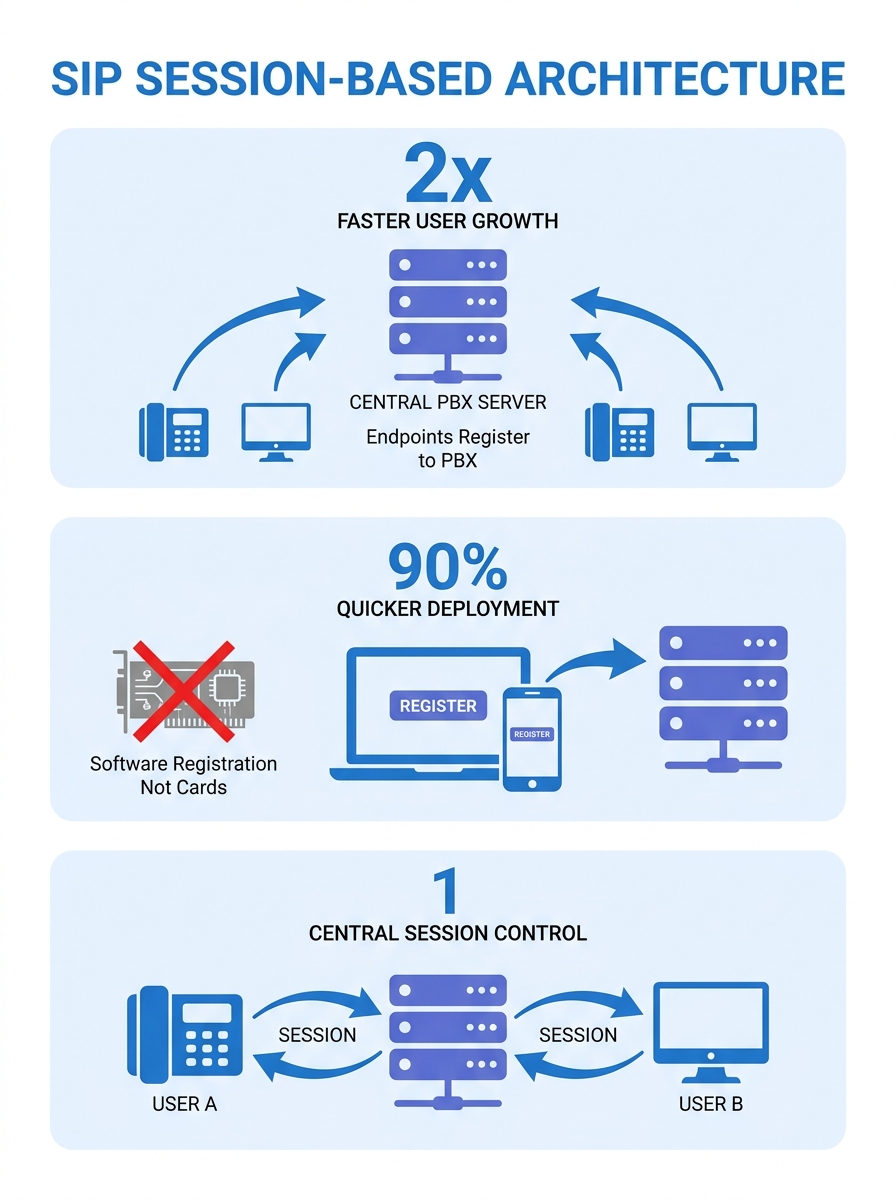
IP telephony treats every call as an independent session with its own signaling channel (SIP, defined by RFC 3261) and its own media stream (RTP). This is the core architectural difference from legacy TDM-based PBX systems, where each call occupied a dedicated physical circuit on a time-division multiplexing card. When you add a user to a SIP-based system, you’re registering a new endpoint and allocating license capacity. No circuit board. No rewiring.
As Mitel describes in their enterprise voice architecture guide, “IP telephony addresses these needs as an extensible, programmable, and observable component of the modern infrastructure stack.” That extensibility comes from the session model: since SIP sessions are software-defined, the PBX allocates them dynamically from a pool. A 200-user Yeastar P-Series deployment and a 10,000-user Cisco Unified CM cluster both follow the same principle. The difference is how large the session pool is and how much processing power backs it.
For Philippine enterprises seeing enterprise phone system growth from 50 to 300 seats over two or three years, the session model means the same server hardware (or cloud instance) handles the expanded user base as long as the concurrent session ceiling isn’t breached. A company with 300 registered extensions where peak simultaneous calls never exceed 60 needs a platform rated for 60+ concurrent sessions, not one rated for 300. That distinction matters for budgeting. You can explore the technical underpinning of this architecture in our comparison of enterprise-grade IP telephony systems versus consumer VoIP.
Three Capacity Gates That Control How Far You Can Scale
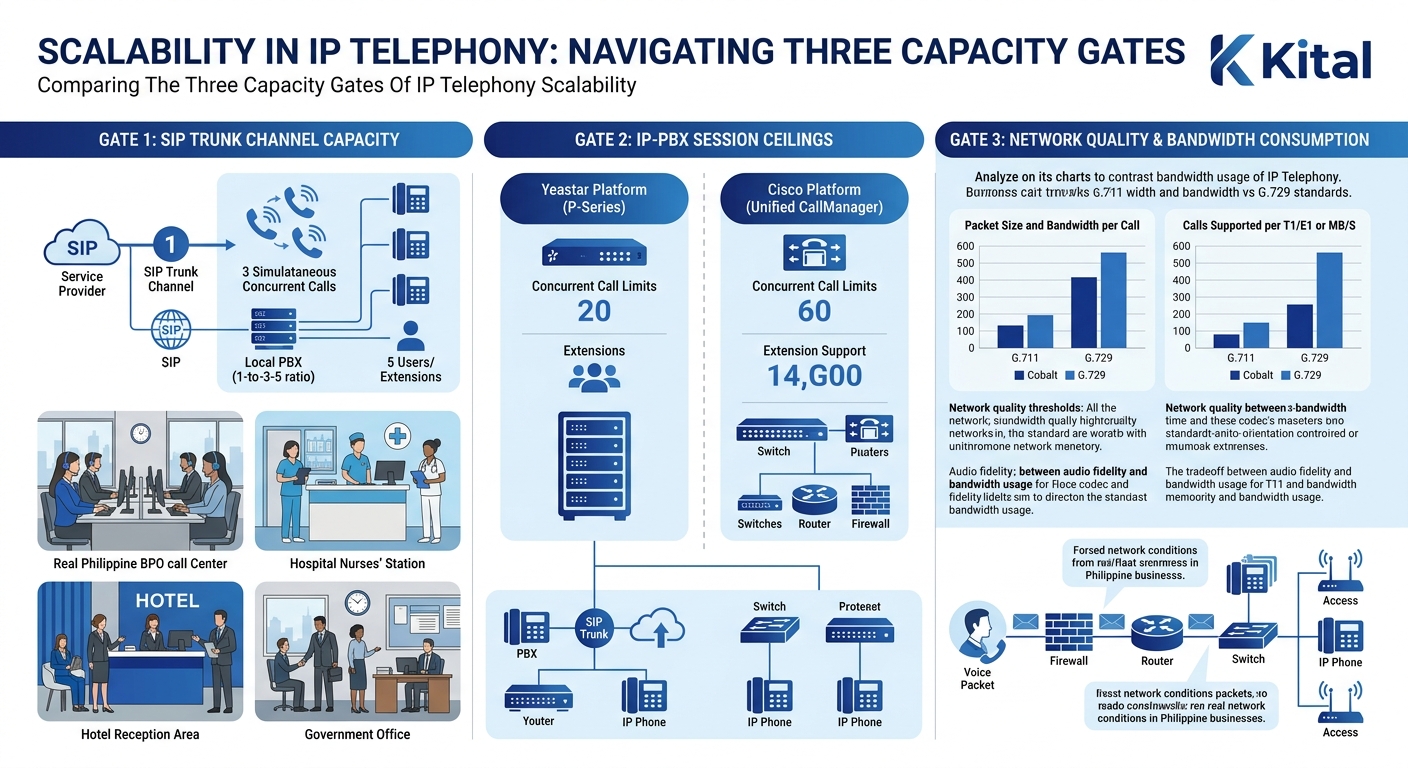
Why does IP telephony scalability have a ceiling at all? Because three independent constraints limit growth, and the lowest one determines your actual maximum. PBX capacity planning requires measuring all three simultaneously.
Gate 1: SIP Trunk Channels. Every external call (inbound or outbound to the PSTN) consumes one SIP trunk channel. A Philippine enterprise with 20 SIP trunk channels from PLDT or Globe can handle 20 simultaneous external calls. Adding 100 new users doesn’t help if trunk capacity stays at 20 while peak external call volume exceeds that number. The standard planning ratio is 1 trunk channel per 3 to 5 users, depending on call patterns. A PBX capacity planning guide from TelecomWorld101 recommends regularly reviewing and adjusting trunk allocations as the user base grows, with specific attention to concurrent call ceilings.
Gate 2: PBX Session Ceiling. The PBX itself has a maximum concurrent session count determined by CPU, memory, and licensing tier. Yeastar’s P-Series Enterprise tops out around 500 concurrent calls. Cisco Unified CM clusters handle over 40,000 registered devices per cluster. VitalPBX notes that “a scalable system should allow for easy and affordable expansion of user capacity,” and per-user licensing fees are where many enterprises hit friction during growth phases. A 1,000-seat deployment on a commercial platform (Cisco, Mitel, or Avaya) can run P500 to P2,500 per seat per month depending on the feature tier, translating to P500,000 to P2.5 million in recurring monthly cost.
Gate 3: Network Throughput and Quality. Each concurrent G.711 call consumes approximately 87 kbps of bandwidth with IP overhead. G.729 compresses that to roughly 32 kbps. A 300-seat call center with 60 simultaneous calls on G.729 needs about 2.4 Mbps of dedicated voice bandwidth; the same scenario on G.711 requires 19.2 Mbps. The real constraint for Philippine deployments isn’t raw bandwidth (100 Mbps fiber circuits are common in Metro Manila). The constraint is quality: packet loss must stay below 1% and jitter below 30 ms for acceptable call clarity. Our guide to codec selection for bandwidth-constrained Philippine networks covers the tradeoffs between these codecs in detail.
How User Provisioning Works at Scale in the Philippines
User provisioning for Philippines-based enterprises at 50 seats looks very different from provisioning at 500 seats. The mechanism itself is straightforward: you create a user account on the PBX, assign an extension number, configure call routing rules, and bind the account to a physical desk phone or softclient. The gap between small-scale and large-scale provisioning is automation.
AVOXI’s documentation on phone provisioning describes manual provisioning as “slow, error-prone, and difficult to scale.” At 50 users, an IT administrator can configure each extension individually in an afternoon. At 500 users across five branch offices, manual provisioning creates bottlenecks that delay onboarding by days.
Modern PBX platforms address this through auto-provisioning protocols (Yeastar supports zero-touch deployment for Fanvil and other SIP phones) and directory integration. Dialpad’s enterprise platform describes the target state: fast user provisioning through SCIM and SAML integrations that sync accounts from Active Directory or Google Workspace directly into the phone system. When HR creates an employee record, the PBX automatically provisions an extension, assigns a DID number, and pushes configuration to the user’s device. When someone leaves, deprovisioning removes their extension and reclaims the license.
For BPO call centers that onboard 100+ agents per month during peak season, automated provisioning is where IP telephony scalability becomes operationally visible. The PBX capacity exists. The trunk channels exist. The bottleneck shifts entirely to how fast you can get endpoints registered and configured. Enterprises that still provision manually at this scale lose 2 to 4 hours per batch of 20 users, compared to automated workflows that complete the same batch in minutes.
Tip: If your PBX supports SCIM-based provisioning, connect it to your identity provider (Azure AD, Google Workspace, Okta) before you cross 100 users. Retrofitting automated provisioning during a rapid expansion is significantly harder than setting it up in advance.
VLAN Segmentation and QoS as Growth Infrastructure
Adding 200 users to a flat network without voice traffic isolation will degrade call quality for everyone, including the original 50 users. The mechanism that prevents this degradation is VLAN segmentation combined with QoS policy enforcement.
Voice endpoints sit on a dedicated VLAN (commonly VLAN 100 or a similar designation), isolated from data traffic. This separation prevents broadcast storms and large file transfers from competing with voice packets, and it lets switches and routers apply differentiated QoS policies. DSCP 46 (Expedited Forwarding) marking on voice packets, combined with Low Latency Queuing at the WAN edge, ensures voice traffic gets processed first even when data traffic saturates the link. We’ve covered step-by-step QoS configuration for VoIP on Philippine enterprise networks in a separate guide.
The scalability implication: every new user’s phone joins the voice VLAN and inherits QoS policies automatically. The network doesn’t need reconfiguration per user. It needs reconfiguration per capacity tier. When you jump from 100 to 250 concurrent endpoints, you may need to upgrade switch uplinks from 1 Gbps to 10 Gbps, add access-layer switches, or provision additional PoE capacity. But the VLAN and QoS architecture stays intact.
This is where network cabling infrastructure becomes a scalability factor that IT teams underestimate. A properly designed Cat6A horizontal cabling plant supports 10 Gbps per run and PoE+ for IP phones. An older Cat5e installation limits you to 1 Gbps and restricts PoE budgets. The cabling doesn’t change the PBX software’s ability to register users, but it gates how many powered endpoints you can physically connect per floor or per IDF closet.
The real scalability constraint in Philippine IP telephony deployments is provincial link quality, not PBX software capacity. A single WAN circuit with high packet loss degrades every call that touches it, regardless of how many users the platform supports on paper.
Hybrid and Cloud PBX Models for Philippine Multi-Site Deployments
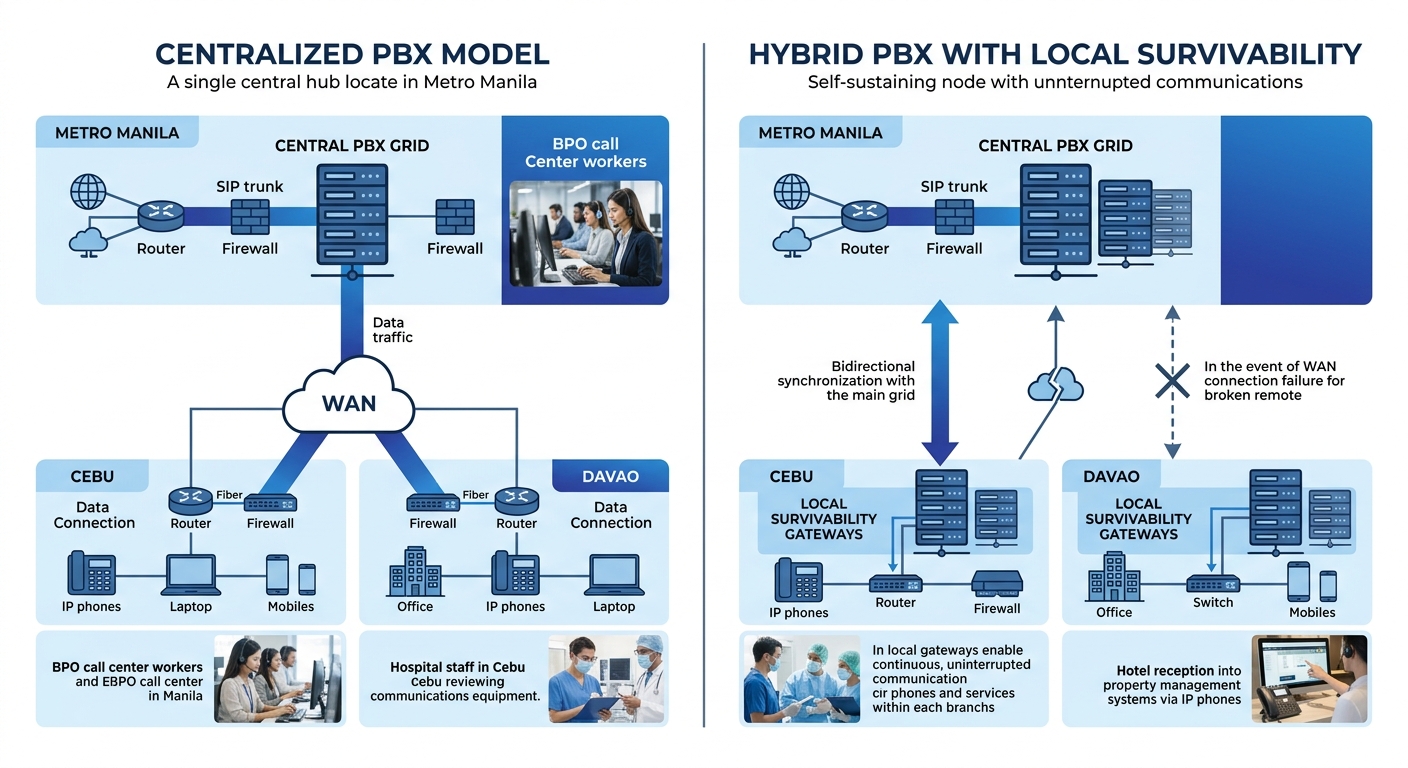
Philippine enterprises with branches in Metro Manila, Cebu, and Davao face a specific scalability question: centralized or distributed PBX deployment? The mechanism behind each model determines how adding users at a remote site works in practice.
A centralized model runs one PBX (on-premise or cloud-hosted) with all endpoints registering over WAN links. Adding a user in Davao means provisioning an extension on the Manila PBX and connecting a SIP phone over the Davao office’s internet circuit. The advantage is a single point of management. The disadvantage is that every call at the Davao office depends on WAN stability. If the link drops, Davao loses phone service entirely.
A distributed model places a local PBX or survivability gateway at each site. Calls within Davao stay local. Inter-site calls traverse the WAN. Adding users at Davao means provisioning on the local appliance. The global VoIP market, growing at a 10.8% compound annual growth rate according to industry analysis cited by PanTerra Networks, is increasingly gravitating toward hybrid architectures that combine cloud management with local survivability nodes.
Singapore-based Velox Networks entered the Philippine market in April 2026, marking its third Southeast Asian market after Singapore and Malaysia. The timing aligns with the Philippines’ ongoing telecom reforms and growing demand for cloud-hosted telephony that doesn’t require on-premise hardware at every branch. For enterprises evaluating this model, a case study worth reviewing is how a Philippine regional bank consolidated 18 branch PBX systems into a hybrid UC platform and achieved 99.99% uptime.
The hybrid approach matters because provincial internet circuits in the Philippines deliver measurably different quality than Metro Manila fiber. A Visayas branch office on a 20 Mbps DSL connection with 3% packet loss will produce poor call quality on a purely centralized cloud PBX. A local survivability appliance keeps internal calls functional even when the WAN degrades, which is the same principle that drives unified communications architecture for Philippine government agencies.
Where the Model Breaks
Session-based IP telephony scalability has three failure modes that no amount of trunk capacity or QoS policy can fix.
Licensing economics at scale. Open-source platforms like FreePBX or VitalPBX eliminate per-user fees but shift costs to in-house engineering talent for maintenance, security patching, and integration work. Commercial platforms offer polish and support contracts but make each incremental user financially heavier. The technical capacity to add users is effectively unlimited; the financial model makes each addition progressively more expensive. Enterprises need to model their 3-year licensing cost at projected headcount before committing to a platform.
Network underlay quality at remote sites. The three-gate model assumes each gate can be independently expanded. In practice, a Mindanao branch office served by a single ISP with no failover circuit creates a hard ceiling. You can provision 200 extensions at that site, but if the circuit supports only 15 concurrent calls before quality degrades, you’ve hit a wall that PBX configuration cannot resolve.
Management complexity. At 2,000+ users across 10+ sites, the operational burden of maintaining dial plans, call routing rules, hunt groups, and user permissions grows non-linearly. Automated provisioning handles user creation, but policy management (who can make international calls, which ring groups activate after hours, how failover routes are prioritized) still requires deliberate architecture. Enterprises at this scale need a UC platform with centralized policy management, which is where the technical choice between standalone PBX and full unified communications becomes a genuine operational decision.
The mechanism works. SIP sessions, trunk channels, and QoS policies scale predictably when all three gates are monitored and expanded together. The breaks happen when one gate stays fixed while the others grow, when provincial WAN circuits lag behind Manila-grade fiber, or when licensing economics outpace the budget faster than headcount justifies the spend.