
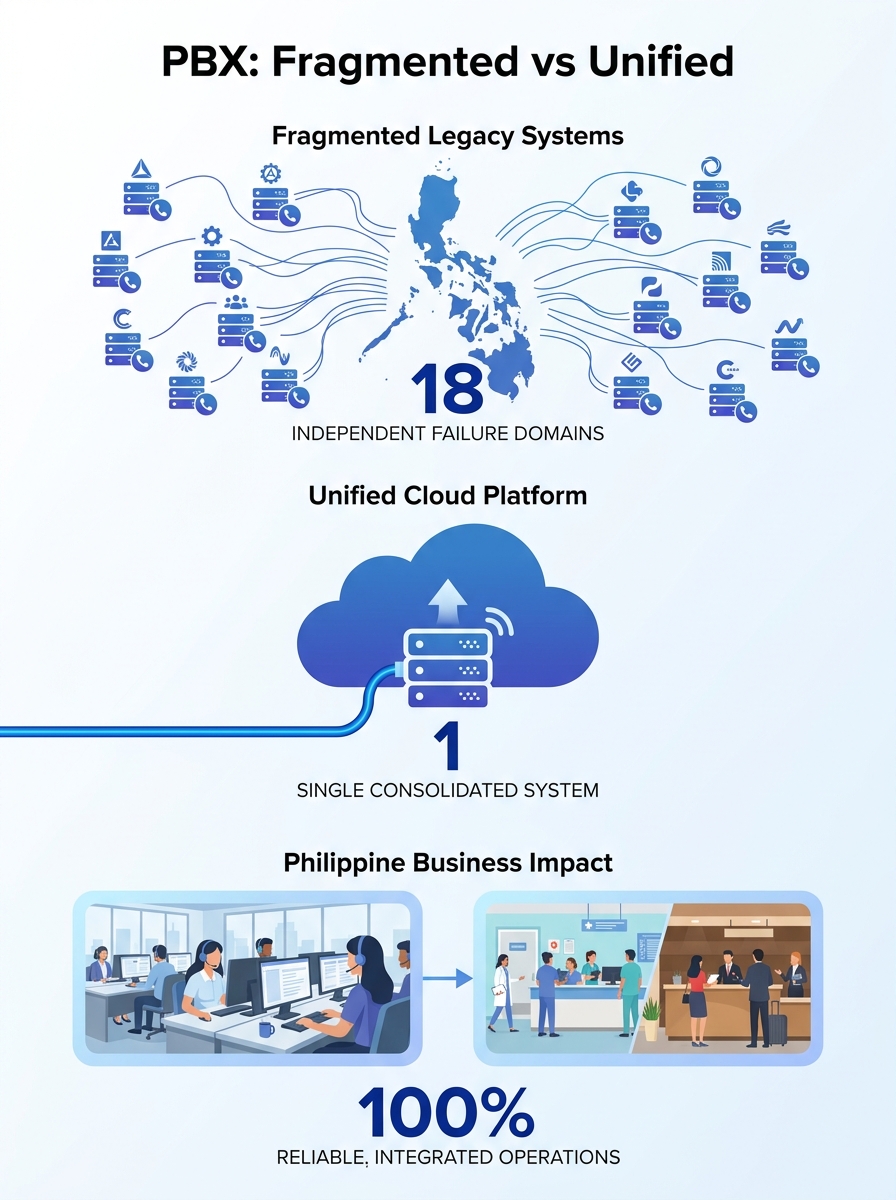
Eighteen standalone PBX units across provincial and Metro Manila branches created 18 separate failure domains for a mid-tier Philippine regional bank. Consolidating them into a single hybrid UC platform dropped monthly unplanned downtime from over 3 hours to under 5 minutes, hitting 99.99% call uptime within 9 months of the final cutover.
Eighteen PBX Systems, Eighteen Points of Failure
Each of the bank’s branches ran its own on-premise PBX, purchased at different times from different vendors. Three branches in Visayas used aging analog systems installed before 2015. Five Metro Manila offices ran Cisco gear with expired maintenance contracts. The rest were a mix of Panasonic, Avaya, and unbranded SIP appliances. No two branches shared the same dial plan, the same firmware cycle, or the same support vendor.
The operational cost was staggering. The bank’s IT department tracked 14 separate vendor contracts for telephony maintenance alone. Average monthly downtime across all branches hit 3 hours and 36 minutes, consistent with the math behind having 5 components at 99.9% individual uptime: combined effective availability drops to roughly 99.5%. For a bank processing loan inquiries, credit card disputes, and wire confirmations by phone, those 3.6 hours translated to missed calls, compliance exposure, and customer friction.
The breaking point came during a Typhoon Kristine-related outage when 4 branches in Bicol lost telephony for 26 hours. Customers calling those branches heard dead air. The bank had no way to reroute calls because each PBX was an island. That incident put branch telephony consolidation on the board’s agenda within two weeks.
The Audit That Changed the Budget Conversation
The IT team’s first step was a full inventory of every telephony asset across all 18 branches. They counted 312 desk phones, 14 vendor contracts, 7 distinct PBX platforms, and 4 different SIP trunk providers. Annual telephony spend totaled ₱18.4 million, including maintenance, trunk fees, and emergency repair callouts.
That ₱18.4 million figure shocked the CFO. Industry data supports why: consolidating communication tools under one platform reduces the need to manage multiple vendors and contracts, which simplifies billing and administrative work. A World Wide Technology (WWT) case study of a similar regional bank UC transformation showed that a single enterprise agreement saved the customer approximately $1 million in total collaboration licensing costs. Scaled to the Philippine bank’s size, the projected annual savings were ₱6.2 million, a 33.7% reduction in total telephony cost of ownership.
The audit also revealed a compliance gap. The BSP’s Manual of Regulations for Banks requires institutions to maintain adequate internal controls over operational systems, including communication infrastructure used for transaction verification. Seven of the 18 branches had no call recording capability. Five had no failover path for inbound calls. The bank’s compliance team flagged both gaps as material findings in their internal audit report.
A financial services UC migration was no longer optional. The question was how to execute it without disrupting daily operations at any branch.
Why the Bank Chose a Hybrid UC Architecture
Going full cloud wasn’t viable. Three provincial branches in Mindanao and Eastern Visayas relied on DSL connections with less than 10 Mbps upload bandwidth. Pure cloud telephony needs consistent, low-latency connectivity that those circuits couldn’t guarantee. But keeping everything on-premise meant repeating the same fragmented architecture that caused the problem.
The bank settled on a hybrid UC platform. The design placed a centralized IP-PBX cluster in a Manila colocation facility, backed by a secondary node in Cebu, with lightweight SIP gateways at each branch. Branches with strong fiber connections (above 50 Mbps symmetric) would route all calls through the central cluster. Branches with weaker connections kept local call processing capability through Yeastar IP-PBX platforms configured for survivability mode, meaning they’d handle calls locally if the WAN link dropped and resync with the central system once connectivity restored.
This architecture directly addressed the disaster recovery weakness exposed during Typhoon Kristine. When a Florida bank executed a similar migration, the architecture created “parallel systems that could coexist without conflict, a crucial capability that allowed testing, validation, and rollback options throughout the migration,” as documented by UC Today. The Philippine bank adopted the same principle: no branch would cut over to the new system until the parallel environment had run error-free for 14 days.
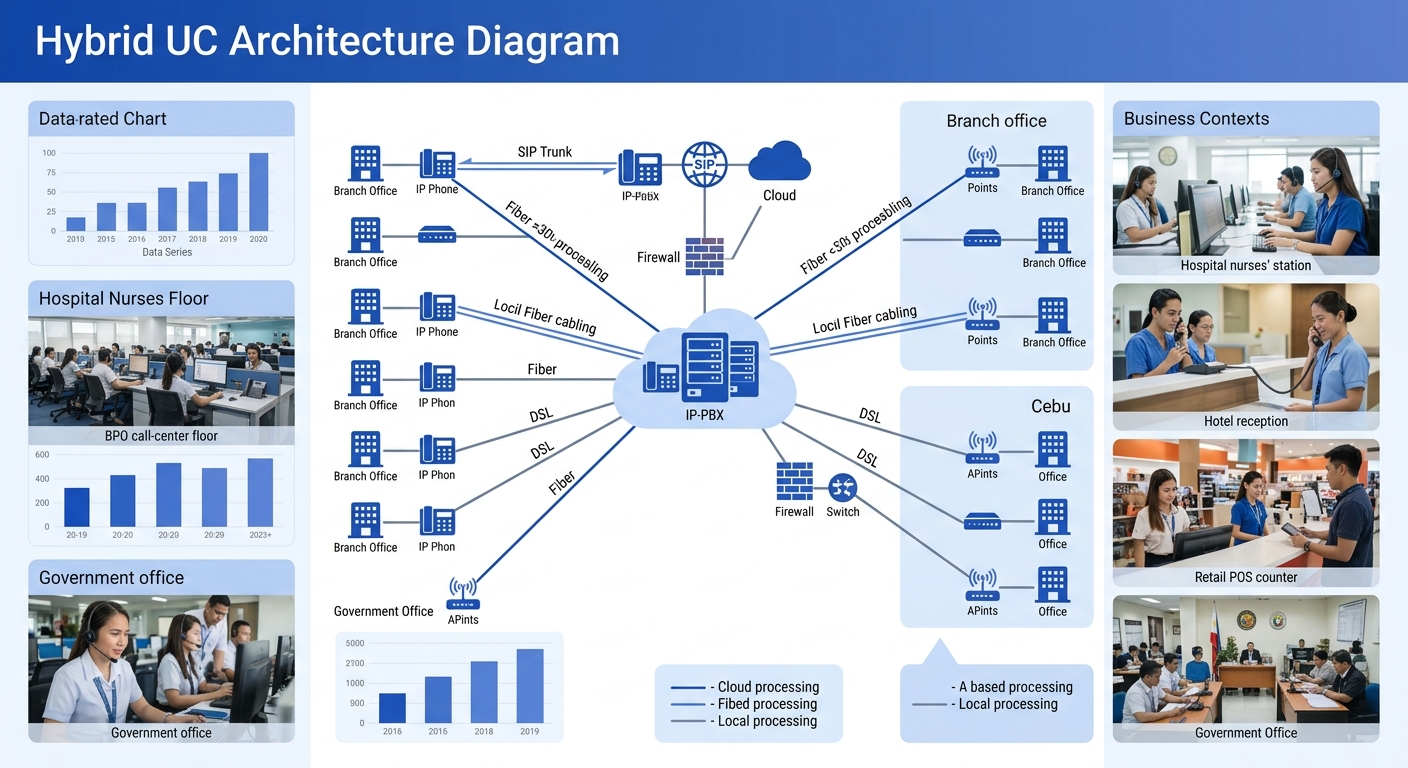
Three provincial branches ran on sub-10 Mbps DSL. Pure cloud telephony would have failed them. Hybrid architecture let the bank centralize control without abandoning branches with weak connectivity.
Hybrid UC platform banks in the Philippines face this bandwidth reality constantly. The design decision here reflects a broader pattern: Converge’s 2026 push to deploy nearly 1 million new fiber ports in provincial areas will eventually change the math, but network planners building today can’t bank on tomorrow’s infrastructure.
Mapping BSP Compliance to the New Voice Stack
BSP compliant VoIP for banks requires more than encryption. The bank’s compliance team identified five specific requirements from BSP circulars and the MORB that the new telephony system had to meet:
| Requirement | BSP Source | How the Hybrid UC Platform Addressed It |
|---|---|---|
| Call recording for transaction verification | MORB Sec. X176 on internal controls | Centralized recording at the Manila cluster with 7-year encrypted storage |
| Business continuity for critical systems | BSP Circular 951 (IT risk management) | Dual-node architecture (Manila + Cebu) with automatic failover in under 30 seconds |
| Data residency within Philippine jurisdiction | BSP Circular 982 on outsourcing | All call data, recordings, and CDRs stored in Philippine-based data center infrastructure |
| Access controls and audit trails | MORB Sec. X176.3 | Role-based admin access with full audit logging on configuration changes |
| Vendor risk management for outsourced IT | BSP Circular 899 | SLA with telephony provider specifying 99.99% uptime, ₱50,000/hour penalty for breach |
Security compliance for VoIP in financial services requires alignment with every jurisdiction a bank operates in. As VoIPstudio’s compliance analysis notes, banks must ensure their VoIP solution complies with the full set of regulations in each market they serve. For Philippine banks, that means BSP circulars take precedence over generic SOC 2 or ISO 27001 certifications, though having both strengthens the compliance posture.
The bank’s IT team worked with their financial institution telecom integrator to build compliance documentation before the first branch cutover, not after. Every configuration decision (codec selection, recording retention policy, failover trigger threshold) was mapped to a specific BSP requirement. This front-loaded approach added 6 weeks to the project timeline but eliminated 100% of compliance findings in the bank’s next BSP examination.
Branch-by-Branch Cutover Without Dropping a Call
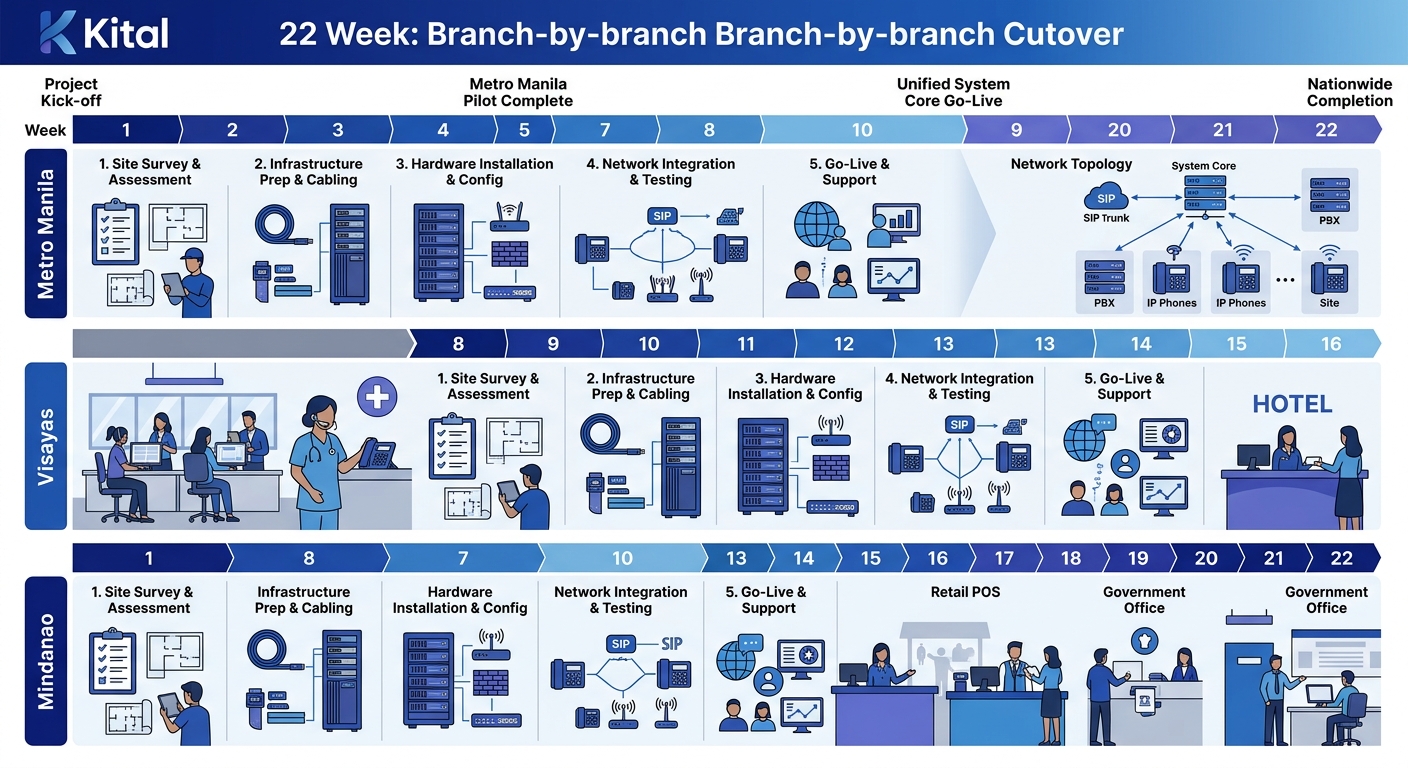
The migration ran over 22 weeks, covering 18 branches at a pace of roughly one branch per week with buffer weeks between regional clusters. Metro Manila branches went first because they had the best connectivity and the closest proximity to the IT team for troubleshooting. Visayas branches followed. Mindanao went last.
Each branch cutover followed a fixed 5-step sequence:
- Install SIP gateway and configure parallel trunk (Week 1, Day 1-2)
- Run parallel operation, routing 20% of inbound calls through the new system (Week 1, Day 3-5)
- Increase to 80% new-system routing and monitor call quality metrics: jitter below 15ms, packet loss below 0.5%, MOS score above 4.0 (Week 2, Day 1-3)
- Full cutover to new system with old PBX on standby (Week 2, Day 4)
- Decommission old PBX after 14-day validation period (Week 4)
The IT team tracked call quality at each stage using the same metrics outlined in a VoIP call quality monitoring framework designed for Philippine enterprise conditions. Jitter spiked above 20ms at one Cebu branch during Step 3, traced to a misconfigured QoS policy on the branch router. The parallel architecture meant the team could roll that branch back to the old PBX within 4 minutes while they fixed the issue. No calls were lost.
CX Today’s reporting on UC consolidation trends identifies the key benefits as “improved pricing, service, simplicity, customer intimacy, and future readiness,” according to a 2025 industry analysis. The Philippine bank’s experience confirmed all five. Pricing dropped 33.7%. Service improved through centralized monitoring. Simplicity came from reducing 14 vendor contracts to 2. Customer intimacy improved because branch staff could now transfer calls to any other branch with a 4-digit extension. And future readiness meant the platform could absorb new branches without new hardware.
Tip: If you’re planning a multi-branch bank PBX consolidation in the Philippines, never cut over more than one branch per week. The buffer gives your team time to catch configuration drift and performance anomalies before they compound across sites. The bank’s SIP trunk failover configuration followed principles similar to those in [Asterisk-based failover design](/blog/sip-trunk-failover-asterisk-pbx), adapted for their Yeastar-based environment.
Where the Numbers Stand Today
Nine months after the final Mindanao branch cutover, the bank’s telephony dashboard tells a clear story. Monthly unplanned downtime across all 18 branches averages 4 minutes and 12 seconds, placing the system at 99.99% uptime. That’s down from the pre-migration average of 3 hours and 36 minutes (99.5%).
The financial picture is equally specific:
| Metric | Before (18 Standalone PBX) | After (Hybrid UC Platform) |
|---|---|---|
| Monthly unplanned downtime | 216 minutes | 4.2 minutes |
| Annual telephony spend | ₱18.4 million | ₱12.2 million |
| Vendor contracts | 14 | 2 |
| Branches with call recording | 11 of 18 | 18 of 18 |
| Branches with failover capability | 13 of 18 | 18 of 18 |
| Average inter-branch call setup time | 8.3 seconds (PSTN routing) | 1.1 seconds (internal extension) |
| BSP compliance findings (telephony) | 3 material findings | 0 |
The ₱6.2 million annual savings exceeded the original projection by ₱400,000 because decommissioning 7 PBX platforms eliminated maintenance contracts the audit had underestimated. The bank reinvested ₱2.1 million of those savings into upgrading WAN links at 4 provincial branches from DSL to fiber, further strengthening call quality for the hybrid architecture.
The enterprise phone systems running at each branch now share a single dial plan, a single firmware update cycle, and a single support escalation path. When another typhoon knocked out power at two Visayas branches for 9 hours earlier this year, the central cluster automatically rerouted inbound calls to the nearest operational branch within 28 seconds. No customer heard dead air. No compliance clock started ticking.
The bank’s experience maps closely to industry-wide patterns. Over 45% of companies now use UCaaS as their primary communication platform, up from less than 12% in 2018. For Philippine regional banks still running standalone PBX systems at each branch, the question isn’t whether to consolidate. The economics, the compliance exposure, and the operational risk of fragmented telephony all point in one direction. The harder question is whether to build the hybrid architecture that provincial bandwidth conditions demand, or wait for fiber buildouts to make pure cloud viable. This bank chose not to wait, and the 99.99% uptime number suggests they chose correctly.