
Cloud VoIP delivers lower five-year total cost of ownership for Philippine enterprises running 50 or more extensions, with savings between 30% and 45% compared to on-premise PBX hardware. Enterprises in provinces with unreliable internet uplinks face a resilience gap that pure cloud deployments can’t close without hybrid failover designs.
What On-Premise PBX Hardware Actually Costs in a Philippine Deployment
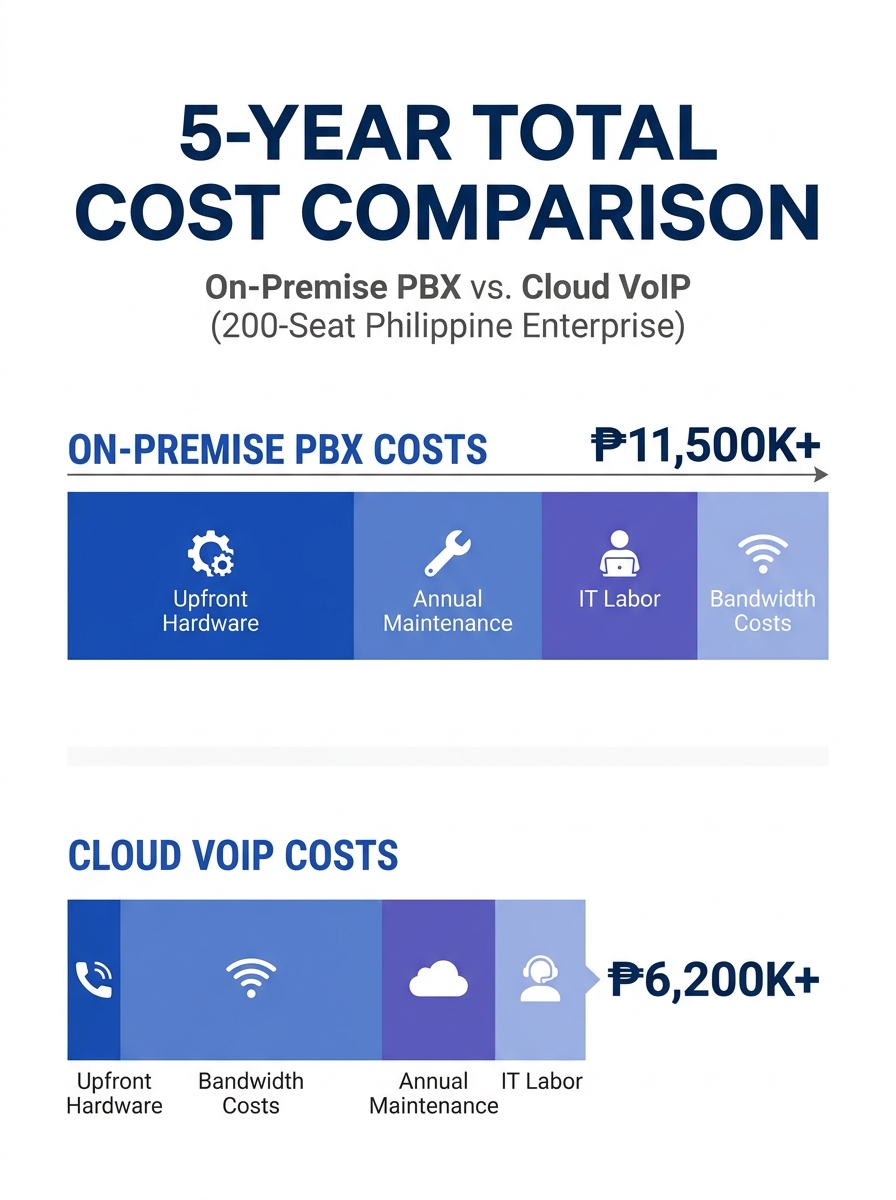
The sticker price on an on-premise PBX system tells you almost nothing about what you’ll spend over its useful life. According to the PBX.IM 2026 pricing guide, upfront hardware runs between $1,000 and $10,000 or more, plus $50 to $200 per extension for licensing, handsets, and gateway modules. For a 200-seat office in Makati or Cebu IT Park, that initial outlay lands somewhere between $11,000 and $50,000 before a single call routes through the system. And that figure covers only the equipment itself, not the structured cabling, the rack space, the UPS battery backup, or the air-conditioned server closet needed to keep everything running through a Philippine summer.
The costs that enterprises underestimate sit in years two through five. Annual maintenance contracts on Yeastar, Grandstream, or Cisco on-premise systems typically run 15% to 20% of the original hardware price. A $30,000 PBX therefore generates $4,500 to $6,000 per year in maintenance fees alone, before you count IT staff hours for firmware updates, SIP trunk troubleshooting, and capacity upgrades as headcount grows. Organizations that have walked through a multi-site PBX consolidation know that each branch office multiplies this cost, because every location needs its own gateway hardware, its own UPS, and often its own local IT support contract.
The Philippine-specific wrinkle is procurement lead time and import duties. PBX appliances from Cisco, Grandstream, or Yeastar pass through customs with 10% to 12% duties on imported telecom equipment, and replacement parts for a failed trunk card can take two to four weeks to arrive. During that gap, the enterprise runs at reduced capacity or pays express shipping premiums that don’t appear in any TCO spreadsheet. For on-premise PBX Philippines deployments, the hidden cost isn’t the hardware you buy. It’s the hardware you can’t get fast enough when something breaks.
Cloud VoIP TCO After Year Three
Cloud VoIP’s financial appeal is straightforward in year one: zero capital expenditure on PBX hardware, no server closet, no maintenance contract. Monthly per-seat costs from Philippine providers and global platforms like RingCentral, Zoom Phone, or Microsoft Teams Phone run between $15 and $35 per user per month, depending on feature tier and call-minute bundles. A 200-seat deployment at $25 per seat costs $5,000 per month, or $60,000 per year. That looks more expensive than a $30,000 PBX appliance until you extend the comparison to year three, when the on-premise system’s cumulative maintenance, IT labor, and hardware refresh cycle close the gap entirely.
The cloud VoIP TCO advantage becomes clear around month 36 to 42 for most Philippine enterprise telephony deployments. By that point, the on-premise system has consumed $13,500 to $18,000 in maintenance alone, plus IT staff time that typically adds another $8,000 to $15,000 per year in blended labor costs for a mid-size enterprise. The ITQlick 2026 IP PBX pricing analysis confirms that total ROI comparisons favor cloud when organizations account for every cost category, including the opportunity cost of IT staff who spend time patching PBX firmware instead of working on revenue-generating projects. Philippine BPO operations, where seat counts fluctuate 20% to 40% between peak and off-peak seasons, see even stronger cloud economics because they pay only for active seats rather than provisioned capacity.
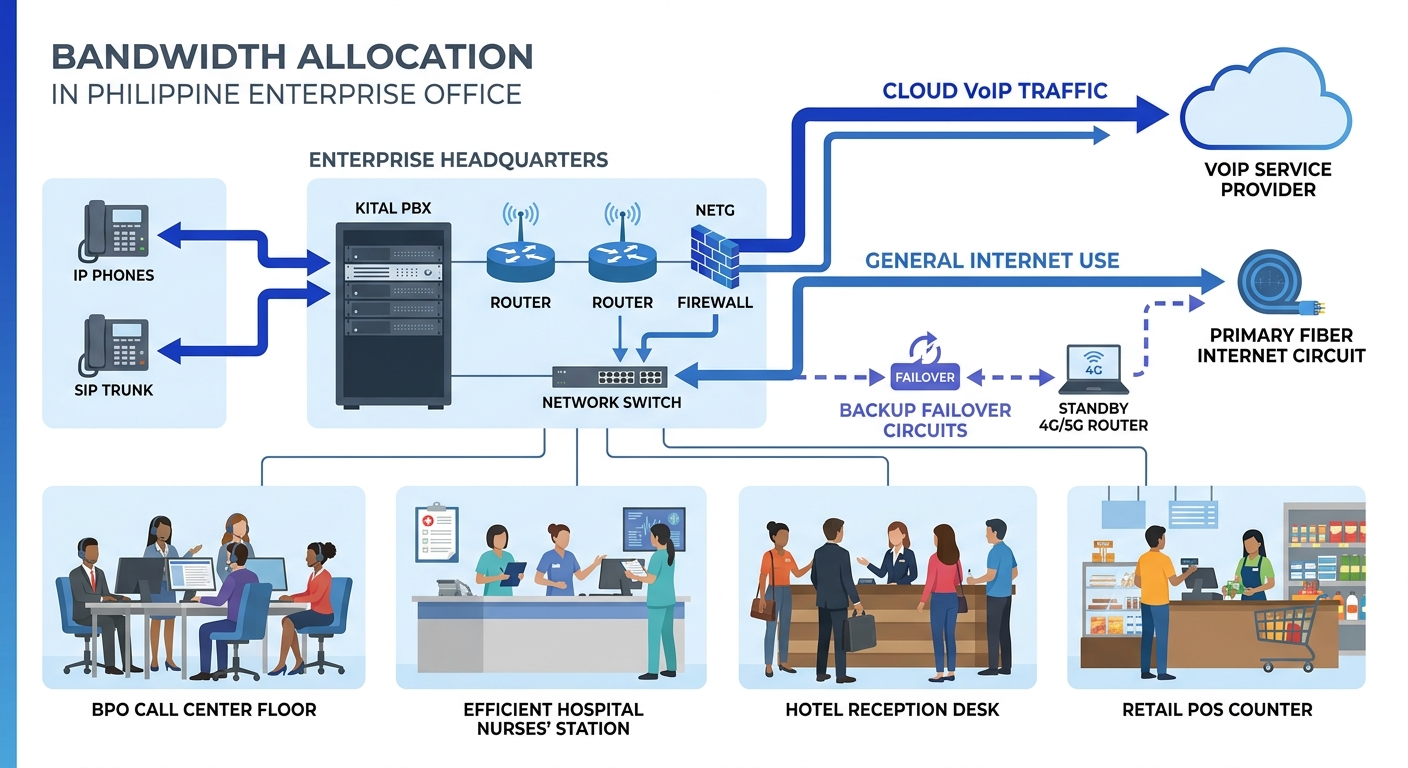
But cloud VoIP carries its own hidden costs that vendors don’t volunteer during sales calls. Bandwidth is the big one. A single concurrent VoIP call using the G.711 codec consumes roughly 85 kbps in each direction. Two hundred concurrent calls need about 34 Mbps of dedicated, low-jitter bandwidth, and Philippine enterprise internet circuits from PLDT, Globe, or Converge price that capacity at $400 to $1,200 per month depending on location and SLA tier. Enterprises that skip the network monitoring checklist for call quality often discover this cost the hard way, after deploying cloud VoIP on a shared internet link that can’t handle the load during business hours.
Sangoma’s PBX migration guide emphasizes that “budget planning for PBX migration should include licensing, network upgrades, migration services, training, and temporary overlap between systems.” That overlap period, where both the old PBX and the new cloud platform run side by side for 30 to 90 days, is a cost that PBX migration cost comparison calculators almost never include. For a 200-seat office, running dual systems adds $5,000 to $15,000 in one-time transition costs.
Resilience Across a Typhoon-Prone Archipelago
Philippine geography makes resilience the single most important variable in the on-premise versus cloud debate, and neither architecture wins cleanly. The Philippines sits in the typhoon belt, averages 20 tropical cyclones per year, and has historically faced internet connectivity costs far above regional norms. The Internet Society’s Pulse report on Philippine internet resilience notes that while conditions are improving, the country’s connectivity cost burden has exceeded the Asia Pacific average of 3% of GNI per capita, a gap driven by the former telecommunications duopoly and outdated regulatory frameworks.
On-premise PBX systems have one clear resilience advantage: they keep working when the internet goes down. Internal extension-to-extension calls route through the local PBX without touching an outside network, and analog trunk lines to the PSTN can stay active even during a fiber cut. For hospitals in Tacloban, government offices in Leyte, or hotel chains in typhoon-prone Visayas provinces, that local survivability matters enormously. A cloud VoIP system with no local fallback goes completely silent the moment the ISP link drops, and building intelligent failover architecture for cloud telephony requires redundant ISP circuits, LTE backup modems, and session border controllers that add $3,000 to $8,000 per site.
Philippine geography makes resilience the single most important variable in the on-premise versus cloud debate, and neither architecture wins cleanly.
Cloud VoIP’s resilience advantage shows up at the disaster-recovery layer. Fanvil V Series phones, Grandstream UCM Series IP PBX systems, and Cisco 8800 Series IP phones all support remote management and automatic failover capabilities designed for business continuity during emergencies. When a cloud platform hosts its call control in geographically distributed data center infrastructure, a typhoon that destroys a Cebu office doesn’t destroy the phone system. Employees can log in from any device, anywhere, and resume taking calls within minutes. An on-premise PBX buried under a collapsed ceiling takes weeks to replace, not minutes.
The World Bank’s approval of EUR 268.22 million for the Philippines Digital Infrastructure Project in October 2024 signals that the connectivity gap will narrow over the next several years. As fiber penetration reaches more provincial cities and 5G fixed-wireless access fills gaps in last-mile coverage, the resilience argument for keeping a PBX on-premise weakens. Enterprises planning their Philippine enterprise telephony strategy for 2026 through 2030 should factor in this trajectory rather than evaluating cloud VoIP against today’s worst-case provincial connectivity.
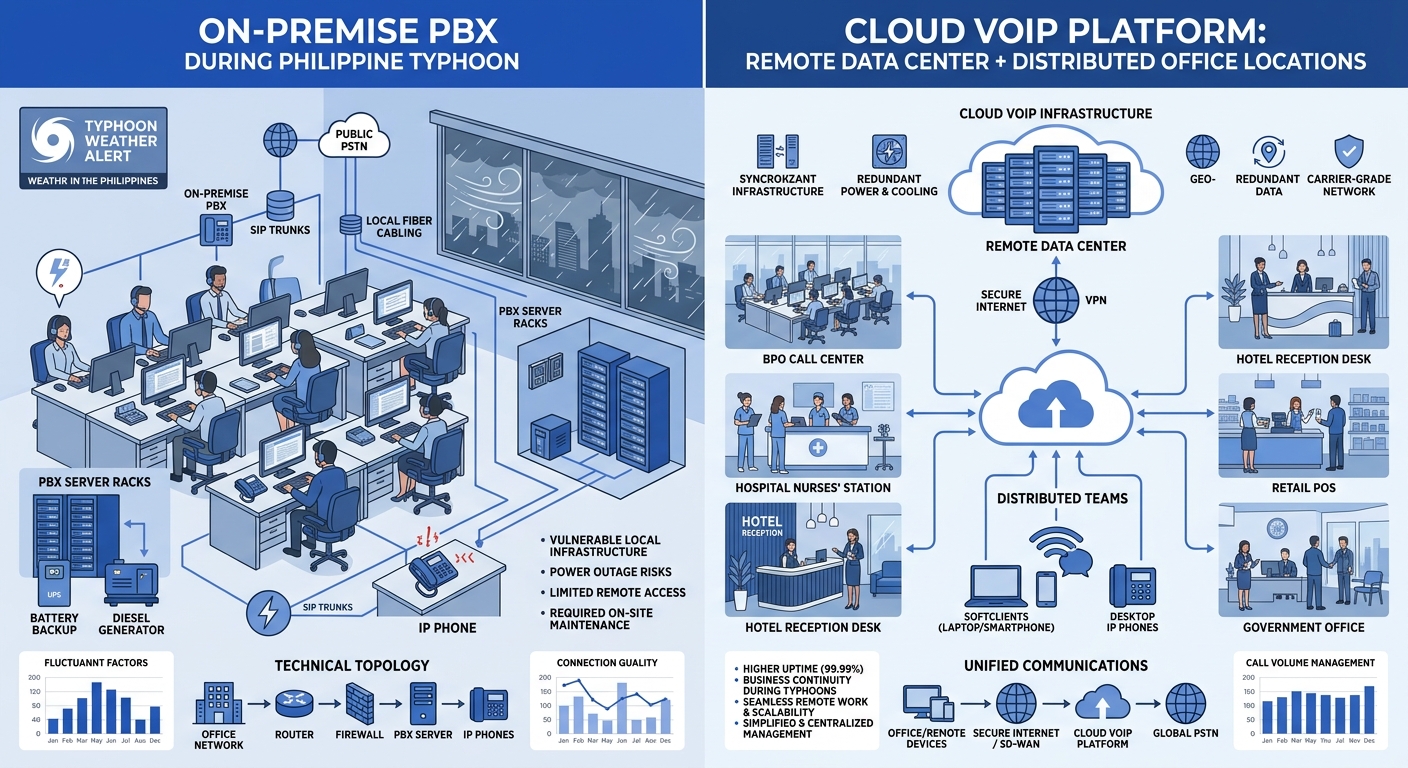
The hybrid approach, where a site-survivable gateway sits on-premise while primary call control runs in the cloud, addresses both failure modes. Yeastar’s P-Series supports this architecture natively, and Cisco’s Unified Survivable Remote Site Telephony (SRST) has done it for over a decade. The cost for a hybrid deployment adds roughly $2,000 to $5,000 per branch, a premium that makes sense for mission-critical sites like call centers or emergency dispatch offices but is harder to justify for a 15-seat satellite office.
Where This Comparison Leaves You Guessing
The numbers favor cloud VoIP for Philippine enterprises with reliable dual-ISP connectivity and 50 or more seats. The numbers favor on-premise PBX for single-ISP provincial sites where telephony downtime during a fiber cut creates immediate revenue or safety consequences. Everything between those two poles, which describes the majority of Philippine enterprises, falls into a gray zone where the right answer depends on variables that no pricing calculator captures: how often your ISP actually goes down (not what the SLA says), how fast your IT team can respond to a PBX failure at 2 AM, and whether your organization’s unified communications roadmap includes video, messaging, and contact center features that on-premise PBX systems handle poorly.
What remains genuinely uncertain is how fast Philippine internet infrastructure will improve in provincial areas. PLDT, Globe, and newer entrants like DITO and Converge are investing aggressively, and the World Bank’s digital infrastructure funding will accelerate fiber buildouts. If provincial uptime reaches 99.9% within three years, the on-premise resilience argument collapses for all but the most risk-sensitive verticals. If it doesn’t, enterprises that went all-cloud in 2026 will spend 2028 retrofitting local survivability gateways at $3,000 to $5,000 per site. The cost of guessing wrong in either direction is real, and enterprises that have mapped out their telecom infrastructure alongside their IT budget are better positioned to absorb whichever scenario plays out. The honest answer to the on-premise versus cloud question for Philippine enterprises in 2026 is that it depends, and anyone who tells you otherwise is selling something.