
PLDT Inc. filed June 22 with the Securities and Exchange Commission and Philippine Stock Exchange to launch VITRO REIT Inc., a P24.2-billion ($399-million) initial public offering that will convert eight existing data centers into the country’s first digital infrastructure real estate investment trust, according to Rappler. The offering comprises 1.913 billion secondary common shares priced at up to P11 each, with an over-allotment option of 287 million additional shares.
TL;DR: PLDT’s June 22 SEC filing creates the Philippines’ first data center REIT, converting eight facilities with 24 MW capacity into a P24.2-billion public investment vehicle under expanded regulator definitions that now classify data centers as real estate assets.
SEC Regulatory Shift Enables Data Center REITs
The PLDT filing follows the March 2026 issuance of SEC Memorandum Circular No. 1, Series of 2026, which revised the implementing rules of Republic Act No. 9856 (the Real Estate Investment Trust Act of 2009) to expand the statutory definition of “income-generating real estate assets.” The circular explicitly added information and communications technology networks and commercial data centers to the list of eligible infrastructure alongside roads, mass transit systems, and energy transmission facilities.
Data centers qualify under the revised framework because their revenue structure mirrors traditional commercial real estate, long-term colocation lease agreements with enterprise tenants, cloud service providers, and hyperscale technology companies generate stable, predictable cash flows comparable to office building or industrial warehouse leases. The SEC determination acknowledges that while data centers house server stacks and fiber-optic arrays, the underlying financial instrument is a high-security real estate envelope leased to creditworthy tenants.
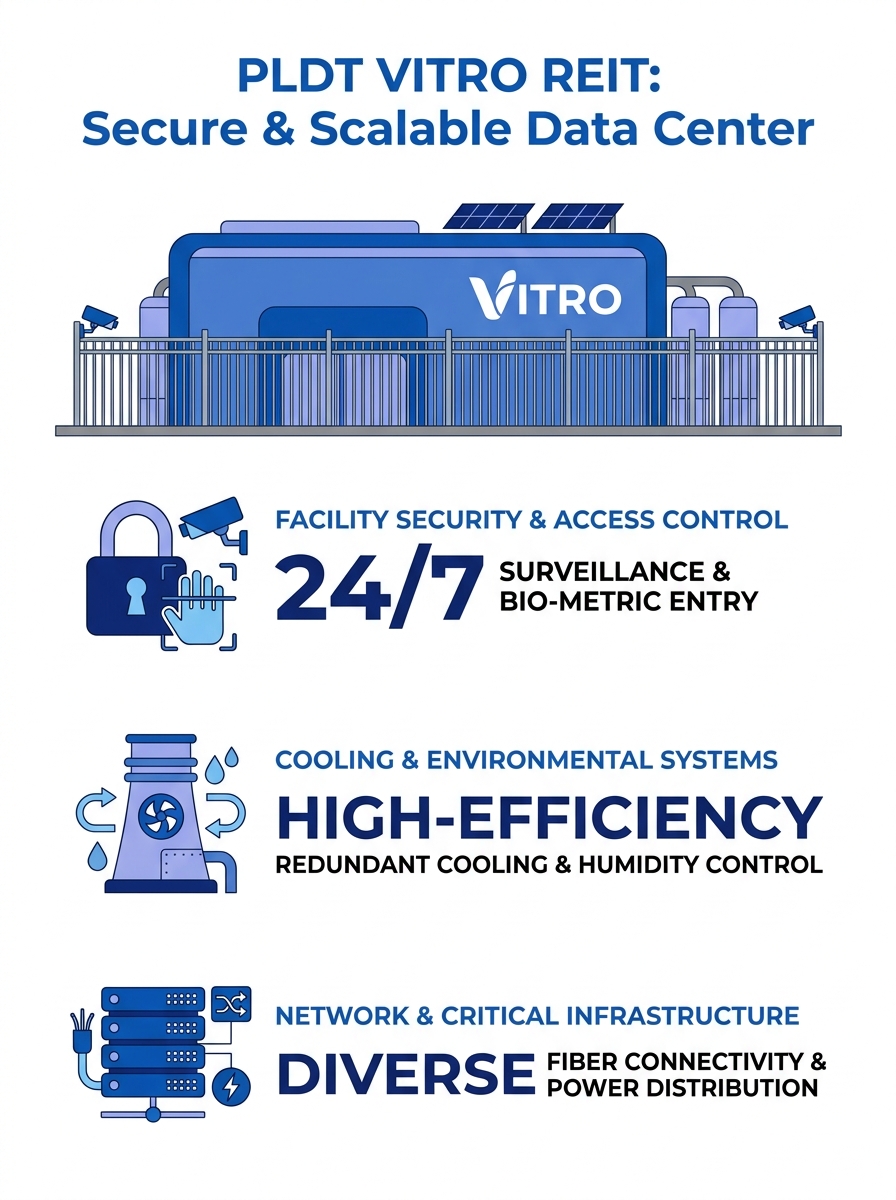
Portfolio Covers 24 MW Across Metro Manila and Regional Hubs
VITRO REIT’s initial portfolio consists of eight fully operational data centers with aggregate IT-ready capacity of approximately 24 megawatts, serving both hyperscale and enterprise node customers. Five facilities sit in Metro Manila’s primary business districts, Makati, Pasig, and Parañaque, while three regional centers operate in Pampanga (Luzon corridor), Cebu (Visayas), and Davao (Mindanao).
The 24 MW portfolio represents what data center financial analysis terms “stabilized” assets, facilities with established occupancy rates, predictable power consumption patterns, and active revenue-generating lease agreements. Geographic distribution across three island regions mitigates risk from localized power grid disruptions or seismic events while capturing enterprise demand in provincial markets where government agencies and regional banks increasingly require local data center solutions to meet data sovereignty and latency requirements.
VITRO operates as the data center division of ePLDT Inc., PLDT’s wholly-owned subsidiary serving as the telecommunications giant’s digital transformation and ICT arm. ePLDT was established in 2000 and now manages the largest data center network in the country by facility count and combined capacity.
Offering Structure and Capital Deployment
The IPO filing structures the offering as a secondary share sale rather than a primary capital raise, meaning existing shareholders (primarily PLDT and ePLDT) will sell shares to public investors without issuing new equity that would dilute ownership. The 1.913-billion-share base offering at P11 per share targets P21.0 billion in gross proceeds; the 287-million-share over-allotment option, exercisable by underwriters to cover excess demand, adds up to P3.2 billion, bringing total offering size to the disclosed P24.2 billion.
The stabilizing agent mechanism built into the over-allotment structure allows underwriters to purchase additional shares at the offering price for up to 30 days post-listing to support market price if initial trading falls below the IPO price. This is standard practice in Philippine equity offerings above P10 billion but represents the first time such a mechanism will apply to a technology infrastructure asset class.
REIT Income Distribution Requirements Apply
As a registered REIT under RA 9856, VITRO must distribute at least 90% of its distributable income to shareholders annually to maintain tax-advantaged status. Distributable income for data center REITs comprises colocation fees, power pass-through charges (billed at cost plus margin), cross-connect fees for inter-tenant fiber links, and ancillary services such as remote hands support and equipment installation.
The 90% distribution mandate means VITRO shareholders will receive quarterly or semi-annual dividend payments tied directly to data center occupancy rates and contract renewals. Enterprise IT managers evaluating long-term colocation commitments can expect pricing stability because REIT economics favor predictable, multi-year lease terms over short-term spot pricing, the same dynamic that governs commercial office leases in Makati’s central business district.
Philippine enterprises considering private data center builds or evaluating third-party colocation options now face a market where the country’s largest provider operates under public-market transparency requirements. VITRO will file quarterly earnings reports disclosing occupancy rates, average revenue per rack, power utilization efficiency (PUE), and contract renewal percentages, metrics that have historically remained proprietary in the Philippine data center sector.
What This Means for IT Managers
The conversion of ePLDT’s data center portfolio into a publicly traded REIT introduces two structural changes for enterprise IT planning. First, colocation contract terms will increasingly reflect REIT economics, expect pricing structures that favor three-to-five-year commitments with predictable annual escalations rather than short-term flexibility, because VITRO’s investor base will demand visibility into long-term revenue. If your organization operates hybrid infrastructure splitting workloads between on-premises systems and third-party colocation, budget discussions should now incorporate longer contract horizons when modeling total cost of ownership for the colocation component.
Second, quarterly public filings will provide unprecedented visibility into Philippine data center market fundamentals. VITRO’s mandated disclosure of occupancy rates, power pricing, and customer concentration will establish pricing benchmarks that inform vendor negotiations across the sector, even with competitors. When negotiating colocation renewals or evaluating new providers, reference VITRO’s filed average revenue per kilowatt as a market baseline rather than accepting vendor-provided rate cards at face value. The transparency obligation built into REIT structures shifts negotiating use toward enterprise customers who track public filings.
Government agencies and regulated industries evaluating business continuity communication plans should monitor VITRO’s geographic expansion beyond the initial eight-facility portfolio. The REIT structure provides access to public capital markets for facility expansion, making regional builds in second-tier cities (Iloilo, Cagayan de Oro, Bacolod) financially viable where private capital historically concentrated in Metro Manila. If your agency serves constituents outside the National Capital Region, VITRO’s post-IPO capital deployment may deliver local data center options that eliminate the latency and data sovereignty complications of Metro Manila-only hosting.