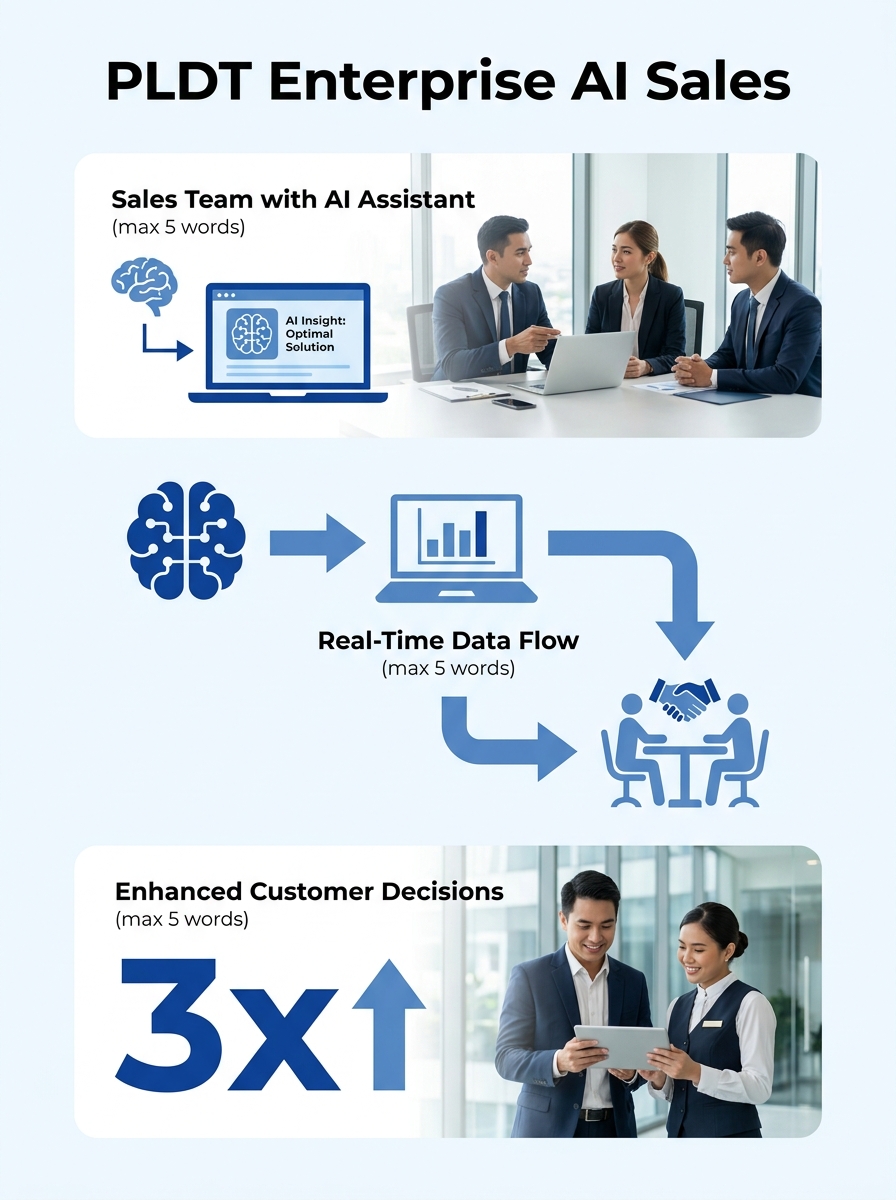
PLDT Inc. launched KAI (Knowledge, Automation, Intelligence), a conversational AI assistant that delivers real-time network capacity and product data to enterprise sales staff during client discussions, according to Back End News. The system went live in production on April 26, 2026, making PLDT the first Southeast Asian telecommunications provider to deploy UiPath’s agentic AI platform in an operational environment.
The deployment addresses a bottleneck familiar to enterprise telco sales cycles: account managers validating network availability or retrieving solution specifications mid-conversation. KAI surfaces that information on demand, eliminating manual lookups across internal systems while the customer waits. PLDT Enterprise teams now access network availability status, product catalogs, and connectivity options through a conversational interface during active sales engagements.
How the System Works in Practice
KAI runs on agentic AI architecture, meaning the platform assists human decision-making rather than automating the entire sales interaction. When a PLDT Enterprise representative discusses fiber connectivity for a Makati office tower or SD-WAN deployment across regional branches, the assistant retrieves current network capacity, service availability timelines, and solution configuration options in seconds.
“Before KAI, our teams had to dig for answers in the middle of a customer conversation,” said Eric Santiago, head of Network Strategy and Architecture at PLDT and Smart, in the source report. “Now the information comes to them.”
The tool targets enterprise IT managers evaluating PLDT for multi-site connectivity, cloud interconnects, or dedicated internet circuits—scenarios where accurate capacity validation and configuration details directly influence purchasing decisions. Philippine enterprises comparing telco proposals now receive faster, more precise responses during initial scoping calls, according to the filing.
Platform Architecture and Governance
PLDT built KAI on UiPath’s conversational AI framework, layering it with human-in-the-loop governance to prevent erroneous data from reaching customers. The system queries internal PLDT databases for network topology, service availability by barangay, and product specifications without exposing raw infrastructure data to external parties.
“By combining agentic automation with human-in-the-loop governance, PLDT is turning complex data into timely, actionable insights,” said Amit Khandelwal, regional vice president and managing director for Southeast Asia at UiPath, in the same report.
The assistant does not replace account managers or technical consultants. Sales staff still control the conversation, but KAI reduces the time spent navigating internal knowledge bases, service catalogs, and network planning tools during live customer interactions. For organizations evaluating enterprise network infrastructure that depends on carrier capacity, this shortens the sales-to-deployment timeline.
Roadmap and Automation Expansion
PLDT plans to extend KAI’s capabilities beyond information retrieval. Santiago said future updates will include automated solution generation based on customer requirements—feeding the assistant a company’s branch locations, bandwidth needs, and redundancy specifications, then receiving a preliminary network design with equipment recommendations and pricing estimates.
“Soon, we can even automate the creation of solutions specific to customer needs,” Santiago said in the source filing. The telco did not specify a launch date for automated design features.
This builds on PLDT’s broader AI adoption strategy. The company previously deployed UiPath’s platform for enterprise client support, handling routine service inquiries and ticket triage. KAI extends that automation into pre-sales engineering, where accuracy and speed directly affect contract close rates.
Philippine enterprises running hybrid networks—on-premise PBX systems connecting to cloud UC platforms over PLDT fiber links—stand to benefit from faster capacity validation during infrastructure planning cycles. IT managers scoping VoIP rollouts or evaluating network segmentation for unified communications can now receive immediate confirmation of carrier availability and bandwidth provisioning timelines during initial vendor discussions.
What Happens Next
Other Philippine telcos will likely accelerate their own AI deployments in response to PLDT’s production launch, particularly in enterprise sales where response speed directly influences deal velocity. Converge ICT and Globe Business already operate customer-facing chatbots, but none have publicly disclosed agentic AI systems embedded in the sales workflow with live access to network infrastructure data.
Philippine IT managers evaluating telco proposals should expect faster turnaround on capacity validation and solution design as carriers adopt similar tools. The shift from manual lookups to AI-assisted sales means initial scoping calls will surface more precise availability data, but it also requires customers to arrive at those discussions with specific bandwidth requirements and site lists ready. Generic inquiries (“Can you service our company?”) will return faster answers but less useful guidance than detailed requests with exact addresses and service-level expectations.
PLDT has not disclosed deployment costs or performance metrics from the KAI launch, so the operational return on investment remains undocumented. The company said it would share updates on automated solution generation capabilities later this year.