
Smargasy Inc released a decision framework on September 19 comparing cloud PBX versus onsite PBX systems across five evaluation criteria: total cost of ownership, reliability design, operational control, remote workforce support, and customer relationship management integration, according to the published guide. The framework addresses infrastructure choices facing Philippine SMBs, BPO operations, and enterprises as distributed teams and multi-location businesses reconsider premise-based phone systems.
TL;DR: A new comparison framework evaluates cloud versus onsite PBX systems on cost, reliability, control, remote work capability, and CRM integration to help businesses choose the right communications infrastructure for distributed operations.
The guide positions the selection not as a feature comparison but as an operational fit decision, noting that “a small business with remote employees and multiple locations has different needs than a facility with specialized internal calling requirements.” The framework urges decision-makers to examine actual call patterns—whether customers reach the right department, whether field technicians can receive business calls on mobile devices, whether receptionists see caller history before answering—before evaluating technical specifications.
Cost Analysis Extends Beyond Equipment Purchase
The framework breaks total cost into visible and hidden components. Onsite PBX systems require capital investment in server hardware, installation labor, software licenses, and ongoing expenses for security updates, battery backup, spare parts inventory, and support agreements, according to the guide. Businesses adding users or opening new locations face additional equipment purchases and physical installation work.
Cloud PBX shifts those responsibilities to the provider, converting capital expense to operational expense. The guide notes that predictable monthly costs appeal to organizations “that would rather invest staff time in customers than phone administration,” particularly those lacking internal IT resources. However, the framework cautions against assuming cloud is automatically less expensive, stating that stable single-site operations with capable IT teams may justify onsite investment over multi-year periods.
The decision point centers on total burden rather than initial price: “Which option gives us the lowest total burden for the way we operate?” the guide asks.
Reliability Depends on Architecture, Not Deployment Location
The framework challenges two common assumptions—that onsite PBX is safer because equipment is visible, and that cloud PBX is safer because infrastructure is hosted elsewhere. Both models face distinct failure modes, according to the analysis.
Onsite systems can maintain internal extension calling during internet outages, depending on configuration, but remain vulnerable to localized power loss, equipment failure, water damage, and site-level disasters. Businesses must manage backup procedures, replacement hardware, and recovery planning internally.
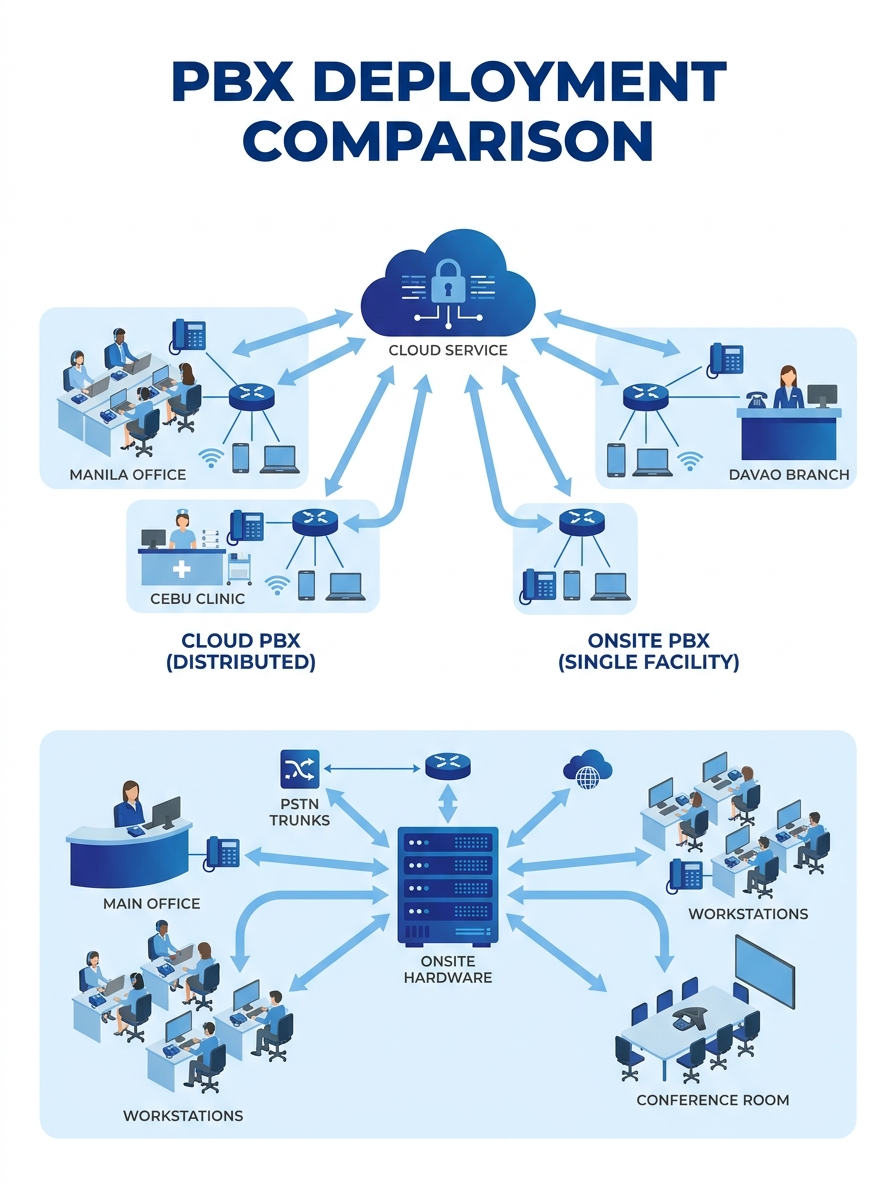
Cloud PBX eliminates single points of failure tied to one office location. If a Metro Manila branch loses power or internet connectivity, incoming calls can reroute to mobile devices, home offices, or other sites. The framework notes that distributed reliability requires proper internet redundancy and backup calling devices at each location.
The guide emphasizes that reliability stems from deliberate design—battery backup, failover routing, documented recovery procedures, and tested continuity plans—rather than from choosing cloud or onsite as a category.
Remote Work Support Favors Cloud Architecture
Cloud systems better support workforces distributed across multiple locations or working from home, according to the framework. Employees can answer through business applications on smartphones or computers without publishing personal phone numbers, maintaining unified business caller identity regardless of physical location. The guide cites field estimators working across multiple cities, managers operating from home offices, and teams split between branch locations as scenarios where cloud PBX reduces operational friction.
Organizations with predominantly onsite workforces, heavy internal extension use, and long-term single-facility operations may find less advantage in cloud mobility features. The framework suggests onsite PBX makes sense when “the company has a clear reason to maintain its own communications equipment” beyond preserving legacy infrastructure.
Many Philippine enterprises operate hybrid models, with call center operations concentrated in Metro Manila, Cebu, and Davao facilities while administrative and sales teams work remotely. Unified communications platforms increasingly integrate PBX functionality with video conferencing, team messaging, and screen sharing to support these distributed models.
CRM Integration Determines Lead Follow-Up Effectiveness
The framework positions phone system selection as part of the broader customer engagement workflow. Missed calls represent lost job requests, service inquiries, and sales leads, particularly for businesses competing in local search results. Modern PBX systems—cloud or onsite—should log calls, display customer history during incoming calls, and enable immediate SMS follow-up when calls go unanswered.
Cloud PBX platforms generally offer simpler integration with web-based CRM systems, marketing automation tools, and customer service platforms through published APIs and pre-built connectors. Onsite systems can integrate with business applications but may require more custom development work or middleware.
The guide recommends evaluating whether “the phone system becomes another disconnected tool or a useful part of your sales and customer-service process.” Organizations using Yeastar PBX systems or similar platforms can access third-party integration options regardless of deployment model, though configuration complexity varies.
Why This Matters Now
Philippine businesses face accelerating pressure to support remote teams, open new locations, and maintain service continuity during power interruptions and natural disasters. The COVID-19 pandemic permanently shifted operational models for many enterprises, with hybrid work now standard at BPO providers, professional services firms, government agencies, and mid-market companies across Metro Manila and regional hubs.
The cloud-versus-onsite decision determines whether communications infrastructure constrains or enables that flexibility. Organizations locked into premise-based phone systems face higher friction when opening satellite offices, accommodating work-from-home arrangements, or maintaining operations during localized disruptions. The framework’s emphasis on operational burden over feature lists reflects market maturity—businesses increasingly evaluate communications as a service delivery tool rather than as isolated IT infrastructure.
For IT managers and operations leads evaluating PBX replacements or first-time deployments, the guide reinforces that neither model is universally superior. The correct choice depends on workforce distribution, internal technical capability, growth trajectory, and how tightly phone interactions tie to customer acquisition and retention workflows. As Philippine enterprises compete on responsiveness and availability, communications architecture becomes a competitive factor rather than a back-office utility.