Enterprise power infrastructure requires layered protection combining uninterruptible power supplies, backup generators, and automated transfer systems to defend against both utility outages and electrical quality degradation, according to a technical implementation guide published by SPS Sales on August 29, 2026.
TL;DR: SPS Sales published a four-component critical power architecture framework on August 29, 2026, detailing how enterprises must simultaneously address power availability and electrical quality to prevent downtime and equipment damage during grid disruptions.
The 3,200-word implementation framework separates critical power infrastructure into distinct hardware layers—each serving a specific role in maintaining continuous electrical delivery during utility failures. The guide documents how unscheduled power disruptions cost commercial facilities millions of dollars annually through operational downtime, hardware damage, and data loss, though it does not cite specific Philippine facility cost data.
Dual-Challenge Framework Addresses Availability and Quality Simultaneously
Traditional backup power planning focuses exclusively on maintaining uptime percentages such as 99.999% availability, but the guide argues that continuous power delivery alone provides insufficient protection if incoming current contains harmful electrical distortions. The publication states that power quality issues—including total harmonic distortion, transient voltage spikes, and electrical noise—cause circuit board damage and equipment failure even when utility power remains online.
“High-performance critical power architecture resolves both metrics simultaneously to prevent equipment failure and extend machinery lifespan,” the guide states. The framework positions power conditioning as equally critical to backup capacity when protecting sensitive IT hardware and industrial control systems.
Philippine enterprises managing data center solutions and telecommunications infrastructure face particularly acute exposure to voltage anomalies given the country’s monsoon-driven weather patterns and aging grid infrastructure in provincial markets outside Metro Manila.
Four-Component Hardware Architecture Forms Protection Foundation
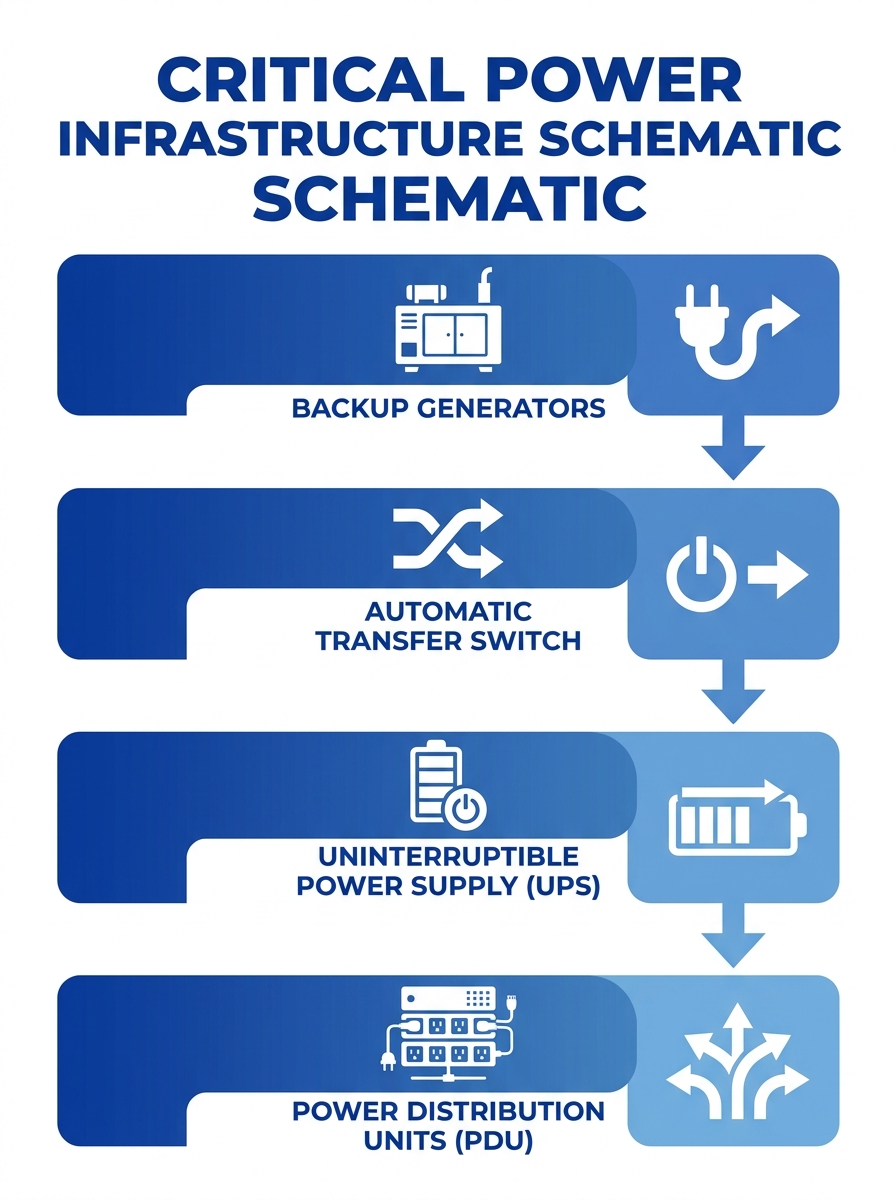
The guide breaks enterprise-grade critical power systems into four interconnected hardware layers, each performing distinct electrical protection functions:
Uninterruptible power supply systems serve as immediate frontline defense during utility disruptions, bridging the critical millisecond gap before secondary generators activate. The guide notes that UPS hardware continuously filters incoming electricity to eliminate transient surges and deliver stable voltage directly to connected IT equipment, preventing system reboots and data corruption during switchover events.
Industrial backup generators provide long-term power generation during extended utility outages lasting hours or weeks. Once started, these engines deliver continuous high-capacity electricity until primary grid operations restore, with automated starting sequences triggered by transfer switch monitoring systems.
Automatic transfer switches act as intelligent load routing controllers, constantly monitoring utility health and initiating generator sequences without dangerous backfeeding into the main grid. The publication positions switchgear as critical personnel safety infrastructure that prevents maintenance worker exposure during manual switching operations.
Power distribution units and conditioners manage downstream delivery to individual equipment racks, using isolation transformers to eliminate ground loops and electrical noise across sensitive circuits. The guide states that intelligent rack PDUs provide real-time current metering to prevent circuit overloads at the rack level.
Redundancy Architecture Selection Depends on Facility Risk Tolerance
The framework outlines four standard redundancy topologies used in commercial critical power deployments, with selection driven by operational risk profiles and budget constraints. An N-capacity design meets baseline facility power demands without additional backup components, representing minimum protection for facilities accepting moderate outage risk.
N+1 configurations add one redundant component beyond baseline capacity requirements, allowing maintenance activities without disrupting primary power delivery. The guide positions this topology as suitable for enterprises requiring high availability without the capital expense of fully redundant infrastructure.
2N architectures deploy completely independent parallel power paths from utility connection through end-point delivery, eliminating all single points of failure. The publication states this approach delivers maximum resilience for facilities requiring continuous uptime, though it doubles hardware acquisition and facility space requirements.
Philippine government agencies and financial institutions evaluating business continuity strategies for mission-critical operations increasingly specify 2N or 2N+1 redundancy in data center procurement requirements, according to recent facilities management conferences in Metro Manila.
Cost Considerations Extend Beyond Hardware Acquisition
Beyond direct revenue loss during outages, the guide identifies four additional downtime cost categories that enterprises must factor into critical power planning: idle workforce hours when systems remain unavailable, material waste when production processes interrupt mid-cycle, supply chain delays affecting downstream customers, and regulatory non-compliance penalties when safety systems fail during utility drops.
The publication emphasizes that electrical surges frequently cause hardware degradation, burnt circuit boards, and permanent data corruption—costs that exceed immediate operational interruption. Facilities lacking adequate power conditioning expose sensitive electronics to cumulative damage even during brief voltage anomalies, the guide states.
Philippine enterprises managing operations across multiple islands face compounding risk exposure given the archipelago’s regionally isolated grid systems and limited interconnection capacity between Luzon, Visayas, and Mindanao power markets. BPO facilities in Cebu and Davao maintaining client service-level agreements require structured cabling and power infrastructure capable of zero-tolerance downtime despite frequent provincial utility interruptions during typhoon season.
What This Means for IT Managers
Philippine IT managers evaluating critical power upgrades should conduct facility-specific risk assessments before selecting redundancy architectures, rather than defaulting to vendor-recommended configurations. The four-layer framework provides a useful starting taxonomy for infrastructure planning discussions with facilities teams and executive leadership, though local utility reliability data and historical outage frequency should drive final topology selection rather than generic industry recommendations.
Enterprise buyers should request detailed power quality measurements—not just availability guarantees—when vetting critical power contractors, particularly for facilities housing sensitive networking equipment or storage systems vulnerable to transient voltage spikes. The framework’s emphasis on simultaneous availability and quality protection aligns with emerging procurement practices among Philippine government agencies managing distributed network operations across challenging geographic terrain.
Facilities managers in Metro Manila, Cebu, and Davh should evaluate whether existing UPS runtime capacity bridges the gap until backup generators reach full load output, as even 30-second switchover delays can trigger communication system failures or database transaction rollbacks in high-throughput environments.