
Network component manufacturer LINK-PP published a comprehensive technical guide to 10/100/1000Base-T Ethernet standards on August 22, 2026, documenting the specifications, cabling requirements, and deployment considerations for Fast Ethernet and Gigabit Ethernet infrastructure, according to the company’s knowledge center. The guide addresses twisted-pair copper cabling standards used in enterprise networks, data centers, and government facilities across the Philippines.
TL;DR: LINK-PP released a technical reference guide covering 10Base-T through 1000Base-T Ethernet standards, providing network planners with specifications for copper infrastructure capacity planning and cabling requirements.
The publication arrives as Philippine enterprises and government agencies evaluate structured cabling upgrades to support higher bandwidth applications, with 1000Base-T (Gigabit Ethernet over copper) now the baseline standard for most new installations in Metro Manila, Cebu, and Davao business districts.
Ethernet Standard Definitions and Capacity Ranges
The guide defines three primary twisted-pair Ethernet standards in current use. 10Base-T delivers 10 megabits per second over Category 3 or higher cable with maximum segment lengths of 100 meters, a standard largely retired from new deployments but still present in legacy industrial control systems. 100Base-T (Fast Ethernet) operates at 100 megabits per second using Category 5 or higher cable, supporting the same 100-meter distance limit and commonly deployed in endpoints where voice-over-IP desk phones connect to switches.
1000Base-T (Gigabit Ethernet) transmits 1 gigabit per second over Category 5e, Category 6, or Category 6a cable, maintaining the 100-meter maximum distance while using all four wire pairs simultaneously, according to the technical specifications detailed in the guide. The standard uses bidirectional transmission on each pair to achieve the full gigabit throughput.
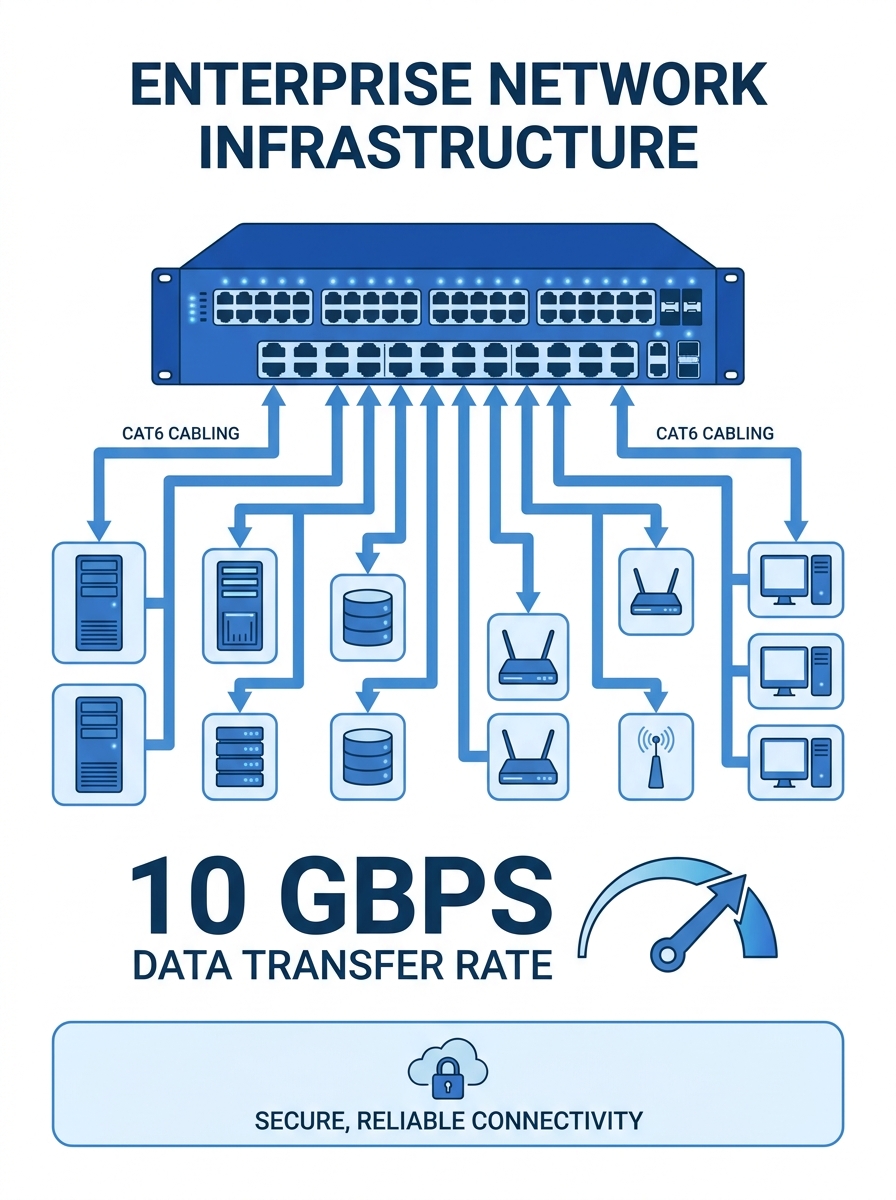
Philippine data center solutions providers typically specify Category 6a cabling for 1000Base-T deployments to provide headroom for future 10GBase-T upgrades without requiring cable replacement. The guide notes that while 1000Base-T functions on Category 5e cable, the newer Category 6a standard reduces crosstalk and supports higher frequencies, making it the preferred choice for new structured cabling installations in hospitals, call centers, and government offices.
Auto-Negotiation and Backward Compatibility
The technical document explains that 1000Base-T network interfaces implement auto-negotiation protocols that detect the maximum supported speed between connected devices and configure link parameters automatically. A 1000Base-T switch port connecting to a 100Base-T device will establish the link at 100 megabits per second without manual configuration, a feature critical for mixed-speed environments common in Philippine enterprises with phased infrastructure upgrades.
Auto-negotiation eliminates the manual speed and duplex configuration that caused connectivity failures in earlier Ethernet deployments. The guide specifies that full-duplex operation—simultaneous transmission and reception—is mandatory for 1000Base-T, while 10Base-T and 100Base-T support both half-duplex (shared transmission medium) and full-duplex modes.
Cabling Infrastructure Requirements
Category 5e cable represents the minimum specification for 1000Base-T deployment, supporting frequencies up to 100 MHz with four twisted pairs rated for gigabit transmission. The guide details that Category 6 cable extends frequency support to 250 MHz with improved crosstalk specifications, while Category 6a—the current recommendation for enterprise installations—handles frequencies up to 500 MHz and provides alien crosstalk protection necessary for high-density switch closets.
Philippine network contractors increasingly specify Category 6a for office buildings and BPO facilities to support both current 1000Base-T requirements and potential 10GBase-T deployments, which require Category 6a cable to achieve the full 100-meter distance. Lower cable categories limit 10GBase-T to shorter runs, creating migration constraints that Category 6a installations avoid.
The technical specifications confirm that all twisted-pair Ethernet standards use RJ45 modular connectors with 8P8C (eight position, eight contact) pin configuration, maintaining physical compatibility across speed grades. Cabling installers must follow TIA/EIA-568-B wiring standards to ensure proper pair assignments and signal integrity at gigabit speeds.
Power over Ethernet Considerations
The guide notes that 1000Base-T infrastructure commonly supports Power over Ethernet (PoE) delivery, using the same four twisted pairs for both data transmission and power distribution. IEEE 802.3af (PoE) delivers up to 15.4 watts per port, while 802.3at (PoE+) extends capacity to 25.5 watts—sufficient for IP phones, wireless access points, and surveillance cameras deployed across Philippine enterprise facilities.
PoE eliminates separate electrical wiring for network endpoints, reducing installation costs and enabling centralized backup power through uninterruptible power supplies protecting the network switches. The simultaneous use of all four pairs for data in 1000Base-T requires PoE to overlay power on the same conductors, a technique called “phantom power” that prevents signal interference through careful voltage management.
The Takeaway
The LINK-PP technical guide provides Philippine IT managers with reference specifications necessary for capacity planning as enterprises migrate from 100Base-T to universal 1000Base-T deployment. With fiber-to-the-home rollouts expanding gigabit internet access across Metro Manila and regional cities, internal network infrastructure becomes the throughput bottleneck when office cabling remains at 100-megabit capacity. Network upgrade projects should specify Category 6a cable even when immediate requirements only demand 1000Base-T speeds—the additional cost of higher-grade cable during initial installation is minimal compared to the expense of re-cabling when 10-gigabit connectivity becomes necessary. Philippine government agencies planning network modernization under DICT infrastructure initiatives can use these standards to ensure cabling contracts deliver appropriate specifications for both current and projected bandwidth requirements through 2030.