
The Philippine Department of Information and Communications Technology now uses Speedtest Intelligence and Downdetector data from Ookla to independently verify network performance across the country’s 7,600-plus islands, according to a case study published by Ookla on August 19, 2026. The deployment replaces DICT’s prior reliance on provider-reported data with third-party measurement of real-world connectivity.
TL;DR: DICT adopted Ookla’s Speedtest Intelligence and Downdetector platforms to independently validate telecom provider performance claims across Philippine municipalities, ending decades of reliance on self-reported coverage data.
The shift gives DICT its first consistent method to validate whether service commitments are being met at the municipal level rather than through national averages that can mask localized performance gaps. The case study describes the measurement challenge as spanning hundreds of cities and municipalities with different infrastructure and connectivity conditions across an archipelago geography.
The Independent Verification Gap DICT Closed
DICT historically lacked an independent baseline to verify provider-reported coverage and performance, according to the case study. Providers self-reported their own network metrics, leaving the regulator without a way to confirm whether service commitments were actually delivered on the ground. National-level reporting averaged out local performance variations, meaning slow speeds and unreliable service in specific communities could remain undetected for extended periods.
The absence of third-party validation affected how millions of Filipinos accessed connectivity for work, education, communication, and online services, the case study noted. Without granular performance data, DICT could not systematically identify underserved areas or measure the real-world impact of national connectivity initiatives.
What Ookla Data Now Enables for Philippine Telecom Oversight
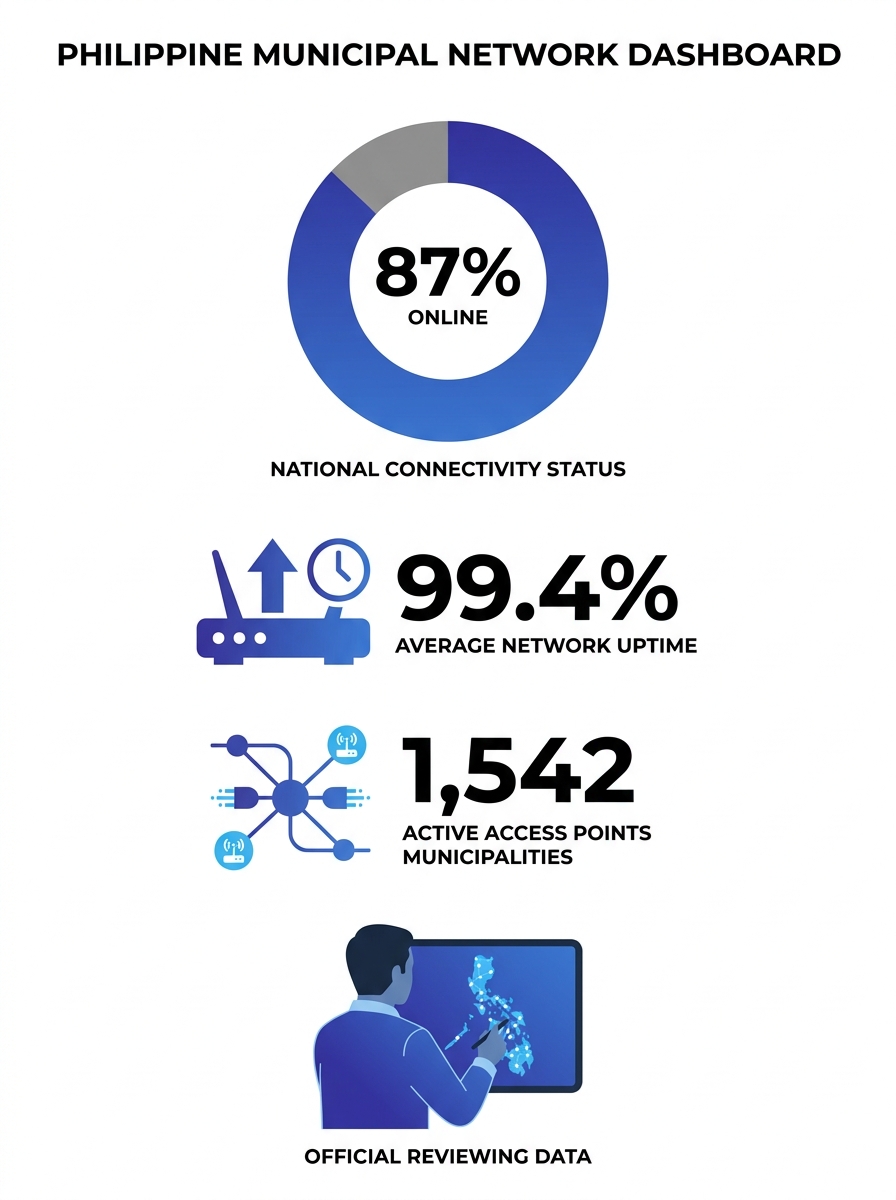
Speedtest Intelligence provides DICT with crowd-sourced network performance data collected from user-initiated speed tests across the Philippines. Downdetector supplies real-time outage and service disruption reporting based on user submissions. The combination gives DICT a consistent view of real-world network performance that differs from provider self-assessments.
The data allows DICT to assess how network performance varies from one municipality to another using independent measurements rather than telco-reported figures. The case study states this capability represents the first time DICT has been able to benchmark providers and identify underserved areas using third-party data at a granular geographic level.
Ookla’s platform measures both mobile and fixed broadband performance, enabling DICT to track faster internet speeds, broader 5G access, and mobile data costs as they affect connected experiences across different regions. The case study identifies these metrics as priorities for improving connectivity that millions of Filipinos rely on daily.
Implications for Provider Accountability and Coverage Expansion
The shift to independent measurement changes the dynamic between DICT and telecommunications providers. Providers can no longer rely solely on self-reported performance data when the regulator maintains its own third-party verification layer. The case study positions this as driving measurable improvements in connectivity by creating accountability for service commitments.
DICT’s adoption of Speedtest Intelligence follows a pattern of Philippine government agencies seeking independent data sources to validate infrastructure investments and service-level agreements. The department’s prior initiatives include mandating adjacent tower construction restrictions within 150-meter radius in high-density districts and receiving a ₱31-billion undersea fiber network proposal from PLDT, Globe, and Converge for inter-island connectivity.
The Ookla data integration supports DICT’s broader role in overseeing telecommunications infrastructure expansion across an archipelago where geography creates inherent deployment challenges. The case study notes that measuring internet performance across more than 7,600 islands remains a major challenge even with third-party data tools.
Why This Matters Now
Philippine enterprises and government agencies evaluating telecom and network infrastructure operate in an environment where regulatory oversight now includes independent third-party performance verification. DICT’s adoption of Speedtest Intelligence means provider performance claims face systematic validation at the municipal level rather than acceptance based on self-reporting. This shifts the baseline for what constitutes acceptable service delivery and creates data-driven accountability for coverage commitments.
The move signals that infrastructure initiatives and provider agreements will increasingly be measured against real-world performance data rather than projected coverage maps or provider-reported metrics. For IT managers and operations leads planning network deployments, the regulatory environment now includes granular performance tracking that can expose gaps between promised and delivered connectivity. This context matters when evaluating provider SLAs, planning redundancy for critical operations, and assessing the reliability of connectivity in specific municipalities outside Metro Manila.
The case study’s August 19 publication comes as Philippine data center capacity is projected to triple by 2028 and telecommunications providers compete for enterprise and government contracts under closer performance scrutiny. The combination of independent measurement and infrastructure expansion creates clearer performance baselines for network planning decisions.