
PLDT’s data center subsidiary VITRO Inc. is evaluating sites in Southern Luzon for a 100-megawatt facility targeting hyperscaler demand, with General Trias City in Cavite identified as the leading candidate for the estimated ₱40-billion project, according to Manila Bulletin. Victor Genuino, president and CEO of VITRO, told reporters last week that Southern Luzon’s sufficient energy capacity makes it the company’s preferred region for its largest data center build to date.
TL;DR: VITRO Inc. is planning a 100-megawatt data center in Southern Luzon—likely General Trias, Cavite—driven by hyperscaler AI demand and regional power availability, with the project estimated at ₱40 billion.
The facility would serve as PLDT’s largest operational data center, designed to meet the extensive computing and storage requirements of hyperscalers deploying artificial intelligence workloads. The company is exploring multiple sites beyond General Trias as it finalizes location plans for the build.
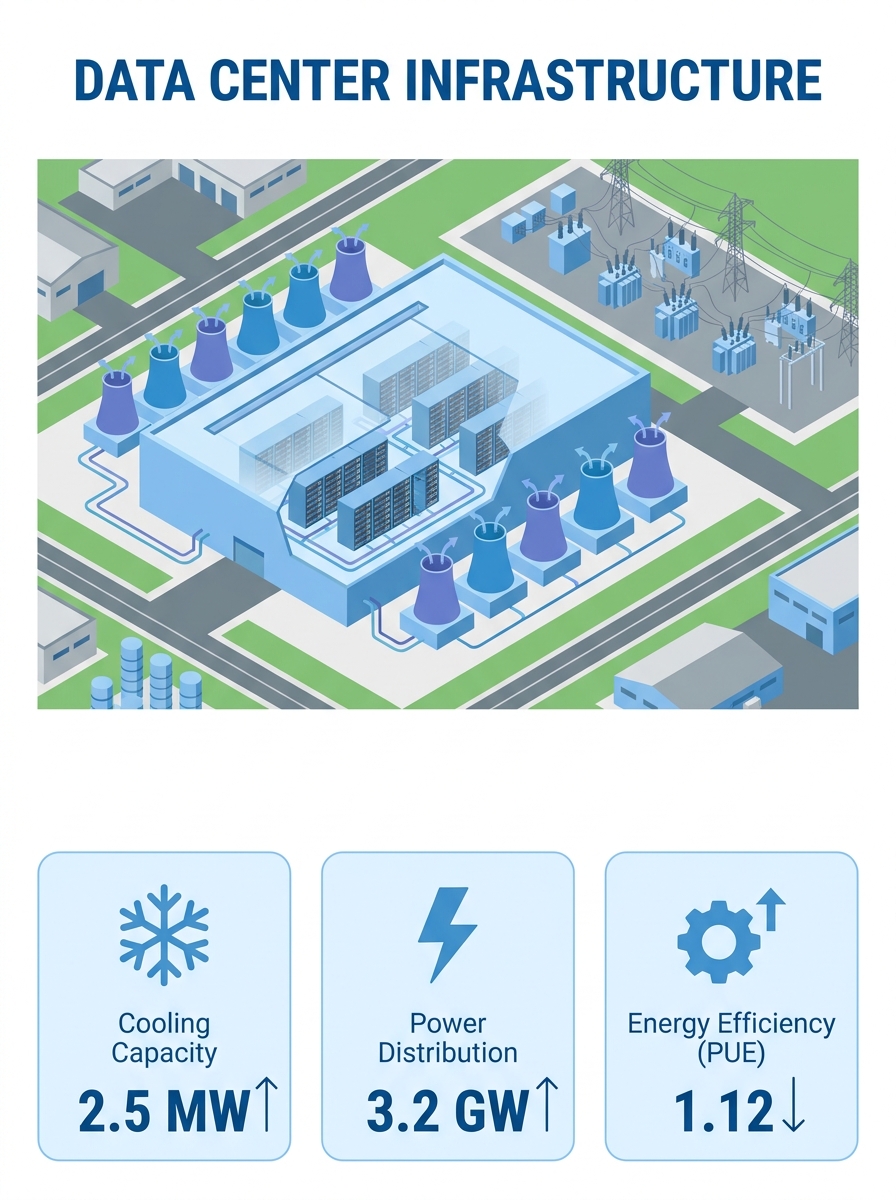
Power Supply Drives Southern Luzon Selection
Genuino identified energy availability as the determining factor in VITRO’s regional preference. Manila Electric Co. (Meralco), part of the Manuel V. Pangilinan-led business group that includes PLDT, has been expanding its power distribution network across Southern Luzon, creating the capacity infrastructure required for large-scale data center operations.
“We’re also evaluating other sites aside from that. But if we build the next one, it’s better if it’s in the south,” Genuino said last week when asked about the project.
A single hyperscaler-class data center can consume electricity equivalent to 100,000 households, according to estimates from the Paris-based International Energy Agency. That power density makes utility capacity a primary site-selection criterion ahead of land cost or fiber connectivity. The 100-megawatt threshold positions the planned facility among the largest data centers in Southeast Asia, comparable in scale to Philippine data center capacity projections that forecast tripling by 2028.
Southern Luzon’s manufacturing and logistics corridors already host substantial industrial power loads, giving Meralco operational experience with high-density distribution that translates to data center deployments.
Central Luzon Alternative Faces Power Constraints
Pangilinan acknowledged last week that VITRO is also considering Central Luzon for a separate data center, specifically in Tarlac province near the proposed Pax Silica AI industrial hub being developed jointly by the United States and the Philippines. However, he noted that power capacity at the New Clark City site remains uncertain, complicating plans for large-scale facilities.
“We just need to know more about it so that we know where we can help BCDA create this Pax Silica,” Pangilinan said, referring to the Bases Conversion and Development Authority’s role in developing the hub.
The BCDA clarified earlier that the Pax Silica site would not host massive hyperscalers given limited power and water capacity, instead targeting smaller data center tenants. That constraint positions the site as a secondary priority for VITRO’s expansion compared to Southern Luzon locations with demonstrated utility headroom.
The Central Luzon evaluation reflects broader data center power supply challenges facing the Philippine industry, where facilities risk claiming up to 30% of local grid capacity as expansion accelerates.
Government Data Residency Requirements Boost Demand
Genuino said government adoption of data center services would accelerate following Executive Order 119, which mandates that Philippine government agencies store secret and sensitive information within national borders. The data residency framework shifts public-sector workloads—historically a smaller portion of VITRO’s customer base—into the domestic data center market.
“With the EO, the public sector will increase for sure, especially if it includes personal identifiable information, or those that we find in our driver’s licenses, passports, medical records,” Genuino said.
Executive Order 119 establishes territorial storage requirements for top-secret and secret government data, creating compliance demand that favors local facilities over offshore cloud regions. The policy directly benefits Philippine data center operators by converting regulatory mandate into infrastructure demand.
Private-sector AI workloads remain the primary driver for VITRO’s hyperscaler-focused expansion, but government requirements provide a secondary revenue stream as agencies migrate classified systems from on-premises infrastructure.
Context and Outlook
PLDT’s 100-megawatt Southern Luzon project signals hyperscaler confidence in Philippine grid readiness despite broader concerns about national power capacity constraints. The ₱40-billion capital commitment—among the largest single data center investments announced in the Philippines—positions VITRO to compete directly with international operators expanding into Manila and surrounding provinces.
The facility’s scale suggests PLDT expects sustained AI infrastructure demand beyond the current deployment cycle, betting that hyperscaler tenants will anchor long-term capacity contracts. Power availability emerging as the binding constraint rather than fiber connectivity or cooling engineering reflects the Philippines’ maturation as a regional data center market, where utility partnerships now determine project viability ahead of traditional telecom infrastructure advantages.
General Trias’s selection as the leading candidate concentrates data center development in the Cavite industrial corridor, creating geographic clustering effects as operators locate near established power substations and fiber routes. VITRO’s expansion timeline remains undisclosed, but site evaluation activity suggests the company is moving toward a construction decision within the next fiscal year as hyperscaler demand visibility firms.