
PLDT, Globe Telecom, and Converge ICT Solutions submitted a ₱31-billion nationwide undersea fiber-optic network proposal to the Department of Information and Communications Technology that would link Luzon, Visayas, and Mindanao through submarine cables running from Batanes to Palawan, according to Technobaboy. The three carriers expect to complete the rollout within two years if the DICT approves the plan, which includes acoustic sensors for seismic activity detection to support disaster response and national defense.
TL;DR: Three Philippine telcos submitted a ₱31-billion proposal to build a nationwide undersea fiber system connecting all three major island groups with two-year deployment and integrated earthquake-monitoring capability.
The joint proposal marks the first tri-carrier infrastructure collaboration of this scale in Philippine telecommunications and arrives as the existing carrier revealed a similar ₱30.63-billion proposal with slightly different financial parameters. The updated submission positions the domestic submarine cable system as a parallel layer to the government’s National Fiber Backbone and would directly benefit an estimated 70 million Filipinos through improved connectivity and disaster resilience.
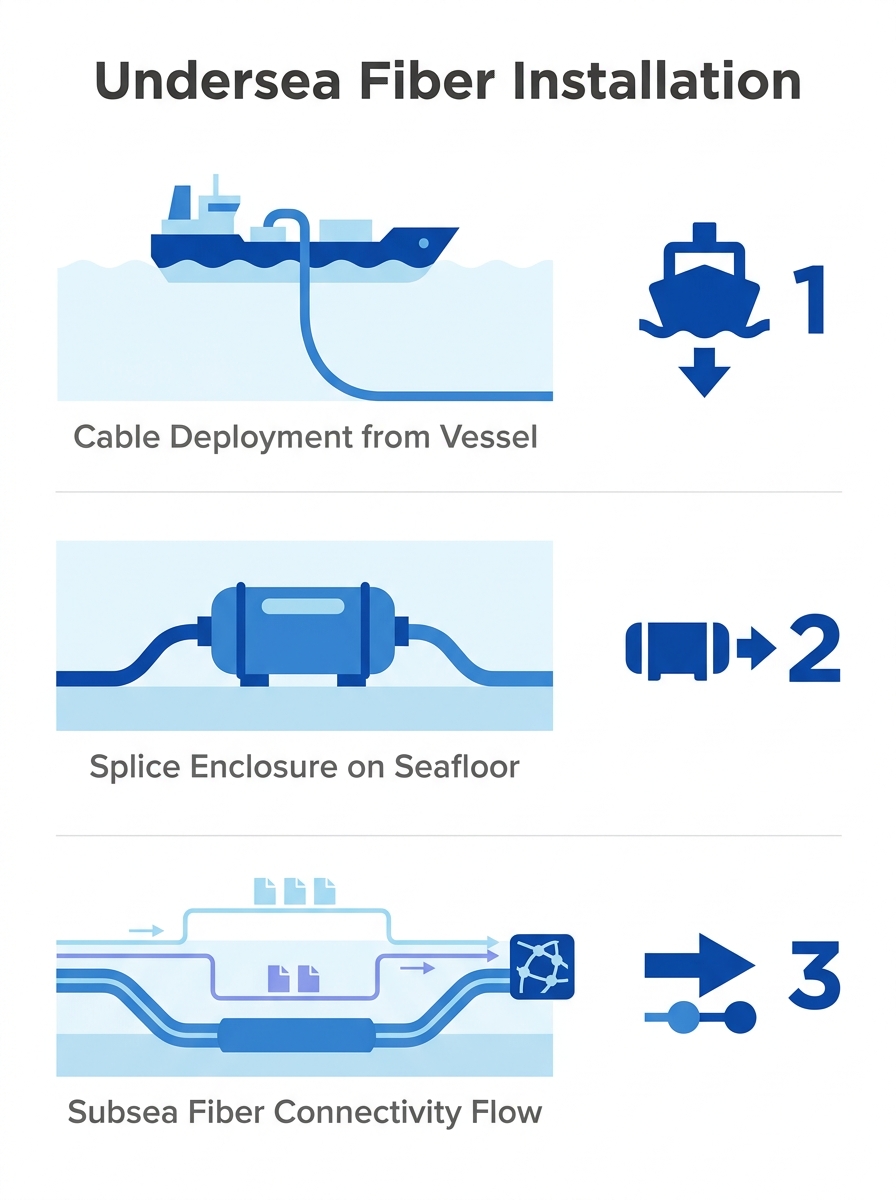
Project Scope and Timeline
The proposed network routes submarine fiber cables along the full Batanes-to-Palawan corridor with interconnection points spanning Luzon, Visayas, and Mindanao. The two-year construction timeline assumes DICT approval proceeds without extended regulatory review periods.
The carriers designed the route to address geographic coverage gaps in existing terrestrial fiber deployments, particularly in island provinces where submarine cable offers the only practical high-capacity backbone option. Cable landing stations will connect to each telco’s existing terrestrial networks at strategic distribution points.
PLDT, Globe, and Converge expect the domestic system to supplement cross-border connectivity rather than replace international links. The three carriers maintain active stakes in regional submarine cable consortia that handle inbound and outbound traffic.
Seismic Monitoring and Disaster Preparedness
The submarine cable system integrates acoustic sensors along the cable route to detect seismic events and provide early-warning data to disaster response agencies. The sensor array represents a dual-use infrastructure approach that delivers telecom capacity while contributing to national hazard-monitoring systems.
Philippine submarine cable routes cross multiple active seismic zones where earthquakes frequently disrupt terrestrial infrastructure. The proposed system positions cables and landing stations to maintain service continuity during events that sever overland fiber paths, directly supporting business continuity requirements for enterprises dependent on always-on connectivity.
The seismic-detection capability extends beyond commercial telecom applications to national defense and maritime monitoring, adding strategic value beyond the carriers’ core service delivery.
Integration With National and International Systems
The domestic undersea network will interconnect with the government’s National Fiber Backbone program, which targets expanded broadband access across underserved regions. The combination creates redundant paths between major economic zones and reduces single-point-of-failure risks inherent in radial network topologies.
PLDT, Globe, and Converge already participate in international submarine cable projects including Candle, Apricot, Bifrost, and SEA-H2X that connect the Philippines to regional internet exchange points in Singapore, Hong Kong, Guam, and Japan. The domestic system provides the backhaul infrastructure necessary to distribute international capacity from cable landing stations to provincial markets.
The tri-carrier collaboration follows PLDT’s recent infrastructure-sharing agreement with DITO, signaling a broader industry shift toward joint capital deployment on passive infrastructure while maintaining competitive retail services.
The Takeaway
Enterprise IT managers evaluating long-term connectivity strategies should treat the proposed domestic submarine cable as a material upgrade to disaster-recovery planning rather than routine capacity expansion. The Batanes-to-Palawan route creates geographically diverse paths that maintain service during typhoons and earthquakes that historically sever terrestrial fiber in single-backbone regions.
The two-year deployment timeline positions 2028 as the earliest availability date for enterprise circuits routed across the new system, meaning current network contracts expiring in 2027-2028 should explicitly address whether renewal terms include migration to submarine-backed paths. Organizations with multi-site operations spanning Luzon, Visayas, and Mindanao gain access to carrier-grade redundancy that previously required independent contracts with multiple providers.
The ₱31-billion investment concentration in passive submarine infrastructure rather than active network equipment suggests the three carriers view physical-layer resilience as the higher-return capital deployment compared to incremental terrestrial capacity additions. For procurement teams, this confirms that vendor selection criteria should weight geographic path diversity and submarine landing-station access alongside traditional bandwidth-and-latency specifications.